

Hydroponics is the future of farming because it grows crops without soil, using nutrient-rich water to deliver exactly what plants need.
Instead of spreading roots through dry or damaged land, plants hang above carefully managed water, which saves up to 90% of water compared to traditional farming.
This efficiency is partly due to using the right type of water, such as purified or filtered water, to maintain system health and nutrient balance, as discussed in the context of what type of water to use for hydroponics.
This matters when clean water is limited, farmland is shrinking, and cities keep growing upward, not outward.
With hydroponics, you can grow more food, more often, in places that once seemed impossible for farming. Keep reading to see how this system actually works and why it could secure our food supply.
Key Takeaways
- Radical resource efficiency, using far less water and land.
- Unprecedented yield increases and faster growth cycles.
- Enhanced climate resilience and suitability for urban centers.
From Concept to Concrete Reality

The principle is simple, yet the implications are vast. Instead of plants searching for nutrients in soil, a hydroponic system delivers a perfectly balanced cocktail of minerals directly to the root system.
Think of it as a direct intravenous line for plants. This direct access eliminates the energy waste of root expansion, allowing the plant to focus all its efforts on growing upward, leafing out, and producing fruit.
This precision and control in nutrient delivery illustrate one of the key benefits of hydroponic farming, including accelerated growth rates and optimized resource use.
It’s a more direct, more efficient form of nourishment. The roots are suspended or supported in an inert medium like clay pebbles or rockwool, which provides stability but no nutritional value itself. All the food comes from the water.
This controlled environment is the real game-changer. Every variable, light, temperature, humidity, nutrient concentration, can be fine-tuned.
There’s no waiting for rain or worrying about a drought. There’s no poor soil quality to remediate. This precision is what leads to those staggering statistics: growth rates that are 30 to 50 percent faster.
A head of lettuce that might take two months in a field can be ready in just over one. For a world on a deadline, that speed is critical. It’s farming by design, not by chance. The systems themselves vary, each with its own advantages.
- Deep Water Culture (DWC): Plants float on a raft with roots submerged in oxygenated nutrient solution.
- Nutrient Film Technique (NFT): A thin film of nutrient-rich water constantly flows over the roots in sloped channels.
- Ebb and Flow: The grow tray is periodically flooded with nutrient solution and then allowed to drain.
Stacking Up Against the Old Ways
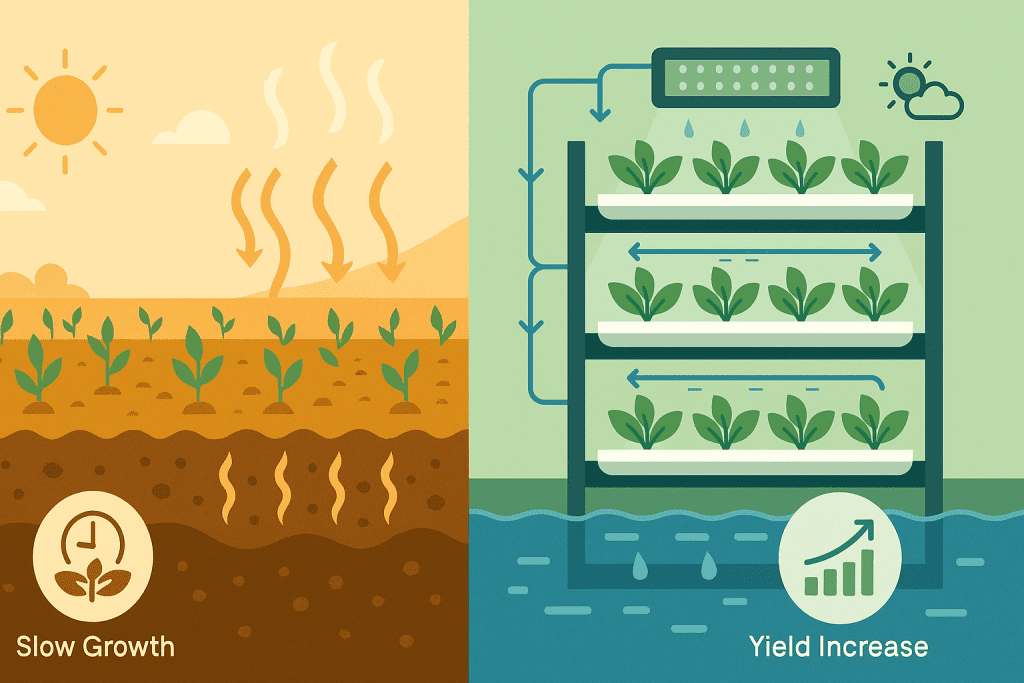
When you place hydroponics next to traditional agriculture, the differences aren’t just incremental. They are fundamental.
The most dramatic contrast is in water usage. Conventional farming is notoriously thirsty, with much of the water applied to fields lost to evaporation or percolation deep into the ground beyond root reach.
Hydroponics, by contrast, operates as a nearly closed-loop system where running water is carefully recirculated, minimizing waste and maximizing plant uptake.
This leads to that jaw-dropping 90% reduction in water use, a figure that makes it viable in deserts and water-stressed regions where traditional farming would be impossible. The water is recirculated, with only what the plants actually consume needing replacement.
This leads to that jaw-dropping 90% reduction in water use, a figure that makes it viable in deserts and water-stressed regions where traditional farming would be impossible.
Then there’s the matter of space. Traditional farming is a horizontal endeavor, demanding vast tracts of land. Hydroponics is inherently vertical.
Plants can be stacked layers high in warehouses or repurposed urban buildings. This high-density approach means a single acre of vertical farm can produce the equivalent of what would require ten or more acres of soil.
For cities looking to produce food locally and reduce “food miles,” this spatial efficiency is a revolutionary advantage. It turns underutilized urban real estate into productive agricultural land.
Yield is the bottom line, and here hydroponics consistently outperforms. By eliminating stressors like pests, weeds, and unpredictable weather, plants thrive.
Studies and commercial operations regularly show yield increases of 20 to 25 percent per square meter. A hydroponic facility might produce 20 heads of lettuce in the space a soil farm produces 10.
This isn’t just about more food; it’s about more reliable food production, year-round, regardless of the season outside. The predictability is a huge benefit for supply chains and food security.
The Tangible Benefits Beyond the Hype
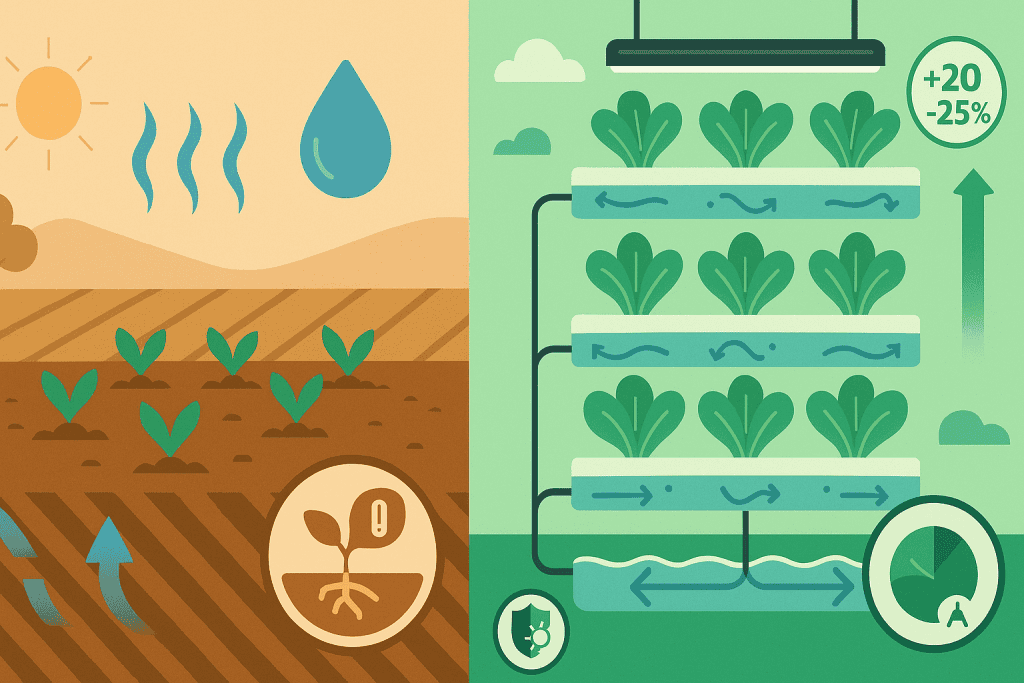
The advantages extend far beyond simple metrics. One of the most significant is the drastic reduction in pesticide use. In a clean, controlled indoor environment, the threat from soil-borne diseases and common pests is minimized.
Many advanced facilities are essentially sterile, requiring no pesticides at all often requiring little to no pesticides, though vigilant monitoring prevents issues. This means cleaner produce for consumers and no chemical runoff polluting waterways, a major environmental problem associated with conventional agriculture [1].
The food is not just efficiently grown; it’s often cleaner and safer. This method also builds incredible climate resilience. Crops are no longer at the mercy of droughts, floods, or unseasonable frosts.
As climate change makes traditional farming increasingly precarious, the ability to grow food in a buffered, indoor environment becomes a strategic asset.
It allows for food production in regions previously considered non-arable, from the Middle East to the Arctic.
This decentralization of food production can strengthen regional food security and reduce a nation’s reliance on long-distance imports. Furthermore, the environmental footprint shrinks in other ways.
- Reduced Land Use: Less need to clear forests for new farmland.
- Lower Carbon Footprint: Local urban farms cut down on transportation emissions.
- No Soil Degradation: Prevents topsoil erosion and nutrient depletion.
The synergy with technology is another powerful driver. Hydroponics integrates seamlessly with IoT sensors, automated nutrient dosing, and LED lighting tuned to specific plant growth spectra.
This creates a data-driven feedback loop where conditions are constantly optimized for peak performance. It’s smart farming in its purest form, moving away from guesswork and towards precise, manageable inputs and outputs.
Making it Work on the Ground
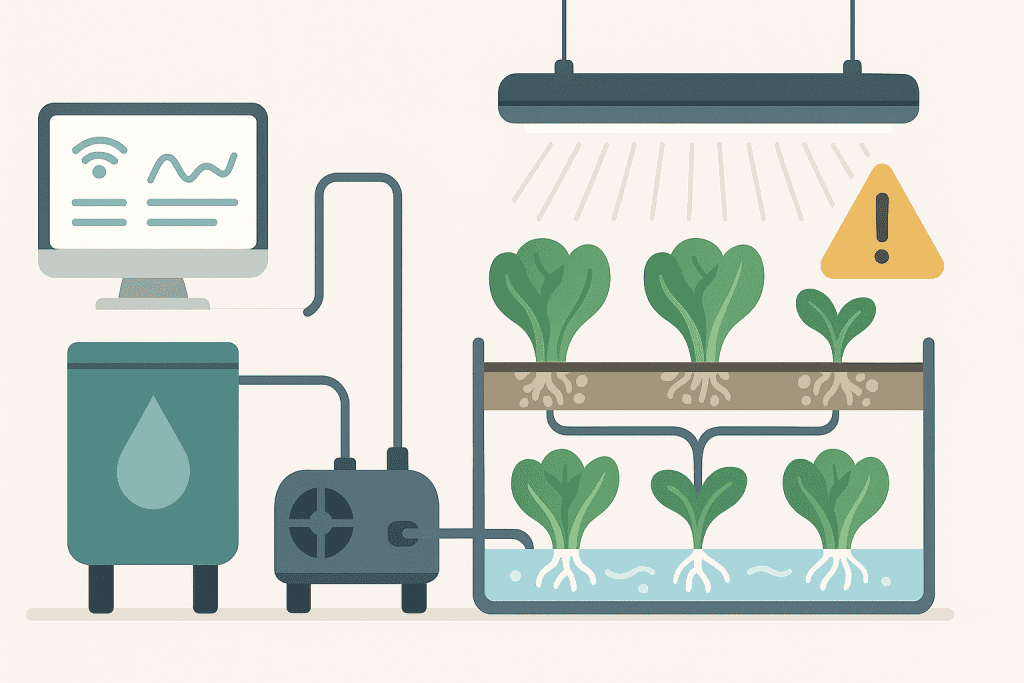
Adopting hydroponics isn’t without its hurdles. The initial investment can be high. Setting up a system requires infrastructure, tanks, pumps, lights, sensors, that has a significant upfront cost compared to planting seeds in a field.
This capital intensity can be a barrier for small-scale farmers, though modular, smaller-scale systems are becoming more accessible for home use and community projects [2].
It also demands a new kind of expertise. A hydroponic farmer is part plant biologist, part systems engineer.
They need to understand nutrient chemistry, pH balance, and electrical conductivity (EC) monitoring. A pump failure or a power outage can be catastrophic in a way that a dry spell is not, because the plants are entirely dependent on the system functioning.
This technical knowledge curve is real, but it’s being lowered by better technology and more widespread educational resources.
The energy demand for lighting and climate control, especially in large-scale indoor vertical farms, is a valid concern.
This is where the integration of renewable energy sources, like solar power, becomes crucial for the long-term sustainability and economic viability of the model.
The industry is actively working on more energy-efficient LEDs and smarter climate control systems to address this challenge. The goal is to ensure that the resource savings in water and land aren’t offset by excessive energy use.
A Future Rooted in Water

Credits: Euronews Culture
So, is hydroponics the future of farming? It certainly looks like a dominant part of it. It’s not that traditional agriculture will disappear entirely, but for securing a resilient, sustainable, and local food supply for urban populations, hydroponics offers a compelling and necessary pathway.
It’s a practical response to the geometric challenges of the 21st century: more people, less water, less land, and a more volatile climate. The market’s projected growth to over $55 billion by 2035 signals a strong vote of confidence.
This isn’t a niche hobby anymore; it’s a serious agricultural sector. The revolution may not be televised, but it might be growing quietly under LED lights in a warehouse near you. Start by exploring a small kit for herbs on your countertop, you’ll see the future firsthand.
FAQ
1. How does hydroponics help people understand hydroponic farming benefits in simple terms?
Hydroponics shows hydroponic farming benefits by using soil-less cultivation and low-water agriculture to grow healthy crops.
It relies on controlled environment farming and efficient nutrient delivery, which support sustainable agriculture and clean food production.
These systems reduce land usage, build resilient food systems, and create high-yield crop systems that help people understand the future of food production more clearly.
2. What makes hydroponics a good choice for year-round food if I live in a city?
Hydroponics works well in cities because urban farming solutions rely on indoor farming technology, urban vertical farms, and modern greenhouse farming to grow food anytime.
These spaces use controlled climate agriculture, LED grow light efficiency, and smart greenhouse monitoring to keep plants healthy.
With resource-efficient agriculture and reduced pesticide use, they support steady, year-round crop production for local communities.
3. How does hydroponics support climate-smart farming when the weather keeps changing?
Hydroponics supports climate-smart farming by using controlled agriculture systems, climate-resilient agriculture tools, and closed-loop irrigation to keep conditions steady.
These systems build resilient food systems and reduce risk from storms, heat, and drought. They also support reduced agricultural footprint, reduced carbon footprint agriculture, and eco-friendly farming methods.
Many farmers choose hydroponics for resilient crop production and regenerative farming technology.
4. Why do people say hydroponics fits future farming technologies and next-generation farming?
People link hydroponics to future farming technologies because it uses automation in hydroponics, IoT in agriculture, and data-driven farming to guide everyday decisions.
These tools support hydroponic nutrient optimization, precision nutrient management, and plant growth optimization.
High-tech farming solutions such as smart irrigation control, hydroponic root zone control, and advanced crop monitoring help farmers work in limited space with reliable results.
5. How can beginners find simple setups that still use innovative food production models?
Beginners often choose alternative farming methods like microgreen hydroponics, aquaponics synergy, and modular farming units because these systems are easy to manage.
They support sustainable horticulture, future-ready farming methods, and innovative food production models.
These setups allow localized food production, decentralized food production, and high-density farming. As hydroponic system adoption expands, people follow hydroponic market growth and hydroponic industry expansion to learn more.
Conclusion
Hydroponics marks a decisive shift in how we produce food, proving that abundance doesn’t require vast land or excessive water, just precision and innovation.
As cities grow and climates become less predictable, this soil-less approach delivers stability, efficiency, and year-round harvests where traditional farming struggles.
By embracing controlled environments and smart technology, we unlock a scalable, sustainable food system. Hydroponics offers a key upgrade, revolutionizing resource use for urban/sustainable farming shaping agriculture’s future.
References
- https://pmc.ncbi.nlm.nih.gov/articles/PMC11049364/
- https://skyfieldagritech.com/return-on-investment-roi-of-hydroponic-farming-how-long-until-you-recover-your-investment/
Related Articles
- https://tophydroponicgarden.com/what-type-of-water-to-use-for-hydroponics/
- https://tophydroponicgarden.com/key-benefits-of-hydroponic-farming/
- https://tophydroponicgarden.com/does-hydroponics-need-running-water/
Was this helpful?
