

A water chiller is sometimes necessary in hydroponics when the nutrient solution keeps getting too warm and simpler cooling methods can’t hold it in a suitable range.
I’d check the actual reservoir temperature before adding one. Temperature and oxygen availability both matter around hydroponic roots, especially when much of the root system stays in the nutrient solution.
At Top Hydroponic Garden, this is why a chiller makes more sense as a fix for persistent heat than standard equipment for every grow.
Keep reading to see when active cooling is worth it and when your system can manage without it.
Quick Read: When Does a Chiller Start to Make Sense?
You don’t need refrigeration just because you grow hydroponically. The temperature pattern matters much more.
- A water chiller actively removes heat from the nutrient solution.
- It becomes useful when reservoir temperature stays too warm or repeatedly rises beyond a suitable range.
- Temperature and oxygen conditions both matter in the root zone, particularly in systems with submerged roots.
- If shade, insulation, ventilation, and other passive methods already keep the reservoir stable, a chiller may be unnecessary.
The easiest rule is simple: measure the water first, then decide whether there’s actually a cooling problem to solve.
Why Does Hydroponic Water Sometimes Need Cooling?
Hydroponic roots rely on the nutrient solution for water and minerals, but temperature also shapes the environment around those roots.
When reservoir conditions drift too far from what the crop can comfortably handle, root function and overall nutrient management can become harder to keep stable.
Temperature also shouldn’t be viewed separately from oxygen availability and the other conditions surrounding the plants.
As noted by Sangeetha and Periyathambi:
“it is essential to maintain a controlled environment that encompasses essential factors such as temperature, carbon dioxide (CO2) levels, oxygen availability, and appropriate lighting conditions.” – Sangeetha & Periyathambi, PeerJ Computer Science
That’s where cooling can become useful. A water chiller gives growers a way to control reservoir temperature when heat keeps building up faster than the system can naturally lose it.
Warm water doesn’t automatically mean unhealthy plants, though. Crop type, root mass, aeration, system design, and ambient conditions all affect how the root zone responds.
The point is to keep temperature from becoming a recurring limiting factor.
What Temperature Is Too Warm for Hydroponic Water?

There isn’t one perfect reservoir temperature for every crop.
You’ll often see roughly 18 to 22°C, or 65 to 72°F, used as a practical starting range for many hydroponic systems, particularly when roots remain heavily submerged.
But crop type, cultivar, ambient conditions, and system design can all shift what works best.
That’s why I wouldn’t automatically set every chiller to one number.
Instead, watch the actual nutrient solution and how stable it remains during the day. Grow lights, direct sunlight, pumps, hot floors, exposed plumbing, and a small reservoir can all raise water temperature even when the room itself doesn’t feel particularly hot.
Top Hydroponic Garden goes deeper into those temperature limits in How Hot Is Too Hot for Hydroponics?.
Measure during the warmer part of the light cycle, not only first thing in the morning. The daily pattern tells you more than one comfortable reading.
When Is a Water Chiller Actually Necessary?
A water chiller becomes much easier to justify when high reservoir temperature is persistent, predictable, and difficult to control another way.
That distinction matters.
One unusually hot afternoon doesn’t mean the system suddenly needs refrigeration.
A reservoir that gets too warm every afternoon for several weeks is a different problem.
| Reservoir Pattern | What It Usually Suggests |
| One unusual heat spike | Temporary cooling may be enough |
| Occasional warming on very hot days | Improve passive cooling first |
| Reservoir runs too warm most afternoons | Active cooling may be worth considering |
| Temperature stays high after passive fixes | Strong case for a water chiller |
The more often excess heat returns, the more useful automatic temperature control becomes.
When the Reservoir Stays Too Warm
A chiller makes sense when nutrient solution temperature repeatedly exceeds the range you’re trying to maintain.
Start by tracking the reservoir over several normal growing days. If possible, include the hottest part of your usual light cycle.
Then try reasonable fixes such as shade, insulation, ventilation, or moving heat-producing equipment.
If those changes lower the temperature enough, great. You probably don’t need active refrigeration.
If the water continues warming beyond a suitable range every day, the chiller now solves a specific problem: it physically removes heat that passive methods aren’t removing fast enough.
When DWC or RDWC Runs Hot
DWC and RDWC deserve extra attention because much of the root system remains submerged in nutrient solution.
That means the roots spend more time directly exposed to whatever temperature and oxygen conditions develop inside the reservoir.
Still, DWC itself doesn’t make a chiller mandatory.
A bucket in a cool indoor room may stay within a suitable range all day. Put the same setup in a hot greenhouse or garage, and the cooling requirement can change completely.
The environment matters more than the system label.
When Passive Cooling Can’t Keep Up
Passive cooling works by reducing how quickly heat enters or builds up in the system.
Shade blocks solar heat. Insulation slows heat transfer. Ventilation can reduce hot air around the reservoir.
What those methods don’t do is continuously refrigerate the water.
If the surrounding environment stays hot for hours, the reservoir may eventually warm despite good insulation.
When heat keeps accumulating faster than the reservoir can lose it, active cooling starts making more sense because a chiller can continuously move that heat out of the nutrient solution.
When Equipment Keeps Adding Heat
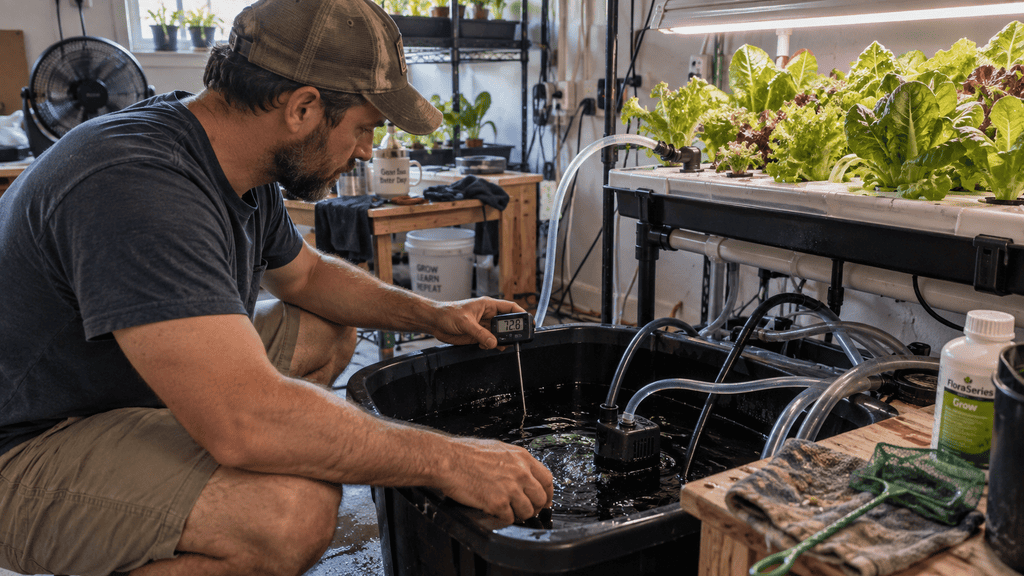
Submersible pumps can transfer waste heat directly into the nutrient solution. Nearby lights, warm plumbing, and poorly ventilated equipment can contribute too.
Check those sources before buying a larger chiller.
You may find that relocating equipment, shading exposed tubing, improving ventilation, or removing an unnecessary submerged pump lowers reservoir temperature enough to solve the issue.
Even when a chiller is still needed, reducing the heat load helps.
The unit won’t have to spend as much energy removing heat that could have been prevented from reaching the reservoir in the first place.
When Can You Grow Without a Water Chiller?
You can grow without a water chiller when the nutrient solution already stays within a suitable and reasonably stable range.
That includes plenty of home hydroponic systems.
A climate-controlled room, shaded reservoir, cooler climate, good ventilation, or larger water volume may be enough to prevent troublesome temperature spikes.
Occasional warm days don’t automatically change that.
If the reservoir only gets warm during a rare heatwave, temporary cooling or environmental changes may make more sense than adding refrigeration for the entire season.
Monitor during the warmest conditions you realistically expect.
If the system stays stable, keep monitoring and leave it alone. Hydroponics already has enough equipment without adding another machine to solve a problem that isn’t happening.
A chiller earns its place when the heat problem becomes recurring, not hypothetical.
What Should You Try Before Buying a Water Chiller?
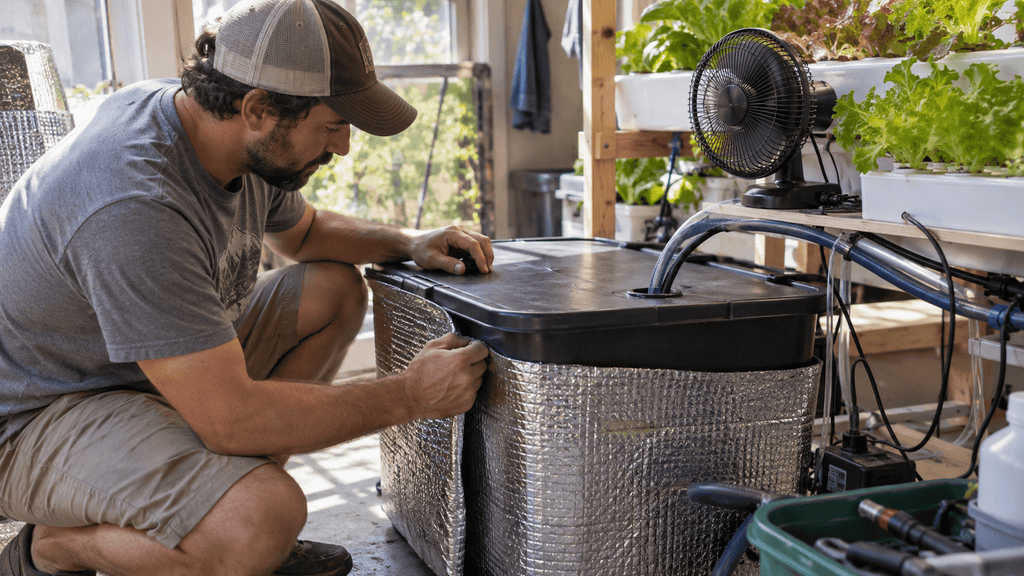
Start by reducing how much unnecessary heat reaches the nutrient solution.
A few basic changes can make a surprising difference:
- Keep the reservoir out of direct sunlight.
- Shade exposed tubing and plumbing.
- Insulate the reservoir.
- Improve airflow around the grow area.
- Move hot lights or electronics farther away when possible.
- Check whether submerged pumps are adding unnecessary heat.
- Use a larger water volume if rapid temperature swings are the main problem.
- Use frozen bottles only as a temporary option during occasional heat spikes.
Top Hydroponic Garden covers more low-tech and active options in Chill Out: Learn How to Keep Hydroponics Cool.
Just remember what passive cooling can and can’t do.
Insulation slows heat transfer. A larger reservoir changes temperature more slowly. Shade reduces incoming heat.
None of them actively refrigerates warm water.
If those methods still can’t prevent recurring high reservoir temperatures, that’s when a chiller starts providing something fundamentally different.
Can More Aeration Replace a Water Chiller?
Not when excessive water temperature is the actual problem.
Aeration and cooling handle two different environmental conditions.
An air pump is used to support oxygen availability in the nutrient solution. A chiller controls temperature by removing heat.
Sangeetha and Periyathambi also treat temperature and oxygen availability as separate factors that need attention in a controlled hydroponic environment. That’s a useful distinction here.
Increasing aeration does not reliably control an overheated reservoir or replace active cooling.
| Situation | More Aeration | Cooling |
| Temperature is suitable but oxygen availability needs improvement | Improve aeration | Usually unnecessary |
| Reservoir is consistently too warm | May help root-zone conditions | Cooling addresses the heat directly |
| One temporary hot afternoon | Maintain normal aeration | Passive cooling may be enough |
| Persistent summer heat | Useful alongside temperature management | Worth considering |
| Hot DWC or RDWC reservoir | Check oxygen conditions | Check temperature conditions |
Sometimes the system needs better aeration. Sometimes it needs cooling. Sometimes both conditions deserve attention.
They shouldn’t be treated as interchangeable.
How Do You Know If You Really Need a Chiller?
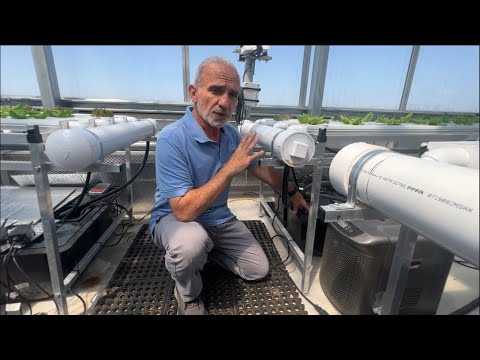
Credits: The Vegetable Doctor
Track the reservoir before making the decision.
I’d record water temperature for several representative days, including at least one warmer day if possible.
Check it:
- Early in the day
- During the warmest part of the light cycle
- During hot weather
- Before and after any passive cooling changes
Don’t look only at the maximum number either.
A reservoir that repeatedly swings between cool mornings and very warm afternoons may need better temperature management even if its daily average looks acceptable.
Then look at the root zone alongside the readings. Root appearance, unusual smells, plant vigor, and oxygen conditions can add useful context.
Research on deep-water hydroponic vegetables also supports looking at cooling as a root-zone tool rather than just a number on a thermometer.
As Hooks et al. noted:
“Solution cooling can increase DO level in the solutions and improve root-zone environment.” – Hooks et al., Horticulturae
That doesn’t mean every warm reservoir needs active cooling. The study found that the benefits of nutrient-solution temperature management were not identical across all plants.
You’re looking for a pattern: temperature repeatedly rises, passive cooling isn’t enough, and the root environment becomes harder to keep stable.
That is a much stronger reason to add a chiller than reservoir size alone.
Does a Large Hydroponic System Need a Chiller?
Not automatically, but larger systems can make temperature stability more important.
A larger water volume usually changes temperature more slowly than a small bucket. That helps buffer short-term swings.
The downside is that once the whole reservoir becomes too warm, bringing that large volume back down can take more time and cooling capacity.
Connected systems also share the same water. One temperature problem can therefore affect a much larger root zone.
Top Hydroponic Garden’s guide to How to Manage a Large Hydroponic Reservoir Well also looks at temperature and other reservoir conditions that become important as system size increases.
That’s where consistent circulation and temperature monitoring matter.
A large system in a cool, well-controlled environment may work perfectly without refrigeration. A similar system in a warm greenhouse may benefit greatly from active cooling.
Size influences the decision, but persistent heat still makes the decision.
Water Chiller or Passive Cooling: Which Makes More Sense?
Once you’ve monitored the reservoir for a few days, the answer usually becomes much clearer.
Passive cooling makes sense when the heat load is modest or occasional.
A chiller becomes more attractive when the same temperature problem keeps returning despite those simpler changes.
| Your Situation | Best Starting Approach |
| Reservoir stays within a suitable range | Monitor only |
| Mild daytime warming | Shade and insulate |
| Occasional heatwave | Temporary cooling |
| Pump or equipment adds heat | Reduce the heat source |
| Reservoir repeatedly becomes too warm | Consider a water chiller |
| Passive cooling no longer keeps up | Active cooling makes more sense |
| Large system needs tighter temperature control | A chiller may be worthwhile |
There’s no advantage in cooling a reservoir simply because you can.
But there’s also little reason to keep fighting recurring high temperatures by hand when automatic cooling would solve the problem more consistently.
FAQ
How Often Should You Clean a Hydroponic Water Chiller?
Check it regularly for debris, algae, or mineral buildup. For the actual cleaning schedule, follow the manufacturer’s instructions.
Can One Water Chiller Cool More Than One Hydroponic Reservoir?
Yes, if the reservoirs are connected and the chiller has enough capacity for the total water volume.
Does a Water Chiller Affect pH or EC?
Not directly. A chiller mainly controls water temperature, so you’ll still need to monitor pH and EC separately.
What Flow Rate Does a Hydroponic Water Chiller Need?
It depends on the model. Stay within the manufacturer’s recommended flow range so water moves through the chiller properly.
Can a Water Chiller Cause Condensation Around the Reservoir?
Yes. Cold tubing or reservoir surfaces can develop condensation when the surrounding air is warm and humid, so insulation may help.
So, Why Is a Water Chiller Sometimes Necessary?
If your reservoir keeps running too warm, your root zone gets harder to manage and plant health can start to suffer.
A water chiller still isn’t necessary for every DWC or RDWC system.
Explore more reservoir-management guides from Top Hydroponic Garden to keep temperature, oxygen, pH, and EC easier to manage throughout the growing season.
If the heat keeps returning and passive methods can’t hold the temperature steady, a water chiller starts to make sense.
It gives you better control over the nutrient solution and helps keep root-zone conditions more stable without relying on constant manual adjustments.
References
- https://pmc.ncbi.nlm.nih.gov/articles/PMC10909207/
- https://www.mdpi.com/1784248
Related Articles
- https://tophydroponicgarden.com/how-hot-is-too-hot-for-hydroponics/
- https://tophydroponicgarden.com/how-to-keep-hydroponics-cool/
- https://tophydroponicgarden.com/how-to-manage-a-large-hydroponic-reservoir/
Was this helpful?

I’m Barrie L., a passionate hydroponic gardening enthusiast dedicated to cultivating thriving, soil-less gardens. With a focus on all things hydroponic, I share my expertise on innovative growing techniques and sustainable practices through my blog, tophydroponicgarden.com. As a seasoned hydroponics specialist, my goal is to inspire and guide fellow gardeners in harnessing the power of water-based cultivation for bountiful and eco-friendly harvests. I’m also an author of the book “Hydroponics For Absolute Beginners: Your Step By Step Guide For How To Create An Hydroponics System At Home Without Soil, For Growing Vegetable, Fruit And Herbs.” which is sold on Amazon. Join me on a journey of redefining the way we cultivate plants, one nutrient-rich solution at a time. Happy growing!