

Hydroponic pH changes are part of normal nutrient management, but the pattern can reveal what is happening in the reservoir.
Tracking pH with EC, water level, alkalinity, and aeration can make these changes easier to understand. Tophydroponicgarden can use this approach to focus on the cause of pH drift rather than making repeated corrections without a clear reason.
What Your Hydroponic pH Is Telling You
pH changes are often connected to plant growth, water chemistry, nutrient uptake, and conditions inside the reservoir.
- Plant Nutrient Uptake Can Shift pH
As plants absorb different nutrients, they change the balance of ions in the nutrient solution. This can cause pH to rise or fall over time. - Water Quality Affects pH Stability
Source-water alkalinity, bicarbonates, and nutrient composition can make it harder to keep pH within a stable range. - Consistent Monitoring Helps Prevent Large Swings
Check pH alongside EC, water level, temperature, and plant growth. Tracking these factors helps you recognize patterns before making unnecessary adjustments.
What Causes pH to Fluctuate in Hydroponic Systems?
Hydroponic pH changes as plants, water, and the growing system affect the nutrient solution. Plant nutrient uptake, source-water chemistry, dissolved CO2, microbes, evaporation, temperature, growing media, and meter errors can all change the reading.
Soilless systems have less natural buffering than soil, so pH is important in hydroponics because it affects how available nutrients are to the plant. Water pH and alkalinity are key factors in soilless growing, which makes regular pH checks important for keeping the nutrient solution stable.
Daily pH drift can provide useful information about how a hydroponic reservoir is performing rather than always indicating a system failure. In a 5-gallon Deep Water Culture (DWC) setup, two mature tomato plants can use water quickly enough to shift pH by up to 0.5 points within 12 hours.
The same crop load in a 200-gallon commercial reservoir spreads those root-related changes across a much larger water volume, creating a wider safety margin.
Common causes include:
- Plant nutrient uptake, especially nitrate and ammonium
- Water alkalinity, mainly bicarbonate
- CO₂ changes from aeration, photosynthesis, and respiration
- Algae and microbial growth
- Evaporation and plant water use
- Temperature and growing-media changes
- Wrong or poorly calibrated pH readings
The direction of the change gives useful clues. A slow pH rise during strong growth is not the same as a sudden overnight drop with cloudy water, bad odors, or damaged roots.
How Does Nutrient Uptake Change Hydroponic pH?

Plant nutrient uptake can change hydroponic pH because roots affect the balance of hydrogen ions as they take in charged nutrients.
As noted by ELABA
“During hydroponic cultivation, the pH of nutrient solution fluctuates due to unbalanced ion absorption by plants” – ELABA
Nitrogen has a strong effect. When plants take up nitrate (NO₃⁻), pH usually rises. When they take up ammonium (NH₄⁺), pH usually falls. Nitrate uptake can lead roots to release hydroxide or bicarbonate, while ammonium uptake can cause the release of hydrogen ions.
Roots also need to keep their electrical balance as nutrients move through cell membranes. If plants take in more positively charged ions, roots may release H⁺ into the water. If plants take in more negatively charged ions, they may release OH⁻ or HCO₃⁻ instead.
So, pH changes can be part of normal plant growth. Fast-growing crops can change reservoir chemistry faster than young plants. Nutrient mix, root size, crop stage, temperature, and water volume can all affect how quickly pH moves.
Why Can Nitrate Uptake Raise pH?
Nitrate uptake can raise hydroponic pH because plants may release OH⁻ or HCO₃⁻ to keep the charge balance as nitrate enters the roots.
A nutrient mix high in nitrate can lead to a slow rise in pH while plants are actively using nitrogen. This may be more noticeable during fast vegetative growth, when nutrient uptake is higher.
Nitrate does not make the water alkaline on its own. The pH change comes from how the plant handles the ions and how the nutrient solution responds.
For example, a reservoir that starts at pH 5.8 may rise over several days while EC drops as plants use nutrients. That pattern can point to active nutrient uptake rather than a bad meter.
The growth stage matters too. Nutrient needs change as plants grow, so the same fertilizer mix may cause different pH trends in seedlings, vegetative plants, and mature fruiting crops.
Why Can Ammonium Uptake Lower pH?
Ammonium-based nutrients can lower reservoir pH because roots release positively charged hydrogen (H⁺) ions as they take up ammonium. Nitrate (NO₃⁻) can have the opposite effect, with roots releasing hydroxyl (OH⁻) ions during uptake.
The nitrogen breakdown in the fertilizer can help explain ongoing pH drift. Adjusting the balance between ammonium and nitrate can address the cause of acid drift more effectively than repeated pH corrections.
Research from the FAO AGRIS study shows
“Nitrogen sources significantly influence the pH of the nutrient solution” – FAO AGRIS
A high ammonium level can make pH fall faster, but that doesn’t mean ammonium should always be avoided. Nutrient mixes use different forms of nitrogen to meet crop needs and change how the solution behaves.
Why Does Tap Water Alkalinity Affect Hydroponic pH?
Tap water alkalinity can affect hydroponic pH because bicarbonate and carbonate help buffer the water. This buffering can slow acidification and push pH back toward a higher level.
pH and alkalinity measure different things. pH shows how acidic or basic the water is at a given time. Alkalinity shows how well the water can resist added acid.
Water with more than 75 ppm alkalinity can cause hydroponic pH to rise. This is why two water sources with the same starting pH can react very differently after fertilizer is added.
High-alkalinity water has more bicarbonate to buffer changes. Low-alkalinity water has less buffering, so small additions can cause larger pH shifts.
Source-water testing can help find the cause of ongoing hydroponic pH drift.
Why Does pH Rise Again After Adding pH Down?
Hydroponic pH can rise again after adding pH Down because the acid reacts with bicarbonate in the water. The reaction can form dissolved carbon dioxide, which may later leave the solution.
The pattern can be confusing. Acid is added, pH drops, aeration continues, CO₂ escapes, and pH rises again. This doesn’t always mean the pH Down failed. The acid may have used up some of the water’s buffering capacity while changing the amount of dissolved CO₂.
Adding more acid without checking alkalinity can lead to the same cycle. The source water may keep adding the buffer that pushes pH back up. A better starting point is to test source-water pH, alkalinity, and EC before setting a nutrient management routine.
Can Aeration and CO₂ Off-Gassing Raise Hydroponic pH?
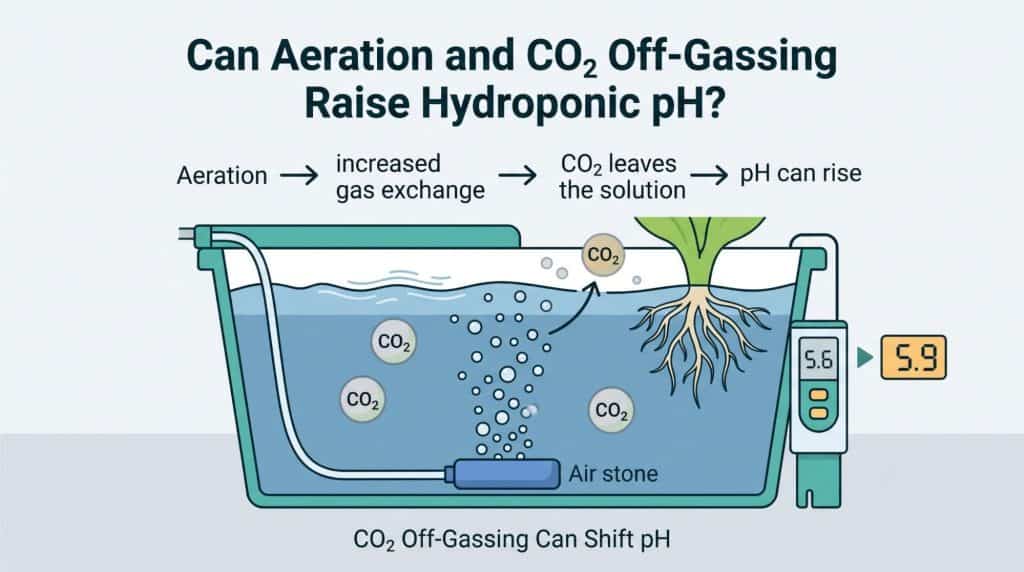
Aeration can raise hydroponic pH when strong gas exchange removes dissolved CO₂. Dissolved CO₂ is part of the carbonic acid system, which affects water acidity. Air stones, waterfall returns, and strong water movement increase contact between water and air. If the water has more CO₂ than the surrounding air, some of it can escape.
As CO₂ leaves the water, the balance changes and pH can rise. This can be more noticeable in water with little buffering. A small DWC reservoir using low-alkalinity or RO water may show a larger pH change than water with high alkalinity.
Still, rising pH doesn’t mean aeration should be removed. Roots need oxygen, and low DO can cause more serious problems. Check pH, DO, water temperature, alkalinity, and aeration together before changing the oxygenation setup.
How Do Algae and Microbes Cause pH Swings?
Algae and microorganisms can cause hydroponic pH swings by changing the amount of dissolved CO₂ in the water. Photosynthesis removes CO₂, while respiration and decomposition add it back.
During strong light, algae use dissolved CO₂, which can push pH higher. When the lights go off, photosynthesis stops but respiration continues. CO₂ can then build up, causing pH to fall.
Microbial breakdown of organic material can also change the water’s carbon balance and oxygen demand. A contaminated reservoir may develop biofilm, slime, odors, and changes around the roots.
A clean reservoir that blocks light can reduce unwanted algae growth and limit one common cause of pH changes.
How Can Light Leaks Trigger pH Changes?
Light leaks can cause hydroponic pH changes by allowing algae to grow in the reservoir or irrigation lines. Algae use dissolved CO₂ during photosynthesis, which can raise pH during the day. Clear containers, see-through tubing, exposed return lines, and uncovered reservoir lids can let in enough light for algae growth.
This can create a repeating cycle. More algae can remove more CO₂ during the day, pushing pH higher. At night, algae respire and change the gas balance again. Opaque reservoir walls and light-blocking tubing can help limit algae growth and reduce this source of pH swings.
When Does a Sudden pH Drop Suggest a Biological Problem?
A sudden pH drop is more concerning when it happens with cloudy water, bad odors, slime, damaged roots, low oxygen, or plant stress.
Ph alone can’t confirm root disease. A low reading may result from nutrient uptake, fertilizer type, changes in alkalinity, or normal biological activity. Still, a quick drop from around pH 6 to below 5, especially with damaged roots, needs a closer look. Don’t keep adding pH Up without finding the cause.
Check the roots, dissolved oxygen, and water temperature. Look for organic buildup in the reservoir, and make sure the pH meter is working correctly. Not every biological issue needs the same response. Root disease, algae, and normal microbial activity can look similar at first, but the right fix can be different.
Does Reservoir Size Affect How Quickly pH Changes?
Reservoir size affects pH stability because more water can spread out chemical changes. Larger reservoirs also offer more thermal and chemical buffering than small ones.
A plant that uses the same amount of water from a 2-gallon container will have a much bigger effect on the solution than it would in a 20-gallon reservoir.
The same applies to nutrient dosing. A small dosing mistake can cause a sharp pH or EC change in a small countertop system. That same amount may have little effect in a large commercial reservoir.
Large reservoirs can still develop ongoing pH drift. Plants may keep removing nutrients, high alkalinity can push pH upward, CO₂ levels can change, and biological activity can affect the water.
The main difference is how fast and how much the pH changes.
How Do Evaporation and Transpiration Affect Hydroponic pH?
Evaporation and plant transpiration can change hydroponic pH by shifting the balance between water and dissolved nutrients.
Plants don’t use water and nutrients in the same amounts. If water leaves the reservoir faster than nutrients, the solution gets more concentrated and EC can rise. If plants use nutrients faster than water, EC can drop.
EC doesn’t show the level of each nutrient. It measures the total electrical conductivity of the solution, so it can’t tell which nutrients are rising or falling. That’s why EC and water level should be checked together when tracking changes in a hydroponic reservoir.
What Does Rising EC and Falling Water Level Indicate?
A rising EC with a falling water level usually means water is leaving the reservoir faster than dissolved salts. Crop uptake and other system conditions can affect the exact cause.
In a warm environment, plants may lose water through transpiration faster than they take up nutrients. The remaining solution then becomes more concentrated.
Topping off with water can bring the reservoir back to its normal level and lower EC. Let the water circulate fully before checking pH and EC again.
Don’t add concentrated fertilizer just because the water level has dropped. Check the EC first to see if more nutrients are actually needed.
Can Temperature and Growing Media Change Hydroponic pH?
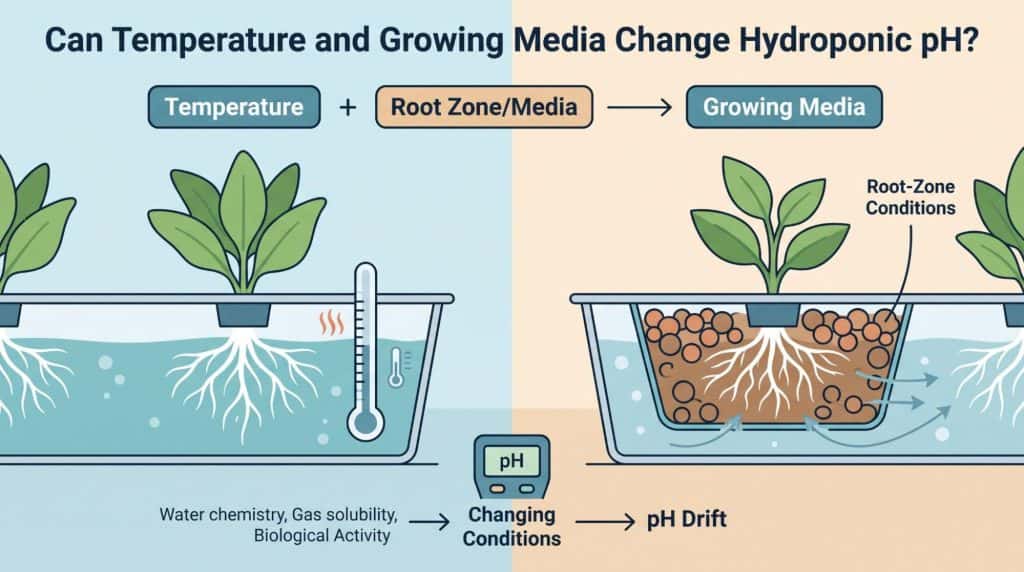
Water temperature can affect hydroponic pH because it changes dissolved gases and activity around the roots. Warmer water holds less dissolved gas, and changes in temperature can also affect plants and microbes.
The growing media can matter too. Coconut coir, expanded clay, and rockwool can each interact with nutrients in different ways. New media may have a stronger effect before it has been fully prepared.
For soilless systems, pH and EC are useful readings to track. Alkalinity and nutrient levels also help explain why the solution may change.
Why Can New Coco Cause pH Instability?
Fresh cocoa can make pH harder to control at first. The material can hold and release ions into the nutrient solution before it has been conditioned. Calcium, magnesium, potassium, sodium, and hydrogen can all be involved in this process.
If the coco hasn’t been prepared properly, the first few irrigation cycles may show odd changes. EC can move, nutrient use can increase, and pH may keep drifting instead of settling. Condition the coco before use to reduce these changes. The right process depends on the product and growing setup, so follow the product’s own preparation instructions.
Are You Chasing pH Instead of Fixing the Cause?
Constant pH corrections can cause more problems when every small change gets treated as an issue instead of finding what is causing the drift.
A reservoir doesn’t need to stay at exactly 5.8 all the time. Healthy plants can handle some movement within a suitable crop range. Different crops also have different pH needs, so one number won’t fit every hydroponic system.
Make corrections slowly. Add a measured amount, let the reservoir mix, wait for the reading to settle, then test again.
Adding pH Up and pH Down back and forth can add more correction chemicals without fixing the reason pH keeps moving.
Persistent drift outside the right crop range still needs attention. The aim is steady pH control, not a perfectly fixed number.
How Much pH Drift Is Acceptable?
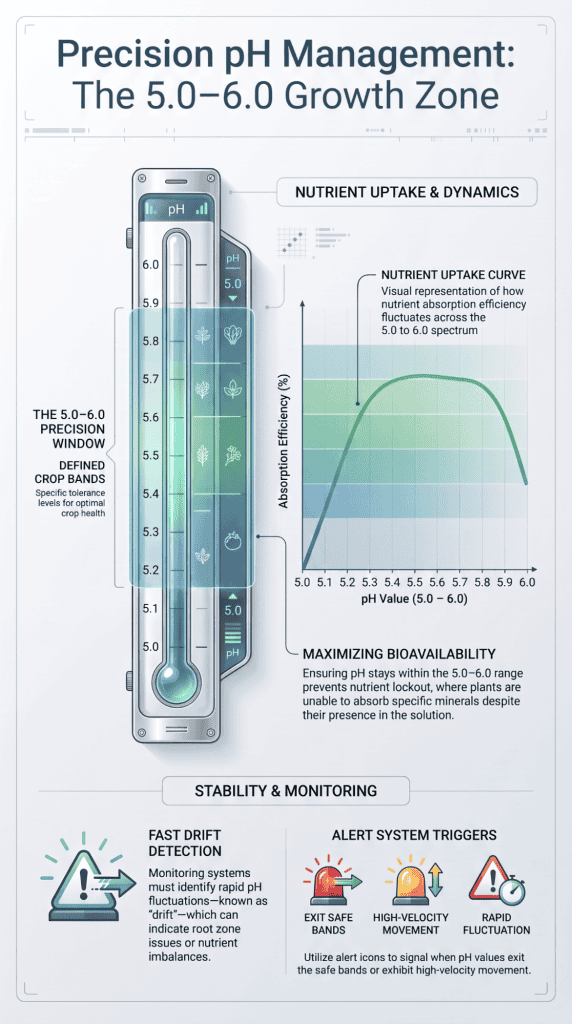
Normal pH drift depends on the crop, nutrient mix, growing method, and target range. A pH of 5.8 isn’t a universal setpoint for every hydroponic system.
A general hydroponic pH range is around 5.0 to 6.0, but individual crops can have different preferred ranges. A good pH level for hydroponics depends on the crop and nutrient system, with the main goal of keeping pH in a range where plants can take up essential nutrients.
A slow pH change within the crop’s suitable range may only need monitoring. A quick shift outside that range needs investigation.
Nutrient availability changes as pH moves. If pH stays too high or too low for too long, plants can show deficiency or toxicity symptoms even when the fertilizer mix is correct.
How Can You Troubleshoot a Hydroponic pH Swing?
The quickest way to troubleshoot hydroponic pH changes is to check the basics before changing the nutrient solution. Check the pH meter, source water, EC, temperature, water level, nutrient mix, and signs of biological activity.
Start with the pH meter. Test the pH of your nutrient solution only after checking that the meter is properly calibrated. A bad calibration can make a stable reservoir look like it has a problem. Keep the electrode clean and store it correctly. This helps separate meter errors from real pH changes.
Take readings at the same time each day. A reading taken right after adding nutrients may not show the final reservoir pH, especially if the water has not mixed fully.
Look at pH and EC together. If EC rises while the water level drops, plants may be using water faster than nutrients. If EC falls, nutrient uptake may be higher, or recent top-offs may have diluted the solution.
A useful troubleshooting routine is to:
- Calibrate and check the pH meter.
- Test source-water pH and alkalinity.
- Record EC, temperature, and water level.
- Check recent nutrient additions and top-offs.
- Look at roots, water clarity, odors, and algae.
- Check aeration, circulation, and light exposure.
- Make one gradual correction, mix the reservoir, and test again.
Nutrient uptake can change the chemistry around plant roots, and pH control is also important in recirculating hydroponic systems. These factors support finding the cause of pH changes instead of repeatedly adding pH Up or pH Down.
How Should You Read the Pattern Instead of One pH Number?
A pattern is more useful than an isolated reading because the direction and speed of change can reveal what is happening inside the reservoir.
| pH Pattern | Possible Cause | What to Check |
| Gradual daily rise | Nitrate uptake, alkalinity, CO₂ loss | Nitrogen form, alkalinity, aeration |
| Gradual daily drop | Ammonium uptake, microbial respiration | Nutrient formulation, roots, organic matter |
| Daytime rise | Algae or strong CO₂ removal | Light leaks, aeration |
| Sudden crash | Biological contamination or dosing error | Roots, odor, dosing equipment |
| Large swings in a small reservoir | Low volume and low buffering | Reservoir size, top-offs, source water |
| Rebound after pH Down | High alkalinity and CO₂ off-gassing | Bicarbonate concentration |
| Erratic readings | Meter or sampling problem | Calibration, electrode condition |
That said, no single pattern proves a diagnosis. A rising pH can come from nitrate uptake, algae, alkalinity, or CO₂ loss, so growers should confirm the pattern with EC, water level, temperature, and visual inspection.
Consistent records also reveal changes caused by crop development. Rapid vegetative growth can produce a different nutrient-uptake pattern from a slower crop phase, meaning the same reservoir may behave differently several weeks later.
How Can Hydroponic Help Stabilize pH?

Credits: Hoocho
Hydroponic pH management works better as a regular monitoring routine than as a daily effort to hold one exact number.
The main goal is to spot changes early. Tracking pH, EC, temperature, water level, and nutrient additions can help show a problem before it leads to serious nutrient lockout.
A useful record includes the time, reading, crop stage, recent top-off, and latest nutrient adjustment. Even five readings a week can show a trend that single readings may miss.
The process can stay simple:
- Check pH and EC at set times.
- Compare readings with the crop range.
- Check water level and recent additions.
- Look for temperature or aeration changes.
- Inspect the reservoir and roots.
- Make gradual changes when needed.
Hydroponic management can follow this same approach by keeping reservoir care practical and consistent. The focus should stay on water quality, nutrient balance, regular checks, and careful adjustments instead of constant chemical corrections.
The same idea applies to reservoirs from 2 gallons to 200 gallons. Larger tanks can soften sudden changes, but the processes that cause pH drift still happen.
What Is the Best Way to Prevent Hydroponic pH Fluctuations?
The best way to prevent hydroponic pH swings is to use stable source water, the right nutrient mix, accurate testing, and regular checks. Don’t try to force the reservoir to one exact pH.
Start with the source water. Check alkalinity as well as pH. Alkalinity shows how much the bicarbonates can resist added acid. High-alkalinity water can push the nutrient solution back toward a higher pH after acid is added.
The nitrogen source matters too. Nitrate and ammonium affect root-zone pH in different ways, so the nutrient mix can change how pH moves from day to day.
Reservoir design also plays a part. Larger tanks give the solution more dilution and temperature buffering. Opaque containers can help keep algae out. Good circulation keeps nutrients and temperature more even.
The main prevention steps are:
- Test source-water alkalinity.
- Choose nutrients for the crop stage.
- Check nitrate and ammonium levels.
- Block light from tanks and tubing.
- Track EC, temperature, water level, and pH.
- Calibrate and care for the pH meter.
- Watch for cloudy water, odors, slime, or root damage.
- Make pH changes slowly.
- Record trends before making another change.
Plant nutrient uptake can change pH by shifting the ion balance around the roots. Some pH movement is normal in hydroponics.
The important part is knowing normal drift from a real problem. A slow change within the crop’s range may only need watching. Large swings, sudden drops, repeated rebounds, or readings outside that range need a closer look.
FAQ
Why does hydroponic pH keep rising every day?
If your hydroponic pH rises every day, check whether the pattern matches active plant growth and nutrient uptake. Rapid plant growth can change the balance of ions in the nutrient solution.
Also test your source water, especially its alkalinity and bicarbonate levels. If pH continues rising after correction, compare fresh nutrient solution with reservoir readings before making further adjustments.
What should I check when pH keeps dropping?
Repeated pH drops can occur when plants change their nutrient uptake, but the pattern matters more than a single reading. Check nitrate and ammonium uptake, overall nutrient concentration, and root health.
Stress or unhealthy roots can affect nutrient uptake and pH behavior. If the drop is sudden, verify your pH meter’s accuracy before changing the nutrient solution.
Does reservoir size affect hydroponic pH stability?
Small reservoirs can show stronger daily pH changes because they contain less water to buffer shifts in nutrient solution chemistry. Reservoir size is worth considering when readings seem unstable.
A small reservoir may require more frequent pH monitoring, while a larger reservoir often changes more slowly. However, plant nutrient uptake can still cause noticeable pH changes in larger reservoirs.
Can tap water make pH harder to control?
Yes, tap water can make pH harder to control when its alkalinity and bicarbonate levels are high. Alkalinity gives water greater buffering capacity, so it resists changes after you add an acid or base. Reverse osmosis water has much lower buffering capacity, so its pH can change more easily. Test your source water before changing your pH adjustment routine.
How can I tell if pH changes are real or testing errors?
When pH readings seem inconsistent, check your testing process before assuming there is a nutrient problem. Use a properly calibrated pH meter, rinse the probe according to its care instructions, and measure a well-mixed nutrient solution.
Take readings at similar times each day. Consistent testing conditions help you distinguish real pH fluctuations from measurement errors.
The Practical Rule for Stable Hydroponic pH
When your hydroponic pH keeps moving, repeatedly pushing it back to 5.8 won’t fix the reason it’s changing. Your plants, source water, nutrients, CO₂, microbes, growing media, and environment can all affect the reservoir, so the direction of the drift matters. The cause comes first.
A better approach is to measure consistently, look for what is driving the change, then make small corrections and check the result. That’s where Tophydroponicgarden can be a useful shortcut, giving you practical guidance to manage pH with more confidence. You don’t need to chase a number every time it moves.
References
- https://vb.lammc.lt/object/elaba:175656827/index.html
- https://agris.fao.org/search/zh/records/69b95fe11acdc0f2bc7fd7dc#1
Related Articles
- https://tophydroponicgarden.com/how-is-ph-important-in-hydroponics/
- https://tophydroponicgarden.com/what-is-a-good-ph-level-for-hydroponics/
- http://tophydroponicgarden.com/how-to-test-the-ph-of-your-nutrient-solution-easily
Was this helpful?

I’m Barrie L., a passionate hydroponic gardening enthusiast dedicated to cultivating thriving, soil-less gardens. With a focus on all things hydroponic, I share my expertise on innovative growing techniques and sustainable practices through my blog, tophydroponicgarden.com. As a seasoned hydroponics specialist, my goal is to inspire and guide fellow gardeners in harnessing the power of water-based cultivation for bountiful and eco-friendly harvests. I’m also an author of the book “Hydroponics For Absolute Beginners: Your Step By Step Guide For How To Create An Hydroponics System At Home Without Soil, For Growing Vegetable, Fruit And Herbs.” which is sold on Amazon. Join me on a journey of redefining the way we cultivate plants, one nutrient-rich solution at a time. Happy growing!