

When a plant’s leaves curl down, it’s usually telling you something is wrong. The most common reason is a watering issue, giving too much or too little. This stress can also come from nutrients, temperature, pests, or root health. Plants like Philodendrons, Monsteras, and Peace Lilies often show this sign first.
Figuring out the specific cause is the key to fixing it. Let’s look at how to diagnose the problem and get those leaves healthy again.
Quick Plant Check
- When leaves curl down, they’re trying to conserve moisture or protect themselves. It’s a clear sign the plant is under stress. The next step is to figure out which specific issue is causing it.
- Symptoms such as texture, color, soil moisture, and leaf shape help identify the underlying problem quickly.
- Early diagnosis improves recovery rates and helps restore healthy growth faster.
Quick Plant Stress Signals at a Glance
When I walk through my greenhouse to diagnose a failing plant, I skip the guesswork and check three immediate physical markers: leaf turgor (firmness), tip directional curvature, and the moisture gradient of the root ball.
For example, a downward curl on a Monstera deliciosa tells a completely different physiological story if the leaf tissue feels papery versus if it feels limp and water-logged.
Look closely at the leaf itself. Is it dry and crispy, or soft and limp? Then feel the soil. Is it bone-dry, soggy, or just damp? The combination of these clues narrows down the cause.
Fungus gnats frequently accompany overwatered plants and can signal developing root problems. That’s a good point. Fungus gnats are more a symptom than the main disease. They thrive in wet soil, so if you see them flying around, it’s a strong signal you’re overwatering.
The gnats themselves are mostly just a nuisance. But their favorite home, consistently damp soil, can lead to root rot, which is the real danger. So, getting rid of the bugs means fixing the underlying moisture problem.
Here are the most common causes of downward curling, starting with the most frequent.
Overwatering makes leaves curl down

Overwatered plants exhibit downward leaf curling because saturated soil completely drives out oxygen pockets. Without cellular respiration, root cells suffocate, lose their semi-permeable membrane integrity, and physically cannot pump water upward.
This triggers a localized drought response in the canopy: the leaves curl downward to reduce surface area and limit transpiration (water loss through leaf pores), creating the optical illusion of a thirsty plant.
The soil stays wet for days, and the leaves become soft and limp. This is the classic sign of overwatering.
Overwatering is one of the most common plant leaf curl causes found in both indoor and outdoor growing environments. Roots require oxygen to function correctly. When soil remains saturated, air pockets disappear and roots begin to deteriorate.
That’s the tricky part. Root rot is what happens next, and it flips the script. The roots are so damaged they can’t drink, so the plant shows signs of thirst, like curling leaves, even though the soil is wet. It’s a vicious cycle.
You’ll need to check the roots to be sure. Healthy roots are firm and white or light-colored. Rotten roots are dark, mushy, and often smell bad.
What to do for root rot
To salvage a plant from root rot, unpot it entirely and rinse the root system under lukewarm water until the bare architecture is exposed.
I use a pair of bypass pruning shears sterilized with 70% isopropyl alcohol to excise any black, mushy cortex tissues back to a healthy, white vascular core.
When repotting, skip standard bag soil; instead, mix a custom, highly oxygenated substrate using 40% coarse orchid bark, 30% perlite, and 30% coco coir to permanently prevent the anaerobic conditions that invite Pythium or Phytophthora root rot fungi.
Water very sparingly until you see new growth, which means the roots are recovering.Signs usually appear gradually. Leaves become soft, droopy, and may start curling downward before yellowing develops. Growth slows while soil remains persistently wet.
The following signs often indicate overwatering:
- Constantly wet soil
- Soft, drooping foliage
- Musty odor around the pot
- Presence of fungus gnats
- Yellowing and curling leaves
- Slow growth despite adequate light
How to Fix Overwatered Plants
The following corrective actions help restore root health:
- Allow soil to partially dry before watering again
- Improve drainage with better potting media
- Remove black or mushy roots during repotting
- Use containers with drainage holes
- Reduce watering frequency
New growth often signals recovery long before damaged leaves improve.
Understanding Downward Leaf Curling Caused by Underwatering
Yes, that’s the plant’s survival move. It’s trying to shrink its surface area to hold onto every bit of water it has. With underwatering, the leaves usually feel dry and brittle, and the soil will be completely dry and may even pull away from the edges of the pot.
How to fix underwatering
Give the plant a thorough, deep watering. Sometimes, if the soil has become too dry and compacted, water will run straight through without being absorbed. In that case, try setting the pot in a tray of water for about 30 minutes so the soil can soak it up from the bottom. Then, let it drain completely. Going forward, check the soil more frequently.
Plants depend on internal water pressure to maintain leaf shape. Right. It’s a short-term fix that can’t last forever. If the dryness goes on too long, the leaves will turn brown and crispy at the edges, and the plant’s growth will stop completely.
The goal is to catch the curl early, when it’s just a warning sign, and adjust your watering routine before permanent damage sets in.
Common symptoms appear quickly in sensitive species such as Peace Lily, Calathea, and Pothos.
The following symptoms usually accompany underwatering:
- Dry soil throughout the root zone
- Brown or crispy leaf edges
- Curling and folding leaves
- Wilted stems
- Slowed growth
According to Harvard University’s Arnold Arboretum
“Leaf curling is a common response when plants attempt to conserve water under drought conditions.” – Harvard University’s Arnold Arboretum
How to Rehydrate a Plant Safely
The following steps help reverse dehydration:
- Water deeply until excess drains from the pot
- Establish a consistent watering schedule
- Check soil moisture before watering
- Increase humidity if conditions are excessively dry
Plants often recover within several days if root damage has not become severe.
Nitrogen Toxicity Can Cause the “Claw” Effect
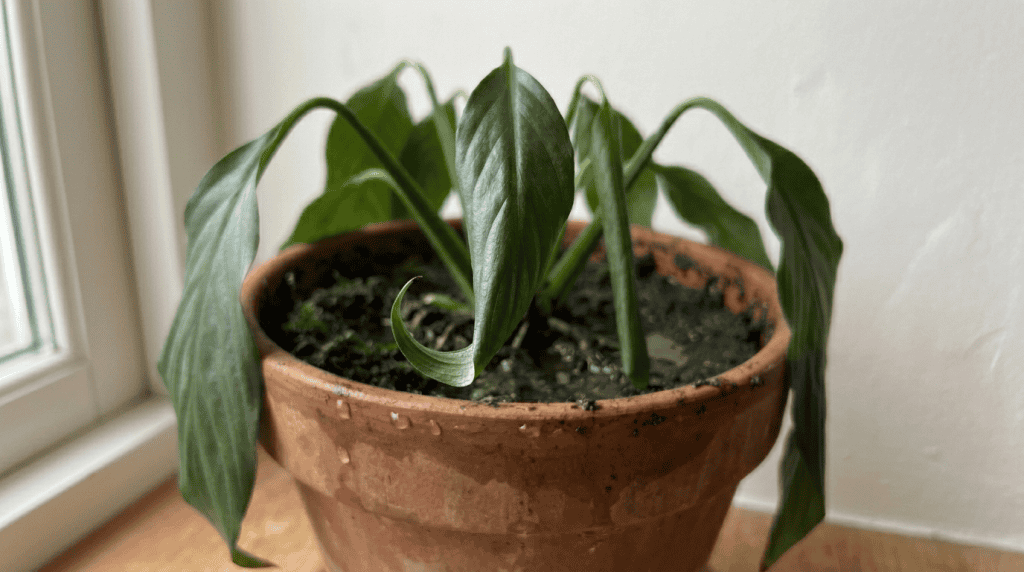
Excess nitrogen commonly causes dark green leaves with curled tips that resemble claws.
Too much nitrogen is a classic issue. The plant grows lots of dark green, often weak and soft leaves, but it struggles to produce flowers or fruit. The leaf tips may curl downward and turn brown or yellow, a symptom called “tip burn.”
It happens from over-enthusiastic fertilizing. The fix is to stop feeding and flush the soil with plenty of water to dilute the excess nutrients.. Growers often call it “leaf clawing.”
Nitrogen stimulates vigorous foliage production. When levels become excessive, leaf tissues develop unevenly, causing tips to bend sharply downward.
Affected leaves frequently appear unusually dark, glossy, and thick.
The following symptoms suggest nitrogen toxicity:
- Dark green curled leaves
- Thick, leathery foliage
- Hooked leaf tips
- Excessive leafy growth
- Delayed flowering
How to Correct Excess Nitrogen
The following actions often resolve the problem:
- Reduce fertilizer applications
- Flush excess nutrients from the growing medium
- Monitor new growth rather than old damaged leaves
- Test soil if problems persist
Improvement usually appears first in newly emerging foliage.
Heat, Light, and Humidity Can Influence Leaf Curling
Environmental stress can force leaves to curl downward as plants attempt to conserve water and protect sensitive tissues.
Temperature and humidity directly influence plant water balance. When conditions become unfavorable, leaves curl to reduce moisture loss.
Heat stress in plants accelerates water evaporation. Excessive heat often causes plant leaves curling from heat, particularly near windows or under strong lighting.
The following environmental factors commonly trigger curling:
- High temperatures
- Intense direct sunlight
- Excessive grow light exposure
- Low humidity
- Sudden temperature changes
Many tropical species struggle when indoor humidity falls below 40%, especially sensitive species like Calathea, Monstera, and Philodendron.
Heat Stress
The following signs commonly appear:
- Rapid soil drying
- Curled foliage
- Wilting and curling leaves
- Brown leaf edges
Light Stress
Plants exposed to excessive light often show:
- Curling near grow lights
- Bleached patches
- Scorched foliage
Low Humidity Problems
The following symptoms may occur:
- Persistent curling despite proper watering
- Crispy leaf margins
- Increased moisture loss
According to the United States Department of Agriculture (USDA)
“Environmental stress frequently reduces plant growth and increases susceptibility to pests and disease.” – United States Department of Agriculture (USDA)
Transitioning environmental conditions gradually often prevents severe damage.
Pests Can Cause Downward-Curling Leaves
Sap-feeding insects damage plant tissues and disrupt nutrient movement, leading to distorted or curled foliage.
Many cases of curled leaves on houseplants originate from pest infestations rather than watering problems.
Insects feed on plant sap, damaging cells and disrupting normal growth patterns. As tissues weaken, leaves become distorted and curl downward.
Common pests include Spider Mites, Aphids, Mealybugs, Whiteflies, and Scale Insects.
The following pests frequently cause leaf curling:
- Spider mites
- Aphids
- Mealybugs
- Whiteflies
- Scale insects
Whiteflies are common pests that can cause leaf distortion through feeding activity.
How to Inspect Plants for Pest Damage
Follow this inspection routine:
- Check leaf undersides
- Examine new growth
- Look for sticky honeydew residue
- Search for webbing
- Inspect stems and leaf joints
Early detection dramatically improves treatment success.
Wet Soil Can Still Lead to Dehydrated Leaves
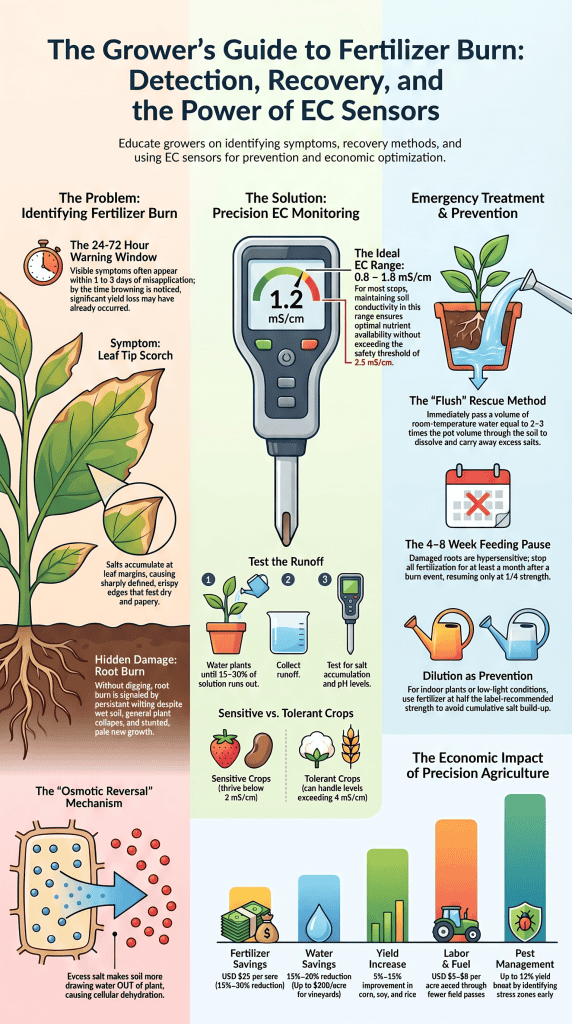
Salt accumulation can block water uptake, causing dehydration symptoms even when the growing medium remains moist.
This issue confuses many plant owners because soil appears wet while leaves continue curling.
When you over-fertilize, excess mineral salts accumulate in the substrate, driving the electrical conductivity (EC) of your soil runoff past safe thresholds (typically above 2.5 mS/cm for sensitive aroids).
This creates a hypertonic soil environment where the osmotic pressure outside the root cell is higher than inside.
Because water naturally follows salt gradients, moisture is actively drawn out of the root tissues and back into the soil, a phenomenon known as exosmosis, or ‘fertilizer burn.’ I diagnose this by measuring the EC of the water draining from the bottom of the pot using a digital EC pen.
Common contributors include:
- Excess fertilizer damage
- Hard water minerals
- Repeated nutrient applications
- Poor drainage
Understanding Osmotic Stress
The following factors increase risk:
- Fertilizer salt buildup
- Elevated EC levels
- Reduced root absorption
- Reverse osmosis effects
How to Reduce Salt Accumulation
The following methods help:
- Flush soil thoroughly
- Use filtered water when necessary
- Reduce nutrient concentration
- Monitor runoff EC
This invisible drought often mimics severe underwatering despite moist soil.
Moisture Meters Can Sometimes Provide False Readings
Standard, inexpensive metal-probe moisture meters do not actually measure water volume; they measure electrical conductivity.
In chunky custom aroid mixes, the air gaps between large pieces of orchid bark and pumice break the electrical circuit, causing the needle to drop to ‘Dry’ even if the core of the root ball is soaking wet.
Instead of trusting these meters, I rely on the pot-weight method: get used to the heft of your plant when completely dry versus completely saturated.
If you must use a tool, use a unfinished wooden dowel pushed deep into the center of the root zone; if it pulls up dark or damp to the touch, hold off on watering.
Common situations where moisture meters fail include:
- Orchid bark mixes
- Perlite-heavy substrates
- Coco coir blends
- Chunky aroid soil mixes
Better Ways to Check Soil Moisture
The following techniques are generally more reliable:
- Finger test
- Pot weight method
- Wooden skewer test
- Root-zone inspection
Many experienced growers consider pot weight the most accurate method for routine monitoring.
A Step-by-Step Approach Helps Diagnose Downward-Curling Leaves

Begin with watering conditions, then evaluate nutrients, environmental factors, and pests before making major changes.
Effective leaf curling diagnosis follows a systematic process rather than guessing.
At Tophydroponicgarden, growers often identify the problem within minutes by following a structured checklist.
Simple Troubleshooting Checklist
- Check soil moisture levels
- Inspect root health
- Review fertilizer history
- Assess temperature and light exposure
- Check humidity levels
- Inspect for pests
- Monitor plant recovery for one to two weeks
| Diagnostic Area | What to Check |
| Watering | Wet or dry soil |
| Roots | Healthy white roots or signs of root rot |
| Nutrients | Recent fertilizer applications |
| Environment | Temperature, humidity, and light conditions |
| Pests | Webbing, insects, or sticky residue |
Key Takeaways About Downward-Curling Plant Leaves

Credits: GreenPlanet Wholesale
Most cases result from watering errors, nutrient imbalances, environmental stress, or pests. Identifying the exact symptom pattern helps resolve the problem faster.
Downward curling leaves rarely occur without a reason. The visible symptoms provide valuable clues about what the plant is experiencing beneath the surface.
The following actions solve most cases of houseplant troubleshooting:
- Check watering habits first
- Rule out fertilizer excess
- Improve humidity and temperature conditions
- Inspect regularly for pests
- Monitor changes before making additional adjustments
At Tophydroponicgarden, successful diagnosis always begins with understanding the relationship between roots, water, nutrients, and environmental conditions.
Healthy roots support healthy foliage. Once the source of stress is corrected, most plants gradually return to normal growth and produce stronger, healthier leaves.
For long-term healthy growth, focus on consistent care rather than quick fixes.
FAQ
Can plants recover after their leaves start curling downward?
Yes, plants can recover after their leaves start curling downward if you identify and correct the underlying problem. Common causes include plant water stress, nutrient deficiency in plants, poor root health, and environmental plant stress.
Existing leaves may not return to their original shape, but healthy new growth should appear once growing conditions improve and the source of stress is removed.
Why are my leaves curling even though I water the plant regularly?
Regular watering does not always prevent leaves curling downward because watering frequency is only one part of plant care. Waterlogged soil symptoms, compacted soil problems, and poor drainage plant issues can prevent roots from absorbing oxygen.
In other cases, inconsistent watering problems cause roots to alternate between overly wet and overly dry conditions, leading to stress and leaf curling.
What causes curled leaf tips before the rest of the leaf curls?
Curled leaf tips often develop before the entire leaf becomes affected. Fertilizer burn symptoms, excess fertilizer damage, low humidity plant problems, and dry air plant damage commonly cause the edges and tips of leaves to curl first. If these conditions continue, the damage may spread across the leaf, resulting in more noticeable foliage curling downward and discoloration.
How does poor soil contribute to houseplant leaves curling?
Poor soil can directly affect root function and plant health. Waterlogged soil symptoms develop when soil retains excessive moisture, while compacted soil problems limit airflow around roots.
These conditions can lead to oxygen deprived roots, root rot symptoms, and overwatering root damage. As root health declines, plants often develop drooping plant leaves, leaf curling and yellowing, and stunted plant growth.
Should I remove curled leaves or leave them on the plant?
You should leave curled leaves on the plant if they remain mostly green and continue supporting photosynthesis. However, you can remove leaves that show severe leaf curling and browning, extensive pest damaged leaves, fungal plant diseases, or viral leaf curl disease.
Before pruning, complete a careful leaf curling diagnosis so you can address the cause and prevent additional damage.
Fix the Cause, Help Your Plant Recover
Curled leaves can be frustrating because they often show up before bigger problems become obvious. That’s the warning sign. By checking soil moisture, root health, light exposure, and pest activity, you can quickly narrow down what’s causing the stress and take action before growth declines further.
Most plants recover well once the source of the problem is fixed. If you’re looking for practical growing advice and plant care solutions, Tophydroponicgarden can be a helpful resource for diagnosing issues and building a more consistent care routine. Small adjustments today can lead to stronger, healthier growth over time.
References
- https://arboretum.harvard.edu/
- https://www.usda.gov/
Related Articles
- https://tophydroponicgarden.com/growing-cherry-tomatoes-in-dwc-system/
- https://tophydroponicgarden.com/hydroponic-wick-system/
- https://tophydroponicgarden.com/how-long-should-water-run-in-hydroponic-system/
Was this helpful?

I’m Barrie L., a passionate hydroponic gardening enthusiast dedicated to cultivating thriving, soil-less gardens. With a focus on all things hydroponic, I share my expertise on innovative growing techniques and sustainable practices through my blog, tophydroponicgarden.com. As a seasoned hydroponics specialist, my goal is to inspire and guide fellow gardeners in harnessing the power of water-based cultivation for bountiful and eco-friendly harvests. I’m also an author of the book “Hydroponics For Absolute Beginners: Your Step By Step Guide For How To Create An Hydroponics System At Home Without Soil, For Growing Vegetable, Fruit And Herbs.” which is sold on Amazon. Join me on a journey of redefining the way we cultivate plants, one nutrient-rich solution at a time. Happy growing!