
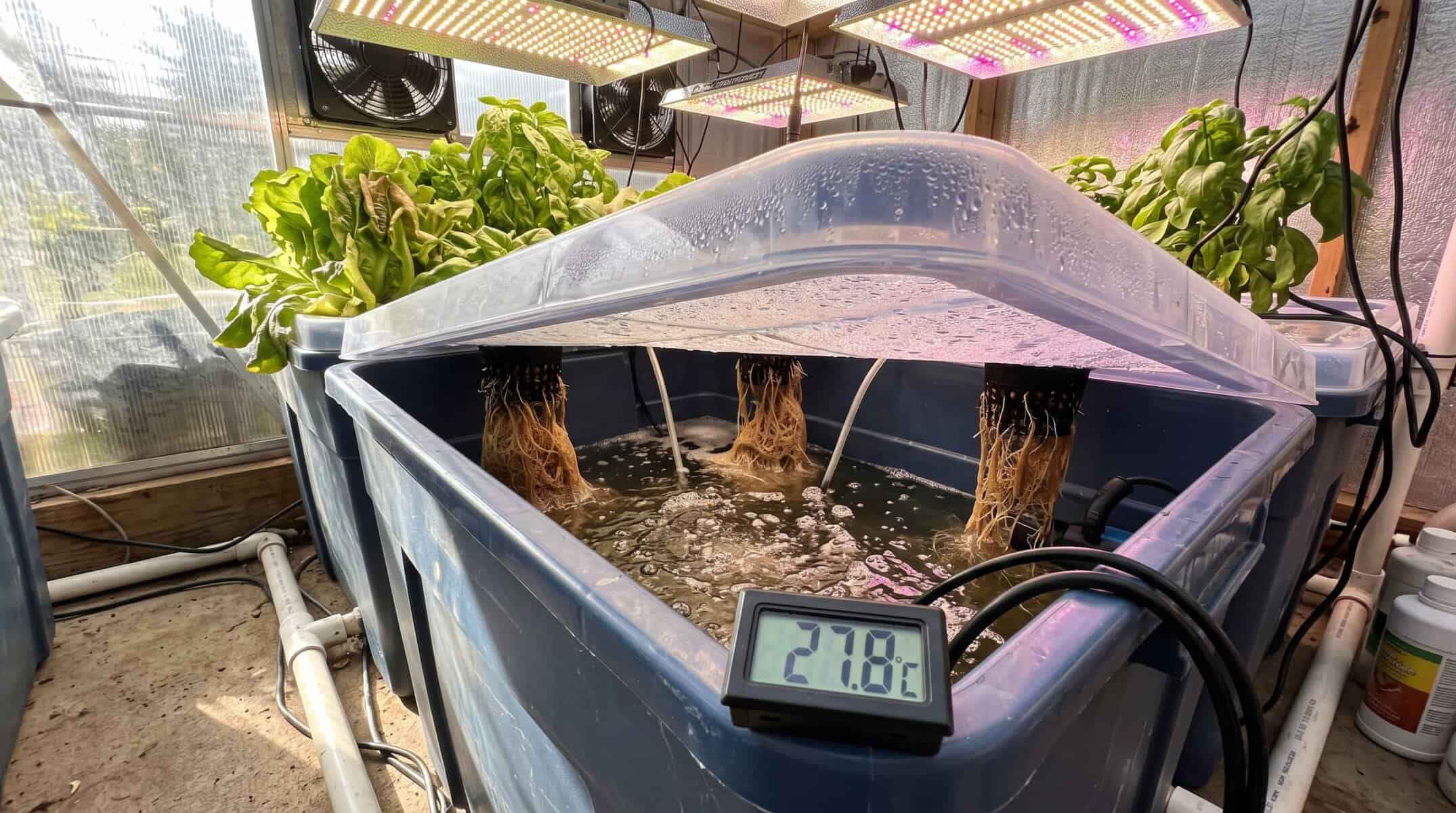
Hydroponic nutrient solution temperature plays an important role in maintaining healthy roots and consistent plant growth. When the reservoir becomes too warm, the problem is not simply that the water feels hot. Higher solution temperatures can also affect oxygen availability and create additional stress around the root zone.
This is especially important in systems where roots remain submerged for long periods, such as deep water culture (DWC). Warm water holds less dissolved oxygen, while plant roots and microorganisms may also have greater oxygen demands under certain conditions.
There are several reasons why a hydroponic reservoir may become warmer than expected. Direct sunlight, grow lights, warm room temperatures, pumps, exposed plumbing, small reservoirs, and poor insulation can all contribute to heat buildup.
The good news is that high nutrient solution temperature is usually something you can diagnose and manage. By identifying where the heat is coming from and understanding how temperature affects oxygen and root health, you can choose the right cooling method instead of simply adding ice whenever the reservoir feels warm.
UNDERSTANDING HIGH NUTRIENT SOLUTION TEMPERATURES
High nutrient solution temperature is usually the result of heat entering the reservoir faster than the system can remove it.
- Understand the Heat Sources. Identify how sunlight, grow lights, room temperature, pumps, and reservoir placement can warm the nutrient solution.
- Monitor Oxygen Availability. Learn why warm water holds less dissolved oxygen and why this becomes particularly important when roots are submerged.
- Control the Reservoir. Use shade, insulation, ventilation, circulation, or active cooling when passive methods are not enough.
What Is Nutrient Solution Temperature?
Nutrient solution temperature refers to the temperature of the water and dissolved nutrients surrounding the plant roots.
Unlike soil-based gardening, hydroponic plants depend directly on the nutrient solution for water and mineral nutrients. This means changes in the reservoir environment can have a direct effect on the root zone.
The University of Florida IFAS Extension recommends regularly monitoring nutrient solution temperature and maintaining adequate oxygenation as part of hydroponic management.
“Nutritive solution should be constantly monitored for temperature, which should be maintained between 65°F and 80°F.” — University of Florida IFAS Extension
The ideal temperature is not necessarily identical for every crop or hydroponic system. Lettuce, herbs, tomatoes, strawberries, and other crops can have different preferences.
The important point is to avoid allowing the reservoir to become consistently hotter than the range appropriate for the crop.
Why Is My Nutrient Solution Getting Hot?
A nutrient solution can become hot for several different reasons.
Common causes include:
- High room temperature
- Direct sunlight
- Grow lights
- Warm floors or surfaces
- Submersible pumps
- Small reservoir volume
- Poor insulation
- Warm incoming water
- Poor ventilation
- Exposed tubing
- Long periods of high ambient temperature
Sometimes several of these factors occur at the same time.
For example, a small reservoir positioned directly beneath a powerful grow light can absorb considerable heat throughout the light cycle. Even if the surrounding air temperature seems manageable, the water can gradually become warmer.
This is why understanding the overall hydroponic environment is important. Water temperature does not operate independently from oxygen, nutrients, and root conditions. If you are still learning how these components interact, this guide on how hydroponics works can help explain the basic relationship between water, nutrients, oxygen, and plant roots.
How Does Room Temperature Heat Nutrient Solution?
The temperature of the surrounding environment has a direct influence on the reservoir.
If the room is hot for several hours, heat gradually transfers from the surrounding air and surfaces into the nutrient solution.
This can be particularly noticeable in:
- Greenhouses
- Indoor grow rooms
- Enclosed balconies
- Outdoor hydroponic systems
- Small rooms with poor ventilation
A hydroponic reservoir does not actively regulate its own temperature.
If the surrounding environment remains hot, the water will eventually absorb some of that heat.
This is why monitoring the nutrient solution itself is more useful than assuming that a comfortable room temperature means the reservoir is also at a suitable temperature.
How Do Grow Lights Heat Nutrient Solution?
Grow lights can contribute to reservoir heating even when they are not physically touching the water.
Heat can reach the reservoir through:
- Radiant heat
- Warm surrounding air
- Heated surfaces
- Equipment positioned near the reservoir
The effect can become more noticeable when the reservoir is directly below or very close to a grow light.
Try measuring nutrient solution temperature at different times during the light cycle.
If the reservoir is significantly warmer near the end of the lighting period than in the morning, your lighting setup may be contributing to the problem.
Can a Small Reservoir Get Hotter?
Yes.
Smaller reservoirs generally contain less water mass, so their temperature can change more quickly in response to environmental heat.
A larger reservoir has greater thermal mass and can be slower to heat up or cool down.
This does not mean that simply increasing reservoir size will solve every temperature problem.
If the heat source is strong enough, a large reservoir can still become too warm.
However, reservoir volume can influence how quickly temperature fluctuates throughout the day.
Why Does Nutrient Solution Temperature Matter?
Temperature affects more than plant comfort.
One of the most important effects is its relationship with dissolved oxygen (DO).
Water holds less dissolved oxygen as its temperature increases.
Research published by IntechOpen explains that nutrient solution temperature can influence physiological processes in plant roots, including the absorption of water and nutrients.
“The temperature of the nutrient solution affects the physiological process in the root, such as the absorption of water and nutrients.” — IntechOpen
This creates an important relationship:
Higher nutrient solution temperature → lower oxygen solubility → greater potential for root stress.
This is particularly important in DWC and other systems where a large portion of the root system remains submerged.
How Does High Temperature Affect Dissolved Oxygen?
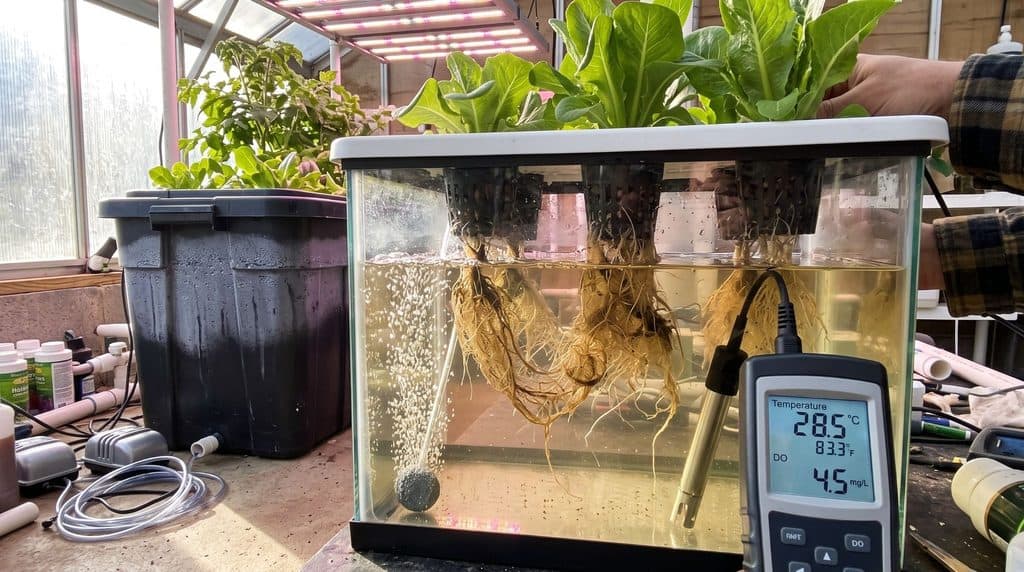
Dissolved oxygen is the amount of oxygen available in the water.
Roots need oxygen for cellular respiration and normal root function.
When nutrient solution temperature rises, the water becomes less capable of holding dissolved oxygen. This means a warm reservoir can create a more challenging environment for submerged roots.
For example, the University of Missouri Extension discusses how increasing water temperature reduces oxygen solubility in hydroponic nutrient solutions.
This demonstrates why temperature cannot be considered separately from oxygen management.
Adding more air may improve oxygen transfer, but warm water still has a lower oxygen-holding capacity.
Signs Your Nutrient Solution May Be Too Warm
A high reservoir temperature does not always produce an immediate, obvious symptom.
However, you may notice:
- Wilting despite adequate water
- Slower growth
- Poor root development
- Brown or unhealthy roots
- Increased algae
- More frequent root problems
- Reduced nutrient uptake
- Faster changes in water chemistry
These symptoms can have many causes, so they should not automatically be blamed on temperature.
Measure the reservoir before changing your nutrient formula or adding supplements.
What Temperature Is Too Hot for Hydroponic Water?
There is no single temperature that is automatically harmful for every crop.
Crop type, system design, oxygenation, root density, and environmental conditions all matter.
As a practical reference, Purdue University recommends a nutrient solution temperature of approximately 65–70°F (18–21°C) for hydroponic growing, although individual crops may have their own preferred ranges.
| Nutrient Solution Temperature | General Consideration |
| Below 18°C / 65°F | Can be cool for some crops |
| 18–21°C / 65–70°F | Common practical target |
| 22–24°C / 72–75°F | Monitor more closely |
| Above 24°C / 75°F | Oxygen and root stress become greater concerns |
| Above 27°C / 80°F | High-temperature conditions require attention |
These values should be treated as practical reference points rather than universal limits for every crop.
Why Does High Temperature Affect Roots?
Roots depend on a suitable combination of temperature, oxygen, moisture, and nutrients.
When nutrient solution temperature increases, two things can happen simultaneously.
First, the water’s capacity to hold dissolved oxygen decreases.
Second, biological activity and oxygen demand can change as temperature rises.
This can create a difficult situation for roots: the water holds less oxygen while the root environment may require more oxygen.
This is one reason temperature management becomes particularly important in systems where roots remain continuously exposed to nutrient solution.
High Temperature and Root Rot
Warm nutrient solution does not automatically cause root rot.
However, warm conditions combined with low dissolved oxygen and stressed roots can create an unfavorable root environment.
If you are already seeing brown, slimy, or foul-smelling roots, temperature should be one of the conditions you investigate.
Do not assume that temperature is the only cause. Root problems can also be related to oxygenation, water quality, pathogens, sanitation, and other environmental factors.
If your plant is already severely stressed, you can also review this guide on how to revive a dying hydroponic plant to identify other factors that may be contributing to plant decline.
High Temperature and Nutrient Uptake
Temperature influences the root environment in which nutrient uptake occurs.
If roots become stressed because of excessive heat or insufficient oxygen, nutrient uptake can become less efficient.
This can create deficiency-like symptoms even when nutrients are present in the reservoir.
However, this does not mean that every nutrient deficiency is caused by temperature.
Check:
- pH
- EC
- Nutrient concentration
- Water temperature
- Dissolved oxygen
- Root condition
Looking at these measurements together gives you a much better picture of what is happening.
High Temperature and Algae
Warm nutrient solution can also make algae management more difficult.
Algae requires light, water, nutrients, and suitable environmental conditions.
If your reservoir is warm and exposed to light, algae may become an increasing maintenance problem.
Start by blocking light from reaching the nutrient solution.
Cover the reservoir and reduce unnecessary exposure before relying on chemical treatments.
How to Lower Nutrient Solution Temperature
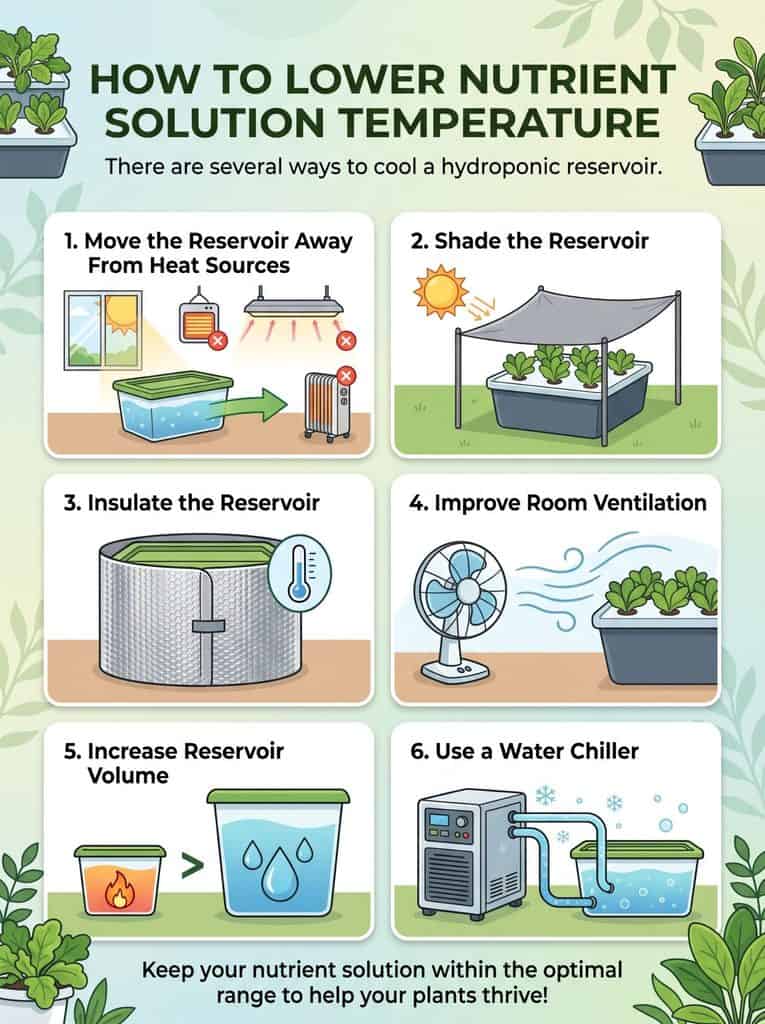
There are several ways to cool a hydroponic reservoir.
1. Move the Reservoir Away From Heat Sources
Start with the simplest solution.
Move the reservoir away from:
- Direct sunlight
- Grow lights
- Heaters
- Warm equipment
- Hot floors
- Poorly ventilated areas
Reducing the amount of heat entering the system can make a significant difference.
2. Shade the Reservoir
Direct sunlight can heat water quickly.
Use:
- Shade cloth
- Reflective covers
- Opaque reservoir covers
- A shaded growing location
Avoid allowing direct sunlight to hit the nutrient solution.
3. Insulate the Reservoir
Insulation can slow the transfer of heat between the reservoir and its surroundings.
It is especially useful when the surrounding environment becomes warm during the day.
Insulation does not actively cool the water.
Instead, it helps the reservoir remain closer to its existing temperature for longer.
4. Improve Room Ventilation
Better airflow can reduce heat accumulation around the hydroponic system.
Fans can help move warm air away from the reservoir and plants.
However, airflow alone may not be enough when the room itself is extremely hot.
5. Increase Reservoir Volume
A larger reservoir can provide greater thermal stability.
This may reduce rapid temperature fluctuations.
However, increasing reservoir volume should be considered alongside the needs of the plants and the overall system design.
6. Use a Water Chiller
A water chiller is the most direct option when passive cooling methods cannot keep the nutrient solution within an appropriate range.
A chiller actively removes heat from the nutrient solution.
If your reservoir repeatedly becomes too warm despite shade, insulation, and ventilation, learn more about why a water chiller is sometimes necessary in hydroponics before deciding whether active cooling is appropriate for your setup.
A chiller is particularly useful when the reservoir becomes too warm repeatedly rather than only during an occasional heat spike.
Should You Put Ice in the Nutrient Solution?
Ice or frozen water bottles can provide temporary cooling, but they are not a precise long-term temperature-control method.
They can cause rapid temperature changes and may complicate water-volume and nutrient management as they melt.
For an emergency heat spike, sealed frozen water bottles may be useful as a short-term measure if they do not contaminate the reservoir.
For persistent high temperatures, identify the heat source and consider passive cooling or a properly sized chiller instead.
Should You Add More Aeration When Water Gets Hot?
Increasing aeration can help oxygen transfer, but it does not completely solve the underlying temperature problem.
Warm water naturally holds less dissolved oxygen.
Therefore, use aeration and temperature control together.
A good air pump and air stone are valuable, but they should not be treated as a substitute for cooling an excessively warm reservoir.
How to Monitor Nutrient Solution Temperature
A simple water-temperature thermometer can help you understand what is happening.
Measure the reservoir:
- In the morning
- Around the middle of the light cycle
- Near the end of the light cycle
- During the hottest part of the day
Recording these measurements can reveal whether your problem is constant or occurs only during certain periods.
For example:
| Morning | Afternoon | Evening | Possible Interpretation |
| 19°C | 21°C | 20°C | Stable |
| 20°C | 25°C | 23°C | Daytime heat buildup |
| 23°C | 27°C | 25°C | Persistent heat problem |
| 21°C | 30°C | 28°C | Severe daytime heating |
The pattern is often more useful than a single temperature reading.
Why Is My Nutrient Solution Hotter During the Day?
Daytime heating is usually related to increased environmental temperature and heat from sunlight or artificial lighting.
If the reservoir is comfortable in the morning but becomes hot every afternoon, check:
- Direct sunlight
- Grow-light position
- Room temperature
- Reservoir placement
- Pump heat
- Ventilation
This is also a good reason to measure temperature throughout the day rather than checking only once.
Why Is My DWC Nutrient Solution So Hot?
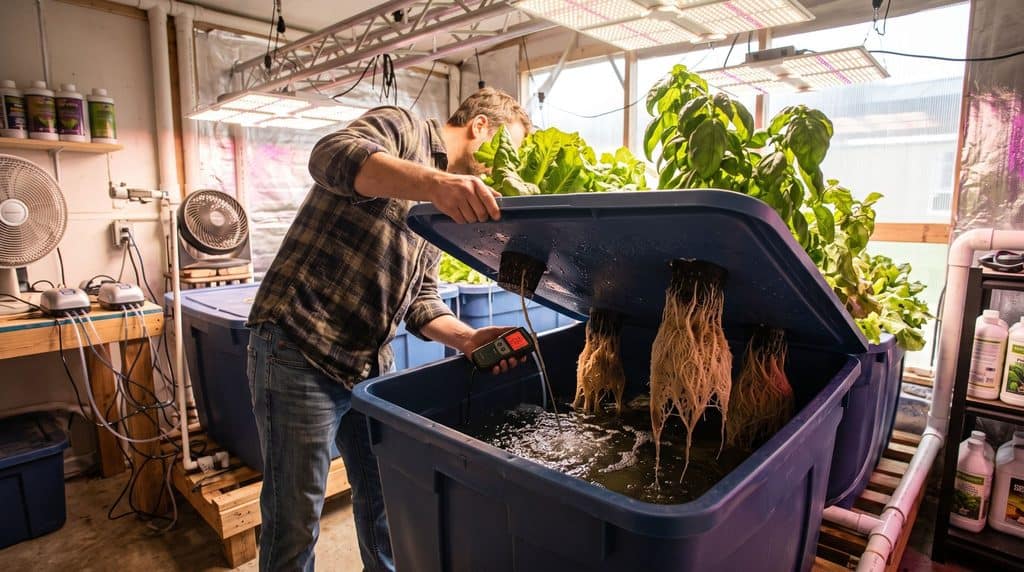
DWC systems can be particularly sensitive to nutrient solution temperature because the roots remain submerged.
A warm DWC reservoir can hold less dissolved oxygen, making aeration and temperature management especially important.
For DWC systems, keeping the reservoir away from heat sources, using an opaque container, improving airflow, and considering active cooling can help maintain more stable conditions.
If you use DWC, it is also useful to understand what temperature a DWC system should be because submerged roots are particularly dependent on adequate oxygen availability.
Common Mistakes When Managing Nutrient Solution Temperature
1. Checking Temperature Only Once
A reservoir can change significantly during the day.
Measure at different times.
2. Measuring Room Temperature Instead of Water Temperature
The room may feel comfortable while the reservoir is warmer.
Measure the nutrient solution directly.
3. Relying Only on Ice
Ice can provide temporary cooling but does not address a persistent heat source.
4. Assuming More Aeration Solves Everything
Aeration helps oxygen availability but cannot eliminate the effect of warm water on oxygen solubility.
5. Ignoring Grow Lights
Lights can contribute substantial heat to an indoor hydroponic setup.
6. Leaving Reservoirs in Direct Sunlight
Direct sunlight can quickly increase water temperature.
7. Ignoring Root Symptoms
Temperature problems often become more obvious when roots are already stressed.
Safety Tips When Cooling Hydroponic Water
When attempting to cool a nutrient solution:
- Avoid sudden extreme temperature changes.
- Do not place electrical equipment near water unless it is designed and installed safely for that environment.
- Keep electrical connections dry.
- Do not add contaminated ice directly to the reservoir.
- Monitor temperature after making changes.
- Follow manufacturer instructions when using a water chiller.
- Avoid making multiple major changes to the nutrient solution at once.
The objective is a stable root environment, not simply the lowest possible water temperature.
Frequently Asked Questions About High Nutrient Solution Temperatures
1. Why is my hydroponic nutrient solution temperature high?
Common causes include high room temperatures, direct sunlight, grow lights, warm pumps, small reservoirs, poor ventilation, and heat transfer from surrounding surfaces.
2. What temperature should a hydroponic nutrient solution be?
A practical reference for many hydroponic systems is around 18–21°C (65–70°F), although the appropriate range varies by crop and system.
3. Does warm nutrient solution reduce oxygen?
Yes. Warmer water has a lower capacity to hold dissolved oxygen. This is particularly important in systems where roots remain submerged.
4. How can I cool my hydroponic nutrient solution?
Start by reducing heat exposure through shade, insulation, ventilation, and better reservoir placement. If the solution remains consistently too warm, a water chiller may be appropriate.
5. Can high nutrient solution temperature cause root problems?
It can contribute to root stress because warm water holds less dissolved oxygen. Low oxygen conditions can make the root environment less favorable and may contribute to poor root function.
Final Thoughts on High Nutrient Solution Temperatures
If your nutrient solution temperature keeps rising, the first step is not to immediately buy a chiller or add ice.
Measure the water and identify when it becomes hot.
If the reservoir heats up during the day, look for sunlight, grow lights, room temperature, pumps, and other heat sources. If the temperature remains high throughout the day, passive cooling may not be enough.
Temperature matters because it affects the root environment, particularly dissolved oxygen. Warmer water holds less oxygen, and this can become especially important in DWC and other systems where roots remain submerged.
Start with simple solutions such as shade, insulation, ventilation, and better reservoir placement. If those measures cannot maintain a stable temperature, active cooling with a water chiller may be worth considering.
The goal is not to make the nutrient solution as cold as possible. The goal is to maintain a stable temperature appropriate for your crop while providing roots with adequate oxygen and a healthy growing environment.
REFERENCES
- https://ask.ifas.ufl.edu/publication/HS1422
- https://www.intechopen.com/chapters/80089
RELATED ARTICLES
- https://tophydroponicgarden.com/why-is-a-water-chiller-sometimes-necessary/
- https://tophydroponicgarden.com/what-temperature-should-deep-water-culture-be/
- https://tophydroponicgarden.com/how-to-revive-a-dying-hydroponic-plant/
Was this helpful?
