

Hydroponic strawberries usually stay small because of poor pollination, nutrient imbalances, weak lighting, heat stress, or unhealthy roots.
But it’s rarely caused by one issue alone. Fruit size depends on several growing conditions working together, and even small problems can add up over time.
Research from the University of Florida shows that the growing environment has a direct effect on strawberry size, yield, and fruit quality.
Keep reading to find out what’s holding your strawberries back and the practical fixes that can help them grow larger.
Bigger Berries Start With the Basics
Bigger hydroponic strawberries come from consistent growing conditions rather than quick fixes. Focus on the fundamentals, and your plants are more likely to produce larger, better-quality fruit.
- Pollination, balanced nutrition, and proper lighting have a greater impact on strawberry fruit sizing than bloom boosters alone.
- Stable temperature and environmental conditions usually deliver more consistent fruit quality than frequent fertilizer adjustments.
- Healthy crowns and vigorous roots support larger berries, while stressed or aging plants tend to produce smaller fruit.
Why Are Your Hydroponic Strawberries Staying Small?
Strawberries rarely suffer from just one problem. Usually, several small stresses add up and hold the plants back.
A strawberry might get enough nutrients but still produce small fruit because something else isn’t right, like poor pollination, low light, or weak roots. The University of Florida explains that good fruit growth depends on many factors working together.
Indoor growers often focus on fertilizer first, but strawberry plants don’t respond well if other needs aren’t met. Nutrients can’t fix bad lighting or incomplete pollination.
Healthy crowns (where the leaves and roots meet), enough oxygen in the root zone, and stable conditions all affect how well hydroponic strawberries yield.
Stress builds slowly. A slight change in pH, high humidity, warm nutrient solution, or uneven watering might not kill the plant, but these add up to smaller fruit and less harvest.
Here’s a simple checklist to diagnose problems:
- Quality of pollination
- Amount of light
- Temperature
- Hydroponic electrical conductivity (EC) levels
- pH balance
- Root health
- Crown age
- Watering consistency
Before adjusting fertilizer, step back and check the whole system. Every little seed (called an achene) on a strawberry sends signals, hormones, that help the fruit grow. If pollination isn’t complete, fewer signals go out, resulting in smaller or oddly shaped berries.
Research from the University of Florida makes this clear: good pollination helps strawberries grow bigger fruit.
Are You Feeding Too Much Nitrogen?

Nitrogen often gets a bad rap, too much, and it pushes leaves to grow big and lush, but the fruit takes a back seat. During the early, vegetative phase, nitrogen is crucial; it fuels strong leaves.
But once flowers start appearing, continuing with a high-nitrogen feed can actually shrink your strawberry harvest. Cornell University and greenhouse research both agree: balanced nutrition, not excess nitrogen, gives you bigger, better berries.
Strawberries don’t expect the same diet throughout their life cycle. Early on, a moderate nitrogen level helps build the plant’s structure. Once flowering kicks in steadily, the plant switches gears, focusing on fruit rather than more leaves.
If you keep feeding like it’s still growing foliage, fruit size can suffer. So keeping the right hydroponic strawberry nutrient solution in check is key, not just to avoid overgrown leaves but to keep plants strong and healthy.
Switching fertilizer formulas gradually after flowering beats a sudden change. The plant needs time to adjust, helping flowers stick around and berries grow fat.
Timing the nutrient switch right matters. Change after flowers are well established, not when fruits just start swelling. This way, the plant has what it needs to keep flowers alive and expand fruit size.
One more twist: Electrical Conductivity, or EC, can sneak in as a hidden troublemaker. EC controls how well plants suck up water. Too high, and salt builds up around roots, choking off water and nutrients.
Many growers keep EC between 1.1 and 1.4 mS/cm during fruiting. On forums like Reddit’s r/Hydroponics, overfeeding, leading to high EC, is one of the top reasons berries don’t grow big.
So, if your fruit seems stuck in size, look beyond fertilizer amounts, check your timing and EC levels too. It’s all connected.
Could Calcium Deficiency Be Limiting Fruit Expansion?
Calcium gets a lot of attention for a good reason, it plays a key role in cell division and fruit growth. But just dumping more calcium in the mix doesn’t guarantee success.
According to research from North Carolina State University, calcium’s journey through the plant depends more on transpiration, the plant’s natural water movement, than on how much calcium is available in the solution.
As highlighted by UF/IFAS Extension,
“Calcium deficiency can be a problem even when calcium is present in adequate amounts in the nutrient solution, because calcium is translocated primarily in the xylem and moves with the transpirational water flow.” – UF/IFAS Extension
Calcium moves with water inside the plant. When humidity stays high or airflow stalls, transpiration slows way down. That means less calcium actually reaches the growing fruit. The problem can look like a nutrient shortage, even when calcium levels are fine.
Many growers jump to add extra calcium right away. But it turns out fixing the environment, improving airflow or lowering humidity, does more for calcium delivery than pouring in supplements.
Watch for signs like:
- Small, underdeveloped berries
- Fruit that’s firm or almost leathery
- Misshapen strawberries
- Weak new leaves or shoots
Research in controlled environments keeps pointing to one thing: calcium transport matters more than the amount of calcium in the water. Without healthy transpiration driven by good airflow and moderate humidity, calcium can’t do its job.
Why doesn’t more calcium always help? Poor airflow, too much moisture in the air, and heat all slow down transpiration. Without water moving steadily, calcium doesn’t reach the fruit.
If you spot small or oddly shaped berries, weak leaves, or symptoms that remind you of blossom end rot (though strawberries show it differently than tomatoes), it’s a good idea to check airflow and humidity first, before adding more calcium.
Sometimes the fix isn’t more nutrients, it’s better air.
Is Your pH Preventing Nutrient Uptake?
Nutrients can play hide and seek when the pH of your solution drifts out of line. Even the best nutrient mix won’t help if the pH locks nutrients away from the plant.
For hydroponic strawberries, keeping pH between 5.5 and 6.2 is key. Within this narrow window, nutrients stay accessible as the plant grows.
When pH slips outside that sweet spot, things start to unravel fast:
- Iron becomes harder to absorb.
- Calcium uptake drops off.
- Phosphorus gets stuck.
- Fruit growth slows down.
A tiny shift in pH can quietly starve the plant, even if fertilizers are spot-on. Strawberries slow down, weaken, and often produce smaller berries.
That’s why daily pH checks are vital. University of Florida research stresses that staying in the right pH range keeps nutrients flowing and fruit healthy.
So what’s the best practice? Keep your nutrient solution pH steady, between 5.5 and 6.2. When it drifts, even a little, expect nutrient uptake to falter and watch how the strawberries respond, not great if you’re after size and vigor.
Are Your Grow Lights Powerful Enough?
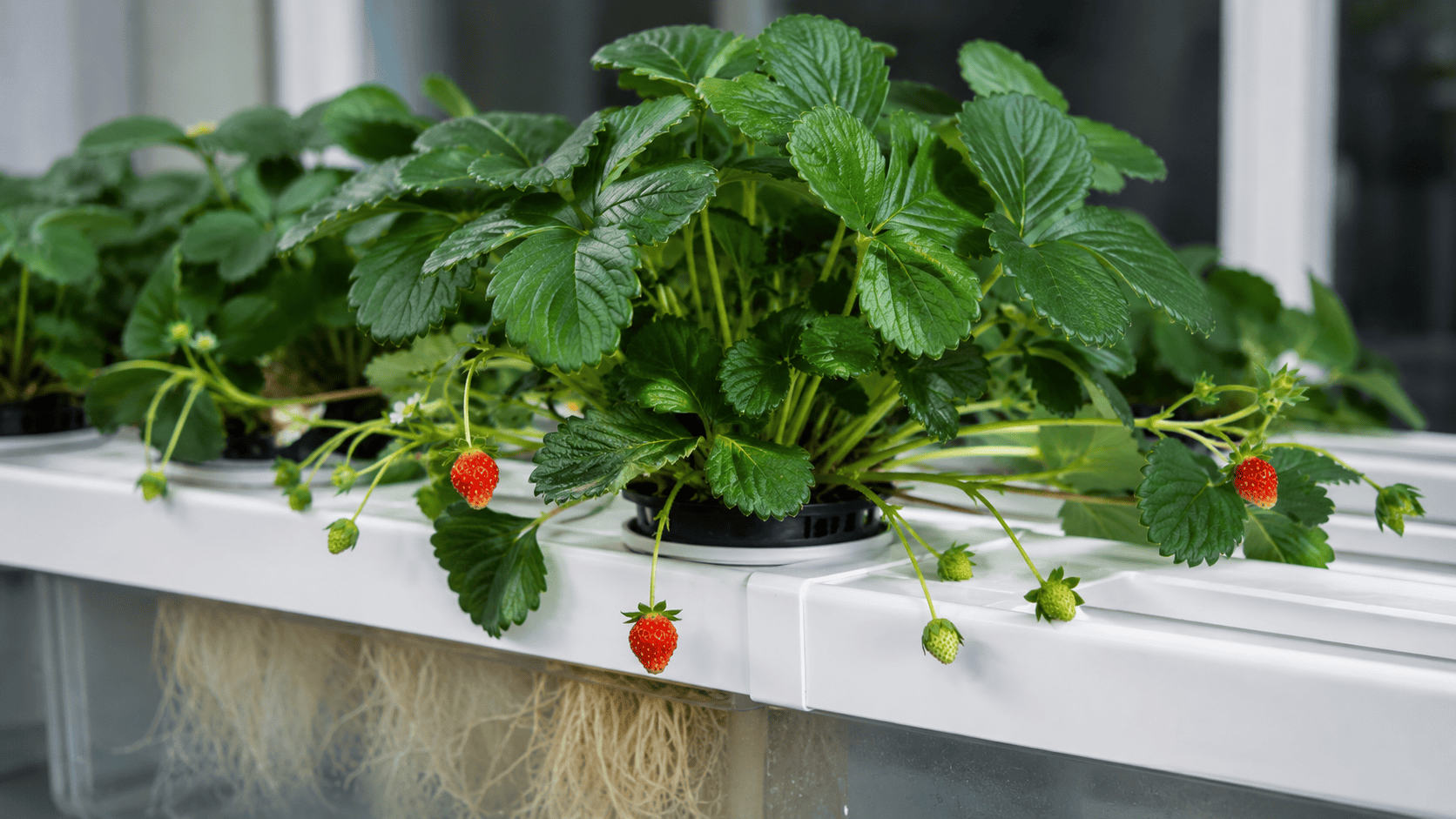
It turns out light isn’t just about how long the plants soak it in, it’s about how strong that light is.
Growing strawberries hydroponically indoors isn’t about flipping the switch for 16 hours and calling it a day. What really matters is whether the plants get enough energy to power photosynthesis all through the crucial fruit development stage.
Too many growers hit the 16-hour mark but don’t deliver enough light intensity. Plants need a solid Daily Light Integral (DLI), that’s the total amount of light they actually use in a day, to flower well and grow big berries.
Light quality matters, too. It affects sugar levels, fruit firmness, and how good the berries taste. Commercial greenhouses aim for around 17.5 mol·m⁻²·day⁻¹ DLI during peak growth.
Simply put, giving plants more usable light often means sweeter, heavier fruit without changing fertilizer plans.
Before rushing to swap out your lights, take a step back and check the setup:
- Keep fixtures clean, dust dims light output.
- Don’t hang lights too high, closer means stronger light.
- Measure PPFD (Photosynthetic Photon Flux Density) to see the real light hitting the leaves.
- Calculate your DLI to understand total daily light energy.
- Replace old LEDs if their output drops.
Why isn’t 16 hours always enough? Because plants care about quality and quantity of light, not just time under it. Measuring PPFD is your best bet for making sure strawberries get the kind of light they need to thrive.
Could High Temperatures Be Shrinking Your Harvest?

Credits : Agriculture Academy
Heat stress is a thief. It steals energy that should go toward making berries grow bigger and instead burns it just to keep the plant alive.
When temperatures rise too much, photosynthesis slows down, and respiration, the plant’s breathing, ramps up, using more fuel than it should.
Strawberries do best with moderate days, cooler nights, and nutrient solutions hovering around 18 to 21 degrees Celsius.
Too warm, and things start to unravel below the surface. Warmer nutrient solutions hold less dissolved oxygen, and roots start struggling well before you see leaf damage.
Keep these targets in mind:
- Moderate daytime temperatures
- Cooler nighttime lows
- Root-zone temperatures near 18–21°C
- Steady environmental control
Root temperature is often the silent limiter, plants can look fine on top while struggling down below. Studies from commercial greenhouses back this up, showing that warm solutions choke oxygen and make it harder for roots to absorb nutrients.
Why does warm nutrient water matter so much? Because less oxygen means weaker roots and, ultimately, smaller fruit. If you want strawberries growing fat and happy, keep that water cool.
Is High Humidity Affecting Berry Size?
Too much humidity is like putting a lid on a pot, the plant’s natural cooling and water movement, called transpiration, slows way down.
When this happens, calcium can’t move efficiently into growing fruit, and berry size suffers. Managing vapor pressure deficit (VPD) is key to keeping strawberries healthy and plump.
Most growers shoot for around 50 to 60 percent relative humidity during fruit development. This range helps balance moisture in the air without choking off transpiration.
Airflow isn’t just a comfort feature, it’s vital. Gentle, steady air movement supports strong flowers, healthier leaves, and smoother pollination. Without good airflow, calcium transport drops, and disease risks rise.
So, to keep your strawberries growing well: maintain humidity around 50–60% and make sure air circulates steadily. It’s the quiet secret behind larger, healthier fruit.
Could Your Strawberry Variety Be the Limitation?
Strawberry genetics set the boundaries. No matter how perfect your setup, a variety that naturally grows small berries won’t suddenly burst into giant fruit. Commercial growers know this well and pick cultivars that fit their goals, whether it’s size, flavor, or season length.
Here’s a quick look:
| Variety Type | Typical Fruit Size |
| June-bearing | Larger |
| Day-neutral | Moderate |
| Alpine | Naturally Small |
There’s also the matter of time. Older crowns, those established parts of the plant where growth happens, slow down as the life cycle moves on. The vigor fades, and so do berry size and quantity. Swapping out old plants keeps yields steady and berries plump throughout the season.
So, to answer the big questions: June-bearers usually bring bigger berries, and yes, plant age does matter. Older crowns often deliver smaller, fewer fruit as they wear out.
Are Root Health and Oxygen Being Overlooked?
Roots don’t get much spotlight, but they’re the silent heroes of strawberry growth. When roots struggle, you often see smaller berries long before any trouble shows up in the leaves. Problems below the surface can quietly choke fruit development.
Several factors harm root health: warm nutrient solutions, salt buildup, poor cleanliness, and lack of oxygen all take a toll. That slimy biofilm or brown roots you find aren’t just ugly, they’re warning signs. Watch for salt crusts, bad drainage, and weak branching too.
Top commercial growers, whether growing strawberries in an NFT system or using other methods, don’t just set irrigation on a timer and hope for the best. Instead, they monitor moisture and use leaching, flushing the system to push salts out, keeping roots healthier, stronger.
What damages roots most often? Low oxygen, too much salt, warm water, and dirty conditions.
Should you rely only on timers for watering? No way. Checking the moisture in your substrate beats blind schedules every time and keeps roots in better shape.
How Can You Diagnose Small Strawberries Step by Step?
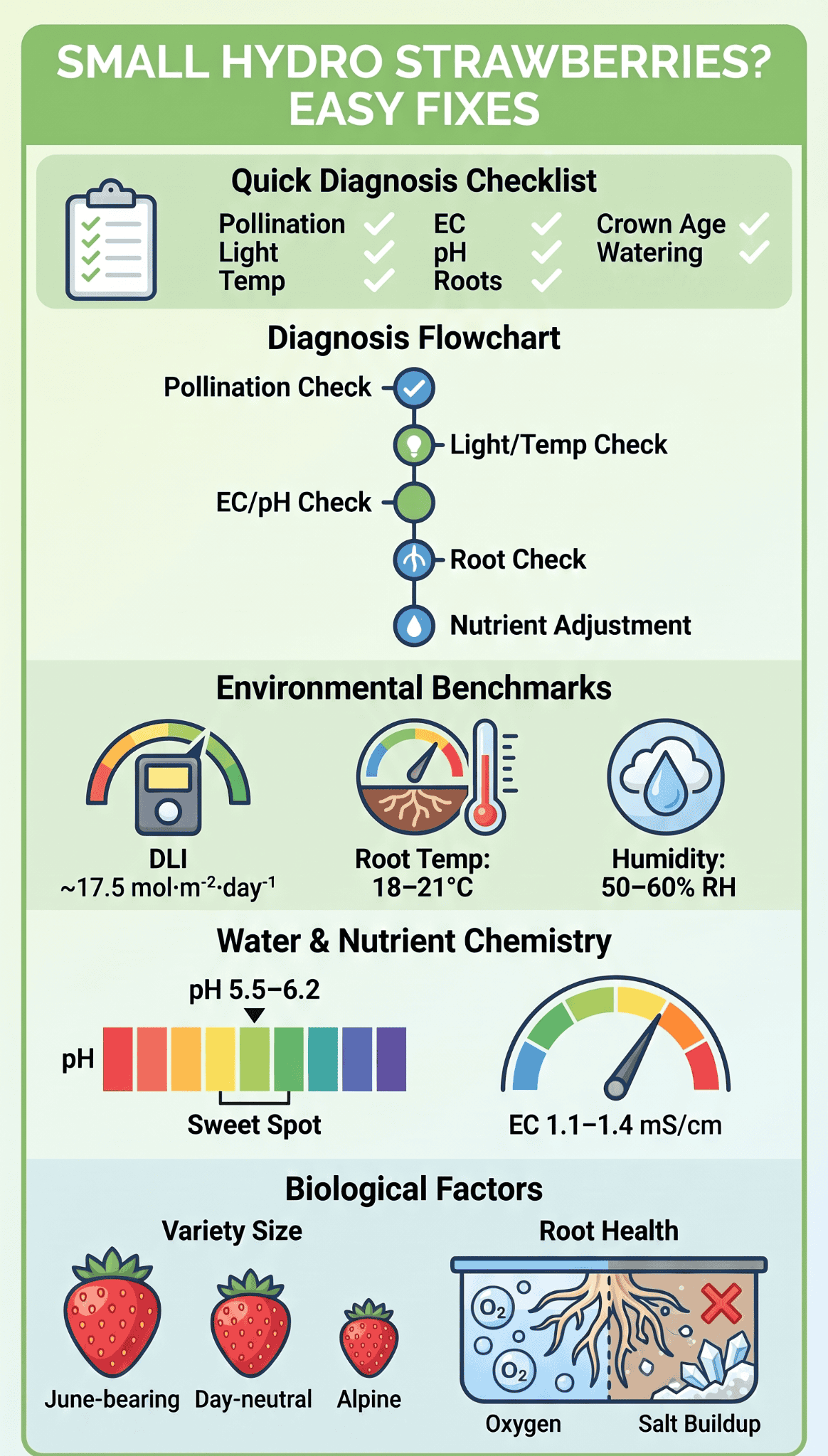
You often fix hydroponic strawberry problems faster by checking the environment step-by-step instead of rushing to tweak fertilizers. Here’s how to approach it:
- Start with pollination, make sure flowers are getting the attention they need.
As noted by UF/IFAS Extension,
“Pollination of all pistils of the strawberry flower and subsequent fertilization results in maximum fruit size and attainment of shape typical of the variety.” – UF/IFAS Extension
- Measure pH to ensure nutrients are available.
- Check EC to see if salt levels are right.
- Look at water temperature, too warm can stress roots.
- Verify light intensity by measuring PPFD and calculate DLI, plants need enough good light to thrive.
- Review humidity and airflow, too much humidity or stagnant air slows calcium transport and weakens plants.
- Inspect roots for signs of trouble like browning or salt buildup.
- Evaluate how old your crowns are; older plants often produce smaller fruit.
Only after this full rundown should you adjust nutrient formulas.
Indoor growers often find that growing hydroponic strawberries at home is a learning curve; specifically, poor pollination paired with weak light limits results the most. Fixing those two usually brings bigger berries before changing fertilizers ever comes into play.
FAQ
Can hydroponic EC levels affect strawberry fruit sizing?
Yes. Hydroponic EC levels directly influence water and nutrient uptake, which affects strawberry fruit sizing. If EC stays too high or too low for long periods, plants may produce smaller berries instead of filling out normally. Check strawberry electrical conductivity regularly and adjust it gradually to support healthy growth without causing unnecessary plant stress.
How does hydroponic strawberry lighting influence fruit size?
Light has a major impact on hydroponic strawberry lighting performance and overall hydroponic strawberry yield. Low light reduces photosynthesis, while poor strawberry lighting duration or incorrect DLI for strawberries can limit fruit development. Providing consistent daily light helps plants produce more energy, resulting in larger berries with better quality and stronger plant vigor over time.
Can root zone oxygen improve hydroponic strawberry yield?
Yes. Healthy root zone oxygen allows roots to absorb water and nutrients efficiently, supporting stronger strawberry root health. When oxygen levels are low, plants experience strawberry plant stress, which often reduces fruit size and overall hydroponic strawberry yield. Good aeration also supports healthier root activity and more consistent fruit production throughout the growing season.
Why is strawberry pollination important for fruit development?
Poor strawberry pollination issues often lead to uneven berries, lower strawberry fruit weight, or strawberry fruit deformity. In indoor strawberry growing, natural pollinators are usually limited, so manual pollination techniques can improve fruit set. Better pollination supports more complete strawberry fruit development, resulting in fuller, better-shaped strawberries at harvest.
Can strawberry cultivar selection make berries naturally larger?
Absolutely. Strawberry cultivar selection plays an important role in fruit size because different varieties have different genetic potential. Some day-neutral strawberries focus on continuous production rather than producing the largest berries. Choosing a variety suited to your hydroponic strawberry system, growing environment, and production goals helps improve fruit size, quality, and long-term performance.
Grow Bigger Hydroponic Strawberries with Tophydroponicgarden
Small hydroponic strawberries can be frustrating when your hard work doesn’t lead to better harvests.
The good news is that bigger fruit comes from keeping the right conditions steady, not from chasing one quick fix. That’s what makes the difference.
If you’re ready to get better results, Tophydroponicgarden offers practical guides that make each step easier to follow.
With the right support and a consistent routine, you can grow healthier plants and enjoy bigger, sweeter strawberries more often.
References
- https://ask.ifas.ufl.edu/publication/CV134?downloadOpen=true
- https://sfyl.ifas.ufl.edu/panhandle/?topic=panhandle-agriculture
Related Article
- https://tophydroponicgarden.com/hydroponic-strawberry-nutrient-solution-recipe/
- https://tophydroponicgarden.com/growing-strawberries-in-an-nft-system/
- https://tophydroponicgarden.com/how-to-grow-hydroponic-strawberries-at-home/
Was this helpful?
I’m Barrie L., a passionate hydroponic gardening enthusiast dedicated to cultivating thriving, soil-less gardens. With a focus on all things hydroponic, I share my expertise on innovative growing techniques and sustainable practices through my blog, tophydroponicgarden.com. As a seasoned hydroponics specialist, my goal is to inspire and guide fellow gardeners in harnessing the power of water-based cultivation for bountiful and eco-friendly harvests. I’m also an author of the book “Hydroponics For Absolute Beginners: Your Step By Step Guide For How To Create An Hydroponics System At Home Without Soil, For Growing Vegetable, Fruit And Herbs.” which is sold on Amazon. Join me on a journey of redefining the way we cultivate plants, one nutrient-rich solution at a time. Happy growing!