

Can You Grow Different Plants in One Hydroponic System?
Yes, you can. Growing different plants together works well if they share similar needs for nutrients, pH, light, and root space. Many herbs and leafy greens are great partners, allowing you to harvest various crops from one setup.
The secret isn’t just about saving space, it’s about avoiding a ‘reservoir war.’ Mixing plants with conflicting needs is the fastest way to turn your weekend hobby into a full-time job of constant troubleshooting.
Here is the blueprint for a system that actually balances itself so you can spend more time harvesting and less time stressing. Below, you will learn about the best plant pairings, which crops to keep apart, and how to build a successful multi-crop system.
Quick Compatibility Wins for Mixed Hydroponic Systems
Growing different plants in one hydroponic system is most successful when compatible crops share similar nutrient needs, growth habits, and growing conditions.
- Choose compatible crops with similar nutrient requirements and growth patterns. Herbs and leafy greens are often the easiest combinations, and proper crop planning is more important than maximizing plant numbers.
- Manage shared resources carefully. Shared reservoirs require nutrient compromises, while aggressive root systems can compete for space and disrupt water flow throughout the system.
- Prioritize system health and efficiency. Disease can spread quickly through recirculating water, but well-managed hydroponic systems can produce yields up to 3–10 times higher than soil while using up to 90% less water.
Can You Grow Different Plants in One Hydroponic System Successfully?
Yes, but success depends on compatibility.
In hydroponics, plants often share the same water, light, and climate. This setup works great, but only if all the plants have similar needs.
Unlike soil gardens, hydroponic systems have little room for error. Soil can hold nutrients, support beneficial microbes, and create natural separation between plants. Hydroponics removes much of that buffer. What happens in the reservoir affects every plant connected to it.
A mixed hydroponic garden offers several benefits:
- More variety from the same growing space
- Continuous harvests throughout the season
- Better use of indoor growing areas
- Reduced dependence on a single crop
The most successful combinations usually share:
- Similar nutrient needs
- Comparable pH preferences
- Matching light requirements
- Similar growth speeds
- Compatible root systems
When those factors align, managing the system becomes much easier.
Which Plants Grow Well Together in Hydroponics?
Herbs and leafy greens are usually the safest place to start.
These crops thrive with similar nutrient levels and pH, making it much easier to manage your reservoir. Most grow best with a pH between 5.5 and 6.5 and moderate nutrient strength.
Recommended hydroponic pairings
| Plant | Good Companions | Typical EC Range | Compatibility |
| Lettuce | Basil, spinach, bok choy | 0.8-1.2 | High |
| Spinach | Lettuce, kale | 1.0-1.8 | High |
| Basil | Lettuce, parsley, cilantro | 1.0-1.6 | High |
| Kale | Spinach, herbs | 1.2-1.8 | High |
| Parsley | Basil, cilantro | 0.8-1.8 | High |
A beginner-friendly setup may include:
- Lettuce
- Basil
- Parsley
- Cilantro
- Kale
- Spinach
These crops usually handle the same conditions and rarely cause nutrient issues. Choosing lettuce or basil as your hydroponic first plant is a top choice because they grow well together, mature quickly, and won’t stress you out.
The EC Compromise: Why Mixed Systems Sometimes Struggle
One reservoir means one nutrient strength.
This becomes a problem when crops have very different feeding requirements.
Electrical conductivity, commonly called EC, measures nutrient concentration in the water. Different crops prefer different EC ranges.
| Crop | Typical EC Range |
| Lettuce | 0.8-1.2 |
| Basil | 1.0-1.6 |
| Tomato | 2.0-5.0 |
| Pepper | 2.0-3.5 |
The difference between lettuce and tomatoes is significant.
In my early setups, I tried forcing a ‘middle-ground’ EC of 1.8 to keep both Lettuce and Cherry Tomatoes happy. The result? Total disaster. The lettuce tasted like a mouthful of aspirin (bitter) and the tips turned brown within days, while the tomatoes just sat there stunted.
The ‘middle-ground’ is a lie. Trying to find a ‘safe’ nutrient level for both lettuce and tomatoes is like trying to find a room temperature that’s perfect for both a polar bear and a cactus. Someone is going to suffer. Pick a lane or build a second tank. If you lower nutrient levels for lettuce, tomatoes often grow more slowly and produce fewer fruits.
Many growers discover that a shared reservoir works best when crops have EC requirements that stay close together.
When your plants start fighting over the reservoir, they won’t just stop growing, they’ll tell you exactly what’s wrong. In my system, the first red flag is usually ‘tip burn’ on the youngest lettuce leaves while the older leaves stay green.
If you see yellowing between the veins (interveinal chlorosis) on one species but not the other, your ‘shared’ nutrient mix has officially failed one of them. For larger systems, separate reservoirs often solve the problem. One reservoir can support leafy greens while another supports heavy-feeding fruiting crops.
Which Plants Should Not Share the Same System?
Some plants repeatedly create problems in shared hydroponic setups.
The issue is not that these crops cannot grow hydroponically, but certain varieties are simply plants not recommended for hydroponics in a mixed setup. The issue is that they often compete too aggressively or require conditions that differ from neighboring plants.
| Plant | Common Issue |
| Mint | Aggressive roots |
| Tomato | Heavy nutrient demand |
| Pepper | High EC requirement |
| Fennel | Potential growth interference |
| Squash | Large roots and canopy |
I’ve made the mistake of putting Mint in a shared NFT system so you don’t have to. Within weeks, the roots didn’t just ‘spread’ they turned into a dense mat that literally choked out my water flow and starved my nearby butterhead lettuce.
Pro-tip: If you absolutely must grow Mint, give it its own bucket.
As noted by TR Dizin
“Triticale with a fibrous root system was more aggressive on root growth compared to common vetch… our results highlight the importance of below-ground interactions for the selection of best ratios.” – TR Dizin
Tomatoes and peppers create a different challenge. Both need stronger nutrient solutions than leafy greens. Sharing a reservoir often forces a compromise that benefits neither crop.
Squash can overwhelm smaller plants through both root growth and canopy size. In limited indoor systems, one squash plant can take over valuable growing space.
In NFT systems, root competition is a real issue because water flows through narrow paths. Large root clumps can block the flow and lower the oxygen levels. Choosing plants with similar growth habits is often more important than just picking the ones you like to eat.
How Do Growth Rate and Canopy Design Affect Success?

Plant compatibility is not only about nutrients. Growth rate and plant size matter too.
A fast-growing crop can quickly shade slower-growing plants. Once light becomes limited, growth slows and yields drop.
Managing above-ground competition
A few simple adjustments can prevent most canopy problems:
- Think of your light source as the sun: always place your ‘giants’ (like tomatoes) at the back. If you put a tall Basil bush in front of your Butterhead lettuce, you’re effectively putting your lettuce in the shade, which is the fastest way to get leggy, weak plants.
- Use trellises for tomatoes and cucumbers.
- Keep plant spacing consistent.
- Remove overcrowded growth when necessary.
Managing below-ground competition
Roots compete for space, oxygen, and water movement.
To avoid root-related problems:
- Check root growth regularly.
- Remove plants that have become oversized.
- Prevent roots from blocking channels or pumps.
- Harvest mature crops before roots become overcrowded.
Many growers use staggered planting schedules. For example, lettuce can be harvested before larger crops become dominant. This approach helps maximize production without creating excessive competition.
What Are the Benefits of Growing Multiple Plants Together?
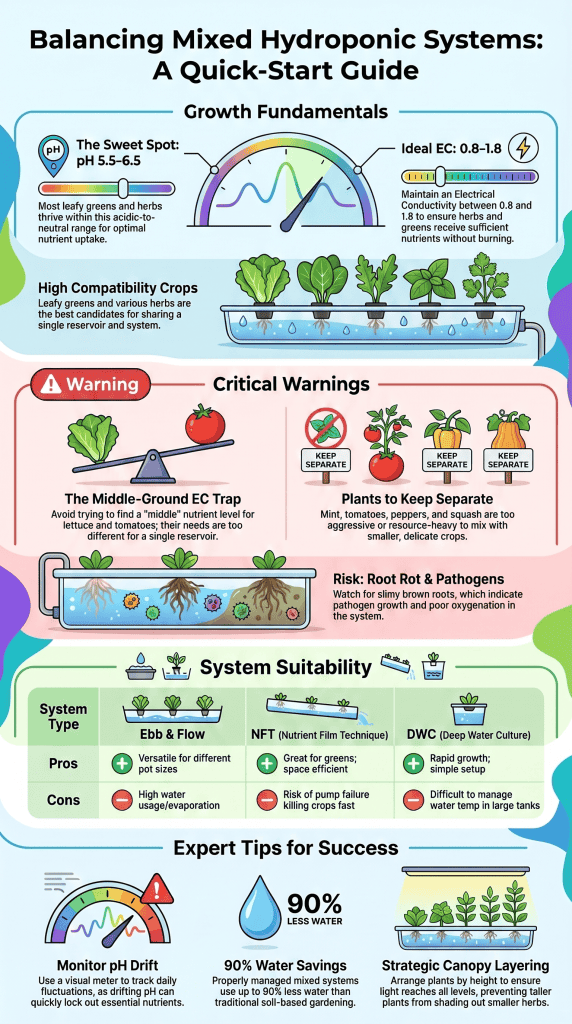
A well-planned mixed hydroponic garden can make better use of available space while producing a wider range of crops.
Benefits include:
- Greater crop diversity
- Better use of growing areas
- More frequent harvests
- Improved food variety
- Reduced dependence on a single crop
Mixed planting also makes gardens look better. Instead of rows of identical plants, you can harvest several different crops from the same system all year long.
While hydroponics isn’t exactly like growing in soil, the idea of companion planting still works. Pairing crops with similar needs creates a more productive system that is easier to manage.
The Shared Circuit Risk: How Diseases Spread Through One Reservoir
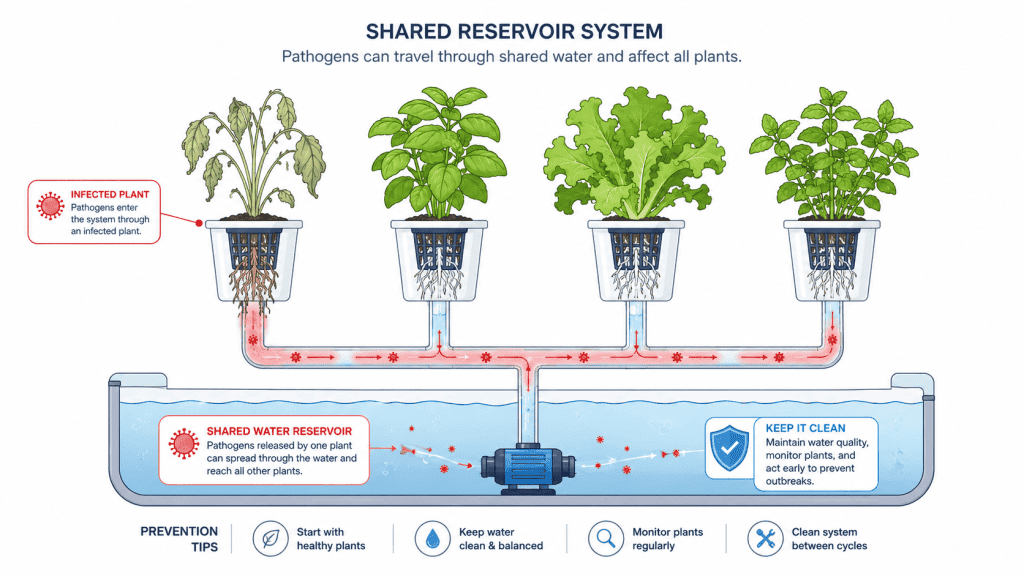
A shared reservoir connects every plant in the system.
That connection improves efficiency, but it also creates risk. If a disease enters the water, it can spread quickly throughout the entire setup.
One of the most common hydroponic threats is Pythium, a pathogen associated with root rot.
Common symptoms include:
- Brown roots
- Slimy root surfaces
- Slow growth
- Yellowing leaves
- Wilting despite adequate water
- Unpleasant reservoir odors
Think of a recirculating system like a shared straw, if one plant gets sick, they all do. Because the water never stops moving, a single pathogen in the reservoir becomes an ‘all-you-can-eat’ buffet for every root in the system within hours.
Reducing disease risk requires regular maintenance:
- Keep reservoirs clean.
- Monitor water temperature.
- Maintain strong aeration.
- Inspect roots frequently.
- Remove infected plants immediately.
Don’t just look at your roots, smell your reservoir. A healthy system should smell like rain or fresh earth. The second you catch a whiff of ‘swamp’ or rotting socks, you’re likely dealing with the early stages of Pythium. I make it a habit to lift my net pots daily; if the roots look like they’ve been dipped in tea or feel like wet silk, you need to flush the system immediately.
Managing Rhizosphere Warfare: Can Plant Microbiomes Clash?
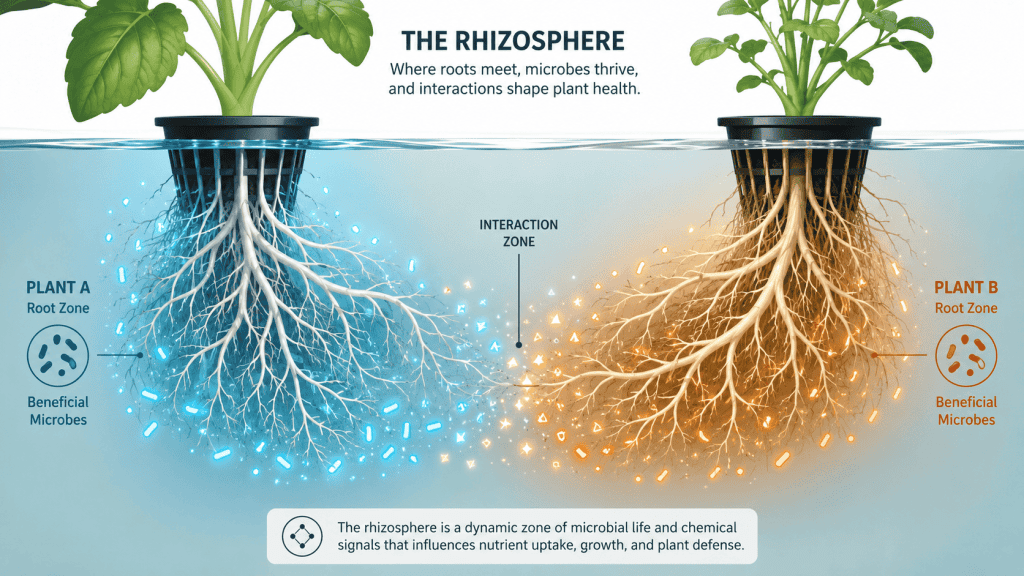
Plant roots do more than absorb nutrients.
Each root system supports its own microbial community, often called the rhizosphere. These microorganisms help with nutrient uptake, root health, and disease resistance.
When different crops share the same system, their microbial communities interact.
In a recent analysis by Research Square
“Companion plants may interact with each other… by suppressing harmful microbes and introduction of beneficial microbes or by increasing microbial diversity.” – Research Square
Sometimes those interactions are neutral. Sometimes they are beneficial. In some cases, microbes compete with one another, creating stress within the root zone.
Possible effects include:
- Slower growth
- Reduced nutrient uptake
- Increased disease pressure
- Root-zone imbalance
If your plants have the perfect pH and EC but still look ‘sad’ or stunted, you’re likely looking at a microbiome clash. Even if the math is right, some root zones just don’t vibe with their neighbors. If a pairing keeps failing, don’t force it, change the lineup.
Hydroponic growing is not only about nutrient formulas. It is also about creating a healthy biological environment around the roots.
As research into plant microbiomes grows, growers are learning that root health depends on both biology and chemistry.
What Hydroponic Systems Work Best for Mixed Crops?
Some hydroponic systems handle crop diversity better than others.
The right choice depends on plant size, root structure, and how much control you want over nutrient delivery.
| System Type | Mixed-Crop Suitability | Difficulty |
| DWC | Moderate | Beginner |
| NFT | Good for greens | Intermediate |
| Drip System | High | Intermediate |
| Ebb and Flow | High | Intermediate |
| Aeroponics | High | Advanced |
DWC (Deep Water Culture)
DWC is great for a quick herb fix, but it’s a trap for mixed fruiting crops. I once tried running Peppers and Kale in the same DWC tote; by week six, the Pepper roots had woven into a solid brick that made it impossible to check the pH or even lift the lid without snapping stems.
For mixed setups, I always recommend Ebb and Flow or Drip, they give the roots enough ‘breathing room’ to exist together without becoming a tangled mess.
NFT (Nutrient Film Technique)
NFT systems are excellent for lettuce, spinach, and herbs. Aggressive-root crops often create blockages, making NFT less suitable for large vegetables.
Drip systems
Drip systems provide flexibility and support a wide range of crops. They are often one of the best choices for mixed planting because irrigation can be managed more precisely.
Ebb and flow systems
These systems accommodate different root structures and provide strong oxygen levels. Many growers consider them one of the most versatile options for mixed crops.
Aeroponics
Aeroponics offers exceptional control and rapid growth. The tradeoff is complexity. System failures can affect plants quickly, so close monitoring is necessary.
How Can Beginners Start with Mixed Hydroponic Growing?

(Credits: Humble Growth)
New growers often succeed faster when they start small.
Understanding the core concepts of hydroponics for beginners means knowing you shouldn’t mix heavy-feeding vegetables with leafy greens right away. Instead, begin with crops that naturally share similar requirements.
Good beginner combinations include:
- Basil and parsley
- Basil and cilantro
- Lettuce and spinach
- Kale and basil
- Bok choy and lettuce
A few simple habits can prevent many common mistakes:
If you’re a beginner, don’t just ‘check’ your levels, track the drift. I’ve noticed that when my lettuce is hitting a growth spurt, the pH tends to spike daily. If you see your pH swinging more than 0.5 points in 24 hours, your reservoir volume is probably too small for the number of plants you’re running.
It’s a classic ‘small tank’ headache that most manuals don’t warn you about. These small adjustments make system management much easier, especially during the first growing cycles.
FAQ
How often should you adjust a shared hydroponic reservoir?
Check your reservoir at least twice a week. But here’s the pro tip: if your lettuce is hitting a growth spurt, watch for daily pH spikes. A shared tank is a moving target; different crops eat at different speeds, so you’re basically acting as the referee to keep things balanced.
Does crop spacing affect hydroponic plant compatibility?
Yes. Hydroponic crop spacing directly affects hydroponic plant compatibility because crowded plants compete for light, airflow, and root space. Poor spacing can increase humidity around the leaves, reduce air circulation, and encourage disease development. Proper spacing supports stronger hydroponic plant health, improves hydroponic crop performance, and allows each plant to access the resources it needs for healthy growth.
Can crop rotation improve mixed crop hydroponics?
Yes. Hydroponic crop rotation can improve mixed crop hydroponics by reducing the buildup of plant-specific diseases and pests between growing cycles. Rotating different crop types also supports better hydroponic crop management because nutrient demands vary from one crop to another. Many growers include hydroponic crop rotation in their long-term hydroponic garden planning to maintain consistent production and healthier growing systems.
How do seasonal changes affect indoor hydroponic systems?
Even in hydroponic indoor gardening, seasonal changes can affect plant growth. Cooler months may lower room temperatures, while warmer months can increase reservoir temperatures and humidity levels. These changes influence hydroponic plant growth rates, water consumption, and nutrient uptake. Good hydroponic environmental control, including proper lighting, ventilation, and hydroponic temperature management, helps maintain stable growing conditions throughout the year.
What is the best way to manage several crops at once?
The best approach is to keep detailed records for hydroponic crop scheduling and hydroponic plant growth management. Record planting dates, harvest dates, pH readings, EC levels, and nutrient adjustments for each crop. Tracking this information helps identify performance trends, improves hydroponic crop yield optimization, and supports better hydroponic system optimization. Consistent record-keeping also makes future hydroponic crop planning more accurate and efficient.
Build a Hydroponic System That Works for Every Plant
Nothing is more frustrating than seeing healthy plants struggle because they’re sharing a system that doesn’t fit their needs. You want steady growth and reliable harvests, not constant adjustments. That’s the reality.
If you want a simpler way to keep your setup productive, focus on plant combinations that naturally work well together. Stop guessing and start growing. By pairing crops that actually vibe together, you turn your reservoir from a battlefield into a powerhouse. Check your EC, pick your partners, and secure your first multi-crop harvest this month.
References
- https://search.trdizin.gov.tr/tr/yayin/detay/441309
- https://assets-eu.researchsquare.com/files/rs-4281411/v1/1ff04927-304b-4432-bcaa-bab56373e45a.pdf?c=1718948839#4#1
Related Articles
- https://tophydroponicgarden.com/hydroponic-first-plant/
- https://tophydroponicgarden.com/three-plants-not-recommend-for-hydroponics/
- https://tophydroponicgarden.com/hydroponics-for-beginners/
Was this helpful?

I’m Barrie L., a passionate hydroponic gardening enthusiast dedicated to cultivating thriving, soil-less gardens. With a focus on all things hydroponic, I share my expertise on innovative growing techniques and sustainable practices through my blog, tophydroponicgarden.com. As a seasoned hydroponics specialist, my goal is to inspire and guide fellow gardeners in harnessing the power of water-based cultivation for bountiful and eco-friendly harvests. I’m also an author of the book “Hydroponics For Absolute Beginners: Your Step By Step Guide For How To Create An Hydroponics System At Home Without Soil, For Growing Vegetable, Fruit And Herbs.” which is sold on Amazon. Join me on a journey of redefining the way we cultivate plants, one nutrient-rich solution at a time. Happy growing!