

Deep Water Culture (DWC) ranks among the best for beginners, alongside passive options like Kratky, and it’s the one you should start with if you want something simple that actually works.
The whole setup is about plants floating above a nutrient solution, with roots hanging straight into oxygen-rich water.
This system is notably friendly for those learning to manage nutrient strength and water pH, core concepts also important in hydroponic system for beginners approaches.
No maze of pipes, no tricky schedules, just steady growth you can literally watch every day. It’s budget friendly, fast to show results, and easy to fix when you make small mistakes.
If you’re wondering where to start with hydroponics, DWC is the easiest doorway in, keep reading to see why and how to set it up.
Key Takeaways
- Deep Water Culture (DWC) offers the perfect balance of simplicity, low cost, and reliability.
- The Kratky method is the most passive option, while pre-built kits offer plug-and-play convenience.
- Success hinges on managing three things: nutrient strength, water pH, and oxygen levels.
Why Deep Water Culture Feels Like the Right Choice

You look at the tangled mess of pipes in a diagram for some hydroponic systems and it’s enough to make you close the browser tab.
It feels like you need an engineering degree. But then you see a picture of a lettuce plant sitting pretty in a simple bucket, its roots dangling into the water. That feels different. That feels possible.
This is the core of the Deep Water Culture system. It’s not about building a complex machine; it’s about creating a stable environment for roots to drink and breathe.
The plant sits in a net pot, held by a growing medium like clay pebbles. This pot is nestled into a lid that sits on top of a reservoir.
That reservoir is filled with water and nutrients. An air pump, the kind you’d use for a small aquarium, bubbles air into the water through a stone.
This constant bubbling is the secret. It oxygenates the water, preventing the roots from drowning and allowing them to absorb nutrients efficiently.
There are no moving parts beyond that pump. No timers, no water pumps, no risk of clogs beyond the reliable air pump. It’s a serene, almost lazy system for the gardener, but a highly productive one for the plant.
This simplicity translates directly to a lower cost. You can assemble a functional DWC system from a five-gallon bucket, a net pot, an air pump, and some nutrients for well under fifty dollars.
It’s a minimal investment for a maximum return in learning and fresh produce. The system is also incredibly scalable.
You can start with one bucket on your balcony. When you’re ready, you build a second. And a third. There’s no need to commit to a large, permanent setup from day one.
- Minimal Failure Points: With only an air pump as its moving part, there’s very little that can break or malfunction.
- Hands-Off Maintenance: Once set up, your main tasks are checking the water level and monitoring pH, a routine that takes minutes.
- Rapid Growth Visibility: You’ll see noticeable plant growth week-to-week, providing a rewarding feedback loop for a new gardener [1].
How DWC Stacks Up Against Other Beginner Options
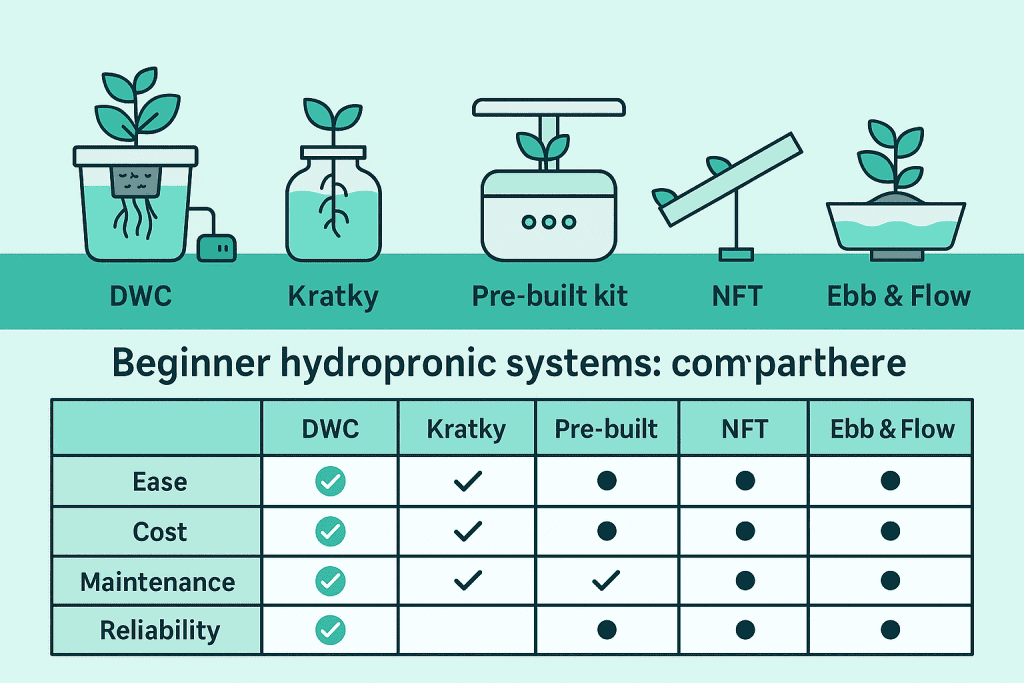
It’s useful to see how DWC compares to its competition. The Kratky method, for instance, is often mentioned for beginners.
It’s essentially a DWC system but without the air pump. The reservoir is filled only partway, and as the plant drinks, an air gap forms for the roots to breathe [2].
It’s brilliantly passive and costs even less. But it has limitations. It’s best suited for smaller, short-lived plants like lettuce.
For larger plants like tomatoes or longer growth cycles, the lack of active aeration can become a problem. DWC, with its air pump, is simply more robust and versatile.
Then there are pre-built kits like the AeroGarden. These are fantastic for absolute simplicity. They include the lights, the pump, the nutrients, everything. You add water and pods. They remove all guesswork and are great for growing herbs on a countertop.
The trade-off is cost and control. They are significantly more expensive than a DIY DWC bucket, and you’re locked into their proprietary seed pods and nutrient cartridges.
You learn less about how hydroponics actually works. DWC teaches you the fundamentals, giving you knowledge you can apply to any future system.
Nutrient Film Technique (NFT) systems look sleek and are space-efficient. They use a shallow stream of nutrient solution flowing through a channel.
But they are prone to pump failure and root clogs, which can wipe out your entire crop in hours. Ebb and Flow offers versatility but adds timers and plumbing for beginners. For a true beginner, these systems introduce variables that can lead to frustration.
DWC keeps the environment stable and contained. The entire root system is always bathed in what it needs.
Your First DWC Setup: A Straightforward Guide
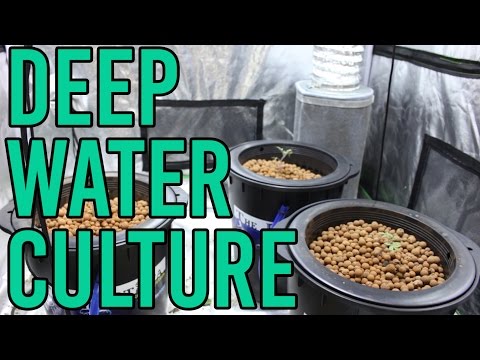
Credits: GrowAce
Starting with DWC is less about construction and more about gathering. You’ll need a light-proof container. A five-gallon bucket from a hardware store works perfectly, but you must paint it or wrap it in tape to block light.
Light in the reservoir promotes algae growth, which you don’t want. You’ll need a lid for that bucket with a hole cut for a net pot. Net pots, clay pebbles, an air pump, airline tubing, and an air stone are all readily available at hydroponic stores or online.
A small bottle of pH up and pH down solution is non-negotiable. Plants absorb nutrients within a specific pH range, usually between 5.5 and 6.5 for most greens and herbs.
A simple pH test kit or digital meter is your best friend here. You’ll also need hydroponic nutrients. Start with a balanced, general-purpose formula. Follow the mixing instructions on the bottle carefully; more is not better. Over-fertilizing can “burn” your plants.
- Container: 5-gallon bucket (painted or covered to block light).
- Aeration: Air pump, tubing, and air stone.
- Plant Support: Net pot and clay pebbles or rockwool cube.
- Essentials: pH test kit, pH adjustment solutions, hydroponic nutrients.
The assembly is simple. Place the air stone in the bottom of the bucket. Run the tubing from the stone, out of the bucket, and connect it to the air pump sitting safely outside and above the water line.
Fill the bucket with your pH-balanced nutrient solution. Place your seedling, nestled in its clay pebbles, into the net pot and set the pot into the lid.
Then, place the lid on the bucket. Turn on the air pump. You’re done. The gentle bubbling is the sign that your system is alive. Your job now is observation.
Keeping operational costs low is part of what makes this setup so accessible, a factor well covered when considering deep water culture systems for home growers.
Check the water level every few days and top it off with plain, pH-adjusted water. Check the pH every couple of days. Every one to two weeks, you’ll replace the entire nutrient solution with a fresh batch.
Setting Yourself Up for Success from the Start
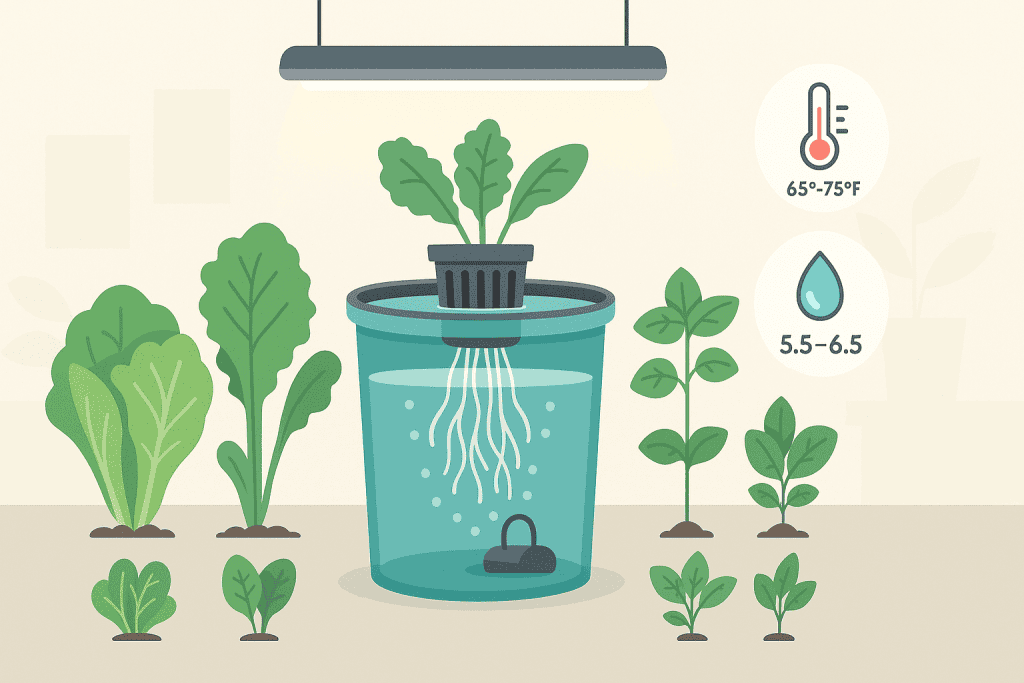
Your choice of first plants matters. Don’t start with strawberries or peppers. Begin with fast-growing, forgiving crops. Leafy greens are the champions of beginner hydroponics.
Lettuce, kale, spinach, and Swiss chard are all excellent choices. Herbs like basil, mint, and cilantro also thrive in DWC.
This ease of growing productive crops means your overall cost to run a hydroponic system remains manageable as you scale up your garden.
These plants provide a quick turnaround, giving you the confidence boost of a harvest in just four to six weeks. They are also less demanding in their nutrient and environmental needs compared to fruiting plants.
Light is the other half of the equation. If you have a very sunny, south-facing window, you might get by. But for consistent, reliable growth, especially indoors, a simple grow light is a wise investment.
You don’t need a professional setup. A basic LED panel or even a strong, full-spectrum shop light positioned a few inches above the plants will work wonders. It ensures your plants have the energy they need to make the most of the perfect nutrient solution you’ve provided.
Pay attention to water temperature. The ideal range for your reservoir is between 65 and 75 degrees Fahrenheit (18-24°C).
If the water gets too warm, it holds less oxygen, which can stress the plants even with the air pump. A simple solution is to keep your bucket in a cool part of the room.
If you’re struggling with warm water, you can paint the bucket white to reflect heat. The roots themselves will tell you a lot. Healthy roots are white and plentiful. If they start turning brown or slimy, it’s a sign of trouble, often related to poor oxygenation or high temperatures.
Your Beginner Hydroponic Journey
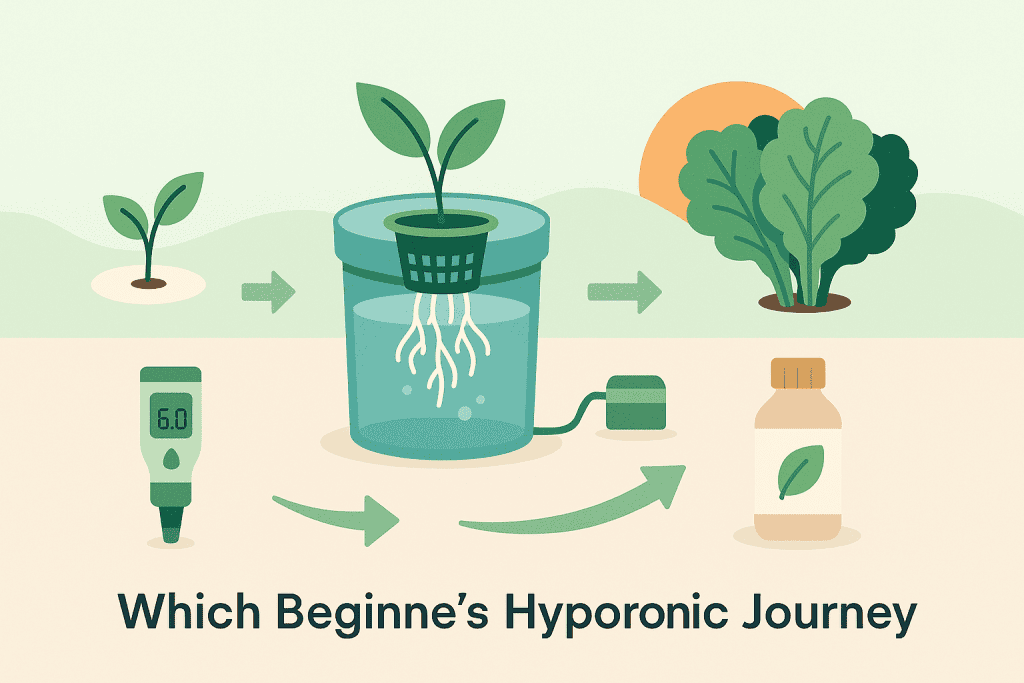
The goal of your first foray into hydroponics isn’t to harvest a record-breaking tomato. It’s to learn the rhythm of the system without getting discouraged.
Deep Water Culture is the best hydroponic system for beginners because it facilitates that learning perfectly. It gives you a front-row seat to plant growth while minimizing the chores and risks.
You learn the critical skills, managing nutrients, pH, and oxygen, in a stable environment. That knowledge is the real harvest.
It’s the foundation that allows you to grow anything, in any system, later on. So find a bucket, get an air pump, and start. Your first homegrown salad is closer than you think.
FAQ
1. How do I choose the right system when I’m new to hydroponics?
You can choose the right setup by learning what beginner hydroponic systems offer and how each one works.
A hydroponics setup guide and a hydroponic systems comparison help you see the differences between simple hydroponic methods.
Most new growers want an easy hydroponic setup, low-maintenance hydroponics, and support while moving through the hydroponics learning curve.
2. What mistakes do beginners often make when starting home hydroponics?
Beginners often make mistakes by ignoring hydroponic nutrient basics for beginners, skipping hydroponic pH basics, or choosing systems that are too complex. Some also pick hard plants instead of starter hydroponic plants.
Following simple hydroponic design ideas, using small hydroponic setups, and learning beginner hydroponic mistakes early helps new growers stay confident and avoid bigger problems.
3. Which simple systems work best in small spaces?
Simple systems that work well in small spaces include a wick system for beginners, passive hydroponics for beginners, and a small hydroponic garden setup.
These systems fit in tight rooms and balconies. A countertop hydroponic system or hydroponic grow box beginners also works well. Each option uses minimal hydroponic starter equipment and keeps care easy.
4. What should I learn first before running my own system?
Before running your own system, you should learn hydroponics basics for beginners, including hydroponic water management tips, hydroponic airflow basics, and hydroponic EC basics.
Many new growers study hydroponics step-by-step plans and practice hydroponic maintenance basics.
Understanding hydroponic system pros and cons and comparing hydroponic system types for beginners builds confidence before setting up an indoor hydroponic starter system.
5. Which systems feel easiest for beginners to manage?
Systems that feel easiest for beginners include DWC for beginners and the Kratky method for beginners because they use simple parts and clear steps.
Some people also choose DIY beginner hydroponics or plug-and-play hydroponics for quick setup. These best hydroponics for starters support home hydroponics for beginners and make beginner-friendly grow systems easy to manage.
Conclusion
Deep Water Culture empowers beginners to grow confidently by keeping things simple, stable, and highly rewarding.
With minimal parts and fast, visible results, it teaches the core skills, pH, nutrients, and oxygen, without overwhelming complexity.
Start with easy greens, observe your system, and enjoy the momentum that early success creates. DWC isn’t just a method; it’s the perfect entry point to a lifelong hydroponic journey. Begin with one bucket, and your harvest potential expands from there.
References
- https://www.hydraunlimited.com/complete-hydroponics-guides/
- https://soilfreeharvest.com/kratky-method-vs-deep-water-culture-which-is-better/
Related Articles
- https://tophydroponicgarden.com/hydroponic-system-for-beginners/
- https://tophydroponicgarden.com/deep-water-culture/
- https://tophydroponicgarden.com/how-much-does-it-cost-to-run-a-hydroponic-system/
Was this helpful?
