

Flushing plants is only necessary in certain situations. It should not become part of every watering routine. Running plain, pH balanced water through the growing medium helps remove excess fertilizer salts and restores balance around the roots.
Current research also suggests routine pre harvest flushing may not be necessary for every grow. Utah State University and experienced commercial growers continue separating proven root zone management from long standing cultivation myths.
The details matter. Keep reading to understand when should you flush your plants actually helps and when it may create more problems than it solves.
Plant Flushing Essentials You Should Know
- When should you flush your plants? Not the date on the calendar. And not because someone says it’s something every grower should do.
- Flushing has a purpose. It helps remove excess fertilizer salts from the growing medium when they build up around the roots.
- Living soil and true organic systems usually shouldn’t be flushed.
The Purpose of Flushing Plants in Modern Growing Systems
Flushing works on the growing medium. It doesn’t “clean out” the plant itself. That’s one of the biggest misunderstandings about flushing.
When fertilizers are mixed with water, plants take up the nutrients they need. But they don’t absorb everything. Some dissolved minerals stay behind in the soil, coco coir, or other media. After enough feedings, those leftover salts begin to pile up.
Water evaporates. The salts don’t. Over time, those deposits raise the electrical conductivity (EC) around the roots. If the salt concentration gets too high, roots struggle to absorb water.
Nutrients become harder to take in, even when plenty are available. According to Utah State University, high soluble salt levels can interfere with normal root function and reduce water uptake.
That’s where flushing comes in. Running plain, pH balanced water through the container dissolves many of those excess salts and carries them out through the drainage holes. The goal isn’t to strip nutrients from the leaves or flowers. It’s to restore a healthier environment around the roots.
Growers often use corrective flushing when dealing with:
- Salt buildup
- Nutrient burn
- Nutrient lockout
- Overfeeding
- Nutrient changes in hydro systems
Still, flushing isn’t a replacement for good feeding habits. It won’t fix poor pH management, and it can’t solve every plant problem. Think of it as one tool among many. Most growers get better results by preventing salt buildup than by fixing it later.
The Facts Behind Pre-Harvest Flushing Practices
This question comes up all the time. For years, many growers believed flushing one or two weeks before harvest produced smoother flowers, better flavor, and cleaner white ash. It became standard advice across countless grow guides.
But newer research has challenged those ideas. Plant scientists, including Dr. Bruce Bugbee, have discussed studies showing little evidence that flushing the root zone removes nutrients already stored inside plant tissue. That makes sense when you think about it. Water moving through the roots doesn’t erase nutrients the plant has already used or stored.
As noted by Utah University:
“Flushing does not reduce the concentrations of mobile nutrients like N in flower tissue” and that “depriving plants of nutrition even at the end of the production cycle can negatively impact yield” – Utah University
Because of that, many commercial growers have moved away from mandatory harvest flushing. That doesn’t mean nobody flushes anymore.
Some growers still prefer reducing or stopping nutrients near harvest. Others like saving fertilizer during the final stage of growth. And some believe it improves the finished product based on their own experience. The science, though, isn’t settled in favor of routine flushing.
Here’s a quick look at how older beliefs compare with current understanding.
| Traditional claim | Current understanding |
| Removes nutrients from flowers | Little scientific evidence supports this |
| Improves flavor | Results remain mixed |
| Produces white ash | Drying and curing have a much bigger effect |
| Saves fertilizer | Yes, because feeding stops earlier |
So should everyone flush before harvest? Not really. Many growers now focus on healthy plants all the way through harvest instead of following an old routine. That’s a practical approach, especially when plant health already looks good.
When Should You Flush Your Plants for the Best Results
If you decide to flush before harvest, timing depends more on the growing medium than the calendar. Different media hold nutrients differently. Soil stores nutrients much longer than coco coir or hydroponic systems. Because of that, growers usually start earlier when growing in soil.
Here’s a general guide.
| Growing medium | Typical flushing time |
| Soil | 10–14 days |
| Coco coir | 3–7 days |
| Rockwool | 3–7 days |
| Hydroponics or DWC | 1–3 days |
These aren’t strict rules. Many experienced growers pay more attention to plant maturity than counting backward from harvest day.
Good signs include:
- Mostly cloudy trichomes
- The first amber trichomes
- Natural late-stage fading
- Healthy overall plant condition
Watching the plant often gives better information than watching the calendar. Some commercial growers don’t perform a heavy flush at all. Instead, they gradually reduce nutrient strength during the final stage. That lowers fertilizer use without shocking the root zone. For many operations, it’s an easier system to manage.
Signs That Salt Buildup Is Affecting Plant Health

Salt buildup usually doesn’t appear overnight. It develops little by little as fertilizers leave behind dissolved minerals after each feeding. At first, plants may look fine. Then small warning signs begin showing up. Brown leaf tips are often one of the earliest clues.
White crusts around the edge of the pot or on top of the growing medium can also point to excess salts. Water may soak into the container more slowly than usual. Growth may stall, even though feeding hasn’t changed. None of those signs prove salt buildup on their own. But together, they tell a clearer story.
Common symptoms include:
- White salt crusts
- Brown or crispy leaf tips
- Leaves curling downward
- Slow water absorption
- High runoff EC
- Weak or stalled growth
Grower communities, including experienced members of r/microgrowery, often point to visible salt deposits as one of the clearest reasons to perform a corrective flush.
Research from Scientia Horticulturae shows:
“Flushing is an effective method to control salt concentration in growing media and that monitoring substrate salinity is critical for maintaining plant quality.” – Scientia Horticulturae
Still, measuring beats guessing.
Checking runoff EC gives much better information than relying on leaf symptoms alone. High runoff readings compared with your feeding solution usually indicate that salts have accumulated around the roots.
Corrective flushing typically means running about two to three times the container’s volume of pH-adjusted water through the medium while monitoring runoff. The goal isn’t to flood the pot. It’s to lower salt levels to a healthier range.
Heavy flushing without checking runoff can leave hidden salts behind, especially in dense potting mixes. That’s why many experienced growers measure first and adjust as needed instead of relying only on what they see.
How Nutrient Lockout Differs From a Nutrient Deficiency
Yes. And it happens more often than many growers realize. A plant can look hungry even when there’s plenty of fertilizer in the growing medium.
That’s because nutrient lockout isn’t about how much fertilizer is present. It’s about whether the roots can absorb it. When the root-zone pH drifts outside the proper range, certain nutrients become unavailable. Adding more fertilizer usually doesn’t solve the problem. In many cases, it makes things worse.
Checking both pH and electrical conductivity (EC) gives a much clearer picture.
| Measurement | Possible flush trigger | Target after flushing |
| Runoff pH | Below 5.5 or above 7.0 (soil) | Around 6.0–6.5 |
| Runoff EC | Much higher than feed solution | Close to the input EC |
Most soil-grown plants grow well with a root-zone pH between about 6.0 and 7.0. Hydroponics, rockwool, and coco coir usually perform better between 5.5 and 6.5.
If runoff pH stays outside those ranges or runoff EC climbs much higher than the nutrient solution going in, nutrient lockout becomes more likely.
Other warning signs include:
- Multiple deficiency symptoms
- Stalled growth
- Healthy feeding schedule
- Rising runoff EC
- Drifting runoff pH
Before reaching for more fertilizer, test the root zone first. That step saves many growers from making the problem worse.
Safe Ways to Flush Plants Without Increasing Root Rot Risk
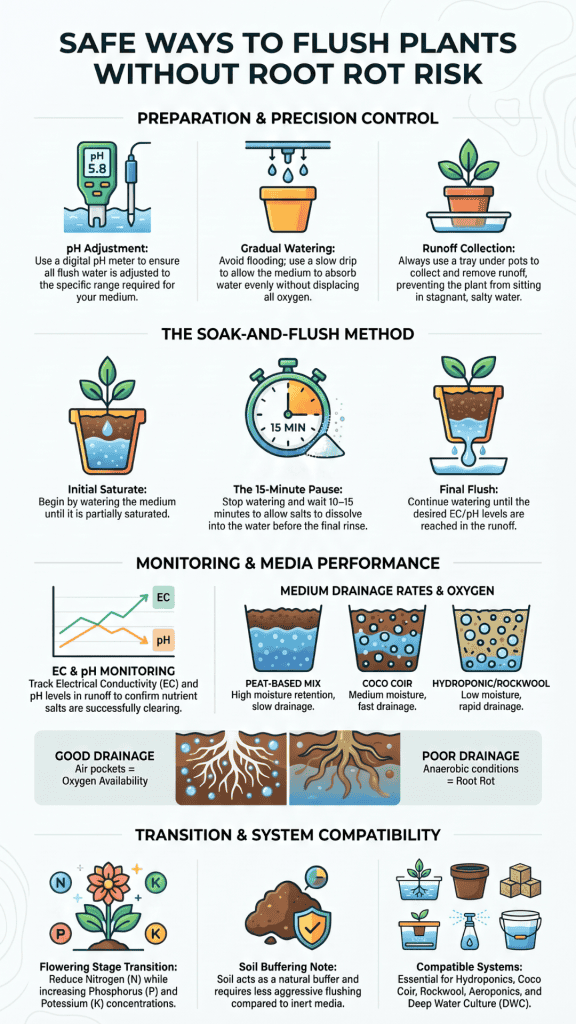
Flushing isn’t complicated. But technique matters. Many problems blamed on flushing are really caused by poor drainage. Roots need oxygen as much as they need water. If the growing medium stays soaked for too long, harmful pathogens like Pythium can take hold. Go slowly instead of dumping large amounts of water into the pot all at once.
A safer approach looks like this:
- Adjust water pH
- Water gradually
- Collect runoff
- Check EC and pH
- Continue if needed
- Drain completely
- Let the medium dry
One method many experienced growers recommend is the “soak-and-flush” approach.
Apply part of the water first.
Wait about 10 to 15 minutes.
Then continue flushing.
That short pause allows dissolved salts to move back into the water before the next rinse. It may remove trapped salts more effectively than one long, continuous drench. Dense peat-based mixes often stay wet much longer than coco coir or hydroponic media. Because of that, they’re more likely to lose oxygen if overwatered.
Flushing and overwatering aren’t the same thing, though. A container with good drainage can recover quickly after flushing. One left sitting in runoff can’t.
The Role of Flushing During the Transition to Flowering
Sometimes. It depends on the growing system. Plants entering the flowering stage need a different nutrient balance than they did during vegetative growth. Nitrogen usually decreases, while phosphorus and potassium become more important.
In hydroponic systems and inert media, nutrients from the previous feeding program don’t disappear overnight. That’s why many growers perform a quick transition flush before switching to bloom nutrients.
Systems that benefit most include:
- Hydroponics
- Coco coir
- Rockwool
- Aeroponics
- Deep Water Culture
Growers also flush when changing nutrient brands or formulas to avoid mixing products that weren’t designed to work together.
Soil is different. Because soil naturally buffers nutrients, aggressive flushing during normal growth transitions usually isn’t needed. In many cases, adjusting the feeding schedule is enough.
Understanding Why Flushing Can Harm Living Soil Systems
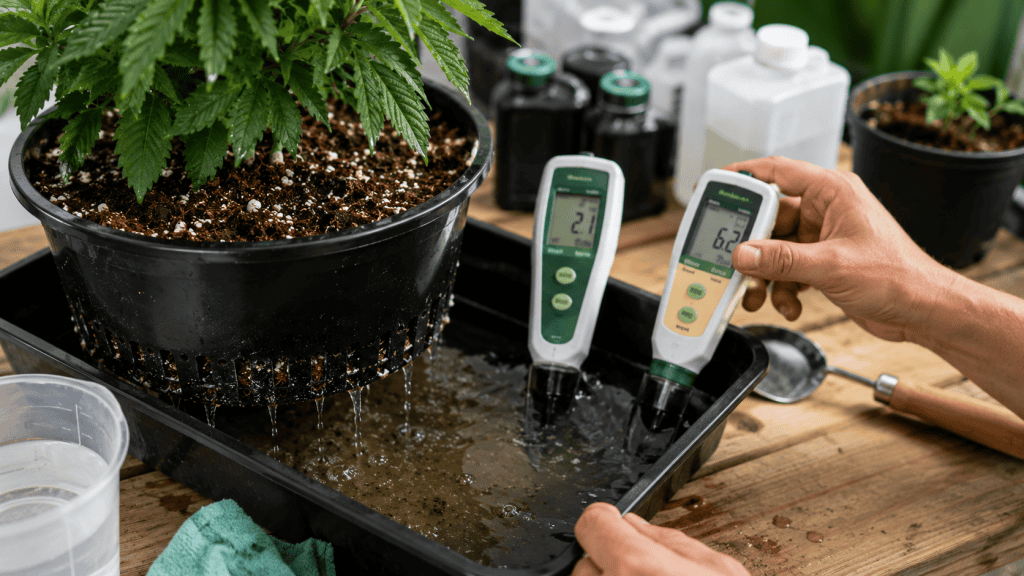
Living soil works because it’s alive. Beneficial bacteria, fungi, worms, and other microorganisms break down organic matter and make nutrients available over time. Heavy flushing can disturb that balance.
That’s why true living soil systems are treated differently from salt-based growing methods.
Flushing may reduce:
- Beneficial microbes
- Mycorrhizal fungi
- Natural nutrient cycling
- Soil biology
Organic growers focus on feeding the soil instead of washing it out. There is one exception. Some products are labeled “organic” but still rely on bottled mineral fertilizers. Those systems can develop salt buildup and may need occasional corrective flushing. So don’t judge by the label alone. Look at what’s going into the container.
Expert Opinions on Plant Flushing and Root Health
Most agree on one point. Emergency flushing has a purpose. Routine pre-harvest flushing is another story. Across grower communities, commercial facilities, and cultivation forums, corrective flushing is widely accepted for problems like nutrient burn, high EC, and salt buildup. Pre-harvest flushing remains a personal choice. That surprised plenty of growers as newer research became available.
Some common points of agreement include:
- Salt buildup is real.
- Nutrient lockout happens.
- White ash proves very little.
- Plain pH balanced water is often enough.
- EC readings beat guesswork.
Growers also see the same mistakes again and again.
- Flushing healthy plants
- Ignoring runoff EC
- Overwatering during flushing
- Flushing living soil
- Mistaking every yellow leaf for nutrient burn
Many experienced growers aim for runoff EC that’s close to the incoming nutrient solution after corrective flushing. Measuring the results gives far more confidence than relying on appearance alone.
Accurate Plant Measurements Lead to Better Growing Decisions
How to Calibrate a pH and EC Meter
Credit: e-GRO Webinars
Plants send signals. But those signals don’t always point to the same problem. Yellow leaves could mean nutrient deficiency. Or nutrient burn. Or incorrect pH. Even root disease. That’s why basic testing tools are worth having. They remove much of the guesswork.
Useful tools include:
- EC meter
- pH meter
- Runoff tray
- Soil EC probe
Compare the runoff with the water or nutrient solution going into the container.
Pay closer attention if:
- Runoff EC keeps rising.
- Runoff pH stays outside the target range.
- Salt crusts return often.
- Growth doesn’t improve after fixing environmental conditions.
Growers using reverse osmosis (RO) water often find these measurements even easier to interpret because the starting EC is very low. The goal isn’t to chase perfect numbers. It’s to make decisions using real measurements instead of assumptions.
FAQ
Can flushing container plants damage healthy roots?
Flushing container plants is safe when the pot has good drainage and the growing medium can dry properly afterward. Problems usually happen when water stays around the roots for too long. Good drainage and proper airflow help prevent root damage and support maintaining healthy root systems after flushing.
Should you flush plants after changing nutrient formulas?
Yes, many growers recommend flushing before changing nutrients, especially in hydroponic systems and inert growing media. Flushing removes leftover nutrients before switching nutrient formulas, which reduces the chance of nutrient imbalances. In most soil gardens, gradually changing the feeding program is often enough without a full flush.
Can flushing help prevent nutrient toxicity over time?
Yes, occasional corrective flushing can help prevent nutrient toxicity by reducing fertilizer residue and preventing salt accumulation in the growing medium. However, flushing should not replace proper feeding practices. Using the correct fertilizer strength and checking runoff regularly are more effective ways to keep nutrient levels under control.
Should you flush hydroponic equipment and irrigation lines?
Yes. Regularly flushing hydroponic equipment, flushing irrigation lines, and performing reservoir flushing help remove mineral deposits and old nutrient solution. This routine keeps water flowing properly, reduces blockages, and supports a clean hydroponic system. Clean equipment also makes nutrient management more consistent throughout the growing cycle.
When Should You Flush Your Plants? A Guide to Better Growing Results
When your plants show stress from excess nutrients, you need a clear way to respond. Flushing should be based on what your setup needs, not a fixed routine. It helps when problems appear and gives you a better chance to restore balance.
Tophydroponicgarden can help you find practical growing guidance without guessing every step. It’s a simple resource for growers who want to make better choices with their plants and growing systems. Start with the right information and adjust based on what your plants show.
References
- https://digitalcommons.usu.edu/etd2023/178/
- https://www.sciencedirect.com/science/article/abs/pii/S0304423818308987
Related Articles
- https://tophydroponicgarden.com/safe-ph-levels-for-leafy-vegetables/
- https://tophydroponicgarden.com/how-to-calibrate-a-ph-pen-correctly/
- https://tophydroponicgarden.com/ph-level-guides-for-growing-lettuce/
Was this helpful?

I’m Barrie L., a passionate hydroponic gardening enthusiast dedicated to cultivating thriving, soil-less gardens. With a focus on all things hydroponic, I share my expertise on innovative growing techniques and sustainable practices through my blog, tophydroponicgarden.com. As a seasoned hydroponics specialist, my goal is to inspire and guide fellow gardeners in harnessing the power of water-based cultivation for bountiful and eco-friendly harvests. I’m also an author of the book “Hydroponics For Absolute Beginners: Your Step By Step Guide For How To Create An Hydroponics System At Home Without Soil, For Growing Vegetable, Fruit And Herbs.” which is sold on Amazon. Join me on a journey of redefining the way we cultivate plants, one nutrient-rich solution at a time. Happy growing!