

Hydroponic systems can grow many vining plants with great results when they get the right nutrients, enough light, and solid support. Tomatoes, cucumbers, peppers, peas, and beans are among the most reliable choices for steady harvests in both home setups and larger growing spaces. But picking the right plant is only part of it.
Keep reading on Tophydroponicgarden to discover the best hydroponic vines and practical tips for bigger, healthier harvests.
Best Hydroponic Vining Plants at a Glance
Not every climbing plant performs the same in hydroponics. Some grow quickly and produce fruit for months, while others need more room and stronger support.
- Tomatoes, cucumbers, beans, peas, peppers, and strawberries are among the easiest and highest-yield hydroponic vines.
- Proper hydroponic trellis, pruning, and nutrient management greatly improve fruit production and plant health.
- Matching the crop to the right hydroponic system helps maximize space, airflow, and harvest quality.
Why Are Tomatoes the Most Popular Hydroponic Vine?
Tomatoes are a go-to hydroponic crop for good reason. They grow well indoors, respond well to feeding, and keep producing for a long time. Indeterminate varieties are especially popular since they set new fruit continuously rather than stopping after one harvest.
For beginners, cherry tomatoes are the easiest starting point: they ripen quickly and don’t need much fussing. Patio types work well in smaller spaces too. If you want to grow larger slicing tomatoes, just be ready for stronger support and more regular pruning.
Supporting Tomato Vines
Once tomatoes start forming, vines get heavy fast, so a vertical string or trellis is a must. Attach the main stem with soft clips as it grows to keep it upright without causing damage.
Prune side shoots (‘suckers’) weekly when they are under two inches long using sterilized shears or your thumb. Never let them mature, or they will split plant energy and choke canopy airflow.
Additionally, stripping off lower, yellowing leaves up to the lowest active fruit truss opens up the bottom 18 inches of the vine, drastically reducing relative humidity and preventing powdery mildew outbreaks.
Spacing your vines well and clearing out older lower leaves keeps moisture from building up and reduces disease risk.
Choosing the Right Tomato Variety
Many tomato varieties can grow in hydroponics, but indeterminate and compact cultivars are often easier to manage depending on space.
If you want a steady supply of fruit over many months, indeterminate varieties are usually the better choice. If space is limited, compact varieties make more sense.
Popular options include:
- Cherry tomatoes
- Patio tomatoes
- Beefsteak tomatoes
- Greenhouse hybrids
Think about your available space before buying seeds. A variety that grows six feet tall needs a very different setup than one that stays compact.
Why Do Cucumbers Thrive in Hydroponics?
Hydroponic cucumbers are fast growers, and that’s one of the reasons so many growers love them. Under good conditions, you can go from transplant to first harvest in a relatively short time under good conditions and the yields tend to be generous compared to growing in soil.
That quick pace is exciting, but it also means the plants need solid support from the start. Vines develop fast, send out lots of tendrils, and will climb just about anything you give them.
To keep things manageable, train one main stem straight up, remove lower leaves as the plant grows to keep air moving through, and give each plant enough space to breathe. Once flowers start showing up, pollination becomes the next thing to stay on top of, unless you’re growing a parthenocarpic variety, which sets fruit without it.
Data from Franco, J. L., Rodríguez, N., Díaz, M., & Camacho, F. (2009),
“There were no statistically significant differences between treatment T1 and treatment T0 (control) in the increase of the number and weight of the total and marketable fruit per area unit. However, there were increases after 141 d.a.t. (days after transplant) for the harvest of additional clusters.” –Franco, J. L., Rodríguez, N., Díaz, M., & Camacho, F. (2009).
Cucumbers Grow Fast and Produce Often
Cucumbers are another favorite for hydroponic gardeners. Once established, vines grow quickly and begin climbing almost anything nearby. Give them a sturdy support system early so they don’t become tangled.
Many gardeners train cucumbers using a single main stem. This keeps the plant organized and makes harvesting much easier. Older leaves near the bottom can be removed as the plant matures. That opens the canopy and improves airflow around the vine.
While water availability is continuous, steering your nutrient solution is critical. Fast-growing cucumbers consume massive amounts of potassium and calcium once fruit sets.
You should keep your reservoir’s Electrical Conductivity (EC) between 1.8–2.2 mS/cm and hold the pH tightly between 5.8 and 6.2 to prevent micro-nutrient lockouts during heavy feeding cycles.
Preventing Common Cucumber Growing Problems
Cucumber plants usually tell you when something isn’t right.
Yellow leaves may point to nutrient problems. Misshapen fruit often develops when growing conditions change too quickly. Crowded plants can also struggle because air cannot move freely between the leaves.
Keeping conditions steady solves many of these problems.
Aim for:
- Stable nutrient levels
- Good airflow
- Plenty of light
- Strong vine support
Nothing complicated. Consistency matters more than anything else.
Beans and Peas Produce Excellent Hydroponic Harvests

If you want to grow more food without using extra floor space, beans and peas can work well in trellised hydroponic systems, with the best setup depending on variety, spacing, and support. Both naturally climb upward using tendrils, making them perfect for vertical gardens.
Pole beans continue climbing throughout the season and usually produce more over time. Bush beans stay compact and need much less support, although they often finish producing sooner.
Peas also fit well into hydroponic systems. Snap peas and snow peas both grow happily on simple trellises or garden netting.
| Crop | Best System | Support Needed | Harvest Speed |
| Pole beans | NFT or Dutch bucket | Trellis | Fast |
| Green beans | Ebb and flow | String support | Medium |
| Snap peas | NFT | Vertical netting | Fast |
| Snow peas | NFT | Trellis | Fast |
| Bush beans | Ebb and flow | Minimal | Medium |
These crops usually require less pruning than tomatoes, making them a nice choice for beginners.
Bush Beans vs. Pole Beans and Tips for Better Harvests
Bush beans stay compact and need little support, making them ideal for smaller hydroponic systems. Pole beans climb upward and often produce larger harvests when given a sturdy trellis and enough light. Guide young vines onto the support before they begin wrapping around nearby plants.
Once attached, they usually continue climbing on their own. Harvest beans and peas often to encourage new flowers and extend production. If you plan to grow beans and peas together, keeping up with frequent harvesting helps both crops stay productive. Leaving mature pods on the vine can slow growth.
With fresh nutrients, consistent lighting, and regular care, both bush and pole beans can produce healthy vines and reliable harvests throughout the growing season.
Peppers Grow Well Even Though They Need Support
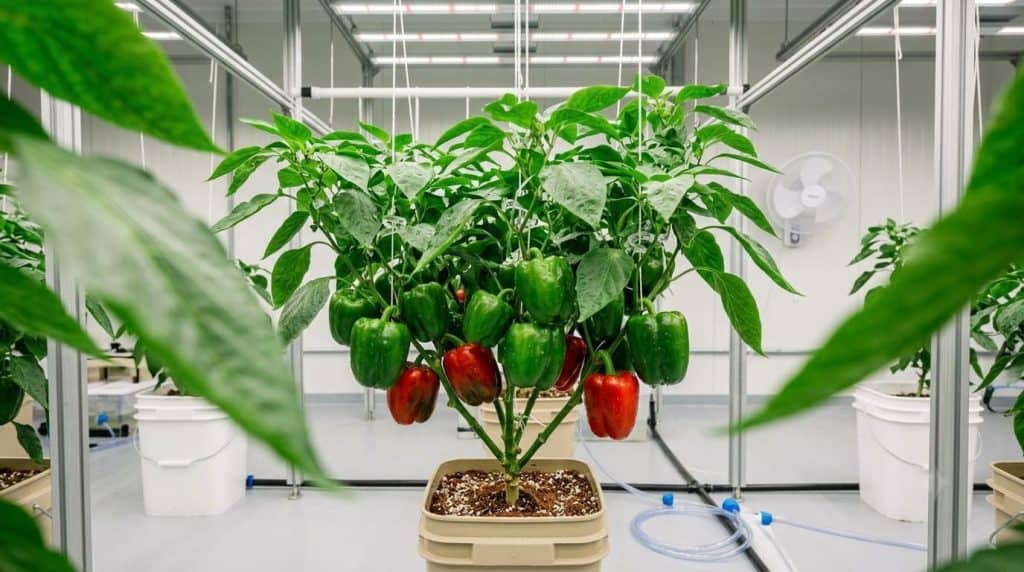
Peppers are not true vining plants, but mature plants often need stakes, cages, or clips to support heavy fruit.
Bell peppers, sweet peppers, jalapeños, habaneros, and many other chili peppers thrive in hydroponics because nutrient availability remains consistent throughout fruit development.
Peppers are notoriously sensitive to calcium delivery issues. Blossom-end rot usually isn’t caused by a complete lack of calcium in your reservoir, but rather by improper transpiration or pH swings outside the 5.5–6.5 window.
To fix this, you should maintain steady canopy airflow with oscillating fans and apply a mild 0.5% Calcium Nitrate foliar spray if rapid fruit growth outpaces root uptake.
Successful pepper production depends on several factors.
- Prevent calcium deficiency.
- Potassium demand increases during fruiting.
- Maintain balanced nitrogen levels throughout growth.
- Strong vine support as fruits enlarge.
That said, pepper plants generally require less aggressive pruning than tomatoes, making them an excellent intermediate crop for new hydroponic gardeners.
Peppers Grow Well With the Right Support
Although peppers are structurally bushy rather than true climbing vines, their heavy fruiting branches require vertical support in high-yield hydroponic environments. Training pepper stems up string trellises using vine clips prevents main-stem splitting when plants carry heavy bell or chili crops.
The good news is that peppers adapt well to hydroponics. With a steady supply of water and nutrients, they can produce over a long season. Bell peppers are a popular choice for larger harvests, while jalapeños, serranos, and other chili peppers fit nicely into smaller systems.
A simple stake, clip, or cage is usually enough to support the plant. As peppers get heavier, check the branches every week and add extra support if needed. It doesn’t take much. But it helps.
Strong vine support prevents broken stems and improves airflow around developing fruit, especially when you grow peppers alongside other fruiting crops in the same hydroponic system.
Tips for Better Pepper Harvests
Peppers like stable growing conditions.
Sudden changes in temperature, lighting, or nutrients can slow growth or reduce fruit production. Keeping your reservoir clean and checking nutrient levels regularly helps plants stay healthy throughout the season.
You can also improve harvests by:
- Supporting heavy branches
- Removing damaged leaves
- Keeping good airflow
- Giving plants enough light
Healthy leaves feed healthy fruit, so avoid removing too much foliage at once.
Can You Grow Squash and Melons Hydroponically?
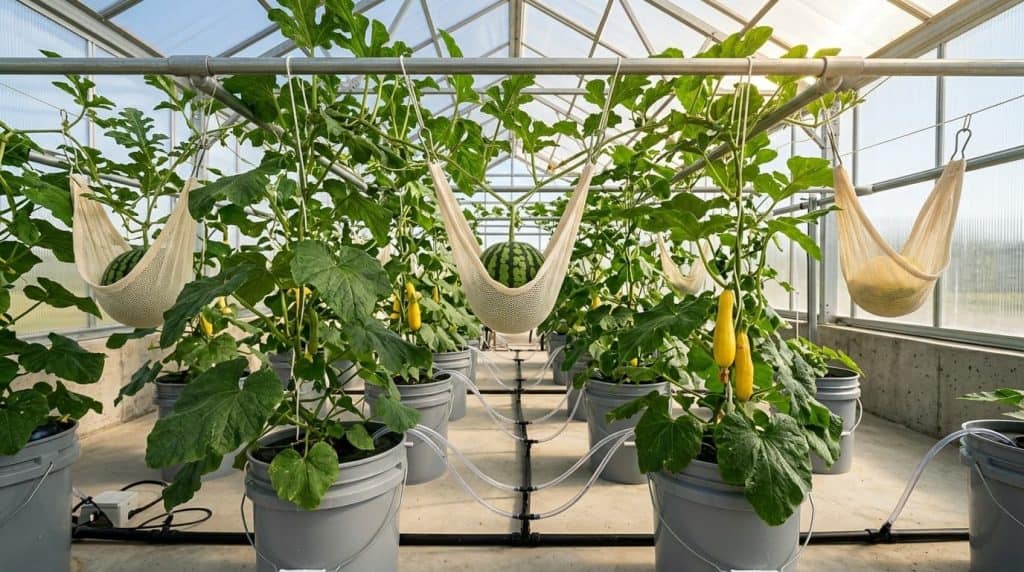
Large fruiting vines require more planning but reward growers with impressive harvests.
Heavy vines like cantaloupe and mini watermelons demand significant root volume and elevated pump capacity. It’s better to grow these in 5-gallon Dutch (Bato) buckets packed with a 70/30 perlite-to-coco coir mix rather than standard NFT channels.
In most setups, supporting individual fruits with soft mesh hammocks hung from an overhead conduit frame allowed us to harvest 8 to 10 lbs of fruit per plant without snapping a single vine.
Because individual fruits become heavy, growers often install slings beneath developing melons to prevent stems from breaking.
These crops perform especially well in Dutch bucket system installations using coco coir, rockwool, or clay pebbles as growing media.
Squash Can Thrive in Larger Systems
Many people don’t think of squash when planning a hydroponic garden, but it can produce excellent results with enough space. Summer squash is usually easier to grow than larger winter varieties because the fruit stays smaller and matures more quickly.
Since these plants spread out, they need room for both the roots and the vines. Dutch bucket systems are often a good choice because each plant has its own growing space.
Support becomes more important as fruit develops. Even smaller squash can become heavy enough to pull on the vine. Use soft plant ties to guide stems and support larger fruit if needed.
Melons Are Possible with Careful Planning
Growing melons in hydroponics takes more planning than growing tomatoes or cucumbers, but many gardeners enjoy the challenge.
Compact cantaloupe and smaller watermelon varieties usually fit indoor or greenhouse systems better than large field varieties.
Strong trellises are essential. As the fruit grows, place each melon inside a mesh sling or fabric support attached to the trellis. This spreads the weight and helps prevent the stem from breaking before harvest.
Spacing also matters. Crowded vines compete for light and airflow, making the garden harder to manage. Give each plant enough room to grow naturally.
Choosing the Right Hydroponic System Matters
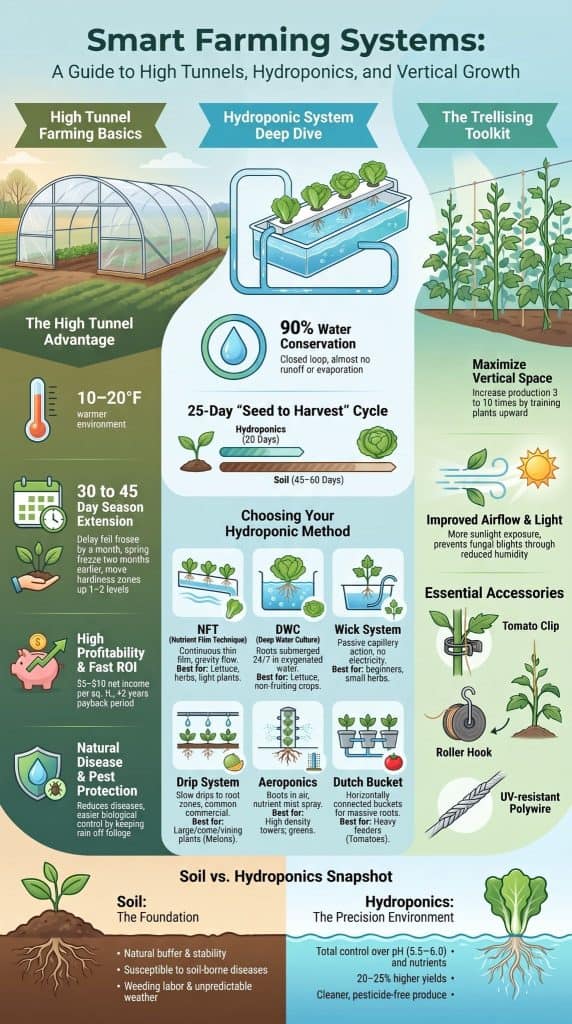
The hydroponic system you choose should match the crop you want to grow.
Large fruiting plants need more root space than lightweight vines. Giving each crop enough room makes maintenance easier and helps plants stay productive.
Here are some general recommendations:
- Dutch bucket: Tomatoes, cucumbers, peppers, squash, and melons
- NFT: Better suited to lighter, fast-growing vines and peas than to heavier fruiting crops
- Ebb and flow: Beans and compact vegetables
- Deep water culture: Generally better suited to leafy greens and smaller crops than heavy vining fruiting plants
There’s no single “best” system for every garden. The right choice depends on your available space, budget, and the plants you want to grow.
Give Every Vine the Support It Needs
Support is one of the biggest factors in a successful hydroponic garden. Without it, vines can become tangled, block light, and place extra strain on stems carrying fruit.
Choose a support system before planting instead of trying to add one later.
Popular options include:
- Vertical strings
- Garden netting
- Wire trellises
- Tomato clips
- Plant ties
As vines grow, guide them gently instead of forcing them into place. A few minutes each week can save hours of cleanup later.
Common Mistakes to Avoid
Even healthy plants can struggle if a few basics are overlooked.
One common mistake is letting vines become overcrowded. Dense foliage blocks airflow and makes it harder for light to reach lower leaves.
Another mistake is ignoring plant support until fruit starts developing. By then, stems may already be bending under the extra weight.
Other problems include:
- Skipping reservoir checks
- Forgetting to prune when needed
- Choosing oversized varieties for small systems
- Allowing vines to grow into each other
Most of these issues are easy to prevent with regular maintenance. Stay consistent. Your plants will reward the effort.
Advanced Training Techniques for Hydroponic Vines

Credits: DIY Garden Ideas
Training your vines isn’t just about keeping things tidy. It actually helps the plants produce more fruit. When you manage how a vine grows, more light reaches the leaves, air moves through the canopy more freely, and the risk of disease drops.
Commercial growers lean on structured pruning and smart support systems for exactly this reason. It takes a little more attention, but the payoff in yield and plant health is worth it.
Lean and Lower Extends Tomato Production
The lean and lower method allows indeterminate tomatoes to keep producing for months without exceeding greenhouse height. Growers gradually lower mature stems while training new growth upward with tomato hooks, support clips, and vertical strings.
Combined with routine pruning suckers and effective canopy management, this technique improves fruit quality, simplifies harvesting, and supports continuous production in both greenhouse hydroponics and large commercial hydroponics systems.
Pruning and Canopy Management Improve Harvest Quality
Regular pruning directs energy toward fruit production instead of unnecessary foliage. Removing older leaves improves airflow, increases light penetration, and lowers humidity around dense hydroponic vines.
Regular pruning, training, and monitoring also help vines remain productive throughout the plant life cycle, from early vegetative growth through flowering, fruit production, and harvest.
As highlighted by Fulton, C. M., & Kempen, E. (2013)
“Stem pruning had little effect on plant growth but did alter plant development. Plants pruned to two stems produced significantly more trusses…” –Fulton, C. M., & Kempen, E. (2013).
Proper stem training, balanced plant spacing, and controlled lateral growth also reduce disease risk while helping crops such as cucumbers, pole beans, and trellised tomatoes develop more consistent fruit throughout the growing season.
FAQ
Can You Grow Different Vining Plants in One Hydroponic System?
Yes, but it works best when the plants have similar nutrients and growing needs. For example, cucumbers, snap peas, and pole beans can often share a system more easily than mixing them with heavy-feeding indeterminate tomatoes or melons.
Matching pH balance, EC control, and nutrient solution requirements helps every crop grow more consistently while reducing maintenance.
Which Hydroponic Systems Support Heavy Vining Crops Best?
Heavy vine crops usually perform better in systems that provide strong root support and a steady nutrient supply. Many growers choose a Dutch bucket system, drip irrigation, or substrate growing with coco coir or clay pebbles for large fruiting plants.
These systems also make reservoir management, root oxygenation, and vine support much easier throughout the growing season.
How Can You Improve Pollination for Indoor Hydroponic Vines?
Indoor hydroponic vines often need a little help during the flowering stage because natural pollinators are absent. Gently shaking flower clusters or using a small brush can improve pollination and increase fruit set.
Maintaining good airflow, proper plant spacing, and adequate grow lights also supports healthier flowers and better harvests.
Why Do Hydroponic Vines Need Regular Training?
Without regular care, climbing vegetables and other trailing plants can quickly become overcrowded. Using string training, support clips, tomato hooks, and occasional canopy pruning keeps stems organized while improving light penetration and airflow.
This simple routine also supports healthier lateral growth, stronger stems, and more productive fruiting throughout the season.
What Nutrient Problems Affect Fruiting Hydroponic Vines Most?
As fruiting plants mature, their nutrient needs change. Many growers watch for calcium deficiency, rising potassium demand, and maintaining proper nitrogen balance to support healthy fruit development.
Regular monitoring of micronutrients, macronutrients, and the overall nutrient feed helps prevent common deficiencies while improving harvest timing and overall crop quality.
What Vining Plants Work Well in Hydroponics for Maximum Harvests
Mastering hydroponic vining crops comes down to matching root-zone system mechanics with proper vertical trellising. By selecting disease-resistant indeterminate or parthenocarpic varieties, maintaining tight control over your solution EC, and training your canopy early, you can convert limited indoor footprint into high-yielding vertical space.
If you’re looking for a simpler way to choose and manage hydroponic vining plants, Tophydroponicgarden can be a helpful starting point. Use the right trellis, keep conditions stable, and train plants as they grow. With a setup that fits your crop, you can make better use of your space and support healthier growth.
References
- https://www.actahort.org/books/843/843_20.htm
- https://www.actahort.org/books/1007/1007_60.htm
Related Articles
- https://tophydroponicgarden.com/how-to-manage-a-plants-life-cycle-hydroponically/
- https://tophydroponicgarden.com/can-you-grow-beans-or-peas-in-hydroponics/
- https://tophydroponicgarden.com/how-to-grow-peppers-in-a-hydroponic-set-up/
Was this helpful?

I’m Barrie L., a passionate hydroponic gardening enthusiast dedicated to cultivating thriving, soil-less gardens. With a focus on all things hydroponic, I share my expertise on innovative growing techniques and sustainable practices through my blog, tophydroponicgarden.com. As a seasoned hydroponics specialist, my goal is to inspire and guide fellow gardeners in harnessing the power of water-based cultivation for bountiful and eco-friendly harvests. I’m also an author of the book “Hydroponics For Absolute Beginners: Your Step By Step Guide For How To Create An Hydroponics System At Home Without Soil, For Growing Vegetable, Fruit And Herbs.” which is sold on Amazon. Join me on a journey of redefining the way we cultivate plants, one nutrient-rich solution at a time. Happy growing!