

The best water pump for hydroponics is typically a submersible pump matched to your system’s flow and head pressure. Most hobby setups use these pumps because they’re straightforward and work well.
Picking the wrong one can lead to poor nutrient flow, warm water, or an early breakdown. Your system type, whether it’s NFT, DWC, or ebb and flow, needs consistent water movement. Choosing a pump is a practical step, not a random pick. Find the right pump type and size below to keep your plants healthy.
Quick Flow Wins for Hydroponic Pump Selection
- Choose a hydroponic pump based on system size, flow rate, and setup type. Submersible pumps suit small–medium systems, while inline pumps are better for large setups.
- Proper sizing follows 1–2x reservoir turnover per hour or about 2 GPH per plant site.
- Ignoring head height can reduce flow by 20–50%, which leads to poor system performance.
The Best Type of Water Pump for Hydroponics
Picking a hydroponic water pump isn’t just about power, it’s about fit. For most home systems, a submersible pump is the best choice.
It’s the easiest to use and the most budget-friendly option available. This makes it perfect for beginners setting up their first garden.
You simply place a submersible pump directly into your nutrient reservoir. It pushes the solution up into channels or pipes with a typical flow of 160 to 800 GPH. Data from ASHS Journals demonstrates :
“Hydroponic systems in plant factories can be categorized into recirculating or noncirculating systems. The concentration of ions in the nutrient solutions and total fresh weight of butterhead lettuce did not show any noticeable difference between the centrifugal magnetic drive pump and the submersible pump”. American Society for Horticultural Science
This range works well for common methods like Deep Water Culture (DWC) or Nutrient Film Technique (NFT). Their simplicity is why they’re the top seller for new growers.
When you have a large or complex setup, consider an inline pump. Also called an external pump, it is installed outside the water tank. It provides much stronger pressure for long pipe runs or vertical towers. A key benefit is that it doesn’t add motor heat to your nutrients.
Other pumps fill specific, important roles. Centrifugal models move huge water volumes for commercial farms. A dedicated sump pump quickly drains trays in an ebb and flow system.
Your systems size and design will point you to the right category. Getting this match correct is the first step to a healthy, productive garden.
Submersible vs. Inline Pumps
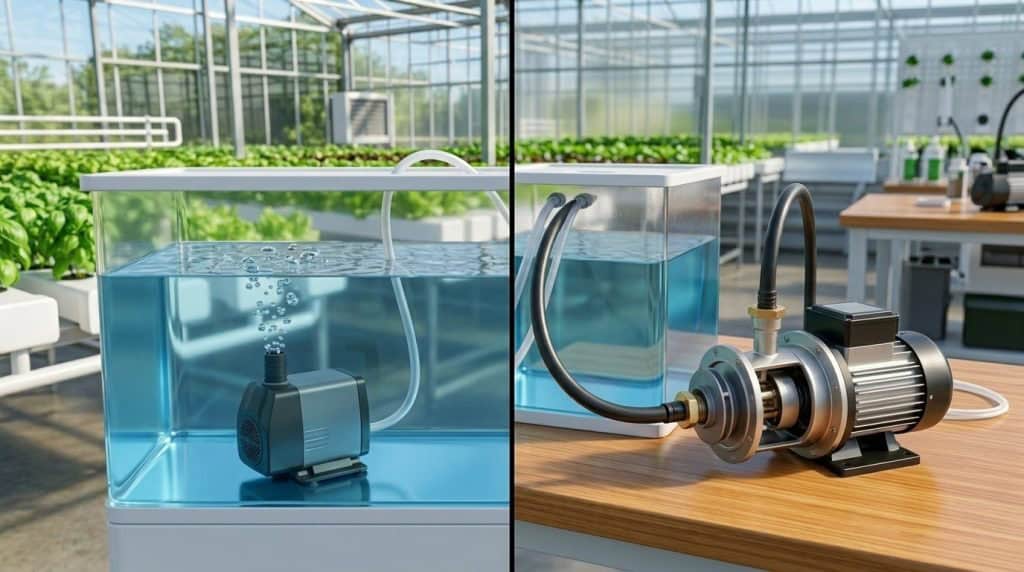
For most small or starter setups, a submersible pump is the usual choice. It sits right in the nutrient tank, is quiet, and you can pretty much plug it in and go.
The main drawback is that it warms the water slightly as it runs. This small temperature rise can sometimes encourage root problems in warmer conditions.
Inline pumps, which sit outside the reservoir, are the heavy duty option. They don’t heat the water, they’re more durable, and they push water with more force over longer distances or up to higher levels. The trade off is that they’re louder and need more parts to connect you’re dealing with extra pipes and fittings.
Growers often start with submersible pumps for simplicity. When a system gets bigger, or uses very long tubing, many switch to an inline model for its consistent power and to keep the water cooler.
| Feature | Submersible | Inline |
| Installation | Easy | Moderate |
| Noise | Low | Medium–High |
| Heat Impact | Higher | Lower |
| Best Use | Small–Medium systems | Large systems |
| Example | Active Aqua 160 | Danner Mag-Drive 550 |
Before choosing, consider how system size and layout affect performance.
Here are the practical differences growers notice most:
- Submersible pumps increase reservoir temperature over time
- Inline pumps maintain stable nutrient temperatures
- Submersibles are easier for beginners
- Inline pumps scale better for commercial setups
This distinction becomes more important as system complexity increases.
Choosing the Right Pump Size for Hydroponics
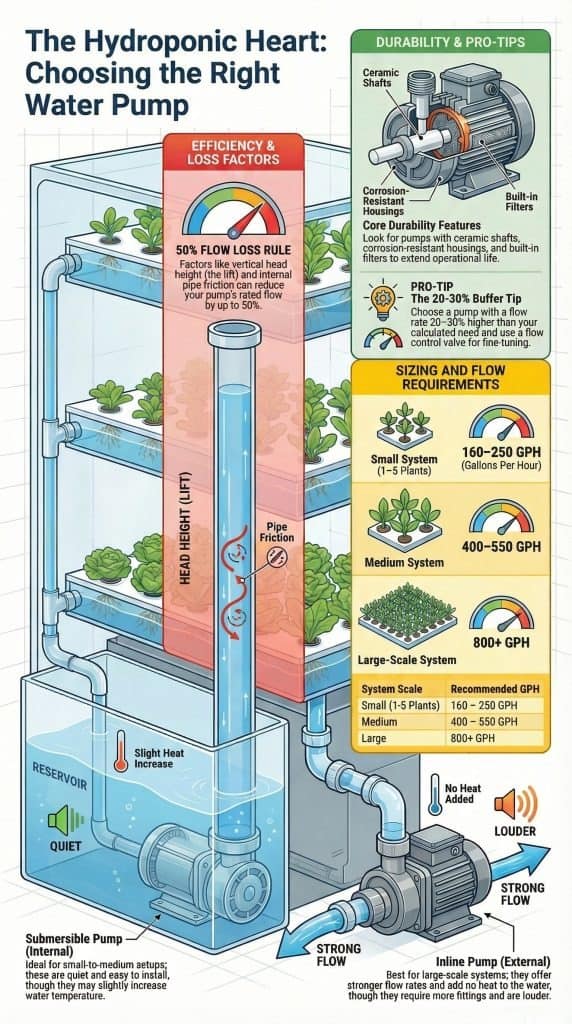
Ignore the big number on the pump box. That’s the flow rate with no resistance. In a real system, you lose flow to pipe friction and the height the water must climb, known as head pressure.
A good starting point is to move your entire reservoir’s volume each hour. For a 50-gallon tank, you’d want a pump that can deliver at least 50 gallons per hour (GPH) after accounting for head loss. Many growers double that to 100 GPH for a stronger, more reliable flow.
For small systems, this often means a pump rated between 160 and 250 GPH. For large commercial setups, you’re looking at 800 GPH or more. The goal is consistent water movement, which research from places like the University of Arizona shows is critical for delivering oxygen and nutrients to plant roots.
| System Size | Recommended GPH | Example |
| Small (1–5 plants) | 160–250 | Active Aqua 160 |
| Medium systems | 400–550 | Hydrofarm 550 |
| Large systems | 800+ | VIVOSUN 800 |
To refine your hydroponic pump capacity, consider these factors:
- Add 20–30% extra capacity to compensate for losses
- Use adjustable flow pump hydroponics models for flexibility
- Match pump output to tubing size and layout
- Ensure compatibility with timers for irrigation cycles
Proper sizing prevents both underfeeding and excessive turbulence.
Head Height and Friction Loss

Think of your pump’s advertised power as its potential. Head height and friction loss are what cut into that power in a real setup.
Head height is the vertical distance the water must climb from the pump to its highest exit point. For every foot it has to lift, the pump’s actual flow drops, sometimes by a lot. A pump rated for 500 gallons per hour (GPH) might only push 300 GPH up a four-foot rise.
Friction loss happens inside the pipes. Long runs of tubing, tight elbows, and valves all create resistance, slowing the water down further. It’s like trying to drink a thick milkshake through a thin, twisted straw.
Together, these factors mean a pump can lose 50% or more of its labeled output. This isn’t just about weak flow. Running a pump against high resistance is inefficient
According to the U.S. Department of Energy, pump efficiency declines when systems operate outside optimal flow conditions, increasing energy consumption and wear.
These are the main factors that reduce real-world pump performance:
- Vertical lift decreases flow efficiency
- Small tubing like 1/2 inch lines increases resistance
- Elbows and fittings create turbulence and drag
- Long pipe runs reduce pressure output
Ignoring these variables leads to undersized pumps that fail to circulate nutrients properly. Understanding these losses allows more accurate pump selection.
What Makes a Pump Last Longer in Hydroponics Systems
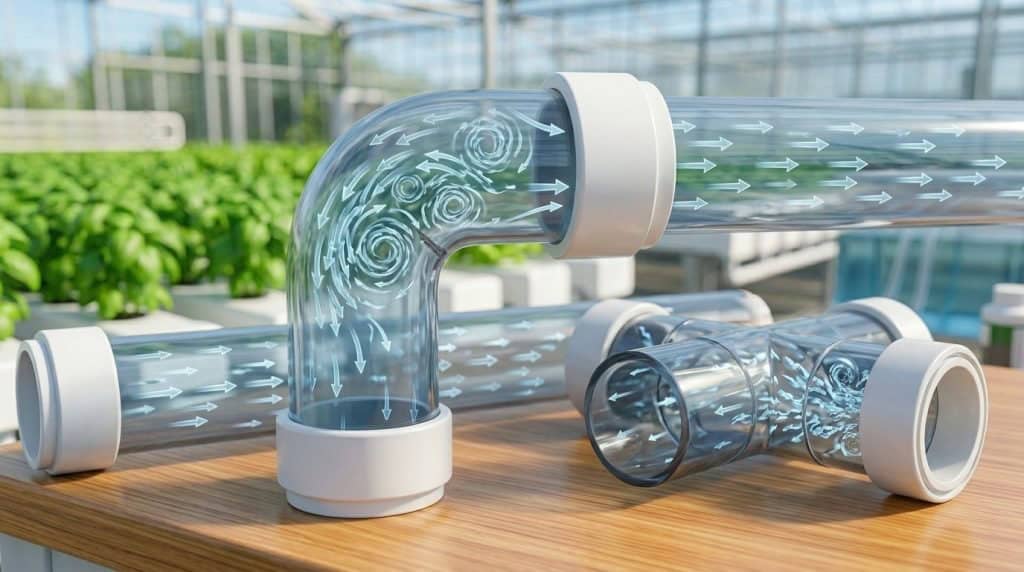
Long-lasting pumps use corrosion-resistant materials, run cooler, and resist clogging, with aquarium grade models often lasting years compared to cheap pumps failing within weeks.
Durability depends on build quality and operating conditions. Pumps in hydroponics run continuously, often 24/7, which exposes them to nutrient salts and biofilm buildup.
Research from Oklahoma State University Extension shows :
“Ebb and flow system works by temporarily flooding the grow tray with nutrient solution and then draining the solution back into the reservoir. This action is normally done with a submerged pump that is connected to a timer. Oklahoma State University
According to EPA water system guidelines, corrosion and biological buildup reduce mechanical lifespan in water-handling equipment.
Higher-quality hydroponic circulation pumps use ceramic shafts and sealed components to resist chemical wear. These designs reduce friction and prevent premature failure.
These features define a durable hydroponic pump:
- Ceramic shafts for corrosion resistance
- Continuous-duty rating for nonstop operation
- Energy efficient hydroponic pump design under 25W for small systems
- Built-in filter to reduce clogging
Common failure causes include biofilm buildup, heat stress, and poor materials.
Many low-cost pumps fail within 4–6 weeks in nutrient-rich environments, while reliable models like EcoPlus Commercial can last years with proper maintenance.
Common pump mistakes
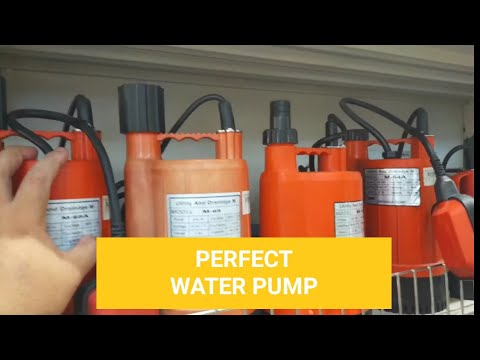
Credit : J&G’s Integrated Farm
It’s easy to pick the wrong pump. Most beginners focus on two things: the lowest price or the biggest number on the box. Both can cause problems.
A pump that’s too weak won’t move your nutrients properly. Your plants get less oxygen. Growth just slows down.
But a pump that’s too powerful can be just as bad. The strong current batters the roots, especially in systems like DWC. It’s stressful for the plants.
Your pump’s lifespan depends heavily on the environment inside your reservoir. It is vital to be mindful of what you add to your water for hydroponics, as certain additives can impact pump performance.
Then there’s head height. People forget about it. That pump rated for 500 gallons per hour? It might only deliver 250 once you account for lifting the water and pushing it through your pipes. You end up with half the flow you planned for.
Maintenance gets overlooked. Filters. If you skip a simple pre-filter, especially with organic nutrients, the pump will clog. Fast. You might get three weeks before it seizes up. And running a pump dry, even for a minute, often kills it for good.
A better approach is to buy a pump slightly stronger than you think you need, maybe 20% more. Then use a simple valve on the output line to dial the flow back to exactly what you want.
This gives you a buffer for head pressure and lets you adjust as your system changes. It’s more reliable.
Quality matters more than a bargain. A cheap pump might save you fifteen dollars now. But it’ll likely cost you more in electricity, or when it fails right before a long weekend.
Replacing Air Stones with One Pump in Hydroponics
Yes, pumps with venturi or needle-wheel systems can oxygenate water effectively, but require sufficient pressure or they risk cavitation and reduced performance.
Advanced hydroponic setups sometimes replace air stones with high-performance pumps that inject oxygen directly into the nutrient stream.
Venturi systems draw air into flowing water, increasing dissolved oxygen without separate air pumps. Needle-wheel impellers go further by breaking air into microbubbles, improving oxygen absorption.
However, these systems require pumps with higher pressure ratings. Low-cost pumps often fail under this load, leading to cavitation and reduced lifespan.
These technologies offer specific advantages:
- Venturi injectors increase oxygen without extra equipment
- Needle-wheel pumps improve dissolved oxygen efficiency
- High pressure water pump hydroponics systems support aeroponics
- Reduced reliance on air stones simplifies system design
Growers on forums like Overgrow report better root health with these setups, but only when using properly sized pumps.
When you rely on a single pump for both circulation and aeration, the chemistry of your reservoir becomes even more important. Before you commit to a high-pressure setup, it is helpful to review what you add to your water for hydroponics to ensure your nutrient solution won’t cause excessive foaming or buildup within the specialized injectors.
This approach suits advanced growers optimizing oxygen levels.
FAQs
What hydroponic water pump works best for beginners?
A beginner should choose a hydroponic water pump that is simple to install and easy to control. A submersible pump hydroponics type works well because it sits inside the reservoir and requires minimal setup. A compact water pump hydroponics design with adjustable flow improves control. An energy efficient hydroponic pump also helps maintain stable water circulation system hydroponics performance without increasing electricity costs.
How do I choose the right pump flow rate for my system?
You should choose the correct water pump GPH hydroponics by calculating your reservoir volume and desired circulation speed. A proper hydroponic pump flow rate calculation ensures nutrients move consistently through the system. A high flow rate pump hydroponics or adjustable flow pump hydroponics works for larger setups. You must also consider hydroponic pump head height to ensure water reaches every level.
Can I use an aquarium pump for hydroponics systems?
You can use an aquarium pump for hydroponics in small systems, especially for deep water culture pump setups or simple recirculation. However, you must check the hydroponic pump capacity and confirm it supports continuous duty pump hydroponics operation. Larger systems require a more durable water pump hydroponics with stronger hydroponic pump suction power and better hydroponic pump efficiency.
What pump type suits different hydroponic systems best?
Each hydroponic system requires a specific pump type. A water pump for NFT systems or a pump for nutrient film technique needs steady, low-pressure flow. An ebb and flow pump supports timed flooding cycles. A hydroponic drip system pump requires stable pressure, while aeroponics systems need a high pressure water pump hydroponics. Vertical setups need pumps designed for height and hydroponic pump flow control.
How do I maintain and extend a hydroponic pump lifespan?
You should perform regular hydroponic pump maintenance to keep the system working efficiently. You must clean components, remove debris, and check for blockages. A hydroponic pump with a filter helps prevent clogs and protects internal parts. Proper hydroponic pump installation and monitoring hydroponic pump energy consumption reduce strain. Using a corrosion resistant pump hydroponics or waterproof pump hydroponics design also extends lifespan.
The Pump That Powers Your Growth
The right hydroponic pump is not just a component, it is the heartbeat of your entire system. Choose too small, and your plants struggle. Choose too large without control, and you risk damage and wasted energy. Precision matters.
For most growers, a submersible pump sized 20–30% above system demand delivers the best balance of efficiency and flexibility. Larger or heat-sensitive setups benefit from inline pumps, offering stronger performance, improved durability, and better heat management.
Keep your decision simple and effective:
• Small systems: Submersible (160–400 GPH)
• Medium systems: Submersible (400–600 GPH)
• Large systems: Inline or 800+ GPH
• Always factor in head height and friction loss
• Use corrosion-resistant materials for longevity
A slightly oversized pump paired with a flow control valve gives you room to adapt as your system evolves, without risking root health.
The right choice creates stable nutrient flow, consistent growth, and a system built to scale. Start with the right foundation, and your entire hydroponic setup performs better from day one.
References :
- https://gogreenaquaponics.com/blogs/news/how-to-choose-the-right-water-pump-in-aquaponics
- https://journals.ashs.org/view/journals/horttech/29/2/article-p189.xml
- https://www.energy.gov/
- https://extension.okstate.edu/fact-sheets/hydroponics.html
- https://www.epa.gov/
Related article :
- https://tophydroponicgarden.com/add-anything-to-water-for-hydroponics/
- https://tophydroponicgarden.com/what-do-you-add-to-water-for-hydroponics/
- https://tophydroponicgarden.com/what-is-the-most-water-efficient-system/
Was this helpful?

I’m Barrie L., a passionate hydroponic gardening enthusiast dedicated to cultivating thriving, soil-less gardens. With a focus on all things hydroponic, I share my expertise on innovative growing techniques and sustainable practices through my blog, tophydroponicgarden.com. As a seasoned hydroponics specialist, my goal is to inspire and guide fellow gardeners in harnessing the power of water-based cultivation for bountiful and eco-friendly harvests. I’m also an author of the book “Hydroponics For Absolute Beginners: Your Step By Step Guide For How To Create An Hydroponics System At Home Without Soil, For Growing Vegetable, Fruit And Herbs.” which is sold on Amazon. Join me on a journey of redefining the way we cultivate plants, one nutrient-rich solution at a time. Happy growing!