

Meta description: What is the most water-efficient system for growing plants? Aeroponics stands out, using up to 98% less water than soil methods.
Aeroponics is the most water-efficient plant growing system, using high-pressure mist nozzles to deliver nutrient droplets directly to exposed plant roots. It can cut water use by 95-98% compared to traditional farming.
The system delivers nutrients through mist droplets typically sized between 30-100 microns, which improves root absorption efficiency, which maximizes absorption.
NASA scientists helped bring the concept to wider attention through their work on growing food in space.
With agriculture using about 70% of the world’s freshwater, finding better irrigation methods is critical. Advanced systems like aeroponics, hydroponics, and drip irrigation tackle this by minimizing water lost to evaporation or runoff.
They allow for more food production with far fewer resources. To see how these systems work and why aeroponics leads the pack, keep reading.
Quick Facts: The Most Water-Efficient Plant Growing Systems
- Aeroponics cuts water use 95-98%, most efficient.
- Drip irrigation saves 30-70%, ideal outdoors.
- Hydroponics & aquaponics recycle water, save 90%+.
The Most Water-Efficient System in Agriculture
When it comes to saving water on the farm, nothing beats aeroponics. The system doesn’t use soil. Instead, plant roots dangle in the air inside a closed chamber, where they’re periodically misted with a nutrient solution.
Because the roots are exposed and the water is delivered as a fine spray, almost none is lost to evaporation or runoff. Studies in controlled environment agriculture show aeroponics can reduce irrigation water use by up to 98% compared with conventional field irrigation.
Agriculture is the world’s biggest user of freshwater, claiming roughly 70% of all withdrawals globally.
That statistic, from the UN’s Food and Agriculture Organization, explains why there’s such a rush to develop better watering tech. The current toolbox includes things like targeted drip lines, in-ground moisture sensors, and timer-based systems.
Old-school methods are notoriously wasteful. With sprinkler irrigation, for instance, a significant portion of the water never reaches the soil.
The U.S. EPA notes 30-60% total irrigation waste from poor maintenance; evaporation/wind can reach 30-50% in poor conditions.
Flood irrigation is an even bigger problem. Water is released across a field with little control, leading to uneven soaking.
Much of it runs off the surface into ditches, while another portion percolates too deep into the earth, beyond the reach of plant roots. This doesn’t just waste water; it also makes pumping it more expensive.
The new generation of agricultural systems is designed to fix this by delivering water precisely to the root zone.
Several technologies are now central to efficient farming:
- Aeroponics
- Hydroponics, including specific methods like Nutrient Film Technique (NFT) or Deep Water Culture (DWC)
- Aquaponics, which pairs fish tanks with plant beds
- Drip irrigation networks
Whether it’s mist, a water film, or a slow drip, the principle is the same: get more crop per drop.
The aim is to maximize yield while cutting down the two biggest sources of waste-evaporation and runoff. That’s the foundation of farming that’s both sustainable and resilient.
Why Traditional Irrigation Wastes So Much Water

Traditional irrigation has a water problem. It spreads water over an entire field instead of putting it exactly where plants need it. A lot of that water is wasted.
It evaporates into the air, runs off the soil surface, or sinks too deep into the ground for roots to reach.
Farmers have been using flood irrigation, or surface irrigation, for thousands of years.
Ancient civilizations in Egypt, Mesopotamia, and the Indus Valley built elaborate canal systems to do it. The method is still common in many parts of the world today.
The reason is simple: it’s cheap and doesn’t require complex machinery. The downside is that water spreads unevenly. Some parts of a field get flooded while others stay dry, leading to patchy, inconsistent crop growth.
Sprinkler systems were meant to be an improvement. They offered better coverage. But they created new problems. Spraying water into the air is inefficient, particularly in hot, dry, or windy places like California, Australia, or parts of Indonesia.
A significant amount evaporates before it even touches the ground. Wind blows the spray off-target, so less water lands on the plants.
There are a few main ways water is lost in these systems:
- Water evaporates during spraying.
- It runs off the surface of the field.
- It percolates too deep into the soil.
- The distribution across the field is uneven.
The basic science is clear: exposing water droplets to heat and air movement speeds up evaporation. This directly lowers how efficient an irrigation system is.
You can find discussions on how environmental factors like heat affect substances, including water, in resources from institutions like Harvard Health.
These persistent inefficiencies are what drove the search for something better. Researchers and engineers started working on systems that could deliver water with much more precision.
Aeroponics as the Most Water-Efficient System

Credits: Agrotonomy
Aeroponics tops the list for water efficiency in farming. The system doesn’t use any soil. Plant roots hang exposed in a dark chamber, where they’re periodically misted with a nutrient solution.
The roots absorb the water and nutrients directly from the air. Nearly all the mist that isn’t absorbed drips down, is collected, and gets recycled back through the system.
Insights from Interesting Engineering indicate
“Compared to hydroponic systems, AirFarm’s aeroponics cuts water usage by 90%…” –Interesting Engineering
The idea got serious attention from NASA researchers decades ago. They were looking for ways to grow food on long space missions where every drop of water counts.
Their work demonstrated that plant roots, when suspended in air and given plenty of oxygen, could take in nutrients with remarkable efficiency from a fine spray.
A typical aeroponic setup is straightforward. Plants are secured in panels with their roots dangling inside an enclosed chamber.
High-pressure atomizing nozzles spray nutrient solution at intervals of 5-15 minutes, producing fine droplets that coat the root surface, coating the roots with a nutrient fog for a few seconds every few minutes.
This approach uses very little water because there’s no big tank or soggy medium surrounding the roots. The system gives the plant exactly what it needs, right when it needs it, with almost no waste.
The water savings are hard to ignore:
- It can cut water use by 95% to 98% compared to field farming.
- Evaporation losses are minimal because the enclosed chamber maintains high humidity and recaptures unused mist for reuse.
- The water is in a closed loop; it’s constantly filtered and reused.
- The roots get massive amounts of oxygen, which they love.
Commercial operations like AeroFarms use this technology in their vertical farms, where saving water isn’t just good practice-it’s a financial necessity.
It’s not just about saving water, either. Plants often grow better this way.
Studies, including work from the University of Arizona’s Controlled Environment Agriculture Center, have found that the high oxygen levels in aeroponic systems can speed up root growth and improve how well plants take up nutrients.
Because it’s a precise, tech-driven method, aeroponics integrates easily with modern farm management.
It works hand-in-hand with IoT sensors, AI that fine-tunes misting schedules, and automated controls. This makes it one of the most sophisticated tools available to farmers today.
Comparison of Other Water-Efficient Systems
Aeroponics gets the top spot for saving water, but it’s got plenty of company.
Other methods-drip irrigation, hydroponics, aquaponics-can also slash water use by 90 percent or more when you stack them up against old-school field farming.
Research from FAO AGRIS shows
“Hydroponic production systems offer higher resource use efficiency, such as water and fertilizer, compared to traditional agriculture systems. Notably, water usage can be reduced by more than 90%…” –FAO AGRIS
What ties these systems together is a simple idea: put the water right on the roots, control the flow, and reuse whatever doesn’t get soaked up.
Drip irrigation is the workhorse you see everywhere. An Israeli firm named Netafim started selling it commercially in the 1960s.
The setup uses plastic tubing with tiny holes or emitters that let water seep out slowly, directly onto the soil around a plant’s base.
Then there’s hydroponics, which cuts out soil completely. Many growers consider finding the most efficient hydroponic system important because hydroponic systems grow plants with roots submerged in a nutrient solution maintained at electrical conductivity levels typically between 1.2 and 2.5 mS/cm.
Two common types are Nutrient Film Technique (NFT), in Nutrient Film Technique (NFT), a thin nutrient film flows continuously along a sloped channel, delivering oxygenated water to plant roots, and Deep Water Culture (DWC), where roots are submerged in oxygenated water.
Both systems pump the same water in a loop, so very little is ever thrown away.
Aquaponics is hydroponics plus a fish tank. The fish produce waste, which gets broken down into nutrients for the plants.
The plants then act as a filter, cleaning the water before it cycles back to the fish. It’s a neat, closed system.
How do they compare? Here’s a basic breakdown:
| System | Water Savings vs. Traditional Soil Farming | Best Use | Main Limitation |
| Aeroponics | 95-98% | Vertical farms and controlled environments | High setup cost and technical maintenance |
| Drip Irrigation | Up to 90% | Orchards, vineyards, and field crops | Emitters may clog without proper filtration |
| NFT Hydroponics | 90-95% | Leafy greens such as lettuce and herbs | Requires a reliable pump and constant flow |
| DWC Hydroponics | Around 90% | Indoor growing systems | Water must stay well oxygenated |
| Aquaponics | Up to 90% | Combined fish and plant production systems | Balancing fish health and plant nutrients can be complex |
Table: Comparison of Water-Efficient Growing Systems
Drip irrigation hasn’t lost its appeal, especially for big outdoor farms. It might not match aeroponics, but it still uses 30 to 60 percent less water than a standard sprinkler system.
This shift toward smarter watering isn’t happening in a vacuum.
Programs like the EPA’s WaterSense encourage more efficient water use everywhere, from backyard gardens to major agricultural operations.
The bottom line is that farming is changing. The goal isn’t to just dump water on a field anymore. It’s to deliver each drop with precision, exactly where and when the plant needs it.
Key Factors That Determine Water Efficiency in Farming
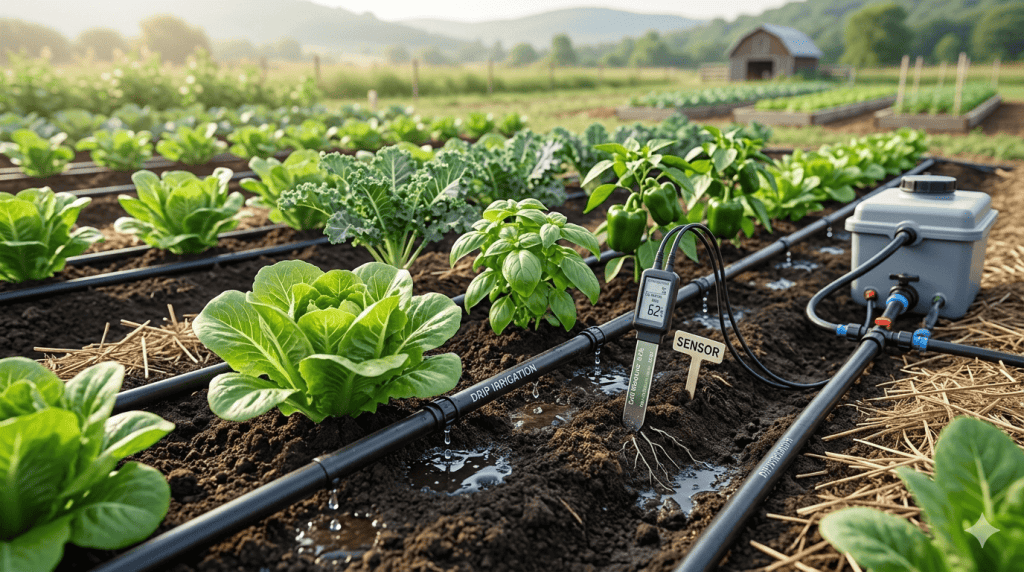
Making every gallon of water count in farming isn’t magic. It boils down to a few practical goals: putting the water exactly where you need it, keeping it from disappearing into the air, and reusing whatever you can.
Engineers and farmers look at specific factors that determine whether a system is efficient or wasteful.
These factors influence two straightforward outcomes: how much food you harvest from a field (yield), and how much water it took to grow it (often measured in kilograms of crop per cubic meter of water).
One major factor is how fast you apply the water. If you dump it on the ground faster than the soil can drink it up, the excess just runs away. That’s a direct hit to your efficiency.
Another is something called evapotranspiration, or ET. This is just a technical term for all the water that leaves your field-some evaporates from the soil, and some is released by the plants themselves.
On a hot, dry, windy day, a huge amount of water can be lost this way. Modern systems try to outsmart the weather.
They use local weather data and sensors to calculate the daily ET rate, figure out how much water the crop actually needs, and then water only enough to make up the difference.It’s an automatic response to the environment.
A toolbox of devices makes this precision possible:
- Soil moisture sensors buried in the ground tell you if the roots are thirsty.
- Pressure-compensating emitters (in drip lines) ensure every plant gets the same amount of water, even at the end of a long row or on a slope.
- Smart controllers use weather forecasts and ET data to set the watering schedule.
- Flow meters track exactly how much water is being used across the farm.
- Automated valves let you water specific zones without manual work.
The aim is simple: avoid drowning the crops and keep the soil moisture just right.
Closed-loop systems like aeroponics and hydroponics take the reuse idea to its limit. In hydroponic setups such as the nutrient film technique, a shallow stream of nutrient solution flows continuously along plant roots, allowing water to be reused with very little loss.
They don’t just avoid runoff; they capture every drop that isn’t absorbed, clean it, add nutrients back in, and send it through the roots again.
This recycling cuts the total water needed to grow food to a fraction of what traditional farming uses. In places running out of water, that’s not just an improvement-it’s a necessity.
Choosing the Right Water-Efficient System for Different Farms
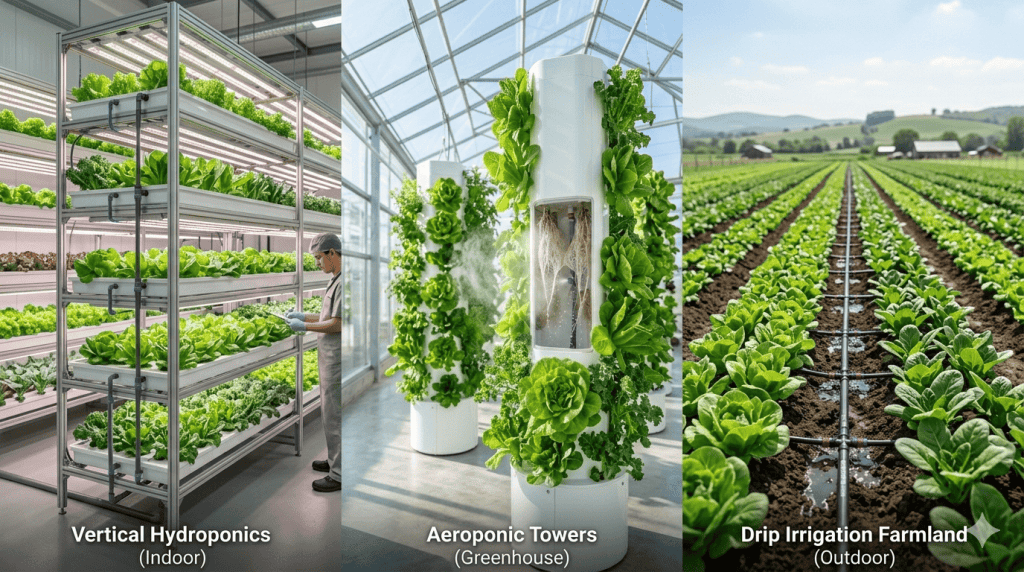
Picking the right system to save water on a farm? It’s complicated. It all depends.
What are you growing? How big is the place? Can you count on the power staying on? And who’s going to fix things when they break?
Aeroponics saves the most water, hands down. But it asks a lot from you. You need constant, reliable electricity for those pumps. The tiny nozzles have to be cleaned, or they’ll clog. For many farms, it’s just too much.
Hydroponics is a good compromise. It wastes very little water and is easier to live with than aeroponics. That’s why you find it everywhere. In greenhouses. In warehouses growing lettuce. In city farms tucked into old buildings.
Now, for a big outdoor field, the answer is usually drip irrigation. Think of a vineyard, or a field of corn. Drip lines are tough.
They can cover miles. They put the water right where the roots are. It just works.
So how do you choose? Let’s break it down.
If water is your biggest problem, if every drop counts, go with aeroponics. Nothing else comes close to pure efficiency.
Farming indoors, in a controlled space? Then hydroponics or aeroponics makes sense. You control everything. Got a huge outdoor operation? Drip irrigation. It’s the reliable, scalable choice.
Want to grow food and raise fish together? That’s aquaponics. It’s a whole loop.
But here’s the thing. The best farms don’t pick just one tool. They mix and match. They collect rainwater in barrels.
They reuse water from washing down barns. They check the weather forecast and adjust the timers.
This flexible approach is the real future. It’s how you keep growing food when the weather gets weird and the wells get shallow. You adapt.
FAQ
How does irrigation scheduling improve water use efficiency in farming?
Irrigation scheduling helps farmers decide when and how much water crops actually need. Farmers use evapotranspiration rate data, soil moisture monitoring, and weather conditions to plan watering.
This process improves water use efficiency and supports crop yield optimization. Proper scheduling also prevents over-irrigation, avoids saturated soil, and maintains steady moisture levels that help plant roots grow properly.
Can sensor-based irrigation reduce water waste in agriculture?
Yes, sensor-based irrigation can significantly reduce water waste in farming. Farmers use devices such as a soil moisture sensor and flow monitoring tools to measure field conditions in real time.
These systems trigger automated watering only when crops require water. This method improves agricultural water management, reduces runoff and evaporation losses, and maintains balanced soil moisture for healthier plant growth.
What role does precision agriculture play in water-efficient irrigation systems?
Precision agriculture improves water-efficient irrigation by using field data to guide watering decisions. Farmers apply techniques such as variable rate irrigation, pressure regulation, and optimal spacing to distribute water evenly across crops.
This approach improves distribution uniformity and reduces unnecessary water use. It also supports higher maize productivity and better yield per hectare by supplying water exactly where plants need it.
How do subsurface drip systems compare with surface drip irrigation methods?
Subsurface drip systems place the drip irrigation system tubing below the soil surface. This setup delivers water directly to the root zone and limits evaporation from the soil surface.
In comparison, surface drip systems place emitters above the soil, which can increase evaporation in hot conditions. Subsurface systems usually provide lower water usage and support sustainable farming in dry regions.
Can automated irrigation systems adapt to changing climate conditions?
Automated irrigation systems can adapt to changing climate conditions by using weather-based adjustment data. These systems combine IoT water management tools, climate-adaptive watering strategies, and AI irrigation optimization.
The technology monitors rainfall, temperature, and evapotranspiration changes. This information allows irrigation scheduling to adjust automatically, helping farmers prevent water stress and maintain stable crop productivity.
Smarter Farming Starts With Smarter Water Use
When you’re trying to grow healthy crops while watching every drop of water, waste feels painful, especially when you know traditional methods lose most of it before plants even use it. Water runs out fast.
Systems like aeroponics or drip irrigation show that precise watering can grow strong plants while using far less water, and once you understand how they work you can plan smarter for the next season or your small greenhouse.
Adopting efficient irrigation systems like aeroponics, hydroponics, or drip irrigation helps farmers increase crop yield per unit of water used.
References
- https//interestingengineering.com/ces-2025/inflatable-farm-uses-99-less-water
- https//agris.fao.org/search/en/providers
Related articles
- https//tophydroponicgarden.com/most-efficient-hydroponic-system
- https//tophydroponicgarden.com/deep-water-culture/
- https//tophydroponicgarden.com/nutrient-film-technique/
Was this helpful?

I’m Barrie L., a passionate hydroponic gardening enthusiast dedicated to cultivating thriving, soil-less gardens. With a focus on all things hydroponic, I share my expertise on innovative growing techniques and sustainable practices through my blog, tophydroponicgarden.com. As a seasoned hydroponics specialist, my goal is to inspire and guide fellow gardeners in harnessing the power of water-based cultivation for bountiful and eco-friendly harvests. I’m also an author of the book “Hydroponics For Absolute Beginners: Your Step By Step Guide For How To Create An Hydroponics System At Home Without Soil, For Growing Vegetable, Fruit And Herbs.” which is sold on Amazon. Join me on a journey of redefining the way we cultivate plants, one nutrient-rich solution at a time. Happy growing!