

What is the ideal humidity for a grow room? The answer depends on the plant’s growth stage, environmental conditions, and airflow management. Keeping humidity within these ranges supports healthy transpiration, nutrient uptake, growth, and disease prevention.
Research in controlled-environment agriculture shows that maintaining proper humidity can improve plant performance compared to poorly managed growing conditions.
Humidity also works hand in hand with Vapor Pressure Deficit (VPD), which affects how efficiently plants move water and nutrients. Keep reading for humidity targets, VPD charts, and practical climate-control strategies.
Grow Room Humidity at a Glance
The right humidity strategy changes throughout the grow cycle and works best when paired with proper monitoring and airflow.
- Ideal growth room humidity ranges from 40% to 80% RH depending on plant stage, with young plants requiring higher humidity and flowering plants benefiting from lower humidity.
- Maintaining lower humidity during flowering helps reduce the risk of mold, bud rot, and other moisture-related diseases.
- Monitoring VPD alongside humidity and maintaining consistent airflow provides a more complete picture of plant performance and environmental conditions.
What Is the Ideal Humidity for Each Growth Stage?
Plants need different humidity levels as they mature. Seedlings and clones rely heavily on moisture from the air, while mature plants depend more on their root systems. As plants get larger, lowering humidity encourages healthy transpiration and reduces disease risk.
These target ranges give growers a strong starting point for every single step of the cultivation cycle:
- Seedlings & Clones: Ideal humidity is 70–80% RH with a typical temperature of 68–77°F (20–25°C). The main goal at this stage is to prevent dehydration.
- Early Vegetative: Ideal humidity is 55–65% RH with a typical temperature of 72–82°F (22–28°C). The main goal is to support root growth.
- Late Vegetative: Ideal humidity is 40–60% RH with a typical temperature of 72–82°F (22–28°C). The main goal is to improve nutrient uptake.
- Early Flowering: Ideal humidity is 45–55% RH with a typical temperature of 68–79°F (20–26°C). The main goal shifts to lowering disease pressure.
- Late Flowering: Ideal humidity is 40–50% RH with a typical temperature of 65–75°F (18–24°C). The main goal is to protect flowers.
- Drying Room: Keep it at 55–60% RH and a strict 60°F (15°C) to prevent flash-drying. If your moisture drops too fast here, your terpene profile is toast.
- Curing Room: Target 58–62% RH at the same temperature. At this phase, your primary objective is locking in moisture equilibrium inside the jars to cure the inner core of the flower safely.
Small adjustments may be needed based on plant variety, room conditions, and cultivation method. For growers exploring controlled-environment cultivation or hydroponics for beginners, understanding how humidity interacts with plant development can make environmental management much easier.
Seedling and Clone Stage: Why Is High Humidity Essential?
Young plants need high humidity because their roots are still small and cannot absorb enough water to support rapid growth.
At this stage, leaves play a major role in moisture absorption. When humidity drops too low, seedlings and clones can lose water faster than they can replace it. This slows development and may reduce survival rates.
Maintaining a strict 75% relative humidity (RH) inside commercial propagation setups is critical for successful root development before clones or seedlings pop. To hit this target consistently without stalling essential air exchange, professional cultivators utilize high-top 7-inch humidity domes paired with heavy-duty flats.
Rather than relying on manual spraying, integrating automated, ultra-fine misting lines ensures precise moisture levels. This combination creates the ideal microclimate, preventing clone dehydration while maintaining enough fresh oxygen flow to prevent stagnation and pathogen growth.
Relying on manually spraying twice a day simply introduces too much human error and causes radical moisture drops that stunt fragile cell division.
High humidity during propagation helps:
- Reduce water stress
- Improve rooting success
- Support faster establishment
- Protect delicate young tissue
- Encourage early growth
The goal is not to keep the environment wet. Instead, growers want a stable environment where young plants can develop roots without struggling to replace lost moisture.
Vegetative Stage: What Humidity Encourages Faster Growth?
During the vegetative stage, plants develop larger root systems, stronger stems, and more leaves. Because roots become more efficient at absorbing water, humidity can gradually be reduced.
Most growers target between 40% and 60% RH during vegetation. This range encourages healthy transpiration without forcing plants to lose water too quickly.
Transpiration acts like a transportation system inside the plant. Water moves upward from the roots and carries nutrients throughout the plant. When humidity is balanced, this process works efficiently.
Plants growing in proper humidity conditions often show:
- Faster growth
- Larger leaves
- Stronger stems
- Better nutrient uptake
- Improved photosynthesis
Environmental controls become increasingly important during this stage. Exhaust fans, intake fans, and automated climate systems help maintain stable conditions as plant size and water demand increase.
Consistent monitoring is also a key part of long-term hydroponic garden maintenance, helping growers avoid environmental fluctuations before they affect plant performance.
Flowering Stage: Why Should Humidity Be Lower?
Flowering plants perform best in a drier environment than seedlings or vegetative plants.
As flowers develop, they become dense and can trap moisture. High humidity around flowers creates conditions that many fungal diseases need to spread.
Relative humidity levels sustained above 60% trap moisture within dense terminal flower structures, fostering optimal environments for airborne pathogens like Botrytis (gray mold). Once mold develops inside dense flowers, it can spread quickly and damage large portions of a crop.
Maintaining humidity between 40% and 50% RH during flowering helps:
- Lower mold risk
- Reduce powdery mildew pressure
- Improve airflow through flowers
- Support healthier harvests
- Protect crop quality
Many growers find that lowering humidity gradually during flowering creates a safer environment without causing unnecessary plant stress.
Late Flowering and Harvest: Should Humidity Be Reduced Further?
During the final two weeks of the flowering cycle, dropping facility targets down to 40% relative humidity (RH) is a standard commercial practice to harden off dense buds and prevent mold. However, implementing this drop in high-airflow setups requires precise control and continuous monitoring.
When humidity levels drop this low, the increased VPD (Vapor Pressure Deficit) combined with rapid air movement can easily over-transpire plants. Cultivators must balance high CFM airflow with strict humidity boundaries to prevent excessive moisture loss, ensuring the flowers dry and harden uniformly without experiencing environmental shock.
If you drop below 38% RH too abruptly, or let your temperature spike simultaneously, you risk flashing off delicate monoterpenes like myrcene and limonene, which ruins your aroma profile. The goal is a gradual, automated ramp-down over 48 hours, not a sudden environmental shock.
Lower humidity near harvest may help:
- Reduce mold outbreaks
- Protect flower quality
- Support resin development
- Improve harvest consistency
The objective is stability, not stress. Extreme drops in humidity can create problems of their own. Most successful growers make gradual adjustments rather than sudden changes.
Why Does Humidity Matter More Than Most Growers Realize?

Humidity affects nearly every major process inside a plant.
Plants move water from roots to leaves through transpiration. This process cools the plant, transports nutrients, and supports photosynthesis. If humidity falls outside the proper range, the entire system becomes less efficient.
Research from American Society for Horticultural Science shows
“Transpiration of the plants was 56% lower at the high RH level… Plant dry weight, height, width, and leaf size were significantly higher at the higher RH. The higher RH decreased the concentration of N, P, and K in leaves and stems…” – American Society for Horticultural Science
When humidity is too high:
- Transpiration slows
- Nutrient movement decreases
- Disease pressure rises
- Growth may stall
When humidity is too low:
- Water loss increases
- Plants become stressed
- Stomata may close
- Photosynthesis can slow
Humidity also influences how effectively plants regulate temperature and exchange gases with the surrounding air.
Because humidity affects so many plant functions at once, even small changes can influence growth rates, plant health, and final yields.
In the next section, we’ll look at Vapor Pressure Deficit (VPD), why experienced growers pay close attention to it, and how it can help fine-tune humidity management throughout the entire growing cycle.
What Is VPD and Why Do Advanced Growers Focus on It?
Humidity tells you how much moisture is in the air. Vapor Pressure Deficit (VPD) goes one step further by showing how easily plants can release water through their leaves.
VPD calculates the exact drying power of your air. Specifically, this metric subtracts the actual water vapor pressure of your room’s air from the saturated vapor pressure inside the wet interior of the leaf.
By tracking this pressure gap, you can instantly see the exact metabolic workload of your crop. A low gap means the air is too wet for the plant to breathe out; a massive gap means the air is stripping water away too fast, forcing the roots to work overtime.
Many commercial facilities monitor VPD because it reflects what the plant experiences, not just what the room environment looks like.
Instead of chasing a single humidity number, growers can use VPD to create conditions that support steady growth throughout the plant’s life cycle.
Recommended VPD Ranges
| Growth Stage | Recommended VPD |
| Seedlings & Clones | 0.4–0.8 kPa |
| Early Vegetative | 0.8–1.0 kPa |
| Late Vegetative | 1.0–1.2 kPa |
| Early Flowering | 1.2–1.4 kPa |
| Late Flowering | 1.4–1.6 kPa |
In our commercial rooms, we scale our VPD targets from 1.2 kPa up to 1.6 kPa as the flower cycle progresses. The reason we pull the air tighter (higher kPa) in late flowers is directly tied to leaf surface temperature (LST).
Under modern, heavy-duty LED fixtures, your plant leaves are typically 2°F to 3°F cooler than the surrounding room air because they are actively sweating.
Tracking this LST differential is the secret to true climate mastery; if you only read your wall sensor, your real VPD at the leaf canopy is actually lower than you think, leaving you wide open to hidden condensation risks.
How Does High Humidity Affect VPD?
High humidity flatlines your VPD. When the room’s air is already completely saturated with moisture, the natural pressure gradient vanishes. The plant simply stops sweating, which immediately locks up nutrient transport from the roots.
Data from National Library of Medicine demonstrates
“The optimal climatic range… predicted optima from these models ranged from 0.9 to 1.1 kPa VPD for P. macadamiae and N. macadamiae and <0.6 kPa VPD for B. cinerea and C. cladosporioides. This study showed that VPD, as a determinant of the fecundity and growth of the four fungal pathogens, was predictive of flower blight incidence.” – National Library of Medicine
A room may appear to have ideal humidity, but if VPD is too low, plant performance can still suffer.
What Happens When Humidity Is Too Low?
Low humidity raises VPD and causes plants to lose water more quickly.
When water loss becomes excessive, plants may respond by closing their stomata. These tiny openings on the leaf surface help regulate water movement and gas exchange.
Common symptoms include:
- Leaf curling
- Excessive water demand
- Nutrient imbalances
- Slower growth
- Plant stress
This is one reason growers monitor both humidity and temperature together. A humidity reading alone does not tell the whole story. Many growers also pay attention to balancing pH alongside climate conditions, since both factors influence nutrient availability and overall plant health.
Why Your “Perfect” Humidity Reading May Be Wrong
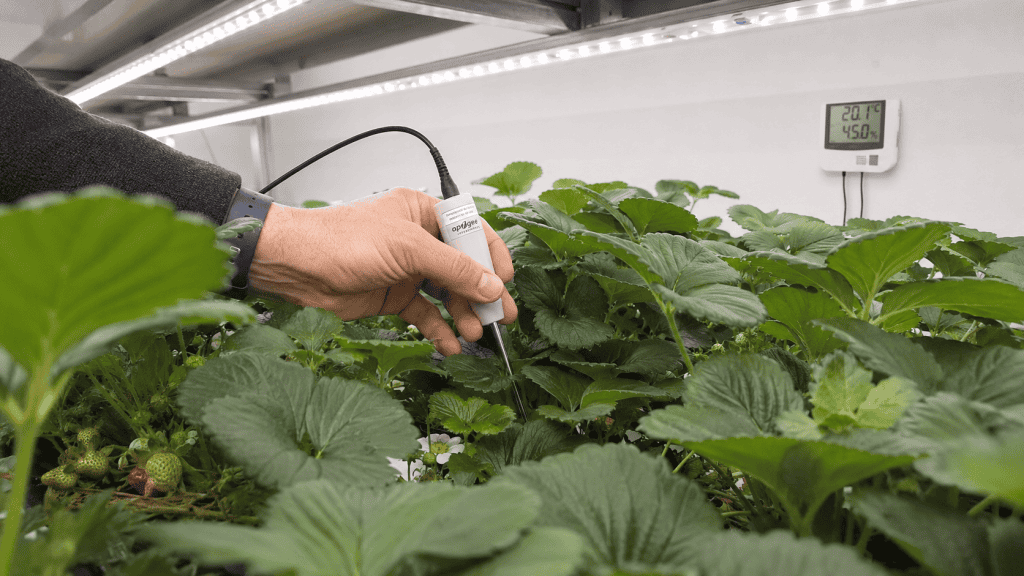
One of the most common mistakes beginner indoor gardeners make when setting up a grow tent is relying on a single, cheap plastic hygrometer attached to a wall or dangling near the zipper door.
This placement only measures the climate of the open air space, not the actual environment surrounding the plants. Dense, sweating foliage creates its own micro-ecosystem. Even if a wall sensor reads a perfect 50% relative humidity (RH), the stagnant air deep inside the plant canopy can easily reach a dangerous 65% RH.
The Hidden Danger of Microclimates
In commercial cultivation facilities, experienced growers know to closely monitor the center of dense, bushy strains. Large plants actively create microclimates by trapping heavily transpired moisture. Without proper under-canopy pruning, this trapped humidity creates an ideal environment for mold to thrive.
Ultimately, the humidity immediately surrounding the leaves is often significantly higher than the reading shown by a single, poorly placed sensor. To maintain an optimal environment, growers must measure the climate directly within the plant canopy rather than relying on ambient room readings.
What Are Grow Room Microclimates?
Microclimates are small areas within a grow room where environmental conditions differ from the rest of the space.
They commonly develop because of:
- Dense plant growth
- Weak airflow
- Poor ventilation
- Crowded plant spacing
- Uneven fan coverage
These hidden zones often become the starting point for mold, mildew, and other plant health issues.
Where Should Humidity Sensors Be Placed?
For more accurate readings:
- Position sensors at canopy level
- Avoid direct light exposure
- Use multiple sensors when possible
- Monitor both upper and lower canopy areas
- Check readings regularly as plants grow
Single sensors create massive blind spots. Microclimates shift constantly across your canopy during a light cycle. Deploying multiple sensors across different vertical zones maps your actual room conditions accurately.
The Power of a Lung Room: Stop Fighting Your Grow Tent
Cramming residential-grade humidifiers or space-hogging dehumidifiers directly inside a 4×4 grow tent is a common mistake that often leads to immediate equipment failure. When an inline exhaust fan replaces a tent’s air volume multiple times per minute, it instantly exhausts the moisture created by small misting units.
This setup forces small, domestic electronics to run continuously at a 100% duty cycle, burning out equipment motors within a single season, spiking electricity costs, and creating severe electrical hazards near water reservoirs.
Shifting Control to the Lung Room
Instead of forcing small equipment to work inefficiently inside a confined footprint, an advanced engineering approach relies on conditioning the “Lung Room” the larger, sealed buffer environment that encloses individual tents.
By sizing the lung room’s HVAC system to handle the total BTU heat load and moisture output of the entire space, commercial-grade dehumidifiers and split-system AC units can process the raw intake air efficiently. The air is perfectly balanced and stabilized before it ever reaches the tent’s intake fan.
Key Benefits of Lung Room Conditioning
Managing the environment from the outside provides several critical advantages for the indoor canopy:
| Benefit | Impact on Cultivation |
| Maximized Canopy Space | Removing bulky equipment frees up valuable floor space for plant growth and better airflow. |
| Elimination of Spikes | Pre-conditioned air stops radical environmental swings when lights turn on or off. |
| Precise VPD Management | Stably controlled intake air ensures Vapor Pressure Deficit (VPD) targets stay consistent. |
| Extended Equipment Lifespan | Commercial-grade units in a larger room experience reduced equipment cycling compared to overworked residential units. |
Ultimately, establishing a stable microclimate is far easier to achieve when the entire footprint works together as a unified system, ensuring better consistency across all growth stages.
How Can You Maintain Stable Humidity in a Grow Room?
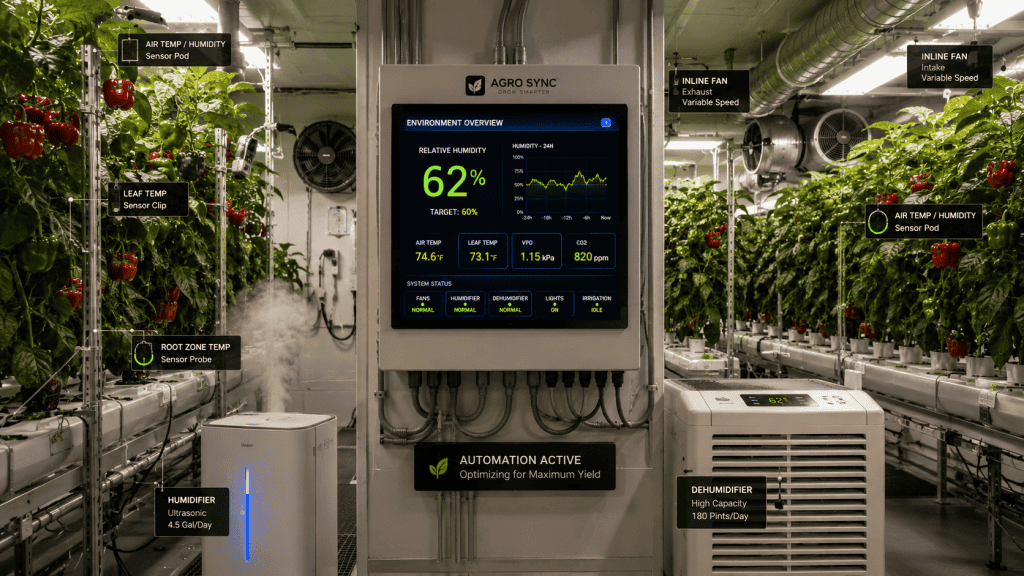
Humidity control works best when several environmental systems work together.
Rather than relying on one device, successful growers combine monitoring, ventilation, airflow, and climate control.
Use Humidifiers Strategically
Humidifiers are especially useful during:
- Seedling production
- Clone propagation
- Dry winter months
- Low-humidity indoor environments
Don’t guess your moisture inputs. If your room needs a humidifier during propagation, skip the cheap tabletop units. An undersized humidifier runs continuously until it burns out its motor, while an oversized, non-automated unit dumps unregulated water vapor, causing condensation pools that invite root rot.
Deploy Dehumidifiers During Flowering
Massive floral canopies sweat constantly. This continuous transpiration drives up the room’s moisture levels every single day. Heavy-duty dehumidifiers pull this excess moisture directly out of the air to keep your flowering zones safely below the mold threshold.
This becomes increasingly important as plant density increases.
Improve Air Circulation
Good airflow helps distribute temperature and humidity evenly throughout the room.
Common airflow tools include:
- Oscillating fans
- Under-canopy fans
- Exhaust systems
- Intake fans
- Ventilation controllers
Let’s be clear: fans do not remove moisture from the air; only a dedicated compressor or exhaust system can do that. However, To break up the stagnant boundary layer under your leaves, you need a target airflow speed of 0.3 to 0.5 meters per second across the canopy.
We achieve this by cross-angling multi-directional fans, which continuously strip away the micro-pocket of humid air clinging to the stomata.
By strategically placing oscillating fans above and multi-directional inline fans below the canopy, we constantly strip away this wet boundary layer, forcing the plant to transpire efficiently even when the room’s total humidity climbs slightly higher than our target.
Monitor Conditions Continuously
Environmental conditions can change quickly throughout the day.
Modern monitoring systems allow growers to track:
- Relative humidity
- Temperature
- VPD
- Equipment performance
- Long-term environmental trends
Reviewing this information regularly helps identify problems before they affect plant health.
What Humidity Mistakes Cause the Biggest Grow Room Problems?

Credits: Everest Fernandez
Many humidity-related issues begin with small mistakes that seem harmless at first.
Common errors include:
- Using the same humidity target from seedling to harvest
- Ignoring VPD
- Relying on a single sensor
- Poor fan placement
- Measuring humidity away from the canopy
- Overcrowding plants
- Using improperly sized equipment
- Neglecting the lung room
These issues often develop slowly. By the time visible symptoms appear, plants may already be under stress.
Making stage-specific adjustments throughout the grow cycle usually produces better results than trying to maintain one fixed humidity level.
How to Build the Ideal Humidity Strategy for Maximum Growth and Yield
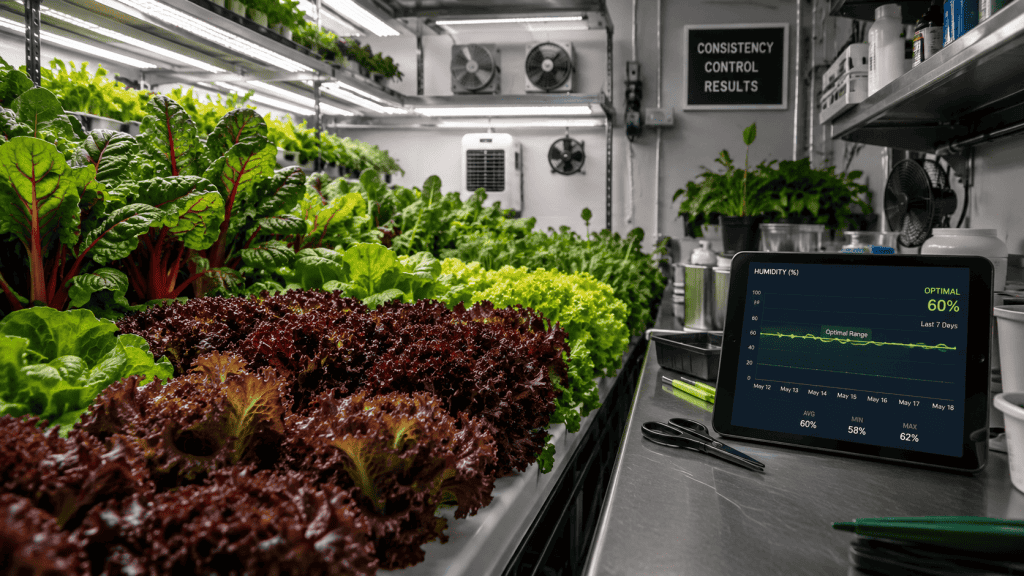
The most effective humidity strategy changes as plants mature.
Young plants need higher humidity because their root systems are still developing. Mature plants need lower humidity to support transpiration and reduce disease pressure.
A practical approach includes:
- Matching RH to each growth stage
- Monitoring VPD alongside humidity
- Measuring conditions at canopy level
- Maintaining consistent airflow
- Managing the lung room environment
- Using properly sized climate-control equipment
- Reviewing environmental data regularly
- Gradually lowering humidity during flowering
Growers who follow these principles often see healthier plants, more consistent growth, and fewer environmental problems.
FAQ
How Do Humidity Fluctuations Affect Plant Growth?
Rapid climate spikes disrupt steady transpiration. Wild humidity swings shock your plants. The leaves constantly snap their stomata shut to lock in water, which immediately stalls your root zone’s ability to pull up nutrients. Keeping your climate dead-steady keeps the plant’s metabolism running smoothly. This constant flip-flopping triggers severe environmental stress, which instantly stalls nutrient uptake and shocks your root zone. Stable grow room humidity helps plants maintain consistent growth, water movement, and overall health.
What Tools Are Best for Monitoring Grow Room Humidity?
The most reliable way to track relative humidity in grow rooms is by using humidity sensors placed at canopy level. A hygrometer for grow room monitoring or a digital humidity meter provides real-time readings that help growers identify environmental changes. Using multiple sensors improves environmental monitoring because humidity levels can vary throughout the canopy. Accurate measurements support better humidity management and climate control decisions.
Why Is Airflow Important for Humidity Control?
Airflow helps distribute moisture evenly throughout the indoor cultivation environment. Without proper air circulation in grow rooms, moisture can accumulate around leaves and create conditions that encourage disease development. Effective grow room ventilation uses intake fans for grow rooms and exhaust fans for humidity control to remove excess moisture and bring in fresh air. Good airflow supports more stable humidity levels and healthier plant growth.
How Does High Humidity Increase the Risk of Plant Diseases?
High humidity creates favorable conditions for fungal diseases because moisture remains on plant surfaces for longer periods. Excess moisture increases the likelihood of problems such as powdery mildew and bud rot, especially in dense plant canopies. Preventing mold in grow rooms requires maintaining proper humidity levels, improving airflow, and monitoring conditions regularly. Consistent humidity control reduces disease pressure and protects crop quality throughout the growing cycle.
When Should Humidifiers or Dehumidifiers Be Used?
Humidity control equipment should be used whenever grow room conditions fall outside the target range for a specific growth stage. A humidifier for growing tent environments is most useful during seedling humidity and propagation humidity stages when young plants require more moisture in the air. A dehumidifier for grow room environments becomes more important during flowering, when lower humidity helps reduce disease risk and maintain healthy growing conditions.
Final Thoughts on Grow Room Humidity
Mastering grow room humidity is ultimately the dividing line between an average harvest and a record-breaking yield. Keeping your air parameters tightly dialed in protects your investments in expensive lights, genetic clones, and high-end nutrients.
Start small by stabilizing your lung room environment, track your target VPD step-by-step, and let the plant’s metabolism do the heavy lifting.
The good news is that you don’t need to make major changes all at once. Small adjustments, backed by VPD tracking and reliable environmental data, can help create more consistent conditions. When your grow room stays stable, it’s easier to support healthy plant development and avoid many common growing issues from start to finish.
References
- https://journals.ashs.org/downloadpdf/view/journals/hortsci/25/5/article-p524.pdf#2#1
- https://pubmed.ncbi.nlm.nih.gov/34319639/
Related Articles
- https://tophydroponicgarden.com/hydroponics-for-beginners/
- https://tophydroponicgarden.com/hydroponic-garden-maintenance/
- https://tophydroponicgarden.com/balancing-ph-in-your-hydroponic-garden/
Was this helpful?
I’m Barrie L., a passionate hydroponic gardening enthusiast dedicated to cultivating thriving, soil-less gardens. With a focus on all things hydroponic, I share my expertise on innovative growing techniques and sustainable practices through my blog, tophydroponicgarden.com. As a seasoned hydroponics specialist, my goal is to inspire and guide fellow gardeners in harnessing the power of water-based cultivation for bountiful and eco-friendly harvests. I’m also an author of the book “Hydroponics For Absolute Beginners: Your Step By Step Guide For How To Create An Hydroponics System At Home Without Soil, For Growing Vegetable, Fruit And Herbs.” which is sold on Amazon. Join me on a journey of redefining the way we cultivate plants, one nutrient-rich solution at a time. Happy growing!