
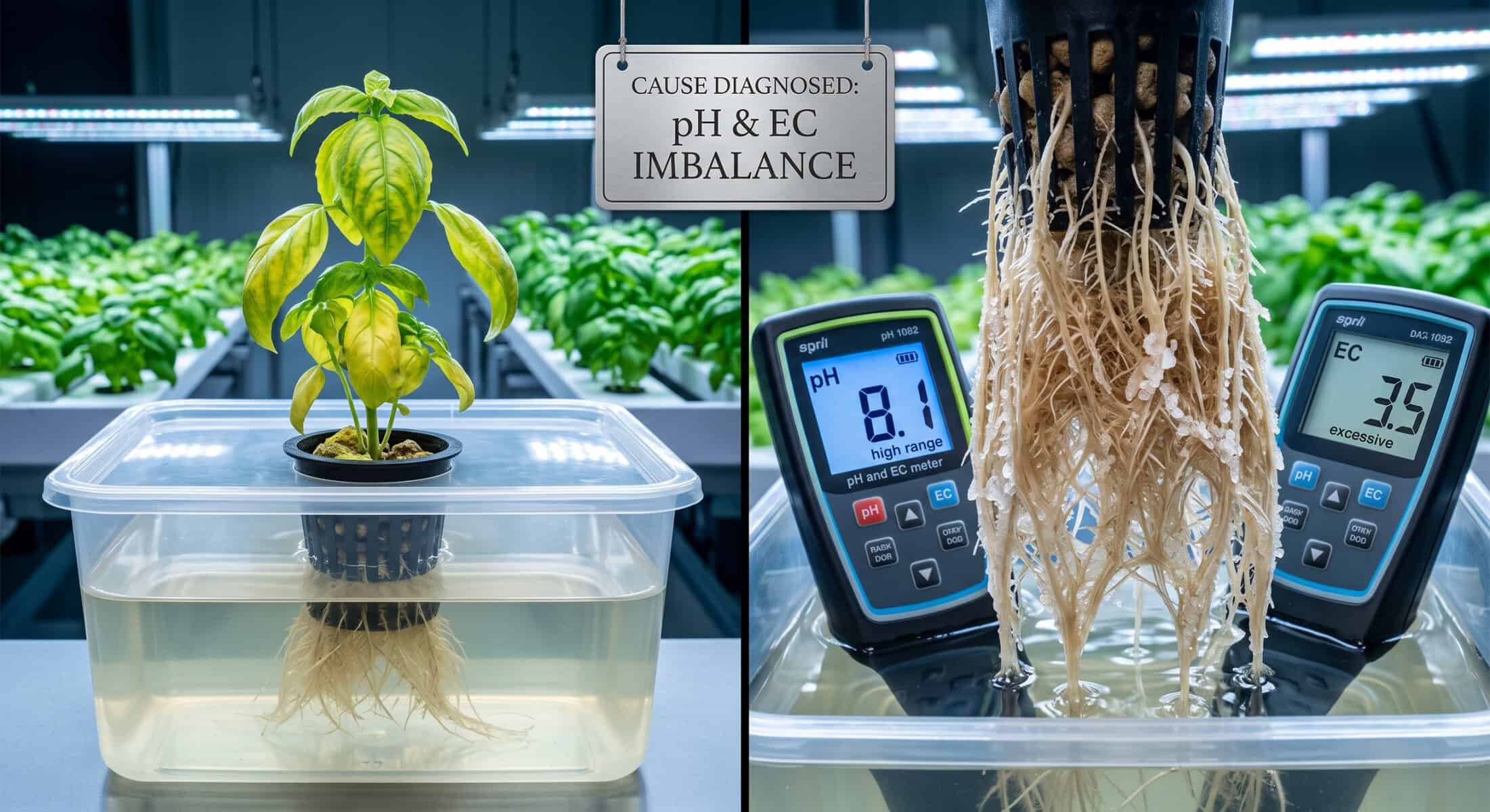
Hydroponic plants can sometimes show signs of nutrient deficiency even when the nutrient reservoir contains enough fertilizer. This situation is commonly referred to as nutrient lockout.
Nutrient lockout occurs when nutrients are present but are not available for efficient uptake by plant roots. Incorrect pH, excessive EC, salt accumulation, nutrient imbalance, poor water quality, and unhealthy roots can all contribute to this problem.
Adding more fertilizer is not always the solution. In some cases, increasing the nutrient concentration can make the situation worse.
Understanding the causes of nutrient lockout helps growers diagnose problems more accurately and maintain healthier hydroponic plants.
UNDERSTANDING NUTRIENT LOCKOUT IN HYDROPONICS
Nutrient lockout occurs when plants cannot efficiently absorb nutrients that are present in the growing environment.
- Understand Nutrient Availability. Learn why nutrients can be present in water but still become unavailable to plant roots.
- Monitor pH and EC. Understand how nutrient-solution chemistry influences nutrient uptake.
- Identify the Root Cause. Learn why correcting the underlying problem is more effective than simply adding additional fertilizer.
What Is Nutrient Lockout?
Nutrient lockout is a condition in which essential nutrients are present in the growing medium or nutrient solution but are unavailable for effective plant uptake.
In hydroponics, plants receive nutrients directly through water. This makes the chemical conditions of the nutrient solution particularly important.
When pH or nutrient concentration moves outside an appropriate range, certain nutrients may become less available to the roots.
Plants can then develop symptoms such as yellowing leaves, stunted growth, discoloration, and weak development.
Why Does Nutrient Lockout Happen?
The main causes include:
- Incorrect pH
- Excessive EC
- Salt buildup
- Nutrient imbalance
- Poor source water
- Incorrect nutrient mixing
- Damaged roots
- Poor root-zone conditions
pH is especially important because it influences whether nutrients remain available to plant roots.
Oklahoma State University Extension explains that pH directly affects nutrient availability.
“The pH of a nutrient solution influences the availability of nutrients.” — Oklahoma State University Extension
For growers who want to understand pH management in more detail, this guide on how to test the pH of your nutrient solution provides a practical starting point.
How Does EC Cause Nutrient Lockout?
EC measures the electrical conductivity of a nutrient solution and is commonly used to estimate dissolved salt concentration.
When EC becomes too high, the nutrient solution can become excessively concentrated.
University of Minnesota Extension warns that excessive nutrients can negatively affect plant water uptake.
“Excessive nutrients in the solution can negatively affect the ability of the plants to uptake water.” — University of Minnesota Extension
This is why nutrient management requires balance rather than simply increasing fertilizer strength.
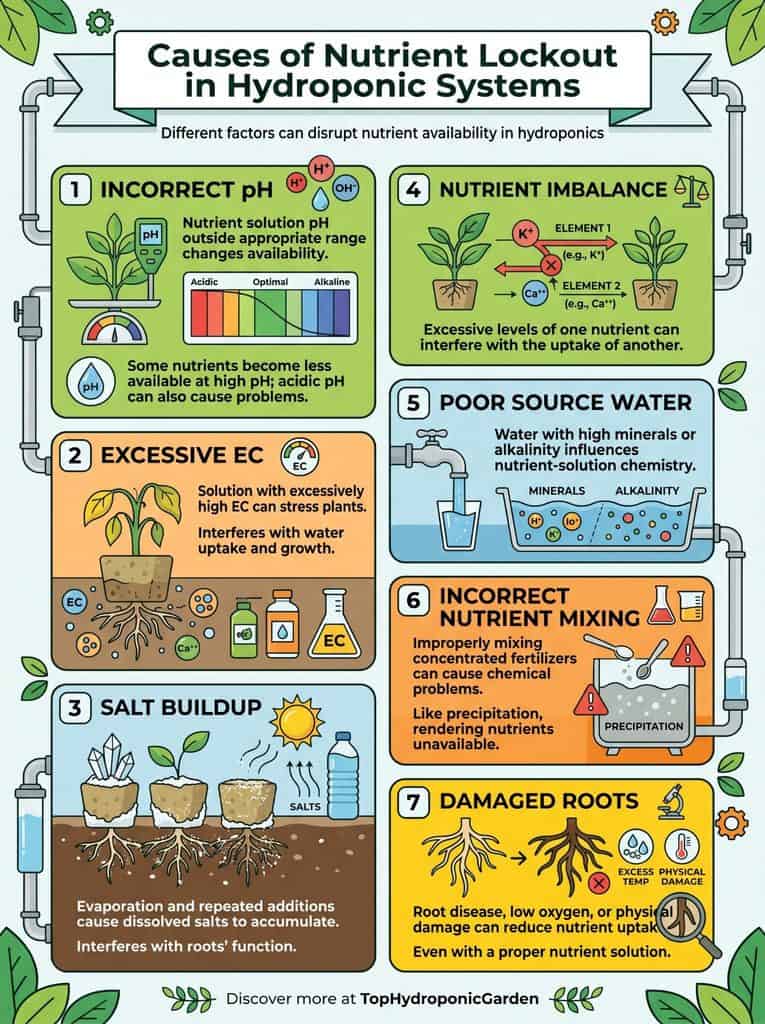
Causes of Nutrient Lockout in Hydroponic Systems
1. Incorrect pH
When nutrient-solution pH moves outside the appropriate range, nutrient availability can change.
Some nutrients become less available at higher pH, while other nutrient-availability problems can occur when pH becomes excessively acidic.
2. Excessive EC
A nutrient solution with an excessively high EC can stress plants and interfere with water uptake.
3. Salt Buildup
Evaporation and repeated nutrient additions can cause dissolved salts to accumulate.
4. Nutrient Imbalance
Excessive levels of one nutrient can interfere with the uptake or availability of another.
5. Poor Source Water
Water containing high levels of minerals or alkalinity can influence nutrient-solution chemistry.
6. Incorrect Nutrient Mixing
Improperly mixing concentrated fertilizer products can cause precipitation or other chemical problems.
7. Damaged Roots
Root disease, low oxygen, excessive temperature, or physical damage can reduce nutrient uptake even when the nutrient solution is properly prepared.
What Does Nutrient Lockout Look Like?
| Symptom | Possible Connection |
| Yellow leaves | Reduced nutrient availability or uptake |
| Interveinal chlorosis | Possible micronutrient availability problem |
| Brown leaf edges | Nutrient or water-uptake stress |
| Stunted growth | Reduced nutrient or water uptake |
| Weak new growth | Nutrient availability or root problem |
Symptoms alone cannot confirm nutrient lockout.
Testing pH and EC and inspecting the roots provides more useful information.
Nutrient Deficiency vs Nutrient Lockout
| Nutrient Deficiency | Nutrient Lockout |
| Nutrient may be insufficient | Nutrient may already be present |
| Often related to inadequate feeding | Often related to pH, EC, or nutrient imbalance |
| Adding the deficient nutrient may help | Adding more fertilizer may worsen the problem |
| Requires checking nutrient formulation | Requires checking pH, EC, water, and roots |
How to Diagnose Nutrient Lockout
1. Check pH
Measure the nutrient solution and compare it with the crop’s recommended range.
2. Check EC
Determine whether the nutrient solution is too concentrated or too dilute.
3. Inspect the Water
Consider whether evaporation or repeated top-ups have increased nutrient concentration.
4. Inspect the Roots
Look for discoloration, slime, unusual odors, or other signs of root stress.
5. Review Your Feeding Routine
Check whether you recently increased fertilizer, changed nutrient products, or added nutrients without testing EC.
How to Prevent Nutrient Lockout
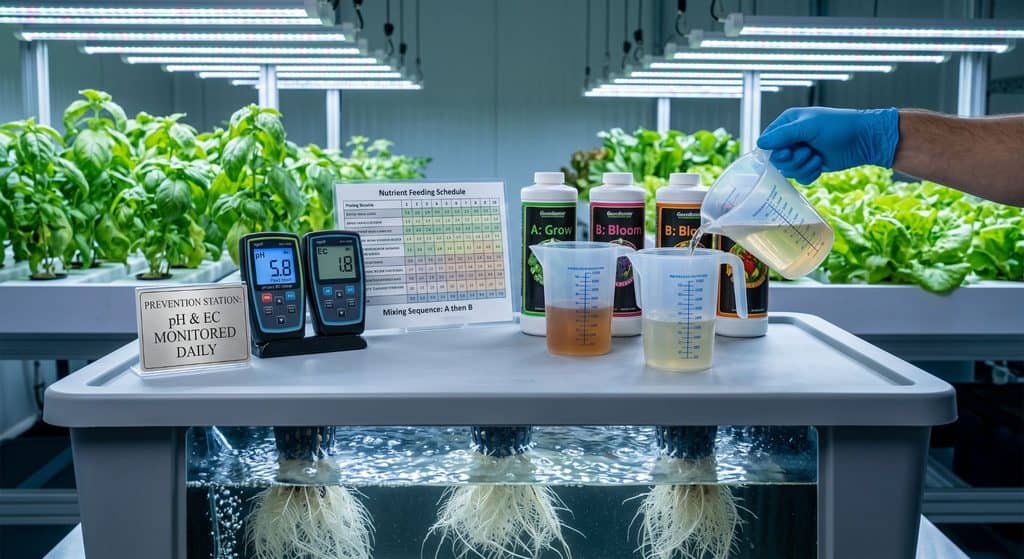
Regular monitoring is the most effective starting point.
Maintain appropriate pH and EC, avoid excessive fertilizer, use suitable source water, and keep roots healthy.
When preparing nutrients, follow the manufacturer’s mixing instructions carefully.
If you are experiencing persistent nutrient problems, this guide on how to fix nutrient lockout in hydroponics provides additional troubleshooting steps.
Common Mistakes That Cause Nutrient Lockout
1. Adding More Fertilizer Immediately
Deficiency symptoms do not automatically mean the plant needs more nutrients.
2. Ignoring pH
Incorrect pH can make nutrients less available even when they are present.
3. Ignoring EC
High EC can indicate excessive dissolved salts.
4. Neglecting Source Water
Water chemistry contributes to the final nutrient solution.
5. Ignoring Root Health
Healthy roots are necessary for effective nutrient uptake.
For a broader understanding of how nutrient formulations work, explore this guide on understanding hydroponic nutrient formulas.
Frequently Asked Questions About Nutrient Lockout
1. What is nutrient lockout?
Nutrient lockout occurs when nutrients are present but plants cannot absorb them efficiently.
2. What causes nutrient lockout?
Common causes include incorrect pH, excessive EC, salt buildup, nutrient imbalance, poor source water, incorrect mixing, and unhealthy roots.
3. Can more fertilizer fix nutrient lockout?
Not necessarily. If the problem is excessive EC or unsuitable pH, adding more fertilizer can make the situation worse.
4. How can I diagnose nutrient lockout?
Check pH and EC, inspect the roots, examine source water, and review recent changes to the nutrient solution.
5. How can nutrient lockout be prevented?
Maintain appropriate pH and EC, avoid overfertilization, use suitable water, mix nutrients correctly, and maintain healthy roots.
Preventing Nutrient Lockout in Hydroponics
Nutrient lockout is not simply a problem of having too little fertilizer. In many cases, the issue is that nutrients are already present but are not available to the plant in a form or condition that allows effective uptake.
When pH, EC, salt concentration, nutrient balance, water quality, or root health falls outside an appropriate range, plants may struggle to absorb the nutrients they need.
The best response is therefore to diagnose the hydroponic system before adding more fertilizer. Check pH and EC, inspect the roots, evaluate the source water, and review how the nutrient solution is being mixed and maintained.
By focusing on the underlying cause rather than only treating visible deficiency symptoms, hydroponic growers can maintain a more stable nutrient environment and improve nutrient availability for healthier plant growth.
Explore more hydroponic nutrient guides, troubleshooting information, and practical growing tips through TopHydroponic to better manage nutrient balance and maintain a healthier hydroponic system.
REFERENCES
- https://extension.okstate.edu/fact-sheets/electrical-conductivity-and-ph-guide-for-hydroponics
- https://extension.umn.edu/garden-and-home/yard-and-garden/gardening-in-minnesota/small-scale-hydroponics
RELATED ARTICLES
- https://tophydroponicgarden.com/how-to-test-the-ph-of-your-nutrient-solution/
- https://tophydroponicgarden.com/how-to-fix-nutrient-lockout-in-hydroponics/
- https://tophydroponicgarden.com/understanding-hydroponic-nutrient-formulas/
Was this helpful?
