

Flushing a hydroponic system means cleaning it. You push plain, pH-balanced water through the pipes, pumps, and reservoirs to clear out old nutrient salts, algae, or mineral gunk.
It’s basic maintenance, something the University of Minnesota Extension recommends for crops that grow a long time. This guide explains when you should flush, how it’s not the same as just changing the water, and the best way to do it for your setup.
Hydroponic Flushing Essentials
- Flushing gets rid of salt buildup, plant waste, and other gunk that can hurt your plants.
- It’s a specific cleaning step, not just adding more water or swapping nutrients.
- Doing it regularly keeps your electrical conductivity (EC) stable, your pH in check, your roots healthy, and your equipment from clogging.
What is Flushing a Hydroponic System
Flushing is when you run clean, pH-adjusted water through every part of your hydroponic setup, the tank, the tubes, the pump, and the roots. The goal is to wash away leftover fertilizer salts, plant waste, and mineral scale before you put in new nutrients. It’s a deep clean, not just dumping out the old water and pouring in new.
Over several weeks, heavy-feeding crops typically consume water faster than taking up specific minerals like calcium. Direct field observations indicate this discrepancy leaves behind a concentrated, unbalanced solution.
Untreated salt crusts routinely reduce pump efficiency by significant margins, making a complete system reset critical. The University of Minnesota Extension points out that longer-growing crops, like tomatoes, often need their nutrient solution completely swapped out one or two times.
Why growers flush their systems:
- To clear salt buildup from around the roots.
- To fix a nutrient imbalance in the water.
- To improve the overall water quality.
- To stop emitters, pumps, and tubing from getting blocked.
- To prepare the system for a fresh batch of nutrients.
Flushing also gives you a chance to check your equipment, clean filters, and scrub out algae before small issues turn into big ones. For quick crops like many leafy greens, you might get through a whole cycle without a full flush. But for plants that fruit and grow for months, it’s usually necessary.
The Importance of Flushing Hydroponic System

Flushing keeps your nutrients balanced, your roots healthy, and your pumps and tubes from clogging up. Your plants need a steady supply of oxygen, water, and food.
When too many fertilizer salts pile up, they can stop the roots from absorbing nutrients properly. This is called nutrient lockout. The salt also makes the water’s electrical conductivity (EC) spike.
Experts at the University of Florida say you should watch your nutrient levels to know when salt buildup is bad enough to need fixing. A good flush also cleans your system. It cuts down on algae, slimy biofilm, and mineral scale that grow in tanks and pipes over time.
What regular flushing does for you:
- Stops nutrient lockout from salt overload.
- Clears out salt deposits in the reservoir and tubing.
- Helps roots stay strong and white.
- Gets rid of biofilm before it blocks water flow.
- Limits algae growth.
- Keeps pumps, drippers, and air stones running smoothly.
But don’t use flushing to avoid checking your water. Often, you can fix a problem just by tweaking your nutrient strength, without doing a full clean-out.
A good tip: always test your EC and pH first. That tells you if you need a full flush or just a small adjustment. A standard commercial benchmark, supported by University of Florida extension guidelines, relies on monitoring runoff EC.
When runoff measures roughly 1.0 mS/cm higher than the freshly mixed nutrient input, severe salt accumulation has occurred. At that threshold, a plain-water flush becomes mandatory to clear the root zone and prevent nutrient lockout.
Understanding Flushing and Nutrient Solution Replacement
Replacing your nutrient solution gives your plants fresh food. Flushing cleans the entire system, the tank, pipes, pump, and roots, to wash away built-up salts and gunk.
A lot of new growers mix up these terms, but they fix different issues. Swapping the solution restores nutrition. Flushing cleans the environment so the new nutrients can actually work. Draining and refilling your tank might be part of flushing, but it doesn’t automatically clean the salt out of your tubing or from around the roots.
This difference really matters in systems where water recirculates, like Deep Water Culture (DWC), Nutrient Film Technique (NFT), ebb and flow, and drip systems. The same water and nutrients keep moving through the same equipment.
As noted by ScienceDirect:
“Owing to limited leaching and the absence of soil-based buffering” – Biosystems Engineering
This is why targeted flushing, rather than simple solution replacement, becomes essential for managing salinity buildup in recirculating setups.
| What you’re doing | What you use | Main goal |
| Replacing nutrients | Fresh nutrient mix | Give plants balanced food |
| Topping off water | Plain water | Replace what evaporated or the plants drank |
| Flushing the system | Clean, pH-balanced water | Remove salts, residue, algae, and buildup |
Many growers do both steps together. They’ll flush the system with plain water, then immediately mix and add a fresh batch of nutrients with the right EC and pH before starting normal feeding again.
The University of Minnesota Extension says how often you change solutions depends on the plant. Long-season fruiting crops usually need more full changes than fast-growing leafy greens.
The Best Time to Flush a Hydroponic System
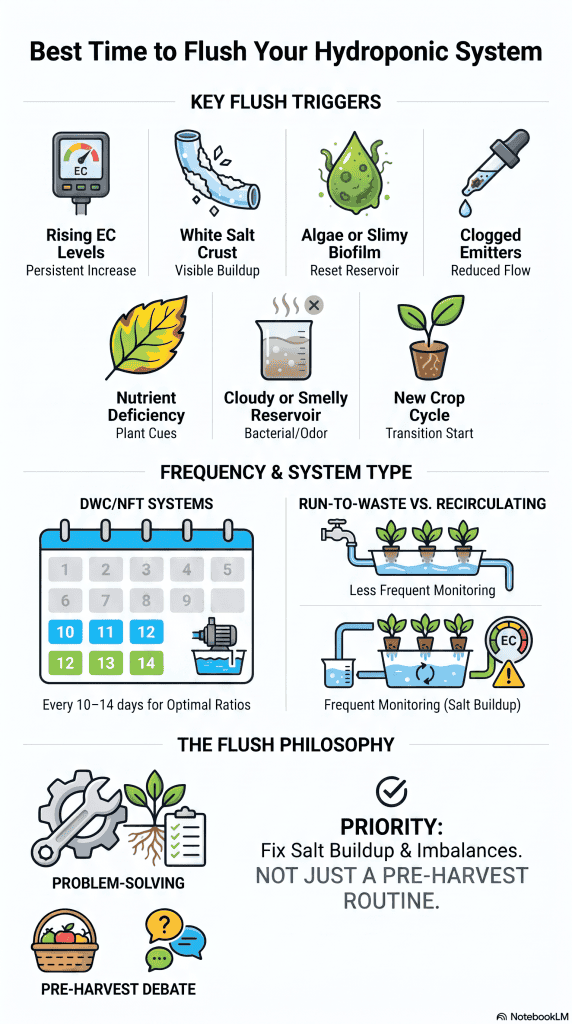
Flush when you see salt buildup, a nutrient imbalance, contamination, or as part of your regular maintenance schedule.
If you wait until your plants look sick, the problem has probably already hurt their growth. Checking your water regularly helps you spot issues early.
Signs it’s time for a flush:
- The EC keeps going up even when you add plain water.
- You can see white salt crust around the reservoir or tubing.
- There’s algae or slimy biofilm inside the equipment.
- Water flow from emitters slows down because they’re clogged.
- Plants show nutrient deficiencies even though you’re feeding them.
- The reservoir water smells bad or looks cloudy.
- You’re starting a new crop cycle.
Your flush schedule won’t be the same as everyone else’s. Tank size, your water quality, the nutrients you use, the plant type, and your grow room conditions all affect how fast minerals build up.
There’s also a current debate among growers. On forums like Reddit and in talks by researchers like Dr. Bruce Bugbee, people are questioning the need for a “pre-harvest flush” meant to improve flavor. Some studies, including work by RX Green Technologies, found that feeding plants right up to harvest often doesn’t change the nutrient content inside the plant much. But everyone still agrees that flushing to fix a measurable salt or imbalance problem is necessary.
That’s the key point. Flushing to fix a problem, like high salt levels, is standard maintenance. Flushing right before harvest just to try and improve quality is still argued about by commercial growers and scientists.
Many small recirculating systems get a full reset every 10 to 14 days. But the best timing comes from watching your plants, tracking your EC, and monitoring conditions, not just following a calendar.
Flushing Schedules for Different Hydroponic Systems
System type dictates the cleaning frequency. In Deep Water Culture (DWC) or Nutrient Film Technique (NFT), a complete system reset every 10 to 14 days prevents rapid salt spikes.
Conversely, run-to-waste setups using coco coir require more frequent runoff EC monitoring; when runoff tests 1.0 mS/cm higher than the input solution, an immediate plain-water flush is necessary to restore the medium’s baseline balance.
Signs it’s time for a flush:
- The EC keeps going up even when you add plain water.
- You can see white salt crust around the reservoir or tubing.
- There’s algae or slimy biofilm inside the equipment.
- Water flow from emitters slows down because they’re clogged.
- Plants show nutrient deficiencies even though you’re feeding them.
- The reservoir water smells bad or looks cloudy.
- You’re starting a new crop cycle.
Your flush schedule won’t be the same as everyone else’s. Tank size, your water quality, the nutrients you use, the plant type, and your grow room conditions all affect how fast minerals build up.
There’s also a current debate among growers. On forums like Reddit and in talks by researchers like Dr. Bruce Bugbee, people are questioning the need for a “pre-harvest flush” meant to improve flavor. Some studies, including work by RX Green Technologies, found that feeding plants right up to harvest often doesn’t change the nutrient content inside the plant much. But everyone still agrees that flushing to fix a measurable salt or imbalance problem is necessary.
That’s the key point. Flushing to fix a problem, like high salt levels, is standard maintenance. Flushing right before harvest just to try and improve quality is still argued about by commercial growers and scientists.
Many small recirculating systems get a full reset every 10 to 14 days. But the best timing comes from watching your plants, tracking your EC, and monitoring conditions, not just following a calendar.
Step-by-Step Guide to Flushing a Hydroponic System
Cleaning Our Hydroponic Rail System
YouTube: Simple Greens Hydroponics
A complete hydroponic flush involves draining the old nutrient solution, circulating clean pH-balanced water, cleaning system components, and refilling with fresh nutrients.
Although the exact process varies slightly between systems, the basic workflow remains consistent. According to routine maintenance guidance from commercial hydroponic manufacturers and educational resources, flushing works best when paired with a complete inspection of the reservoir and irrigation equipment.
Follow these steps.
- Turn off pumps and circulation equipment.
- Drain the reservoir completely to remove the old nutrient solution.
- Inspect the reservoir for algae, biofilm, mineral crust, or debris.
- Clean the hydroponic reservoir using clean water and appropriate sanitation methods if necessary.
- Refill with clean water, preferably reverse osmosis (RO) or distilled water for low starting EC.
- Adjust the pH to approximately 5.5–6.5, depending on the crop.
- Circulate the water throughout the entire system so it reaches the hydroponic root zone.
- Drain the flush water after the appropriate flushing period.
- Mix a fresh nutrient solution, verify EC and pH, then restart normal operation.
Before restarting the system, inspect every major component.
- Filters
- Air stones
- Pumps
- Irrigation tubing
- Emitters
- Reservoir seals
Beyond that, many growers also check root color and odor during reservoir flushing. Healthy hydroponic roots are generally light-colored, firm, and free of slimy residue.
In a recent analysis by the National Institutes of Health:
“Salinity accumulation from salt buildup causes “osmotic and ionic disruptions” that can reduce productivity by 10-15% per unit increase above optimal levels. This underscores why monitoring and flushing are critical, not optional, for maintaining commercial viability.” – National Institutes of Health (NIH)
Of course, advanced growers sometimes avoid dropping EC directly from a high nutrient concentration to nearly 0.0 EC. Instead, they gradually reduce nutrient strength over several days to avoid sudden osmotic stress, especially in sensitive crops.
Can You Flush with Only Water?
For basic cleaning, plain pH-balanced water is usually enough to wash out extra nutrient salts and freshen up the system.
A water-only flush works fine for regular maintenance, cleaning the tank, or fixing a minor salt problem. A lot of growers use reverse osmosis (RO) water because it has almost no minerals in it to start, so it can break down built-up salts better.
When a plain water flush is fine:
- Draining and refilling the reservoir.
- Resetting your nutrient balance.
- Dealing with mild salt buildup.
- Doing preventive system maintenance.
- In between full nutrient changes.
When you might need something stronger:
- Fighting heavy algae growth.
- Removing thick, slimy biofilm.
- Cleaning long-term mineral scale.
- Sanitizing at the end of a season.
- Fixing severe nutrient lockout.
For tough jobs, you can buy commercial flushing products. These often have enzymes or special compounds to break up stubborn deposits. Products with cleaning enzymes are usually saved for the break between crops, not used during normal growing.
Just remember, a routine flush shouldn’t wipe out all the microbes in a healthy root zone. In some systems, those good bacteria and fungi can actually help the roots work better.
A good rule is to flush until the water coming out has an EC close to your source water. That means most of the old nutrient salts are gone.
Common Hydroponic Flushing Mistakes to Avoid
Most problems happen because people flush too much, don’t check their water, or forget to look at their equipment.
Consistency is key. Flushing too much strips away nutrients the plants need. Not flushing enough lets salts build up and block nutrient uptake.
Mistakes to watch for:
- Not paying attention when your EC keeps rising.
- Forgetting to adjust the pH of your flush water.
- Using untreated tap water that’s full of minerals.
- Not cleaning the filters.
- Leaving biofilm inside the tubing.
- Refilling the system without checking the pumps first.
- Waiting until plants show bad deficiencies to act.
- Doing repeated water flushes and then not giving the plants any nutrients afterward.
The University of Florida points out that you should put nutrients back in after flushing. Don’t leave your plants in plain water for a long time, unless that’s specifically what you’re trying to do.
There’s also a big mix-up about “pre-harvest” flushing. A lot of growers do it hoping to improve taste, but research from people like Dr. Bruce Bugbee shows there’s little proof that flushing by itself makes harvested crops taste better or have fewer nutrients inside. That doesn’t mean flushing is useless. It’s still a solid fix for nutrient toxicity, recovering from feed problems, keeping your reservoir clean, and maintaining your equipment.
The Impact of Flushing on Plant Health
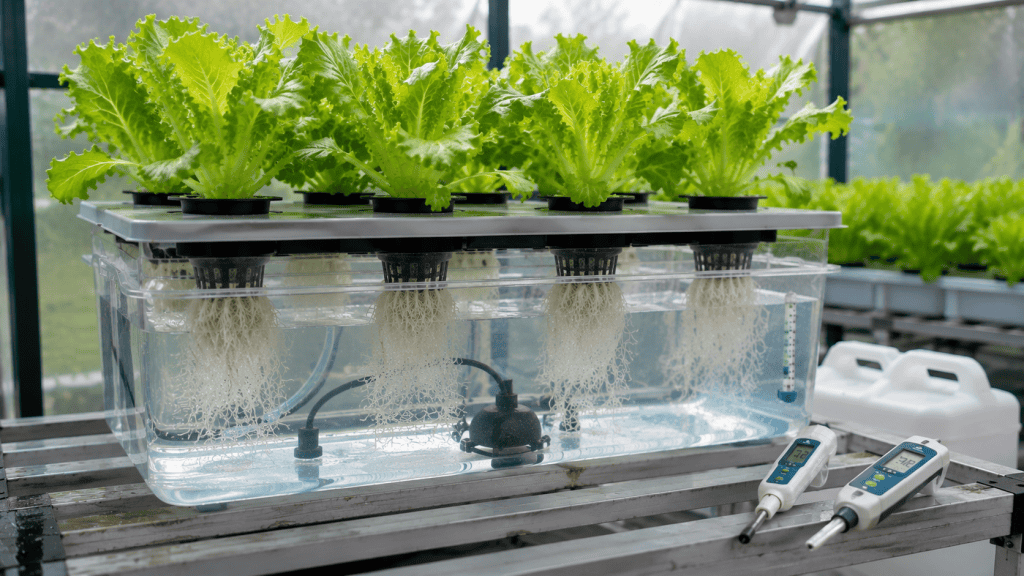
Flushing regularly helps your plants by cutting down on salt, making nutrients easier to absorb, and keeping your pumps and tubes clean.
Plants need more than just food. They need stable salt levels (EC), the right pH, clean water, enough oxygen, and water that keeps moving. Flushing fixes things when too much salt or gunk gets in the way of those needs.
What flushing can do for your plants:
- Helps roots take in nutrients more easily.
- Lowers the chance of nutrient lockout.
- Keeps equipment like pumps and drippers from clogging.
- Makes your EC readings steadier and more predictable.
- Improves the overall quality of your water.
- Promotes stronger, whiter roots.
- Limits algae and slimy biofilm growth.
A crop that grows for months, like tomatoes, will usually need a tank cleaning more often than fast lettuce. That’s because the same nutrients are circulating for a much longer time.
Still, flushing is just one piece of the puzzle. Things like your lights, how much oxygen is in the water, water temperature, the nutrient brand you use, and your room’s climate often have a bigger direct impact on how your plants grow than how often you flush.
Creating a Routine Maintenance Plan
The most effective maintenance strategies rely on daily metrics rather than calendar dates. Waiting for visible plant stress indicates that growth has already stalled. Logging EC, pH, and reservoir clarity daily helps spot elemental buildup trends before irreversible damage occurs.
A straightforward maintenance plan:
- Check the EC at least once a week.
- Test the pH every time you add nutrients.
- Look over your pumps, filters, and tubing for blockages or wear.
- Always flush the system between one crop and the next.
- Do a full reservoir replacement when your readings say you need to.
- Flush more or less often depending on your plant type and your tap water.
- Keep a logbook of what you did and when.
Before you start your system back up, run through this list:
- Tank is scrubbed clean.
- All tubing is checked and clear.
- Pumps are working properly.
- A fresh batch of nutrients is mixed.
- The EC of the new solution is correct.
- The pH is balanced.
- Your source water quality is good (like using filtered or RO water).
Sticking to this routine keeps your nutrients in balance and stops a lot of common problems before they can ruin your season.
FAQ
Can reverse osmosis water improve hydroponic system flushing?
Yes. A reverse osmosis water flush removes nutrient salts more effectively because the water starts with very few dissolved minerals. This makes hydroponic system flushing more efficient and helps maintain better hydroponic water quality. If reverse osmosis water is unavailable, distilled water flush hydroponics is another suitable option for routine maintenance.
Does flushing help prevent nutrient lockout over time?
Yes. Regular hydroponic flush removes excess salts before they interfere with nutrient absorption. This process helps prevent nutrient lockout, supports hydroponic root health, and maintains a stable hydroponic pH balance. Combining flushing with regular EC and pH checks gives plants a more consistent growing environment and reduces avoidable nutrient problems.
Should you replace nutrients immediately after flushing?
Yes. After nutrient solution drainage, refill the system with a fresh nutrient solution instead of leaving roots in plain water for long periods. A proper hydroponic solution exchange restores nutrients, supports hydroponic nutrient management, and helps plants continue growing without unnecessary stress or nutrient deficiencies.
Can flushing improve long-term hydroponic system maintenance?
Yes. Routine hydroponic system maintenance includes hydroponic reservoir maintenance, hydroponic cleaning routine, and occasional complete reservoir replacement when needed. Following a hydroponic maintenance checklist helps keep pumps, tubing, and reservoirs clean while reducing equipment wear. Regular maintenance also supports healthier roots and more reliable system performance throughout the growing season.
Keep Your Hydroponic System Performing at Its Best
When nutrients build up, your system can become harder to manage and your plants may not grow as well as expected. That’s why regular flushing, along with checking EC and pH, helps keep water quality steady. It makes a real difference.
If you want a simple way to stay on track, keep an eye on your system and make changes based on what you see instead of following a fixed schedule. For more practical tips and easy-to-follow hydroponic guides, tophydroponicgarden is a helpful place to learn and improve your growing routine.
References
- https://www.sciencedirect.com/science/article/abs/pii/S1537511007002760
- https://pmc.ncbi.nlm.nih.gov/articles/PMC12731808/
Related Articles
- https://tophydroponicgarden.com/how-to-properly-clean-a-hydroponic-system/
- https://tophydroponicgarden.com/what-causes-wilting-in-hydroponic-plants/
- https://tophydroponicgarden.com/what-are-the-easiest-hydroponic-herbs/
Was this helpful?

I’m Barrie L., a passionate hydroponic gardening enthusiast dedicated to cultivating thriving, soil-less gardens. With a focus on all things hydroponic, I share my expertise on innovative growing techniques and sustainable practices through my blog, tophydroponicgarden.com. As a seasoned hydroponics specialist, my goal is to inspire and guide fellow gardeners in harnessing the power of water-based cultivation for bountiful and eco-friendly harvests. I’m also an author of the book “Hydroponics For Absolute Beginners: Your Step By Step Guide For How To Create An Hydroponics System At Home Without Soil, For Growing Vegetable, Fruit And Herbs.” which is sold on Amazon. Join me on a journey of redefining the way we cultivate plants, one nutrient-rich solution at a time. Happy growing!