

You look at those complicated hydroponic setups with their tangled tubes and buzzing pumps and wonder if there’s an easier way. There is. Passive hydroponics means growing plants without soil using natural forces like capillary action to deliver water and nutrients. No electricity, no moving parts, just a simple system that works while you’re away.
It’s gardening that respects your time and the environment. This method harnesses basic physics to create self-regulating plant environments. Keep reading to understand how this ancient-yet-modern approach can transform your space into a thriving garden with minimal effort.
Key Takeaways
- Passive hydroponics uses capillary action instead of pumps
- Systems like the Kratky method require zero electricity
- LECA clay pellets are the most common growing medium
The Simple Science Behind Passive Hydroponics

Water moves upward against gravity through small spaces. You see this when a paper towel soaks up a spill. Passive hydroponics uses this capillary action to draw nutrient solution from a reservoir to plant roots. The growing medium acts like a network of tiny straws, essential for efficient nutrient absorption without soil.
Plants only take what they need. There’s no risk of overwatering because the system self-regulates. Roots get constant moisture without drowning. Oxygen reaches them through air pockets in the medium. It’s a balanced environment that mimics natural conditions.
The Kratky method takes this further. Plants sit on a floating platform above a nutrient solution. As roots grow downward and drink, the water level drops. An air gap forms naturally, providing oxygen. No wicks, no pumps, just clever design.
How Passive Systems Differ From Active Hydroponics
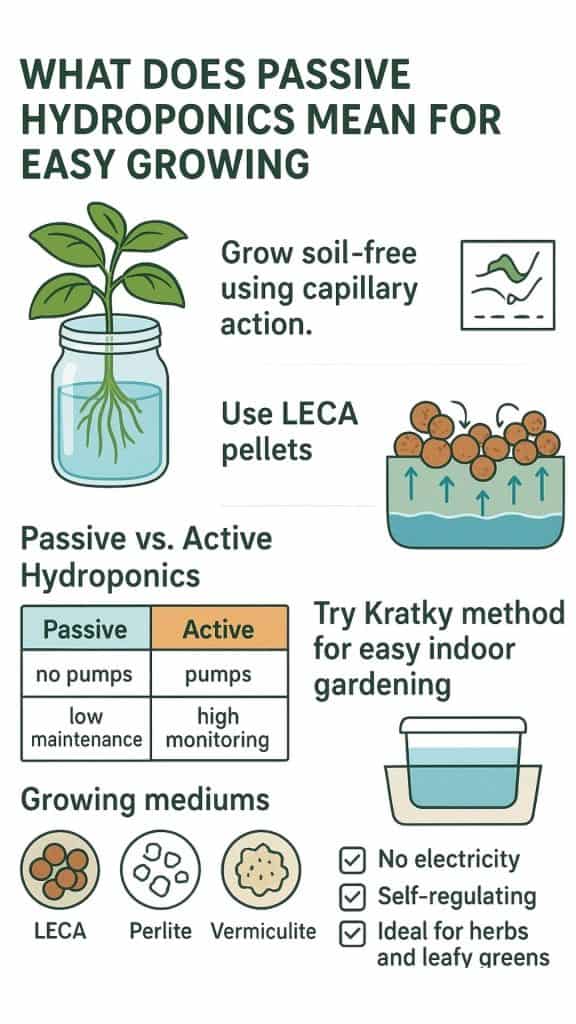
Active hydroponics uses pumps to circulate water. Nutrient film technique (NFT) systems constantly flow solution past roots. Deep water culture (DWC) uses air stones to oxygenate water. These systems can grow plants faster but need electricity and monitoring.
Passive systems trade some control for simplicity. You won’t get the same explosive growth as with aeroponics. But you also won’t come home to dead plants after a power outage. The trade-off makes sense for most home gardeners.
Maintenance differs significantly. Active systems require checking pH levels and nutrient strength weekly. Passive systems might need a reservoir refill every few weeks. It’s the difference between caring for a high-performance engine and a reliable bicycle [1].
Essential Components for Your Setup
Your container choice matters. Opaque materials prevent algae growth. A simple plastic storage bin works well. Size depends on your plants, lettuce needs about two gallons per plant while herbs can share smaller spaces.
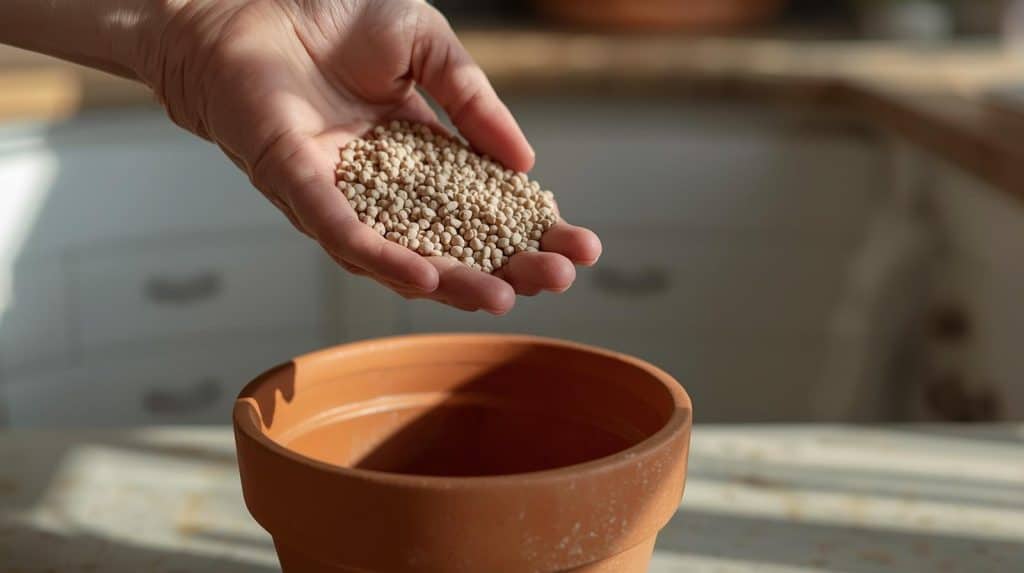
LECA (lightweight expanded clay aggregate) is the go-to medium. These porous clay balls absorb water while leaving air spaces. They’re reusable after sterilization. Perlite and vermiculite work too but are messier. Avoid materials that decompose like wood chips, especially if you want a setup that can also be adapted for outdoor hydroponics environments.
Wicking systems need a good connector. Cotton rope works but degrades over time. Synthetic felt lasts longer. The wick should touch both reservoir water and growing medium. Test flow rate before planting, too fast drowns roots, too slow starves them.
Nutrient solutions should be balanced for passive uptake. General hydroponic formulas work fine. Start at half-strength since plants absorb continuously. Change solution completely every four to six weeks to prevent salt buildup.
Real-World Applications and Success Stories

Credit : DeBacco University
Urban apartment dwellers love passive hydroponics. Windowsill herb gardens thrive in small Kratky jars. Office buildings use decorative systems with peace lilies improving air quality. The simplicity makes it accessible for non-gardeners.
Orchid collectors swear by semi-hydroponics. Epiphytic plants like phalaenopsis excel in LECA setups. Their roots get the moisture and air circulation they crave. Many report healthier plants and more frequent blooms compared to traditional bark media.
Schools use passive systems for science education. Children observe root development through clear containers. They learn capillary action firsthand. The low cost allows classroom-scale projects without maintenance headaches during holidays [2].
Making Passive Hydroponics Work For You
Start small with a single lettuce plant in a mason jar. Use the Kratky method, it’s foolproof. Once comfortable, scale up to a wick system with multiple plants. Choose crops matching your commitment level. Leafy greens and herbs are most forgiving.
Monitor plants during the first week. Drooping leaves might indicate poor wicking. Yellowing suggests nutrient issues. Adjust one variable at a time. Keep a simple journal tracking changes and outcomes. This data becomes invaluable for troubleshooting. Using simple hydroponic setups can help beginners avoid common pitfalls early on.
Embrace the slow pace. Passive hydroponics won’t break growth records. But it will provide fresh food with minimal intervention. That reliability becomes precious in our hectic lives. The system works quietly in the background, a calm counterpoint to daily chaos.
Your garden should serve you, not the other way around. Passive hydroponics embodies that philosophy. It proves that sometimes the simplest solutions are the most elegant. Give it a try, you might find it’s exactly what you’ve been searching for.
FAQ
What should you check when setting up passive hydroponics at home?
You check how passive hydroponics works in a simple container. You watch the nutrient reservoir level and keep the hydroponic nutrient solution fresh. You pick an inert growing medium like LECA or perlite substrate. You let capillary action move water. You keep plant root oxygenation stable so the roots stay healthy in soil-free gardening.
How can beginners manage root moisture control in a passive system?
You keep the hydroponic container only partly filled so the roots touch air and water. You let passive nutrient absorption happen through capillary action. You use lightweight expanded clay aggregate or vermiculite media for steady moisture. You watch for signs of root rot prevention passive system methods. You refill the nutrient reservoir when the level drops.
Which materials work best as a passive hydroponic substrate?
You can use LECA, expanded clay pellets, coconut husk chips, or rock wool. You pick a hydroponic growth medium with good air space. You want hydroponic media decomposition resistance so the system stays clean. You choose materials that support natural plant hydration method and slow nutrient delivery. You match the medium to your plant type.
How does the wick system help with hydroponic water management?
You place a wick in a hydroponic container so it pulls water from the nutrient reservoir. You rely on nutrient uptake by capillary action. You use a wicking hydroponic system when you want hydroponics without pumps. You watch the flow to avoid overwatering. You pick a wick that supports constant moisture hydroponics and plant hydration.
When should you try the Kratky method as a nutrient film alternative?
You try the Kratky method when you want no pump hydroponics and low maintenance hydroponics. You let natural water circulation drop slowly as the roots grow. You use a plastic wrap lid method to limit evaporation nutrient delivery loss. You check root aeration as the reservoir lowers. You keep the setup simple for hydroponics for beginners.
Conclusion
Passive hydroponics isn’t just a technique; it’s a gardening philosophy that prioritizes ease and sustainability. By letting natural processes do the heavy lifting, you gain fresh produce without the complexity of pumps or timers. This method proves that effective gardening doesn’t require constant intervention. Start with a single Kratky jar on your windowsill. Let the quiet success of your first harvest inspire you to grow more, with less effort. Your low-maintenance garden awaits.
References
- https://www.researchgate.net/publication/350461842_PERFORMANCE_OF_DRY_HYDROPONIC_SYSTEM_ON_CULTIVATION_OF_GREEN_LETTUCE_Lactuca_sativa_L
- https://journal.ubb.ac.id/index.php/enviagro/article/view/4471
Related Articles
- https://tophydroponicgarden.com/how-to-build-a-simple-hydroponic-setup/
- https://tophydroponicgarden.com/how-plants-absorb-nutrients-without-soil/
- https://tophydroponicgarden.com/can-hydroponics-be-done-outdoors/
Was this helpful?

I’m Barrie L., a passionate hydroponic gardening enthusiast dedicated to cultivating thriving, soil-less gardens. With a focus on all things hydroponic, I share my expertise on innovative growing techniques and sustainable practices through my blog, tophydroponicgarden.com. As a seasoned hydroponics specialist, my goal is to inspire and guide fellow gardeners in harnessing the power of water-based cultivation for bountiful and eco-friendly harvests. I’m also an author of the book “Hydroponics For Absolute Beginners: Your Step By Step Guide For How To Create An Hydroponics System At Home Without Soil, For Growing Vegetable, Fruit And Herbs.” which is sold on Amazon. Join me on a journey of redefining the way we cultivate plants, one nutrient-rich solution at a time. Happy growing!