

Healthy hydroponic roots are usually white or cream colored. They should feel firm, grow lots of tiny root hairs, and have little or no smell. That’s the ideal.
But color isn’t the whole story.
Roots can darken as they age. Some nutrients even stain them. What matters more is whether they’re still firm, growing, and free from slime or a rotten smell.
A quick root check every week can catch problems long before the leaves start showing them.
Quick Read: Spotting Healthy Hydroponic Roots
Healthy hydroponic roots are not judged by color alone, but by their overall structure, texture, and smell, since these traits show how well the plant is absorbing water, oxygen, and nutrients beneath the surface.
- White or cream-colored roots with firm texture
- Presence of fine root hairs and fresh growing tips
- No foul smell from the root zone
Why Does Root Color Matter?
While root color provides an immediate visual diagnostic clue, you should look closely at the tips where fresh growth occurs. Healthy, actively developing root systems constantly push out bright white tips.
If you notice these vibrant tips expanding consistently week after week, your plants are successfully scaling their root architecture.
| Root appearance | What this may mean |
| White tips | New growth |
| Cream-colored roots | Older roots or staining |
| Dark, soft roots | Possible root damage |
| Lots of root hairs | Active nutrient uptake |
Novice growers frequently panic when their root systems lose that pristine, bright white luster, but this aesthetic shift rarely justifies alarm. Mature roots naturally darken over time, and common elemental inputs frequently stain the root cortex.
Instead of obsessing over color, seasoned cultivators track physical elongation to confirm the system is actively growing.
Can Brown Hydroponic Roots Still Be Healthy?

Yes.
Brown roots don’t always mean root rot.
Organic nutrients, kelp products, and other additives can stain roots without hurting them.
Healthy brown roots are usually:
- Firm
- Flexible
- Attached tightly
- Clean smelling
Damaged roots look different.
They may be:
- Soft
- Slimy
- Weak
- Easy to pull apart
Pay more attention to texture than color.
That’s the part most people miss. Learning how to care for a hydroponic plant often starts with understanding the difference between harmless staining and genuine root damage.
Checking Root Texture and Smell Can Reveal Plant Health
While color catches your eye first, texture and smell reveal the root’s true health.
Healthy roots should feel firm. They should stay together when touched gently.
If they feel slippery or start falling apart, something isn’t right.
Watch for:
- Slime
- Soft spots
- Rotting tissue
- Peeling outer layers
Insights from HortiDaily indicate,
“Cornell University plant pathologists describe what this actually looks like up close: as Pythium colonizes a root system, often the outer portion of the root sloughs away leaving behind the inner part of the root, producing the telltale “rat tail” look, and the root system can eventually turn slimy and black” –
HortiDaily
Be gentle while checking them.
Roots are easy to damage, and rough handling can create new problems.
Now smell the root zone.
Healthy roots usually smell like clean water or almost nothing at all. A sour or rotten odor can mean low oxygen or poor water quality.
Sometimes the smell changes before the roots do.
That’s why regular checks are worth it.
What Does Good Root Growth Look Like?

Long roots aren’t the only goal.
Healthy roots spread out and produce lots of smaller branches. Those branches give the plant more places to absorb water and nutrients.
Look for:
- Thick main roots
- Small side branches
- Plenty of root hairs
- Fresh white tips
Running Deep Water Culture (DWC) systems taught me that massive root nets are a double-edged sword. While beginners love showing off giant root ‘beards,’ my experience has shown that over-crowded root masses actually restrict localized water flow and trap dying tissue.
As a hydroponic consultant, I always tell my clients to stop chasing sheer volume and focus strictly on root branching and tip vitality.
Why Are Root Hairs Important?
Microscopic root hairs handle the heavy lifting of your cultivation cycle by exponentially increasing surface area. These delicate structures execute the vast majority of water and nutrient ion absorption, making them the literal engine of your plant’s metabolic intake.
Healthy root hairs are usually:
- Fine
- White
- Spread across the roots
- Attached firmly
Some people mistake them for mold.
There’s an easy way to tell the difference.
Root hairs grow evenly from the root itself. Mold usually appears in random patches and doesn’t follow the shape of the root.
Small parts.
Big job.
How Oxygen Affects Hydroponic Roots
Roots need oxygen, even underwater.
That’s something many beginners don’t expect.
Without enough oxygen, roots struggle to take in nutrients. Plant growth slows, and root problems become more likely.
Low oxygen can lead to:
- Weak roots
- Slower growth
- Poor nutrient uptake
- More disease risk
As noted by ScienceDirect
“Research backs this up. A peer-reviewed study on tomato roots found that root zone oxygen deficiency can lead to poor root and plant performance and an increase in the incidence of disease, and pinpointed a real threshold: when dissolved oxygen dropped below about 2.8 mg per liter, tomato plant roots are much more susceptible to Pythium infection. Missouri Extension puts a number on the safe zone too, noting that a dissolved oxygen level over 6 ppm is optimum for hydroponics production, and that low oxygen levels may inhibit growth and increase ethylene production.” –
ScienceDirect
Dissolved oxygen availability operates on an inverse relationship with reservoir temperature. Keeping your water tightly regulated ensures maximum gas saturation, whereas uncooled, stagnant water creates an anaerobic playground for root pathogens.
| Water temperature | Root condition |
| 18 to 21°C | Good oxygen levels |
| 22 to 24°C | More stress |
| Above 24°C | Higher risk |
Inspect your commercial air pumps and micro-pore air stones during every reservoir change. A mechanical failure can deplete dissolved oxygen levels within hours, triggering a systemic root crash before your leaves even begin to show signs of stress.
Choosing Between a Sterile or Living Reservoir
There isn’t one right answer.
Some growers keep the reservoir as clean as possible. Others add beneficial microbes that compete with harmful ones.
Both methods can grow healthy plants.
| Sterile reservoir | Living reservoir |
| Uses sanitizers | Uses beneficial microbes |
| Lower microbial activity | Higher biological activity |
| Needs careful monitoring | Needs balance |
| Often includes hydrogen peroxide | May include helpful bacteria |
Helpful microbes can support root health.
But they can’t fix poor growing conditions.
Good oxygen, clean equipment, and stable water quality still come first. Regardless of the approach you choose, consistent maintenance of hydroponic plants is what keeps root conditions stable over time.
What Are the Warning Signs of Root Problems?
Root problems rarely show up all at once.
Usually, several warning signs appear together.
| Healthy roots | Problem roots |
| Firm | Soft |
| Clean smell | Bad odor |
| White or cream | Dark and damaged |
| Active growth | Weak growth |
| Visible root hairs | Slimy coating |
Watch for:
- Rotten smell
- Slimy roots
- Slow growth
- Roots falling apart
- Wilting leaves
Don’t wait.
Small problems are much easier to fix than large ones.
How Can You Keep Hydroponic Roots Healthy?
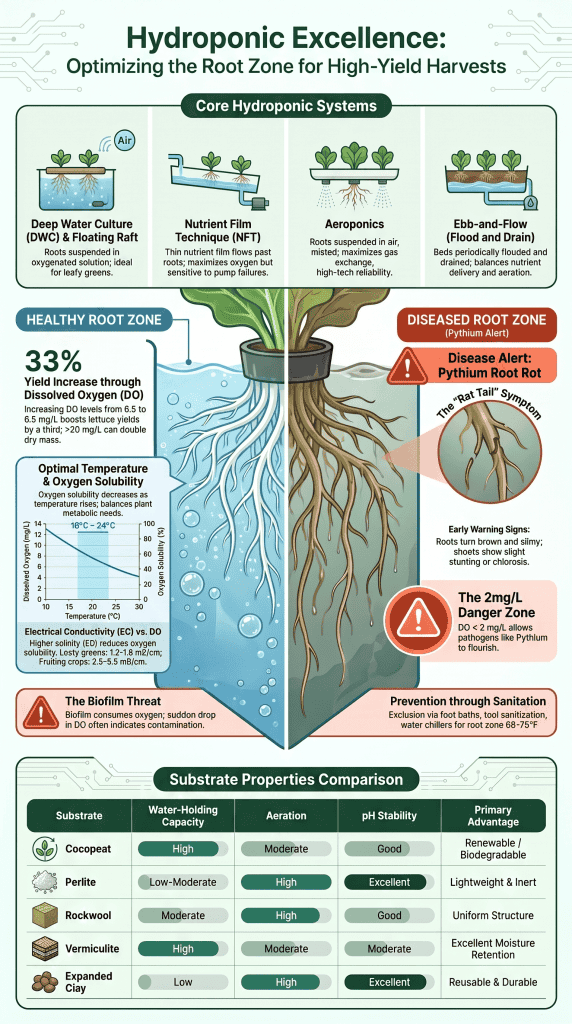
I rely on a strict weekly preventive protocol. Every Monday, I do a physical ‘squeeze test’ on the lowest root clusters to check for firmness. Simultaneously, I check my chiller settings to lock water temperatures between 18 and 21°C.
If a reservoir ever smells slightly off, I don’t wait for slime, I immediately dose a 34% food-grade hydrogen peroxide solution at 1 mL per gallon to sanitize the system.
Look at the roots whenever you do routine maintenance.
Notice what’s changing.
Are new tips still growing? Do the roots feel softer than last week? Does the water smell different?
Those small changes often show up before the plant starts looking unhealthy. Tracking how hydroponic nutrients affect root appearance over time can make early diagnosis much easier.
Things happen.
Pumps fail. Water warms up. Nutrient levels drift. Catching those changes early makes life much easier.
Examples of Content They Can Create

Credits: Humble Growth
Hydroponics is a modern way to grow plants using only water and nutrients, without any soil. In traditional gardening, plant roots pull nutrients from water that filters through soil. Hydroponics removes the soil entirely, delivering nutrients directly to the roots. This direct method lets plants grow up to twice or even three times faster than in soil .
There are several types of hydroponic systems. The Kratky method is passive and non-circulating, where roots sit in a vat of nutrient water. Deep Water Culture (DWC) adds an air stone to oxygenate the roots.
The drip method delivers nutrients via a drip onto roots suspended in air. Ebb and Flow systems flood and drain roots regularly. Nutrient Film Technique (NFT) keeps a shallow stream running under roots. Aeroponics, the most advanced method, sprays nutrients as mist onto air-suspended roots .
Maintaining proper pH levels is crucial since different plants thrive at different acidity levels. Beginners often start with the General Hydroponics Flora series for nutrients .
FAQ
What do healthy hydroponic roots look like in color, texture, and structure?
Healthy hydroponic roots are white or cream in color, and they feel firm but not hard. The structure is fibrous, with many fine branches spreading evenly through the system. Vibrant root systems display continuous tip elongation and clear lateral branching.
Maintaining a clean, resilient root network ensures optimal elemental absorption and anchors long-term vegetative stability.
How can I tell if there are healthy roots vs unhealthy roots in the hydroponics system?
Healthy root networks display a clean, creamy profile with strong structural integrity and dense lateral branching. Conversely, compromised root systems turn dark brown, secrete a distinct microbial slime, and break under minimal tension due to tissue degradation.
What causes root rot symptoms like brown or slimy roots in hydroponics?
Classic root rot symptoms materialize when dissolved oxygen levels collapse within the reservoir. Elevated water temperatures and stagnant circulation zones allow virulent water molds like Pythium to multiply rapidly and colonize vulnerable host tissue. Without proper root zone hygiene, the roots lose structure and begin to decay quickly.
How does oxygenated root zone and dissolved oxygen affect root growth hydroponics?
Maintaining rich dissolved oxygen saturation accelerates cell division, promoting vigorous root elongation and complex lateral branching. When gas exchange drops, the root system experiences severe hypoxic stress, halting tip development and stalling the plant’s entire metabolic output.
What is the best way to do hydroponic root inspection and maintenance for a strong root network?
Conduct weekly root inspections by closely evaluating tissue elasticity, density, and structural development. Comprehensive maintenance requires resetting the reservoir periodically, sterilizing fluid lines, and stabilizing the chemical balance of your working nutrient solution. Consistent checks help prevent root rot symptoms and support strong root network development.
Healthy Hydroponic Roots, What Good Growth Really Looks Like
Healthy hydroponic roots are usually white to cream in color, firm to the touch, and showing fresh growth. You should also see fine root hairs and steady branching, with little to no smell. The real issue is people judging only by color and missing early warning signs.
Focus on texture, oxygen levels, water temperature, and consistent growth checks instead. Small daily checks help you catch problems before they spread. Healthy roots rarely demand attention, until something starts going wrong.
References
- https://www.sciencedirect.com/science/article/abs/pii/S0304423807001203
- https://www.hortidaily.com/article/6040777/pythium-root-rot-on-hydroponically-grown-basil-and-spinach/
Related Articles
- https://tophydroponicgarden.com/how-to-care-for-a-hydroponic-plant/
- https://tophydroponicgarden.com/how-to-maintain-hydroponic-plants/
- https://tophydroponicgarden.com/how-long-do-hydroponic-nutrients-last/
Was this helpful?

I’m Barrie L., a passionate hydroponic gardening enthusiast dedicated to cultivating thriving, soil-less gardens. With a focus on all things hydroponic, I share my expertise on innovative growing techniques and sustainable practices through my blog, tophydroponicgarden.com. As a seasoned hydroponics specialist, my goal is to inspire and guide fellow gardeners in harnessing the power of water-based cultivation for bountiful and eco-friendly harvests. I’m also an author of the book “Hydroponics For Absolute Beginners: Your Step By Step Guide For How To Create An Hydroponics System At Home Without Soil, For Growing Vegetable, Fruit And Herbs.” which is sold on Amazon. Join me on a journey of redefining the way we cultivate plants, one nutrient-rich solution at a time. Happy growing!