

Plant roots grow upward when environmental conditions, physical barriers, or natural growth habits outweigh their normal downward response to gravity. Gravity drives positive gravitropism, but oxygen availability, soil resistance, moisture gradients, and plant biology can redirect root growth.
Tophydroponicgarden offers practical guidance on root growth and hydroponic plant care. Read on to identify normal upward roots and signs of stress.
Why Plant Roots Grow Upwards
- Low oxygen, soggy soil, or packed dirt can push roots to find spots with more air or less resistance.
- Gravity normally drives roots downward, but auxin signaling, moisture gradients, physical barriers, and environmental stress can change root growth direction.
- Upward roots aren’t always a problem. Orchids and other epiphytes naturally produce aerial roots. But if you see this in potted plants or hydroponic setups, it often means they need improved aeration, a better moisture balance, extra space, or a tweak in their growing conditions.
What Makes Roots Normally Grow Downward?
Roots usually grow downward because special cells near their tips sense gravity. These cells kick off signals that adjust growth on different sides of the root, guiding it down into the soil.
Inside the very tip of every root, tiny cells act like internal levels. They hold tiny, heavy starch grains that settle downward with gravity. Wherever those grains fall, the root senses ‘down’ and grows in that direction. Research summarized by Texas A&M University describes the root cap’s columella cells as an important site of gravity sensing.
The signal then affects polar auxin transport, creating an auxin concentration gradient across the root. In roots, increased auxin generally inhibits cell elongation, so unequal growth causes the root tip to bend.
NC State Extension explains that auxins support differential cell growth and that roots normally grow downward because of gravitropism. The process involves amyloplast sedimentation, statocyte signaling, auxin redistribution, and differential cell growth.
- Gravity establishes the default direction.
- The root cap provides the main gravity-sensing region.
- Auxin helps translate the signal into bending.
That means an upward-growing root does not necessarily have a broken gravitropic system. It may be responding to another environmental cue that has become stronger or more useful.
How Does Gravitropism Determine Root Direction?
Positive gravitropism means growth with gravity, so primary roots generally grow downward into the soil. Shoots show negative gravitropism and grow upward against gravity.
The process acts like a biological default. Statolith displacement tells the root cap how gravity acts, triggering a gravitropic signaling pathway that changes auxin movement toward the elongation zone.
The exact molecular steps remain under study. The University of Wisconsin’s Gilroy Lab notes that key auxin transport systems are known, but how gravity signals control precise growth remains unclear.
Roots also respond to moisture, oxygen, touch, chemical gradients, and other environmental signals.
Why Can Roots Override Gravity and Grow Upwards?
Roots might turn upward when they find better oxygen for plant roots, more room, moisture, or other key resources nearer the surface. It’s all about chasing the best spot to thrive.
A useful distinction is between negative gravitropism and adaptive root reorientation. Some roots can change their gravitropic set point angle, while many upward roots result from competing environmental cues rather than a simple reversal of gravity sensing.
Research from the Journal of Experimental Botany shows
“Wheat seminal roots and rice crown roots actively maintain their growth angles vertically growing wheat and rice seminal roots displayed upward bending. We hypothesize cereal seminal roots may possess an anti-gravitropic offset that enables growth at a slight non-vertical.” – Journal of Experimental Botany
The University of California Statewide IPM Program notes that low root-zone oxygen can cause root asphyxiation and damage.
- Waterlogging: creates oxygen-poor root zones.
- Compaction: limits both root penetration and oxygen diffusion.
- Container restriction: forces roots to search through limited pore space.
- Chemical or moisture gradients: can redirect root growth.
- Hormonal disruption: can alter normal directional growth.
Upward growth alone cannot identify the cause. The same pattern can have different causes in orchids, compacted soil, or hydroponic systems.
How Can Waterlogging Change Root Growth?
Waterlogged soil slows oxygen movement through the root zone, creating an oxygen shortage response. When soil pores fill with water, oxygen reaches deeper layers more slowly. Some plants produce aerenchyma to transport oxygen internally.
Rice can develop cortical aerenchyma to adapt to flooding, while less flood-tolerant plants may suffer root decline. Roots may also grow toward better-aerated surface zones. This involves root oxygen sensing, ethylene accumulation, stress signaling, and root architecture changes.
Insights from Plant Physiology indicate
“Elevated ethylene levels negatively regulate root gravitropism… ACC [ethylene precursor] may reduce gravitropic curvature by altering flavonoid synthesis.” – Plant Physiology
Could Compacted Soil or a Pot Cause Roots to Grow Upwards?
Mechanical impedance can redirect roots when downward pathways become too difficult to penetrate.
Roots must physically push through soil pores, and dense or compacted media can reduce both pore space and oxygen movement. A root encountering a hard layer may bend sideways, circle, follow a crack, or move toward a less resistant region.
This is one reason adaptive root architecture can look irregular even when the plant is healthy. Root systems respond continuously to soil density barriers, soil pore space limitation, moisture, oxygen, and physical contact.
A container creates another version of the same problem. When roots reach the bottom or sides of a restricted pot, they can change direction and begin circling. If the growing medium above the rootball is easier to penetrate, some roots may turn upward.
The result is root architectural flexibility, not necessarily a disease.
A practical check is simple: inspect the rootball rather than judging direction from the visible root alone. Look for circling, dense mats, roots pressing against the container, or a compacted layer beneath the plant.
Can Disrupted Auxin Transport Make Roots Grow Upwards?

When auxin shifts around differently, it can mess with the usual way roots bend toward gravity. This is especially true if stress, injury, or genetic quirks interfere with how hormones move inside the plant.
After gravity is detected, auxin efflux carriers and auxin influx carriers help move the hormone through root tissues. The resulting auxin concentration gradient changes cell behavior on opposite sides of the root.
In a normal gravitropic response, increased auxin on the lower side of a root inhibits cell elongation. The upper side therefore elongates more, producing curvature toward gravity.
The supplied sources identify BBC Bitesize as a reference for this basic auxin model and connect disrupted auxin transport with altered root orientation. They do not provide a numerical statistic for how frequently auxin disruption causes upward roots.
This difference is important because auxin movement is just one step in the process, not always the root cause. Factors like waterlogged soil, physical blockages, lack of oxygen, chemical changes in the soil, or root injury can all shift the signals that shape how roots grow.
Are Upward-Growing Roots Normal for Orchids and Other Epiphytes?
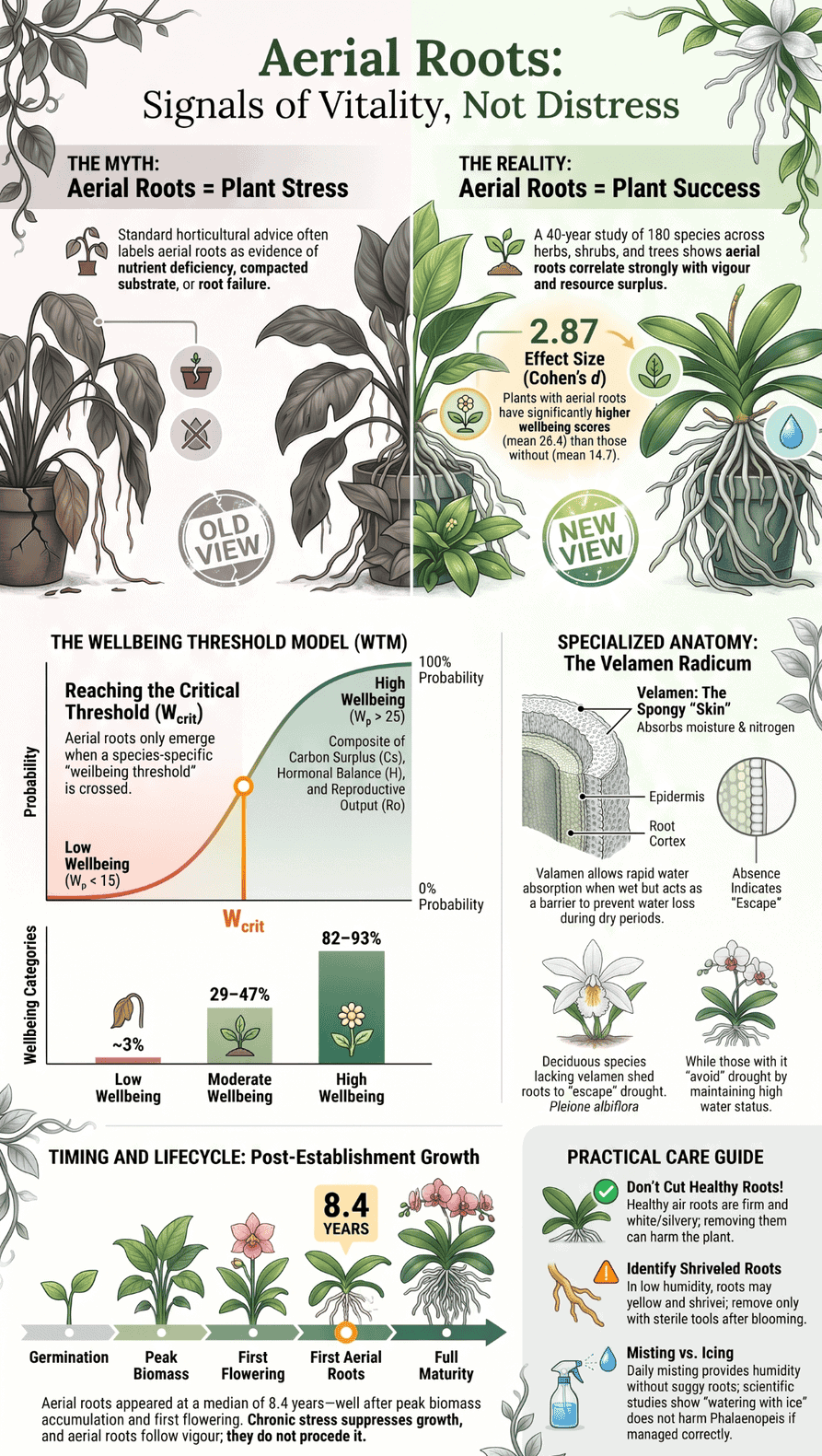
Epiphytes such as orchids naturally produce exposed or aerial roots, so upward growth can be normal rather than a sign of environmental stress.
Orchids do not need every root buried in soil. Their natural growth habit allows roots to remain exposed, where they can absorb moisture and nutrients while also providing physical support.
Talks on Reddit often treat aerial roots in orchids and aroids as a normal trait, not a red flag for bad care. Still, the information given doesn’t include clear numbers to show how often upward root growth happens among epiphytic plants.
Species identification is therefore essential. An upward orchid root and an upward root from a soil-grown crop may look similar but reflect different biological responses. The same applies to some aroids, climbing plants, and other species that develop roots above the soil line.
- Check the plant’s natural growth habit.
- Look for healthy, firm aerial roots.
- Avoid burying naturally exposed roots simply because they point upward.
- Judge root direction alongside leaf, stem, and root health.
A healthy aerial root can be normal developmental plasticity, not a problem that needs correction.
Do Roots Grow Upwards When They Are Searching for Water?

Credit: Arabidopsis Events UK
Roots do shift toward places with better moisture, but hydrotropism doesn’t mean they always chase the wettest spot around.
Roots integrate several signals through tropic signal integration, including gravity and water availability. A moisture gradient can influence the direction of growth when the plant detects a meaningful difference between competing zones.
The interaction between gravity and hydrotropism is complex. Research involving Arabidopsis has shown that root hydrotropism and gravitropism can interact through overlapping hormone and signaling pathways.
A root might stray from its usual path downward when something in the environment gives it a better chance to grow elsewhere.
Bottom-watering can also change where moisture remains available in a container. If the surface becomes relatively dry while moisture concentrates lower down, roots may favor lower zones. The opposite moisture pattern can encourage root proliferation closer to the surface.
The key idea is that root environmental cue integration produces the final growth pattern. Gravity provides one signal, while moisture, oxygen, nutrients, touch, and physical resistance provide others.
What Does Upward Root Growth Mean in Hydroponics?
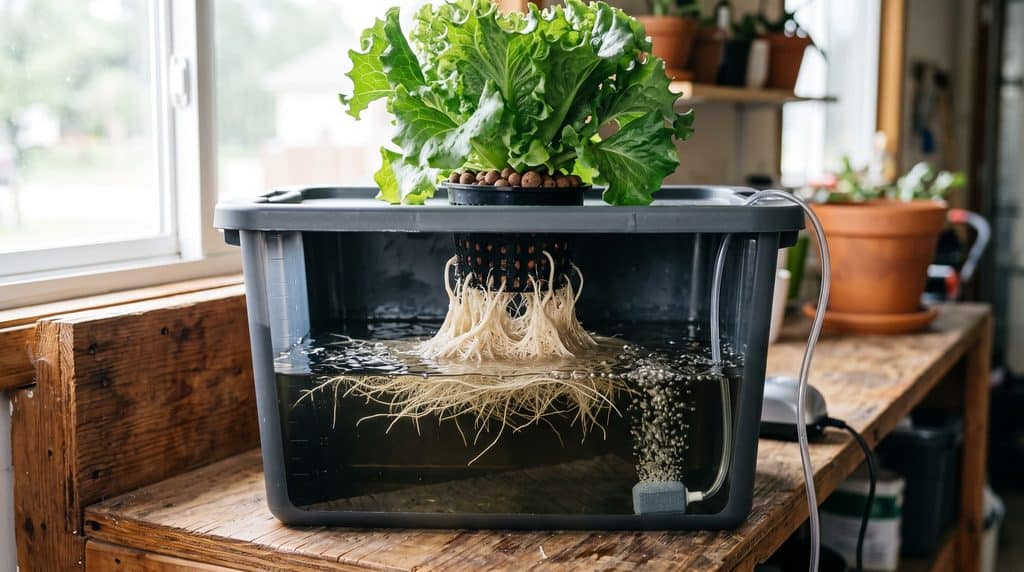
In hydroponic systems, upward or surface-rooting can reflect root-zone oxygen availability, water chemistry, physical exposure, or impaired root function.
Hydroponic roots have no conventional soil matrix to buffer changes. In my Deep Water Culture (DWC) setups, whenever roots break the water surface and crawl upward, it almost always points to low dissolved oxygen. Hydroponic mistakes such as poor aeration can also make root problems harder to diagnose.
If your air pump underperforms or your air stones clog, roots migrate upward toward the air gap above the water line to avoid suffocating. One conversation points out that when aeration is poor, root problems tend to spike. Still, these community notes stop short of proving, with clear data, that low aeration directly triggers upward growth.
Biofilm can create another problem. If material accumulates around roots, it can interfere with root surfaces and reduce effective uptake. A plant experiencing root-zone stress may then produce new roots in more favorable locations.
DWC, aeroponics, and other hydroponic systems therefore require attention to the entire root environment rather than root direction alone.
Which Hydroponic Conditions Should Growers Monitor?
Four checks provide a practical starting point for diagnosing abnormal root growth.
| Check | Why it matters | Possible warning |
| Aeration | Supports oxygen availability | Weak or deteriorating roots |
| pH | Influences nutrient availability | Poor nutrient uptake |
| EC/TDS | Indicates nutrient concentration | Excessive or insufficient feeding |
| Root appearance | Shows physical root condition | Discoloration, damage, biofilm |
The supplied material mentions a 68–72°F reservoir target in grower discussions, but it does not provide enough independent evidence to present that range as a universal requirement. Treat such community guidance as system-specific rather than a general law.
What Is the Simplest Way to Diagnose Upward-Growing Roots?
The simplest diagnosis starts with the plant’s species and then checks oxygen, moisture, physical resistance, and available root space. In hydroponics, comparing unusual growth with healthy hydroponic roots look like can make root problems easier to identify.
This decision framework separates normal architecture from stress-induced root reorientation:
| What you see | Most likely direction for diagnosis |
| Healthy exposed roots on an orchid | Natural aerial-root growth |
| Roots concentrated above saturated media | Investigate oxygen stress |
| Roots circling inside a small pot | Investigate root restriction |
| Roots stopping at a hard soil layer | Investigate mechanical impedance |
| Surface roots with unusual moisture pattern | Investigate hydrotropism |
| Abnormal growth after root injury | Investigate disrupted signaling |
| Hydroponic surface rooting plus poor root health | Check aeration and water chemistry |
The goal is not to force every root downward. It is to determine whether the plant is displaying adaptive root architecture or responding to an avoidable environmental problem.
If roots are healthy and the species normally produces aerial roots, intervention may do more harm than good. If upward growth appears alongside yellowing, root deterioration, persistent saturation, or severe restriction, the environment deserves attention.
FAQ
Can upward-growing roots recover after temporary soil oxygen problems?
Yes. Roots can recover when low-oxygen conditions are temporary and the soil environment improves. Waterlogged or compacted soil can create hypoxic root zones that limit oxygen supply.
When soil aeration and oxygen diffusion improve, root growth plasticity can help restore normal growth. However, prolonged root zone hypoxia can damage root tissues and reduce the plant’s ability to recover.
How do roots decide whether to bend around an obstacle?
Roots respond to gravity, moisture, oxygen, and physical barriers when adjusting their growth direction. Mechanical impedance avoidance can redirect the root tip when compacted soil or another barrier blocks growth.
Root environmental cue integration helps the plant assess these conditions. This root obstacle avoidance supports adaptive root architecture and allows roots to grow through areas with less physical resistance.
Can flooding cause new roots to develop above the original root zone?
Yes. Some plants respond to flooding by changing their root structure and producing new roots closer to oxygen-rich areas. A flooded soil response can include adventitious root formation, aerenchyma development in roots, and upward root proliferation.
These changes can improve oxygen access and support root survival. The response is part of the plant’s broader root system adaptation to waterlogged conditions.
Why can roots change direction even when gravity remains constant?
Roots can change direction because gravity is only one of several signals that control root growth. Auxin redistribution, environmental stress signaling, and chemical soil gradients can alter cell growth on different sides of the root.
This differential cell growth changes root curvature dynamics and causes root tip bending. As conditions change, the plant can adjust its root tropic responses.
Do damaged root tips affect how roots respond to gravity?
Yes. The root cap contains specialized gravity-sensing cells called statocytes that help detect changes in gravity. Damage to the root cap can disrupt statolith displacement and statocyte cell signaling.
This disruption may affect the gravitropic signaling pathway and alter root growth directionality. The effect depends on the severity of the damage and the root’s ability to regenerate and resume normal growth.
What to Remember About Upward Roots
Upward root growth can result from oxygen stress, physical barriers, moisture gradients, altered hormone signaling, or normal aerial-root development. First, consider what type of plant is growing the root, then examine the conditions around it.
For container plants, check moisture, soil aeration, compaction, root space, and planting depth. In hydroponic systems, check aeration, pH, EC/TDS, and root condition. Tophydroponicgarden also provides practical guidance for hydroponic root care.
For orchids and other epiphytes, exposed roots may be normal growth. Overall, root direction reflects the combined effects of gravity and the root’s environment.
References
- https://academic.oup.com/jxb/advance-article/doi/10.1093/jxb/erag286/8706277
- https://academic.oup.com/plphys/article/140/4/1384/6115031
Related Articles
- https://tophydroponicgarden.com/hydroponic-mistakes-troubleshooting/
- https://tophydroponicgarden.com/what-do-healthy-hydroponic-roots-look-like/
- https://tophydroponicgarden.com/why-is-oxygen-crucial-for-plant-roots/
Was this helpful?

I’m Barrie L., a passionate hydroponic gardening enthusiast dedicated to cultivating thriving, soil-less gardens. With a focus on all things hydroponic, I share my expertise on innovative growing techniques and sustainable practices through my blog, tophydroponicgarden.com. As a seasoned hydroponics specialist, my goal is to inspire and guide fellow gardeners in harnessing the power of water-based cultivation for bountiful and eco-friendly harvests. I’m also an author of the book “Hydroponics For Absolute Beginners: Your Step By Step Guide For How To Create An Hydroponics System At Home Without Soil, For Growing Vegetable, Fruit And Herbs.” which is sold on Amazon. Join me on a journey of redefining the way we cultivate plants, one nutrient-rich solution at a time. Happy growing!