

You’re right to focus on water savings hydroponics uses up to 90% less than traditional farming. That efficiency is a huge advantage. But the setup cost is just the beginning, especially for growers building their first hydroponic system. To understand the true price, you need to look at the hidden costs of hydroponic systems.
The ongoing bills tell a different story. Your electricity uses spikes from running pumps, lights, and climate control around the clock. Keeping the water’s pH and nutrient levels perfect isn’t optional; it’s a daily chore. Systems need constant cleaning to stop algae or root rot, and parts like water pumps or sensors don’t last forever.
It becomes a balance of time and money. You either learn the technical details yourself or pay someone who already knows.
The promise is big, but the real costs are in the details. Let’s look at where the money actually goes.
Quick Reads: The Real Costs Behind Hydroponic Farming
- The biggest hidden expenses come from electricity, cooling systems, automation maintenance, nutrient management, HVAC infrastructure, and sudden crop-loss risks.
- LED grow lights, HVAC systems, water chillers, and submersible water pumps often run for long hours, increasing energy consumption and monthly utility bills in indoor farming setups.
- Ongoing costs also include pH calibration probes, electrical conductivity sensors, hydroponic nutrient solutions, and growing media such as rockwool cubes and coco coir.
Why Hydroponics Consumes So Much Electricity
When setting up your first hydroponic system, keeping the lights on is a major, constant cost. Everything runs non-stop: water pumps, air pumps for oxygen, and systems that control temperature and humidity. If the power flickers, even briefly, your plants can suffer from low oxygen fast.
This 24/7 operation makes electricity one of the biggest bills. It’s why large indoor farms use far more power than a traditional field. They have to perfectly control every aspect of the environment, all day and all night. Any fluctuation in heat, moisture, or light can hurt your harvest.
In fact, studies show lighting and climate control are the biggest energy users in these setups. Growing tomatoes indoors can use as much electricity as running the appliances in a home.
The largest operational loads usually include:
- LED grow lights and light cycle management
- HVAC systems and dehumidification costs
- Water chillers and reverse osmosis filtration
- Carbon dioxide enrichment equipment
- Air circulation and plant transpiration control
The grow lights you pick will show up on your power bill every month. For a commercial grower raising lettuce or herbs, those lights might be on for 14 to 18 hours straight, all to give plants the exact amount of light they need, day after day. It’s a tricky balance.
You’re paying for all that electricity while trying to get a harvest that’s both plentiful and consistent. In the end, your lighting setup isn’t just a piece of equipment—it’s one of your biggest regular expenses.
Backup Power Infrastructure
A power outage is a serious threat to a hydroponic garden. The roots depend on the water pumps and air stones running non-stop to get oxygen. If the electricity cuts out, that circulation stops. The water goes still, oxygen levels drop fast, and the roots can begin to suffocate and rot in just a few hours.
Most commercial growers install:
- Backup generators
- Uninterruptible power supply systems
- Battery backups for automated dosing systems
- Emergency alarms linked to internet of things sensors
A backup system costs money to install. But think about this: if the power goes out and you lose a whole crop, that loss could be bigger than the price of the backup gear.
Studies on indoor farming show that managing your energy costs is often the key to making a profit, not just growing a huge amount. A single blackout can ruin that balance and destroy your plants before you can fix it.
The Chiller Tax in Deep Water Culture

Keeping your reservoir cool is critical in Deep Water Culture. Warm water holds less oxygen, which can lead to root rot and nutrient problems fast.
Most growers aim to keep water below 68°F (20°C) to prevent diseases like Pythium. Once it gets into the mid-70s, the risk shoots up.
Room heat affects your water more than you might think. Big tanks soak up ambient warmth, especially in enclosed tents.
Commercial water chillers can cost $400 to $1,200. DIY options save money upfront but often mean more work, redesigning plumbing and extra cleaning.
Without proper cooling, water heats up slowly. Oxygen drops, algae blooms, and maintenance turns from a weekly chore into a daily battle.
Reservoir Temperature and Root Health
Warm reservoirs create biological instability fast.
Common side effects include:
- Reduced dissolved oxygen
- Increased biofilm removal requirements
- Faster algae growth
- Higher Pythium infection rates
- Nutrient lock-out from unstable root conditions
Treating your water with hydrogen peroxide or adding beneficial bacteria can help fight off root diseases. Both methods work, but they’re not a one-time fix. You have to keep buying the supplies and adding them to the system regularly, which turns into another ongoing cost you have to budget for.
Hydroponic Automation and Sensor Drift Costs
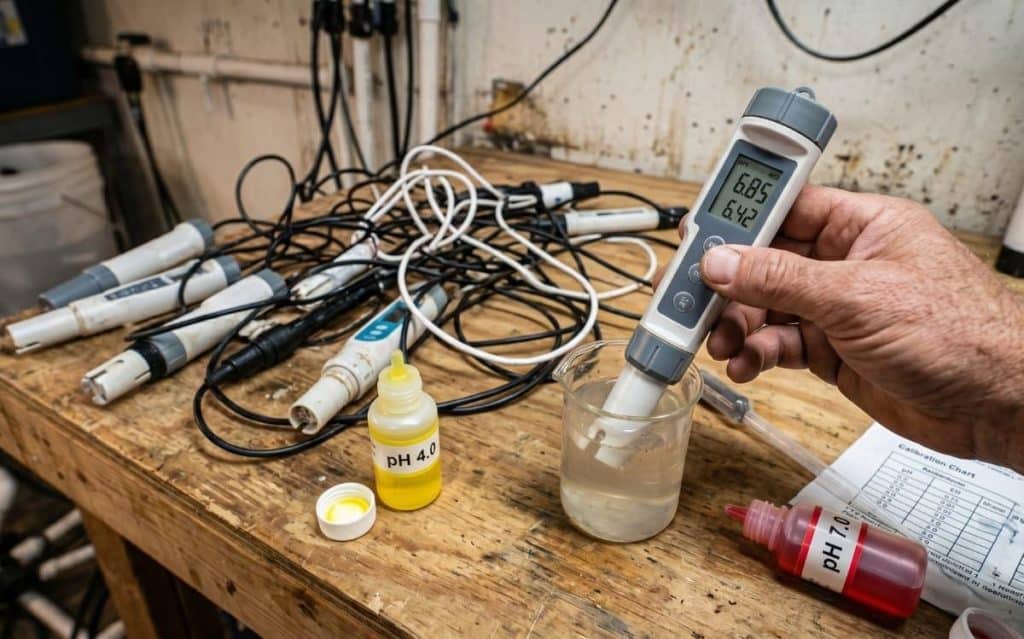
Automation cuts down on daily chores, but it introduces its own set of regular costs. The sensors that monitor your water’s pH and nutrient levels don’t last forever.
Cheap probes, especially, can give bad readings quickly. The salts and minerals in the nutrient solution slowly damage them, causing their measurements to drift. An inaccurate reading might lead you to feed your plants the wrong mix, which can cause nutrient problems for the whole grow.
That’s why many serious growers spend more on trusted brands like Bluelab or Apera. But even these better systems cost over $300 to start, and you’ll still need to budget for replacing the sensor probes every so often.
The hidden maintenance burden usually includes:
- Monthly pH calibration
- Electrode cleaning schedules
- Calibration fluid replacement
- Probe storage solutions
- Sensor replacement every 12 to 24 months
DIY automation also creates labor inefficiencies. Many growers discover the controller itself is inexpensive, but reliable probes are not.
Some operators build custom climate control automation using internet of things sensors and peristaltic pumps. Others abandon DIY systems after repeated failures during commercial production runs.
Commercial Monitoring vs DIY Systems
DIY hydroponics may reduce upfront costs, especially for growers starting a system for beginners, but troubleshooting consumes time quickly.
Commercial systems usually provide:
- Better environmental control systems
- More stable automated dosing systems
- Integrated alarms
- Remote monitoring dashboards
- Better compatibility with greenhouse management software
That stability matters once crops operate on tight harvest schedules and supply chain logistics.
Hydroponic Vulnerability and Sudden Crop Failure
Hydroponic plants depend entirely on stable water chemistry and circulation, so even short equipment failures can destroy crops rapidly.
Traditional soil buffers nutrient fluctuations through natural cation exchange processes. Hydroponics lacks that safety net entirely.
A sudden pH shift can trigger nutrient lock-out within hours. Plants stop absorbing macronutrients and micronutrients even when nutrients remain inside the reservoir.
Hydroponic crops also experience faster biological spread because water recirculates continuously. Once pathogens enter the system, contamination moves rapidly between root zones.
The most common disease threats include:
- Pythium root rot
- Fusarium infections
- Algae growth
- Biofilm accumulation
- Oxygen depletion
Closed-loop nutrient film technique, aeroponics, and aquaponics systems are particularly vulnerable because all plants share circulating water.
As highlighted by Sutton, J.C., Sopher, C.R., Owen-Going, T.N., et al.
“Pythium species can be a persistent problem, especially in closed systems like greenhouses and hydroponic systems. The flow dynamics of nutrient solutions heavily influence the dispersal of Pythium propagules. In NFT, the rapid flow between roots contrasts with areas of stagnation where zoospores tend to aggregate, facilitating localized infection.”
Pump failures create another major risk.
Pump Failure and Root Damage
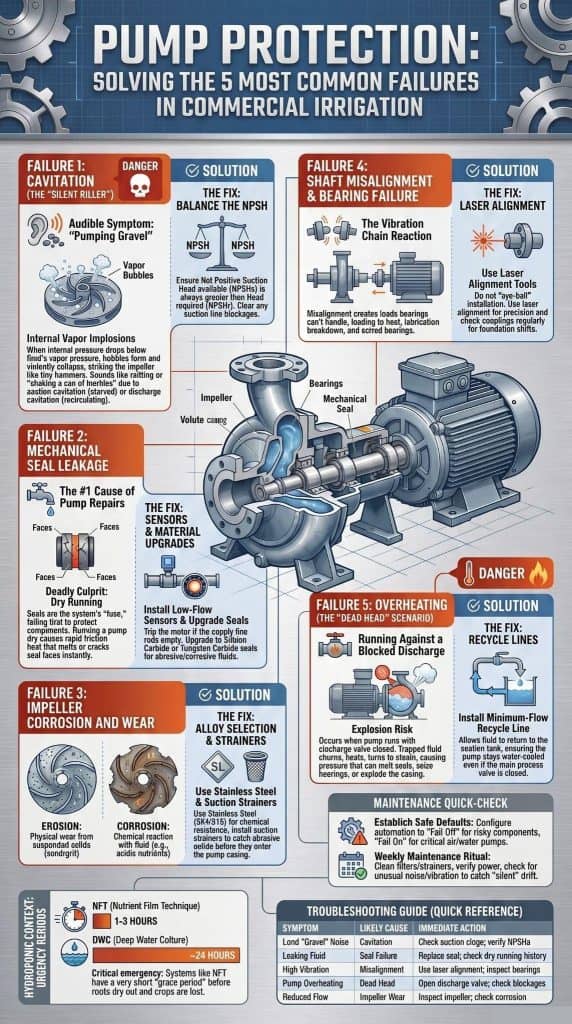
Roots inside hydroponic systems dry out quickly once circulation stops.
If a water pump stops working, plants show signs of stress very quickly often within just a few hours. In a tightly packed vertical farm, where every plant depends on a perfect, automated flow of water, the damage happens even faster. The roots begin to dry out almost immediately without that constant circulation.
Common failure points include:
- Submersible water pumps
- Air stones
- Peristaltic pumps
- Automated dosing systems
- Backup generator failures
That’s why a lot of commercial farms build in backups. They’ll install a second, standby pump on the same system. If the main pump fails, the backup kicks in automatically. They do this because losing one pump could wipe out an entire room of plants before anyone even gets to work to notice the problem.
Hydroponic Pump Failures and Irrigation Engineering
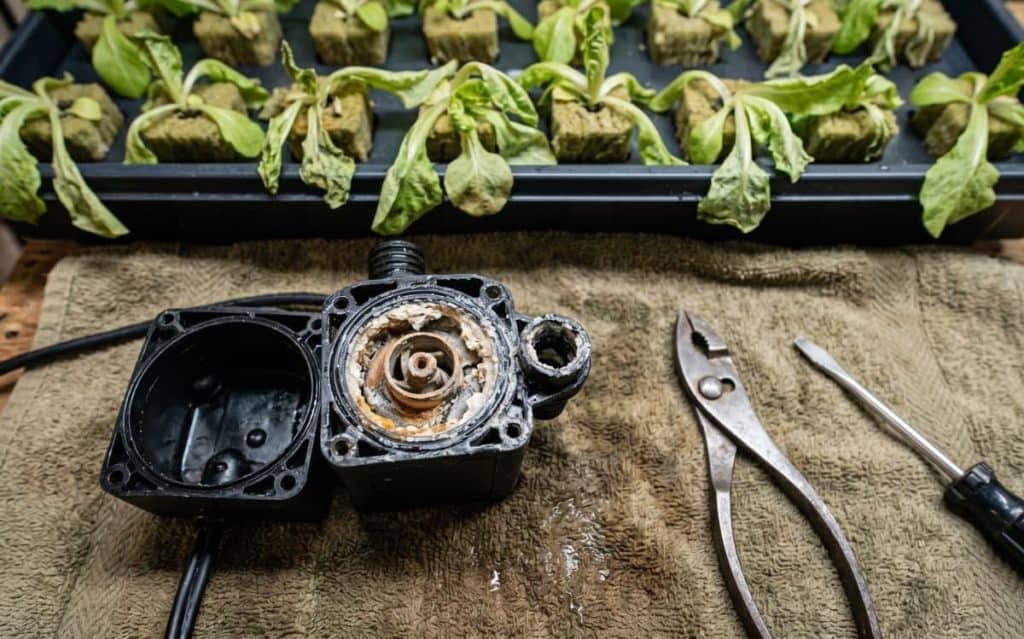
Pumps fail early for a few common reasons. They’re constantly turning on and off, which wears them out. The nutrient solution is corrosive and slowly damages their internal parts. Sometimes, they’re just not built well for the job. When a pump starts to go, you’ll often see your water pressure become uneven and unreliable.
Cheap pumps rarely survive commercial hydroponic workloads. Nutrient-heavy reservoirs expose plastic impellers, seals, and tubing to constant chemical stress.
Frequent cycling also creates cavitation problems. Pressure fluctuations damage pump internals and reduce irrigation consistency across modular grow systems.
Commercial irrigation systems solve these problems using:
- Pressure accumulators
- Positive displacement pumps
- Backup circulation loops
- Redundant filtration systems
Many home systems use simple, cheap centrifugal pumps. But for a commercial farm that runs non-stop, those pumps often can’t handle the workload and burn out too fast. They need more heavy-duty pumps built to keep pressure steady.
Even high-quality pumps aren’t immune to wear. Critical parts, like the impeller that moves the water, are often made from tough plastics. But sitting in a corrosive nutrient solution day after day can slowly degrade that material. It’s a slow process, but eventually, that wear can cause the part to fail, stopping the pump.
Consumables That Increase Hydroponic Costs Over Time
Recurring purchases of nutrients, growing media, filters, and pH control products significantly drive up how much it costs to run a hydroponic system over the long term.
Many beginner budgets focus on initial equipment while ignoring recurring consumables.
Nutrient management alone becomes expensive once production scales beyond small indoor systems. Water-soluble hydroponic nutrient solutions require precise formulations that differ from conventional fertilizers.
| Consumable | Why It’s Needed | Replacement Frequency |
| Nutrient Solution | Plant feeding | Continuous |
| Coco Coir / Rockwool | Root support | Per cycle |
| pH-Up / pH-Down | Water balancing | Regular |
| Calibration Fluid | Sensor accuracy | Monthly |
You need nutrients made for hydroponics, like the ones from General Hydroponics. Regular farm fertilizer can gunk up your pumps and drip lines with leftover salts.
It also tends to throw off your water’s nutrient strength, making the readings jump around. If that strength isn’t stable, your plants get a inconsistent feed, which stresses them and can ruin your harvest. The specialized mixes dissolve cleanly and keep everything balanced.
Growing media replacement adds another hidden cost.
Growing Media Replacement and Sterilization
Growing media supports roots but also traps pathogens and salts.
Common media include:
- Rockwool cubes
- Clay pebbles
- Coco coir
- Perlite
It’s often cheaper for a big farm to use new growing media each season than to sterilize the old stuff. Even with disinfectants, cleaning the whole system requires shutting down and costs labor time.
HVAC and Humidity Control Expenses
Hydroponic grow rooms generate high humidity levels that require aggressive climate control systems to prevent mold and disease.
Plant transpiration releases enormous moisture into indoor growing spaces. Once humidity rises too high, fungal pathogens spread rapidly.
Commercial growers manage this balance using vapor pressure deficit calculations. Vapor pressure deficit measures the relationship between temperature, humidity, and plant water movement.
High humidity may improve growth temporarily, but fungal pressure increases sharply above 70% humidity.
HVAC systems must continuously manage:
- Dehumidification costs
- Carbon dioxide enrichment
- Air circulation
- Facility insulation
- Climate control automation
Commercial dehumidifiers consume large amounts of electricity, especially inside sealed urban farming facilities.
Vapor Pressure Deficit and Disease Pressure
Poor vapor pressure deficit management creates biological instability.
High humidity environments commonly increase:
- Powdery mildew
- Bud rot
- Algae growth
- Biofilm accumulation
- Plant transpiration stress
Commercial facilities frequently install redundant HEPA filtration systems to reduce airborne contamination. That added filtration increases energy consumption further.
Environmental Tradeoffs in Hydroponic Systems

Credits: Business Letters
Hydroponics saves water but can create high electricity demand, nutrient waste, and wastewater disposal challenges.
Hydroponic systems reduce water consumption dramatically through water reuse systems and controlled irrigation. Some operations also integrate rainwater harvesting and reverse osmosis filtration to reduce municipal water dependence.
Yet wastewater management creates new environmental concerns.
Discharging ‘spent’ nutrient water into municipal drains can lead to legal fines or environmental damage (algal blooms) due to high nitrate and phosphate levels. System flushing becomes necessary to restore proper chemistry.
Improper disposal can contribute to:
- Algae blooms
- Nutrient runoff
- Water contamination
- Salt accumulation
A hydroponic farm might use 90% less water than a field. But that claim gets complicated when you look at the power needed to run the lights and climate control all day.
Sustainability and Off-Grid Hydroponics
Some growers reduce operational expenses using off-grid solar hydroponics systems.
Insights from Markatos, E. indicate
“Hydroponic cultivation is examined both as a production system and as a resource-efficient method… When a hydroponic greenhouse is designed following the WEF Nexus approach, it can achieve up to 90% energy autonomy.The integration of renewable energy systems and closed-loop solutions strengthens the operational resilience of the facility.”
These systems may lower long-term utility bills through:
- Solar panels
- Battery storage
- Rainwater harvesting
- Passive greenhouse management
However, initial capital expenditure remains high, especially once backup systems and climate controls are included.
Hydroponic Farming Gets Expensive Fast
Running a hydroponic system sounds efficient until the power bills, maintenance costs, and equipment failures start piling up, which is why many growers eventually calculate how much it costs to run a hydroponic system before scaling further. You can grow more in less space, but that doesn’t guarantee profit. A lot of growers learn this too late.
That’s why smart budgeting matters before you scale. Planning for backups, climate control, and daily operating costs gives you a better shot at building a farm that actually lasts. If you’re serious about long-term results, start treating cost planning like part of the system, not an afterthought.
FAQs
How do HVAC systems increase indoor farming operating costs?
HVAC systems control temperature, humidity, and airflow inside indoor farming facilities and controlled environment agriculture setups. These systems run continuously, which increases energy consumption and monthly utility bills.
High plant transpiration levels also raise dehumidification costs because excess moisture must be removed to prevent mold and unstable growing conditions. Poor facility insulation forces HVAC systems to work harder and increases overall operational expenses throughout the year.
Why does reverse osmosis filtration increase hydroponic maintenance expenses?
Reverse osmosis filtration improves water quality, but it also creates additional maintenance and operating costs. Growers must replace filters regularly and monitor water hardness, electrical conductivity, and pH calibration to maintain stable hydroponic nutrient solutions.
Improper filtration management can cause nutrient lock-out and micronutrient deficiencies that reduce plant growth. Reservoir maintenance, system flushing, and regular equipment inspections also increase long-term operational expenses in commercial hydroponic systems.
What hidden risks come with nutrient film technique and deep water culture?
Nutrient film technique and deep water culture systems can develop serious biological problems when water conditions become unstable. Low dissolved oxygen levels often lead to root rot, Pythium, algae growth, and difficult biofilm removal. Growers must maintain submersible water pumps, air stones, and water chillers to keep water circulating properly.
Regular system sterilization, hydrogen peroxide treatments, and beneficial microbes are also necessary to support healthy roots and stable crop yield optimization.
Why do LED grow lights increase long-term hydroponic costs?
LED grow lights improve growing efficiency, but they still increase long-term operational expenses in vertical agriculture and urban farming systems. Growers must carefully manage photosynthetically active radiation, daily light integral, and light cycle management to maintain consistent plant growth.
Large facilities often experience high energy consumption because lighting systems operate for many hours every day. Carbon dioxide enrichment, backup generators, and climate control automation also add significant costs over time.
Can automation reduce labor costs in hydroponic facilities?
Automation can improve labor efficiency, but it also increases capital expenditure and maintenance costs in smart agriculture facilities. Automated dosing systems, internet of things sensors, peristaltic pumps, and harvest automation equipment require regular monitoring and technical support.
Many hydroponic operations also need a specialized agricultural workforce for greenhouse management, integrated pest management, and biological controls. These additional expenses can reduce commercial viability and delay return on investment for large-scale growing operations.
Related articles:
- https://tophydroponicgarden.com/first-hydroponic-system/
- https://tophydroponicgarden.com/hydroponic-system-for-beginners/
- https://tophydroponicgarden.com/how-much-does-it-cost-to-run-a-hydroponic-system/
Reference
- https://www.itia.ntua.gr/en/docinfo/2552/
- https://doi.org/10.1590/S0100-54052006000400001
Was this helpful?
