

Meta description: What are the best strawberry companion plants for healthier plants and bigger harvests? See which companions help with pests, pollination, and soil.
Growing the right strawberry companion plants helps reduce pests, attract pollinators, improve soil health, and increase fruit production. According to The Old Farmer’s Almanac, companion planting supports healthier gardens by encouraging biodiversity and reducing pest pressure naturally.
Instead of relying on one “miracle” plant, successful gardeners combine flowers, herbs, legumes, and thoughtful spacing to create a resilient strawberry bed. Continue reading to learn which companions truly help strawberries thrive, and which plants should stay far away.
Strawberry Companion Planting Essentials
- Borage is widely considered the best all-around companion for strawberries because it attracts pollinators and beneficial insects.
- Garlic, onions, chives, marigolds, bush beans, lettuce, and thyme each contribute unique benefits, from natural pest control to improved soil health.
- Healthy harvests depend just as much on plant spacing, runner management, soil drainage, and crop rotation as they do on choosing the right companions.
What Makes a Good Strawberry Companion Plant?
The best plants to grow near strawberries help in a few key ways: they attract more pollinators, keep pests down, or improve the soil. Crucially, they don’t fight too hard for water, sun, or food. Strawberries (Fragaria × ananassa) have shallow roots. Good neighbors work with that system instead of crowding it out.
Strawberries need full sun and soil that drains well. They prefer it slightly acidic, with a pH between 5.5 and 6.5. As supported by University of Minnesota Extension guidelines on root diseases, keeping strawberry crowns elevated in well-drained soil remains the single best prevention strategy against crown rot (Phytophthora).
Companion planting works by letting different plants do different jobs in the same space. A smart combination often delivers several benefits at once. The right plants can:
- Draw in pollinators like bees.
- Encourage beneficial insects that eat pests.
- Add nutrients or structure to the soil.
- Suppress weeds naturally.
- Help control pests without chemicals.
- Keep air moving around the strawberry crowns to prevent rot.
Just being close isn’t enough. Plants that need similar amounts of water and sun tend to form a stronger, low-maintenance patch together.
Before picking any companions, it helps to know how strawberry roots behave. This makes every planting choice clearer.
Why does root depth matter?
Plants with deep root systems compete less with strawberries. Strawberries have shallow feeder roots near the soil surface. Deep-rooted plants pull water and nutrients from further down, leaving the upper soil layer for the strawberries.
A good example is borage. It has a large taproot that reaches into the subsoil. This root pulls up minerals. When the borage leaves drop and decompose, those minerals become available in the topsoil where strawberries feed.
There’s no solid proof that borage makes strawberries taste better, but that’s a common garden belief. What is certain is that borage brings in more pollinators and increases overall garden biodiversity.
Which growing conditions should companions share?
Successful companions should thrive under nearly identical conditions.
Choose plants that prefer:
- Full sun
- Moderate irrigation
- Well-drained organic soil
- Slightly acidic growing conditions
- Similar seasonal growth patterns
Matching environmental needs simplifies watering schedules while reducing unnecessary competition.
Which Companion Plants Work Best with Strawberries?
The healthiest strawberry beds mix different types of plants. You should combine flowering plants, fragrant herbs, legumes, and low-growing vegetables instead of planting just one kind of companion. The Royal Horticultural Society backs this up. Their research shows that having more biodiversity is a practical way to build a healthier garden.
Each companion plant solves a different problem. Some are great at attracting beneficial insects like bees, hoverflies, and ladybugs. Others are effective at repelling pests such as aphids, spider mites, thrips, or root nematodes. Then there are plants whose main job is to improve the soil or to act as a living mulch, covering the ground to suppress weeds and retain moisture.
The following guide summarizes the best options.
| Companion Plant | Primary Benefit | Best Placement |
| Borage (Borago officinalis) | Attracts pollinators and beneficial insects | Bed borders |
| Garlic | Natural pest control | Between rows with careful spacing |
| Chives | Repels aphids | Permanent bed edges |
| Onions | Masks strawberry scent | Border rows |
| Bush beans | Nitrogen fixers | Adjacent rows |
| Peas | Nitrogen fixers | Nearby trellis outside main bed |
| French marigolds | Suppress root nematodes | Sunny borders |
| Thyme | Groundcover and beneficial insects | Path edges |
| Sage | Aromatic pest deterrence | Outer edges |
| Lettuce | Living mulch | Between plants |
| Spinach | Weed suppression | Front rows |
A diverse planting scheme creates several layers of protection instead of depending on one companion. That diversity also supports more stable populations of lacewings, beneficial wasps, and native pollinators throughout the growing season.
Why is diversity more effective?
Planting flowers that bloom at different times brings in a steady stream of helpful insects all season long. Early bloomers feed the first bees of spring, while late summer flowers keep them around.
There’s another big benefit. Mixing many types of plants together, in layers, breaks up your garden. It stops pests from moving easily from one plant to the next. A diverse bed is nothing like a big, vulnerable patch of just one crop. This variety creates a more balanced ecosystem.
The USDA notes that increasing plant diversity leads to healthier, more stable insect communities. This makes your whole garden more resilient and better at resisting major pest attacks.
Why Is Borage the Best Strawberry Companion?

Borage is the best plant to grow next to strawberries. It does three important jobs. It brings in bees and other pollinators. It gives a home to good bugs that eat pests. And it makes the soil healthier. It does all this without its roots stealing food from the strawberries.
The plant has bright blue flowers that bloom for weeks. These flowers attract bees, hoverflies, and helpful wasps exactly when the strawberry plants are flowering. This isn’t just pretty. It’s necessary.
If a strawberry flower isn’t pollinated well, the berry will be small, lumpy, or not fully formed. Practical garden trials demonstrate a night-and-day difference in fruit development: beds with heavy pollinator activity yield plump, perfectly formed berries, whereas isolated beds produce small, misshapen fruit.
Data from Griffiths-Lee et al. demonstrates
“Companion plants were found to significantly increase both yield and market quality of strawberries, suggesting an increase in insect pollination per plant. Test strawberries companion planted with borage produced an average of 35% more fruits, and 32% increased yield by weight. Test strawberry plants produced significantly more fruit of higher aesthetic quality when assessed by Marketing Standards for Strawberries.” – Royal Entomological Society
Borage also develops a substantial taproot that reaches deeper than strawberry feeder roots.
This deeper rooting pattern means:
- Less direct competition for surface nutrients
- Better access to subsoil minerals
- Improved biodiversity
- Excellent pollinator support
Many experienced gardeners also believe borage improves strawberry flavor. While scientific evidence remains limited, repeated observations from growers across organic gardening communities suggest healthier overall plant vigor where borage is grown responsibly.
Of course, borage benefits come with one practical condition. It reseeds aggressively if left unmanaged. Regular pruning before seed formation prevents overcrowding while preserving the plant’s pollinator value.
How Do Garlic, Onions, and Chives Protect Strawberry Plants?

Credits: Green Life Zen
Garlic, onions, and chives act as a protective barrier for strawberries. Their strong smell masks the strawberry’s scent, confusing common pests and helping to keep some fungal issues in check. Insects that find their targets by smell are particularly put off by the odor.
As noted by Frontiers in Sustainable Food Systems
“Intercropping systems, especially with chives and marigold, increased the richness of arthropod species (+100% as compared to strawberry in pure crop).” – HortiDaily
Natural sulfur compounds emitted by allium foliage act as a pungent deterrent against scent-driven pests, a mechanism detailed in research from Iowa State University Extension. It’s important to be realistic: planting garlic nearby won’t replace a full pest management plan. But as one part of a larger strategy, it can definitely lower the number of pests you have to deal with.
Growers commonly report fewer problems with:
- Aphids
- Spider mites
- Thrips
- Certain beetles
The placement of alliums matters just as much as choosing them.
Where should alliums be planted?
Experienced gardeners often recommend:
- Chives along permanent bed borders
- Perennial alliums around the outer edge
- Garlic between rows only where harvesting will not disturb strawberry roots
That last point deserves attention. Because strawberries have a delicate shallow root system, repeatedly digging annual garlic or onions between established crowns can damage feeder roots. Many permaculture growers instead create a perennial allium border system, allowing aromatic protection without repeated soil disturbance.
Which Herbs Grow Well with Strawberries?
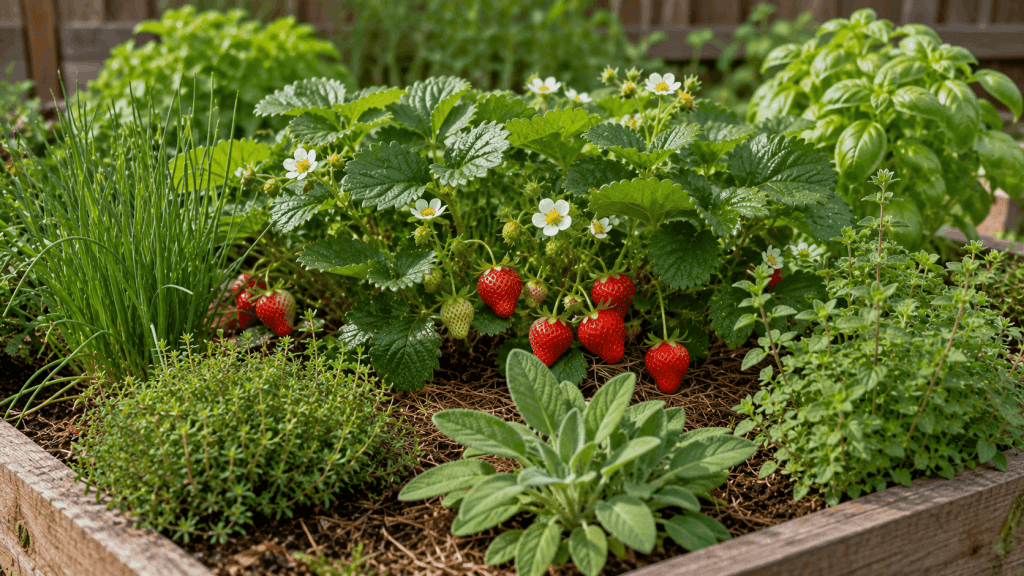
Planting low-growing herbs around strawberries offers several practical benefits. They attract insects that are helpful to your garden, help deter some common pests, and form a light protective layer over the soil when kept tidy.
Because they stay compact, these herbs don’t steal sunlight or block air from circulating around the base of the strawberry plants. This airflow is important. Keeping low herbs trimmed maintains vital airflow across the soil level, directly targeting humidity and curbing Botrytis gray mold, a practice backed by Royal Horticultural Society plant pathology standards.
Popular herb companions include:
- Thyme
- Sage
- Oregano
- Basil
- Chives
Regular pruning keeps herbs productive without shading neighboring strawberries.
Which herbs require regular trimming?
Even beneficial herbs become competitors when allowed to overgrow.
Maintain herbs by:
- Removing flower stalks if excessive
- Preventing canopy cover over strawberry crowns
- Keeping pathways open
- Improving airflow between plants
That simple maintenance routine helps reduce disease while supporting pollinators and beneficial insects throughout the season.
How Do Legumes and Leafy Greens Benefit Strawberries?
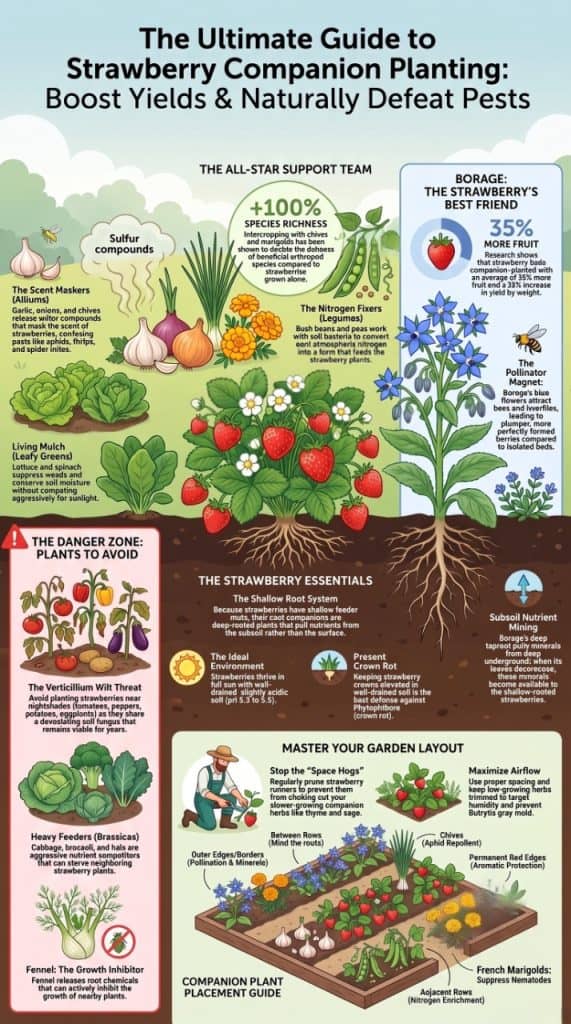
Bush beans and peas add nutrients to the soil. Lettuce and spinach help by crowding out weeds and keeping the soil moist for the strawberries.
This works because legumes have a special relationship with Rhizobium bacteria. These bacteria take nitrogen from the air and convert it into a form plants can use. Research from the University of California notes that this natural process creates a healthier soil environment and improves fertility over time.
Benefits of bush beans include:
- Natural nitrogen enrichment
- Compact growth habit
- Minimal shading
- Compatibility with raised beds
Leafy greens offer a different advantage.
How do lettuce and spinach help?
These shallow-rooted vegetables function as living mulch by:
- Suppressing weeds
- Conserving soil moisture
- Providing light canopy cover
- Supporting weed prevention
Unlike taller crops, lettuce and spinach rarely compete aggressively with strawberries when harvested regularly.
Can Strawberries and Asparagus Grow Together?
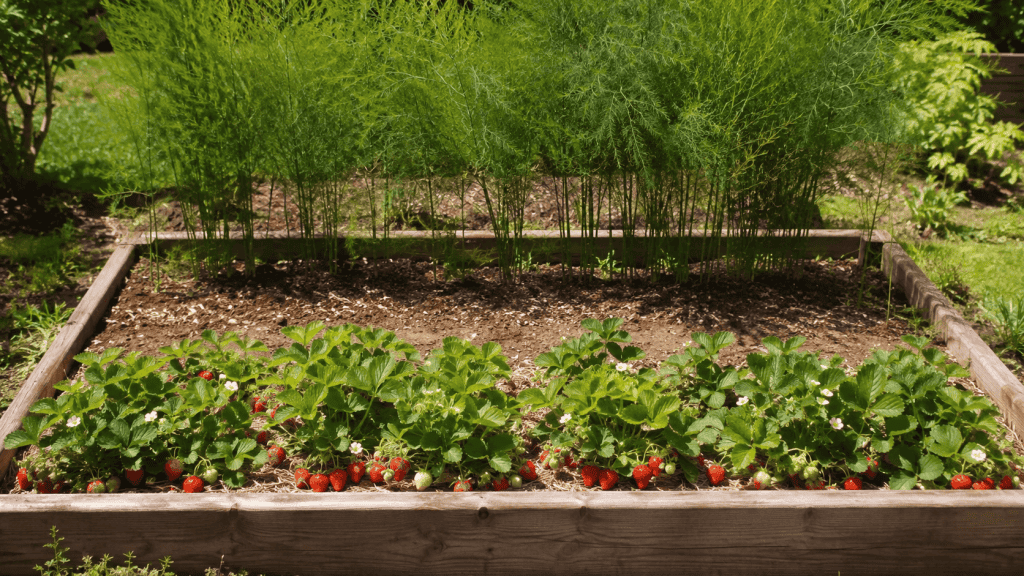
Yes, you can grow strawberries and asparagus together, but it takes planning. They won’t thrive if you just plant them side-by-side and forget them. Success depends on giving them enough space, controlling the strawberry runners, and paying close attention.
The reason it can work is their root systems. Asparagus roots grow very deep, far below where strawberry feeder roots spread out. This difference means they aren’t fighting for the same water and nutrients in the topsoil. Because of this reduced competition, the pairing is often used in permaculture gardens and guild planting systems.
However, real-world growers consistently report three common challenges:
- Mature asparagus ferns create heavy summer shade.
- Strawberry runners quickly spread into asparagus crowns.
- The crops prefer slightly different soil pH ranges.
How can you make this pairing successful?
Several practical techniques consistently improve results.
- Plant strawberries on the south-facing edge of the bed.
- Practice regular runner management.
- Leave clear harvest paths.
- Monitor soil pH over time.
- Maintain excellent soil drainage.
In orchard setups, many permaculture gardeners choose alpine strawberries over the common June-bearing types. Alpine strawberries (Fragaria vesca) don’t spread aggressively. Their slow, clumping growth makes them much easier to manage around the base of fruit trees.
Still, you need a plan. Using strawberries as a living mulch under trees creates some practical headaches. If the plants are right under the canopy’s drip line, they can get in the way during pruning and harve
Which Plants Should Never Grow Near Strawberries?
Some plants will hurt your strawberries. Stay away from anything that carries disease, hogs all the nutrients, or leaks stuff into the soil that slows strawberries down.
Watch out for Verticillium wilt. It’s a nasty soil fungus that hits strawberries hard. The trouble is, it also lives in a lot of common garden plants, especially nightshades like tomatoes, peppers, and potatoes. Putting these near your strawberry patch is asking for trouble.
| Plant | Why Avoid It? |
| Tomatoes | Shared Verticillium wilt risk |
| Potatoes | Common soil pathogens |
| Eggplants | Similar fungal diseases |
| Peppers | Disease overlap |
| Brassicas | Heavy nutrient competition |
| Cabbage | Aggressive feeding |
| Broccoli | Nutrient competition |
| Kale | Heavy feeder |
| Fennel | Inhibits nearby growth through root chemicals |
Why are nightshades especially dangerous?
The University of Minnesota Extension recommends avoiding strawberries in soil recently occupied by tomatoes, potatoes, peppers, or eggplants because Verticillium can remain viable in soil for several years.
Good crop rotation helps interrupt disease cycles while preserving long-term soil health. Gardeners seeking total soil disease control often explore controlled-environment culture, leveraging the space-saving efficiency and pest-reducing benefits of hydroponic strawberries alongside traditional outdoor planting.
What Garden Layout Produces the Best Results?
The best strawberry beds are organized. Plan your layout by grouping plants according to their height, how deep their roots go, how much sun they need, and how much care they require.
A simple, well-spaced design almost always works better than the crowded, complicated ones you often see online. Giving your plants room to breathe improves air flow and makes harvesting easy. You’ll get more strawberries from a bed you can actually work in than from one crammed full of every possible companion plant.
A practical arrangement looks like this:
- Border: Chives
- Corners: French marigolds
- Outer edge: Borage
- Center: Strawberries
- Adjacent bed: Bush beans
How much spacing should strawberries have?
Provide enough room for:
- Air circulation
- Harvest access
- Crown protection
- Seasonal runner management
- Weed control
Overcrowding restricts root respiration and light penetration, which often keeps outdoor plants and hydroponic strawberries small while triggering fungal outbreaks in dense beds.
What Common Companion Planting Mistakes Should You Avoid?
When companion planting with strawberries fails, it’s usually not the idea that’s wrong. It’s the execution. Unchecked fungal issues, root crowding, and pest spikes remain common strawberry problems that stem from planting things too close together, neglecting pruning, or picking plants that just don’t get along.
Experienced gardeners have a name for strawberries: “space hogs.” If you don’t control them, their runners will shoot out and claim every inch of empty ground, choking out the plants you put there to help them.
Common mistakes include:
- Ignoring runners
- Planting tall herbs too closely
- Digging repeatedly near strawberry crowns
- Overcrowding garden beds
- Ignoring soil pH
- Poor plant spacing
- Weak soil drainage
Why do experienced gardeners call strawberries “space hogs”?
Let your June-bearing strawberry runners go, and they’ll claim the whole garden. Within a year or two, they’ll sprawl over everything, burying the plants you put there to help them.
Pruning the runners isn’t optional. Do it regularly. Snip them off, and you’ll let the sun in for all your plants. You’ll be able to find and pick your berries without a struggle. And you’ll save the slower-growing companion plants, the thyme, the sage, the flowers, from being choked out entirely.
Which Strawberry Companion Strategy Delivers the Best Results?
The best strawberry gardens use a team of plants. Don’t just pick one helper. Combine flowers, herbs, and legumes in a smart layout.
A solid, balanced plan often uses these plants:
- Borage to attract bees and other pollinators.
- Garlic or chives to naturally repel pests with their strong smell.
- Bush beans to pull nitrogen from the air and fix it in the soil.
- French marigolds to fight off harmful root nematodes.
- Thyme to form a low, protective groundcover.
These companions work much better when the basics are right. Good soil, enough space between plants, and regular care, like watering and weeding, make all the difference. Pay attention to how your plants grow each season. You can then adjust your mix to suit your own garden’s weather and conditions, building a stronger strawberry patch over time.
FAQs
What companion plants naturally reduce strawberry pests?
Several strawberry companion plants help reduce pest problems. Garlic, onions, and chives belong to the alliums family and release strong odors that discourage aphids, spider mites, and thrips. French marigolds can help reduce root nematodes in the soil. Thyme, sage, and other herbs also support natural pest control by attracting beneficial insects that feed on common strawberry pests.
Which flowers improve strawberry pollination and fruit production?
Borage is one of the best flowers to grow with strawberries because it attracts bees, hoverflies, and other pollinators that improve blossom pollination. It also attracts ladybugs, lacewings, and beneficial wasps, which feed on harmful insects. Adding flowering companion plants increases insect activity around strawberry blossoms and often leads to better fruit production throughout the growing season.
Which vegetables grow well with strawberry plants?
Several vegetables grow well beside strawberries when you leave enough plant spacing to reduce root competition. Bush beans and peas are nitrogen fixers that improve soil health. Lettuce and spinach provide living mulch that supports weed suppression and helps retain soil moisture. Avoid planting tomatoes, potatoes, eggplants, peppers, cabbage, broccoli, kale, or fennel because they can increase disease or reduce strawberry growth.
How should I arrange companion plants around strawberries?
A good companion planting guide considers root depth, root zone, sunlight, and airflow. Strawberries have a shallow root system, so they grow best beside plants with deeper roots that pull subsoil minerals upward through a long taproot. This planting method works well in raised beds, garden beds, intercropping, polyculture, permaculture, guild planting, and fruit tree guilds.
Which growing practices produce healthier strawberry harvests?
Healthy June-bearing strawberries, everbearing strawberries, alpine strawberries, and Fragaria vesca grow best in well-drained organic soil with the proper soil pH for acidic soil conditions. Combine perennial companions and annual companions to provide groundcover, weed prevention, runner control, runner management, and crown protection. Practice crop rotation to reduce Verticillium wilt and harmful soil fungi while improving soil drainage and supporting yield optimization.
Keep Your Strawberry Bed Healthy for the Long Run
Strawberry runners that spread too far block sunlight and shove other plants aside. This happens fast.Spend a few minutes cutting back those runners. Your garden becomes easier to handle, and each plant gets the space it needs.
Turn this into a regular task. Your strawberries will stay productive instead of taking over the whole bed. You won’t waste time untangling a crowded mess, you’ll just pick more berries. It’s a small, simple job that makes every growing season better. For more practical growing tips, visit Tophydroponicgarden.
References
- https://resjournals.onlinelibrary.wiley.com/doi/full/10.1111%2Feen.12880
- https://www.hortidaily.com/article/9766869/study-examines-sustainable-ways-to-diversify-strawberry-herb-intercropping/
Related Articles
- https://tophydroponicgarden.com/why-are-my-hydroponic-strawberries-small/
- https://tophydroponicgarden.com/troubleshooting-common-strawberry-problems/
- https://tophydroponicgarden.com/what-are-the-benefits-of-hydroponic-strawberries/
Was this helpful?

I’m Barrie L., a passionate hydroponic gardening enthusiast dedicated to cultivating thriving, soil-less gardens. With a focus on all things hydroponic, I share my expertise on innovative growing techniques and sustainable practices through my blog, tophydroponicgarden.com. As a seasoned hydroponics specialist, my goal is to inspire and guide fellow gardeners in harnessing the power of water-based cultivation for bountiful and eco-friendly harvests. I’m also an author of the book “Hydroponics For Absolute Beginners: Your Step By Step Guide For How To Create An Hydroponics System At Home Without Soil, For Growing Vegetable, Fruit And Herbs.” which is sold on Amazon. Join me on a journey of redefining the way we cultivate plants, one nutrient-rich solution at a time. Happy growing!