

Hydroponic strawberries grow faster, stay cleaner, and use far less water than traditional soil-grown crops. But those benefits don’t happen on their own. A good setup, steady monitoring, and the right growing conditions still matter.
One of the biggest advantages is water efficiency, with the U.S. Environmental Protection Agency (EPA) reporting that recirculating hydroponic systems can cut water use by up to 90% compared with conventional farming.
And because the environment is controlled, growers can harvest throughout the year.
Keep reading to see the biggest benefits, the real challenges, and how Tophydroponicgarden helps growers get better results.
Strawberry Snapshot: Why Hydroponics Makes a Difference
- Hydroponic strawberries grow without soil using a balanced nutrient solution, supporting healthy roots and consistent plant growth.
- Controlled growing conditions improve efficiency by producing cleaner fruit, maintaining stable pH and EC levels, and using up to 90% less water in some systems, according to the EPA.
- Success depends on proper management, including climate control, nutrient balance, and regular monitoring to achieve reliable, high-quality harvests.
Why Are Hydroponic Strawberries Becoming So Popular?
Strawberries grown without soil are catching a lot of attention these days. Hydroponics lets growers produce more fruit in less space, with dependable harvests and great taste, whether at home or on a commercial scale.
The secret? Instead of relying on soil, the plants get all their water and nutrients in a carefully controlled way.
Growing Fragaria × ananassa like this means farmers don’t have to gamble on weather or soil quality. They provide a balanced mix of fertilizers and minerals using precise irrigation systems, so the plants get exactly what they need.
Here are the main advantages of using this innovative farming approach:
- Controlled Environment Agriculture is expanding rapidly because it offers more control and significantly less risk from unpredictable weather swings.
- Experts at the University of Arizona point out that indoor and greenhouse growing make crop yields much more reliable throughout the year.
- Hydroponics boosts production efficiency overall while actively reducing the waste of both water and vital fertilizers.
This method fits right into modern agricultural trends that prioritize high yields and resource conservation. Technology has pushed hydroponics even further by introducing vertical farming, which stacks plants upward to save precious space.
At its core, hydroponics feeds plant roots directly through carefully engineered nutrient solutions. Providing the right nutrient solution ensures roots get everything they need to flourish.
Nutrients stay dissolved in water, always ready to be taken up by roots. This lets plants spend their energy on growing fruit instead of hunting for food in the soil.
Strong roots mean healthier plants and sweeter berries. The careful balance of nutrients, pH, and oxygen around the roots keeps everything running smoothly.
Plus, it keeps everything cleaner with no dirt and fewer pests to worry about. For home gardeners, the appeal is obvious: steady harvests all year round, even when outdoor conditions are poor, thanks to LED lights and automated monitoring.
Here is how the system comes together for everyday growers:
- First, growers set up a controlled indoor or greenhouse space equipped with supportive growing media like coco coir or rockwool.
- Next, precise irrigation systems deliver a balanced mix of dissolved minerals, oxygen, and nutrients directly to the plant roots.
- Finally, automated sensors monitor conditions and adjust the environment in real time to guarantee a sweet, high-quality harvest.
It’s true that hydroponics requires a learning curve, but smart, automated dosing systems have taken much of the daily hassle out of the process.
In the end, hydroponic strawberries are about having control, control over the growing environment, the harvest schedule, and the quality of the fruit. It’s no wonder more people are turning to this method for fresh, delicious berries.
What Are the Biggest Benefits of Hydroponic Strawberries?
There’s a lot to like about hydroponic strawberries, faster growth, cleaner fruit, bigger yields, and smarter use of water and nutrients. Both hobbyists and commercial growers find these traits hard to resist.
The magic lies in how plants get nutrients. Instead of waiting for nutrients to trickle in through soil or hoping watering is just right, hydroponic strawberries receive a steady, carefully managed supply.
Research from Cornell and other experts shows this steady feeding leads to stronger plant growth and fruit that develops more evenly.
Stable conditions also knock out many common problems. Drought stress, nutrient shortages, or sudden temperature swings? Less worry there, since the environment is tightly controlled.
The benefits don’t stop there:
- Growth speeds up because roots get nutrients immediately instead of scavenging for them.
- Fruit stays cleaner since there’s no soil to splash during watering.
- Yields jump thanks to less stress on the plants.
- Berries look and grow more uniformly.
- Vertical farming stacks plants up, squeezing more production into smaller spaces.
One tip that often helps growers: keeping electrical conductivity (EC), pH, and oxygen levels steady tends to deliver better, more reliable harvests than constantly tweaking nutrient mixes.
Plus, hydroponics makes data tracking simpler. Automated monitoring and digital record keeping mean growers can fine-tune their process over time, spotting trends and improving yields without guesswork.
It’s this control, over nutrients, environment, and data, that makes hydroponic strawberries a smart choice for anyone serious about consistent, high-quality fruit.
How Does Hydroponics Improve Strawberry Quality?

Controlled nutrients, water, and environment shape strawberries that are sweeter, cleaner, and more consistent. It’s no accident; fruit quality leans heavily on steady mineral supply, balanced growing conditions, and healthy roots.
Hydroponic growers can tweak nutrient levels as the plants grow, keeping an eye on things like osmotic stress and calcium shortages before the plants even show signs.
Cornell University research backs this up, steady watering and feeding often lead to berries that are more uniform and less prone to disorders.
Why are hydroponic strawberries cleaner? Simple: no soil contact.
No muddy splashes dirt up the fruit during irrigation, and because most hydroponic setups happen indoors or in greenhouses, berries avoid heavy rain, dirt, and other debris. This means less scrubbing before eating and less risk of soil-based diseases.
A few key reasons for cleaner berries:
- No soil contamination
- Cleaner surfaces during harvest
- Less washing needed
- Lower chance of soil pathogens
All this helps berries look better during shipping and on store shelves.
What about flavor? That depends on more than just the growing method. Genetics, when the fruit gets picked, and careful nutrient management play bigger roles.
Keeping Brix levels right, managing irrigation well, and holding steady growing conditions work together to bring out the sweetness and flavor.
Studies have found that hydroponic strawberries, when managed well, can taste just as good or even better than those grown in traditional soil. Things like stable humidity, proper light levels (PPFD), and healthy plant crowns help make that happen.
In essence, hydroponics offers a way to produce fruit that not only looks good and stays clean but can also deliver on flavor, if you pay close attention to what the plants need, when they need it.
Can Hydroponic Strawberries Produce Higher Yields?
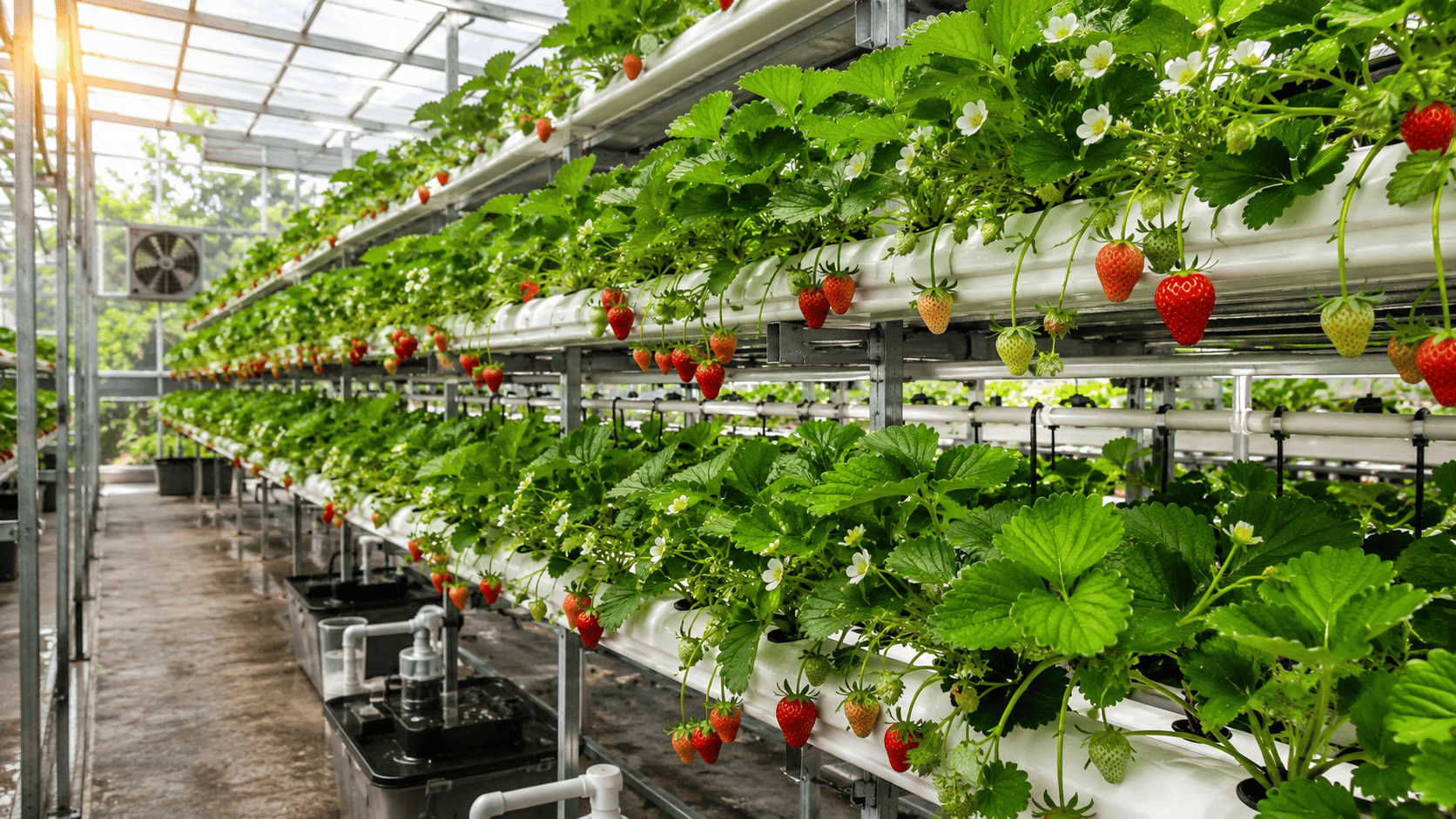
Optimized growing conditions often give strawberries a leg up compared to traditional soil farming. Hydroponics cuts out a lot of competition underground by delivering a perfectly balanced nutrient mix straight to the roots.
When roots get enough oxygen, water, and precise nutrients, plants grow strong leaves and vines before even thinking about flowers.
Keeping the environment steady, including temperature, humidity, and vapor pressure, means the plants don’t have to waste energy coping with stress. Instead, they focus on making more flowers and filling out fruit.
Commercial growers take this further by stacking plants in vertical farms, squeezing more berries into less floor space while still keeping air moving around them.
The biggest production boosts come when growers improve several of these areas at once, rather than focusing on just one.
Why do yields get better? It’s all about the roots. When they consistently get oxygen, water, and minerals, plants never have to slow down their growth.
Ohio State research shows that carefully timed irrigation and environmental control often lead to bigger, more efficient harvests with less wasted input. But what really drives production? It’s a delicate balance between strong genetics and a well-managed environment.
Choosing the best strawberry varieties matters, as does good lighting, pollination, and careful nutrient management.
LED grow lights play a key role here, making sure plants get the right amount of light intensity during growth and flowering stages.
Still, no fancy tech can fix sick or stressed plants. Healthy runners, which are the young shoots that spread the crop, will always produce far more fruit than ones struggling under poor conditions.
So, hydroponic strawberry yields jump mostly because conditions stay ideal, roots stay happy, and growers make smart choices across the board.
How Do Hydroponic Strawberries Save Water?
Water efficiency stands out as one of hydroponics’ strongest suits. Unlike traditional farming, where much water evaporates, seeps deep, or runs off into drainage systems, recirculating hydroponic setups reuse water over and over.
This keeps unused nutrients in the mix, ready to feed plants again on the next cycle.
The U.S. Environmental Protection Agency points to some hydroponic systems cutting water use by as much as 90% compared to conventional methods.
That kind of savings isn’t just a number, it matters a lot in places where drought hits hard or water prices climb.
What helps make this possible? Several design choices come into play:
- Closed-loop recirculation keeps water moving in a cycle, not escaping.
- Reduced evaporation means more water stays put where roots can reach it.
- Lower fertilizer runoff protects the environment and cuts waste.
- Precise irrigation timing delivers just the right amount when needed.
Water efficiency isn’t just about saving money on bills; it’s critical for the bigger picture of sustainable farming and food security.
With automated sensors and controls, growers can track reservoir levels and nutrient strength, making sure nothing gets wasted and plants keep thriving.
How much water growers save depends on everything, from system setup to climate to how carefully they manage irrigation.
But well-run recirculating systems always use water far more wisely than open-field watering, since the nutrient-rich water stays contained, reused again and again.
Regular maintenance matters too. Keeping reservoirs clean and managing leftover solutions helps keep nutrient levels balanced throughout the growing season, avoiding surprises that can hurt the crop.
In short, hydroponic water recycling isn’t just efficient, it’s a smarter, more sustainable way to grow strawberries, especially in a world where every drop counts.
Do Hydroponic Strawberries Reduce Pests and Diseases?
Hydroponics cuts out many soil-borne diseases, but it’s not a free pass. Without soil, fungal pathogens and pesky insects often found in fields don’t get a foothold.
Still, pests and diseases aren’t completely off the table, greenhouses can harbor aphids, spider mites, powdery mildew, and botrytis, especially when air doesn’t circulate well.
It’s a balance. The soil risks drop sharply, but growers must stay alert to airborne threats and greenhouse pathogens. Routine checks help catch trouble early, before it spreads and becomes a full-blown problem.
Here’s a quick look: hydroponics reduces issues like soil fungi, root diseases, and soil insects but doesn’t eliminate powdery mildew, aphids, spider mites, or botrytis.
What keeps things running smoothly? Successful growers stick to a mix of prevention and vigilance.
Good habits include frequent crop inspections, ensuring proper airflow, maintaining clean water reservoirs, sanitizing every tool, and following Integrated Pest Management (IPM) guidelines.
The goal isn’t just to react, it’s to create growing conditions, such as using companion plants, that discourage pests and diseases from ever gaining ground.
Healthy environments are the best defense. When humidity, temperature, and airflow stay balanced, plants are tougher and less likely to fall prey to trouble. That’s the quiet work behind the scenes that keeps hydroponic strawberries thriving year after year.
Are Hydroponic Strawberries More Sustainable?

Credits : Everything Hydroponics
Hydroponic systems offer a more sustainable way to grow strawberries by cutting down on water use, fertilizer runoff, and land needs.
Because nutrients are delivered with pinpoint accuracy, there’s less waste that might seep into nearby waterways.
Plus, stacking plants vertically means farms can produce more fruit in smaller spaces, something urban growers and greenhouse operators find incredibly useful when farmland is scarce.
The Food and Agriculture Organization (FAO) highlights resource efficiency as a key to feeding the world’s growing population. Hydroponics steps into this role by using less water, occupying less land, reducing nutrient runoff, and generally squeezing more out of every input.
But it’s not just the tech that makes hydroponics efficient; smart design and management matter most.
Automation ties everything together, dosing nutrients, running sensors that monitor temperature and humidity, and adjusting irrigation on the fly. This keeps conditions stable and cuts wasted resources.
Of course, there are trade-offs. Running hydroponic systems needs electricity, and building greenhouses and equipment carries an environmental cost.
Studies show that these costs shrink considerably when operations rely on renewable energy. In the end, sustainability depends less on the technology itself and more on how well the system is run.
Hydroponics isn’t a perfect solution, but with careful planning and management, it offers a sharper, more efficient way to grow strawberries, especially in places where resources or land are limited.
What Challenges Should You Expect?
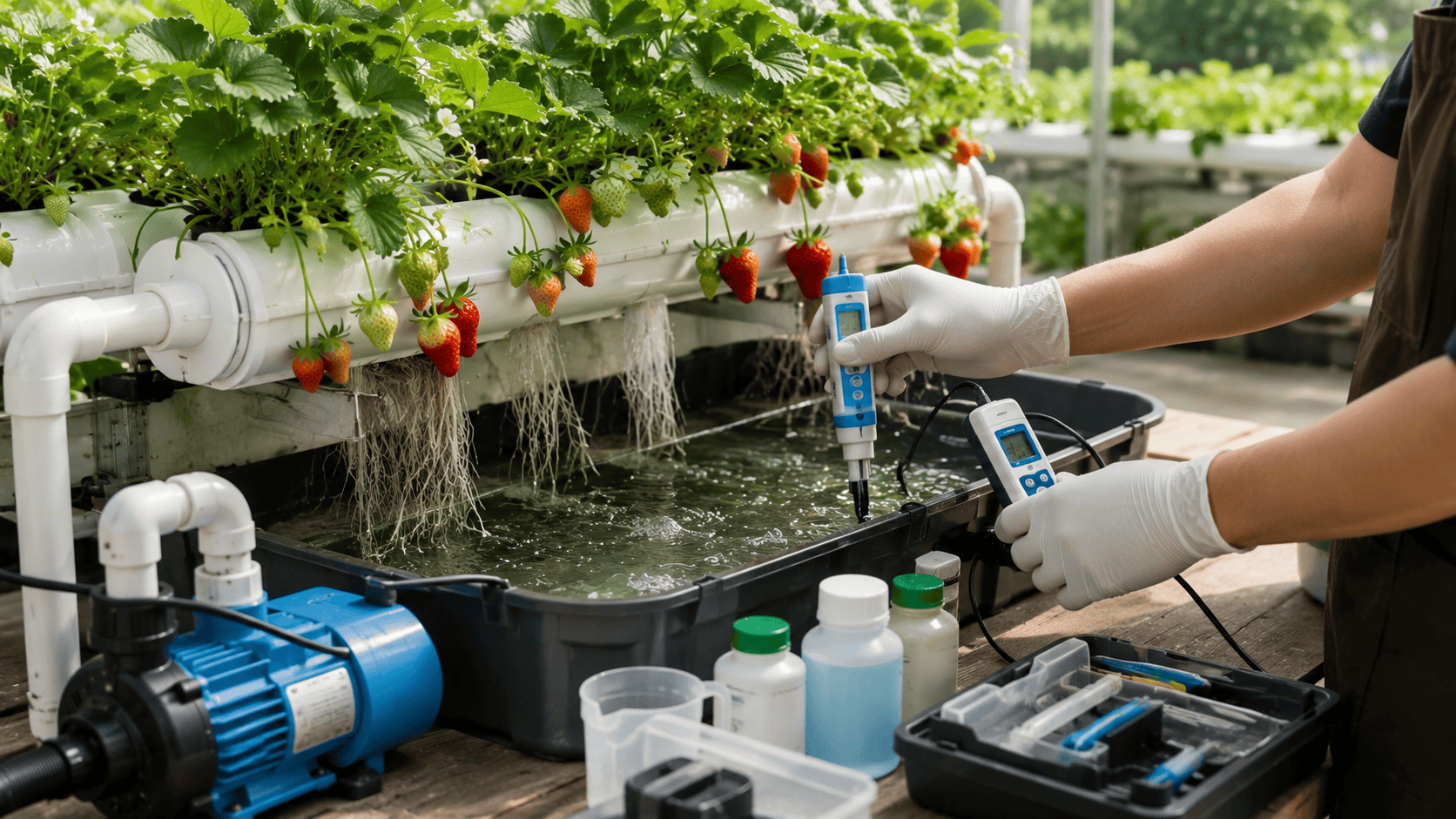
Hydroponic strawberry growing isn’t a casual hobby, it demands attention, technical know-how, and a bigger upfront investment than traditional gardening. Because the plants depend entirely on what you provide, any slip-ups show up fast.
If pH swings out of balance, electrical conductivity (EC) wavers, or irrigation stops even briefly, the plants suffer within hours.
Successful growers lean on steady maintenance routines instead of constant tweaking. That steady hand reduces the chance of costly problems.
Common hurdles include higher startup costs, equipment failures, managing nutrient levels, reliance on electricity, and risks of root rot if oxygen doesn’t reach the roots properly.
Hydroponics clears many soil-born issues but replaces them with new technical duties. Growers monitor EC, reservoir temperature, dissolved oxygen, and nutrients closely, fighting off root rot, tip burn, and calcium deficiency by keeping mineral nutrition in check.
For beginners, it’s smarter to start with a simple setup rather than jumping into the biggest, most complex system. Practical steps include:
- Checking pH every day
- Watching EC levels regularly
- Keeping reservoirs clean
- Having backup pumps ready
- Recording every nutrient change
Ultimately, nothing beats consistent watching and recording. It’s the farmer’s best tool to catch small problems before they turn big. Hydroponics pays off, but only if growers respect its demands and stay on top of the details.
Which Hydroponic System Works Best for Strawberries?
Picking the right hydroponic system boils down to your space, your goals, and how much time you’re willing to spend on upkeep. Each setup has its strengths, some excel at keeping things straightforward, others push for maximum yield, and some shine in tight vertical spaces.
Here’s a quick look at the options:
| Hydroponic System | Best For | Main Advantage |
| Nutrient Film Technique (NFT) | Commercial production | Continuous nutrient flow supports efficient root development. |
| Drip Irrigation | Greenhouse production | Precise water and nutrient delivery with easy control. |
| DWC | Beginners and home growers | Simple setup with constant root access to oxygenated nutrient solution. |
| Vertical Towers | Indoor gardening | Maximizes production in limited space. |
| Dutch Bucket System | Flexible growing layouts | Suitable for different planting arrangements and future expansion. |
No matter which system you pick, success comes down to steady maintenance and attention.
Data from Frontiers in Plant Science demonstrates
“Not all hydroponic systems are created equal. A 2025 study in Frontiers in Plant Science compared various systems for strawberry production and found that specific designs significantly impact results. The researchers reported that, based on yield and resource use efficiencies, “the substrate system performed the best, with the vertical tower system also showing promising performance”.” – Frontiers in Plant Science
For beginners, simple drip or NFT setups usually win out. They strike a good balance between reliability and manageable care, without overwhelming complexity.
Many home hydroponic kits bundle reservoirs, pumps, and nutrient dosing gear to get you started with less hassle, and offer room to grow as your skills improve.
In the end, the “best” system is the one you can maintain consistently and that fits the space and scale you have in mind.
How Can You Grow Hydroponic Strawberries with Tophydroponicgarden?
Getting started with hydroponic strawberries doesn’t have to be complicated. With the right gear and steady care, even beginners can grow healthy plants and enjoy regular harvests.
It all begins with strong runners or stolons, well-balanced nutrients, and reliable tools to keep an eye on conditions.
As noted by Frontiers in Plant Science
“A study published in Frontiers in Plant Science in 2025 found that using soil moisture sensors to automate irrigation in hydroponic systems is a key strategy for improving resource efficiency. The researchers concluded that sensor-controlled fertigation can “aid growers in employing more efficient fertigation management strategies to increase crop quality and reduce resource use for CEA strawberry production”.” – Frontiers in Plant Science
Whether you’re working inside a greenhouse or an indoor garden, consistency beats complexity every time. Key equipment includes a hydroponic system, nutrient solution, pH meter, EC sensor, and, if indoors, LED grow lights and an air pump to keep oxygen flowing around roots.
A complete setup covers irrigation, lighting, nutrient dosing, and monitoring of the environment. It’s wise to have backup pumps on hand, extra nutrient salts, and clean water ready before you even start planting.
Here’s a straightforward way to jump in:
- Pick a hydroponic system that fits your space
- Mix up nutrient solution with good-quality water-soluble fertilizer
- Plant healthy strawberry runners
- Check pH and EC daily
- Adjust temperature, humidity, and light as plants grow
- Harvest berries often to encourage new fruit
With regular observation and care, even a beginner can enjoy reliable strawberry harvests throughout much of the year. Hydroponics might sound technical, but breaking it down into steady steps makes it manageable, and rewarding.
FAQ
Can soilless culture improve strawberry growth compared to soil?
Yes. Soilless culture gives growers better control over the nutrient solution, pH balance, and mineral nutrition. Common substrate culture materials include coco coir, perlite, rockwool, and peat moss. Stable conditions support plant growth, root health, and resource use efficiency while reducing many soil-related problems. Regular nutrient management helps maintain healthy plants throughout the crop cycle.
How do growers prevent root rot in hydroponic strawberries?
Healthy roots depend on clean water, enough dissolved oxygen, and good reservoir maintenance. Water recirculation systems should be checked regularly to avoid root rot and fungal pathogens. Automated monitoring with EC sensor technology, IoT sensors, and automated dosing systems helps maintain electrical conductivity, nutrient dosing, and water quality before small problems affect plant physiology or crop performance.
Which hydroponic system works best for strawberries?
The right system depends on your space and goals. Nutrient film technique, deep water culture, water culture, drip irrigation, and ebb and flow each have different strengths. Vertical farming with vertical towers is useful for indoor gardening and greenhouse production because it saves space while supporting commercial production and home hydroponic kits in controlled environments.
Why are climate control and lighting important for hydroponic strawberries?
Climate control keeps temperature management, humidity levels, and vapor pressure deficit within suitable ranges for healthy plants. LED grow lights provide consistent light, while photosynthetic photon flux density (PPFD) affects photosynthesis and fruit development. Together, these factors support crown health, reduce tip burn and calcium deficiency, improve harvest timing, and encourage better fruit quality and sweetness.
Can hydroponic strawberries be grown sustainably at home or commercially?
Yes. Sustainable agriculture benefits from efficient water use, water recirculation, and reduced pesticide use through effective pest management. Organic hydroponics, aeroponics, aquaponics, and controlled environment agriculture (CEA) can all support cleaner production. Proper irrigation systems, water-soluble fertilizer, nutrient salts, magnesium sulfate, plant propagation through runners and stolons, and yield optimization help improve food security and consistent harvests.
Why Hydroponic Strawberries Are Worth Growing
Growing strawberries this way can solve common problems like messy fruit, uneven growth, and wasted water.
You get more control over how your plants grow, which can lead to better results when you stay consistent. That’s what makes the extra effort worth it.
If you’re ready to get started or improve your setup, Tophydroponicgarden is a helpful place to learn what works.
You’ll find simple guides, useful equipment tips, and practical growing advice that can help you grow healthy strawberries with more confidence.
References
- https://pubmed.ncbi.nlm.nih.gov/39925371/
- https://www.frontiersin.org/journals/plant-science/articles/10.3389/fpls.2025.1469430/full
Related Article
- https://tophydroponicgarden.com/hydroponic-strawberry-nutrient-solution-recipe/
- https://tophydroponicgarden.com/what-are-companion-plants-for-hydroponics/
- https://tophydroponicgarden.com/best-strawberry-varieties-for-hydroponics/
Was this helpful?

I’m Barrie L., a passionate hydroponic gardening enthusiast dedicated to cultivating thriving, soil-less gardens. With a focus on all things hydroponic, I share my expertise on innovative growing techniques and sustainable practices through my blog, tophydroponicgarden.com. As a seasoned hydroponics specialist, my goal is to inspire and guide fellow gardeners in harnessing the power of water-based cultivation for bountiful and eco-friendly harvests. I’m also an author of the book “Hydroponics For Absolute Beginners: Your Step By Step Guide For How To Create An Hydroponics System At Home Without Soil, For Growing Vegetable, Fruit And Herbs.” which is sold on Amazon. Join me on a journey of redefining the way we cultivate plants, one nutrient-rich solution at a time. Happy growing!