
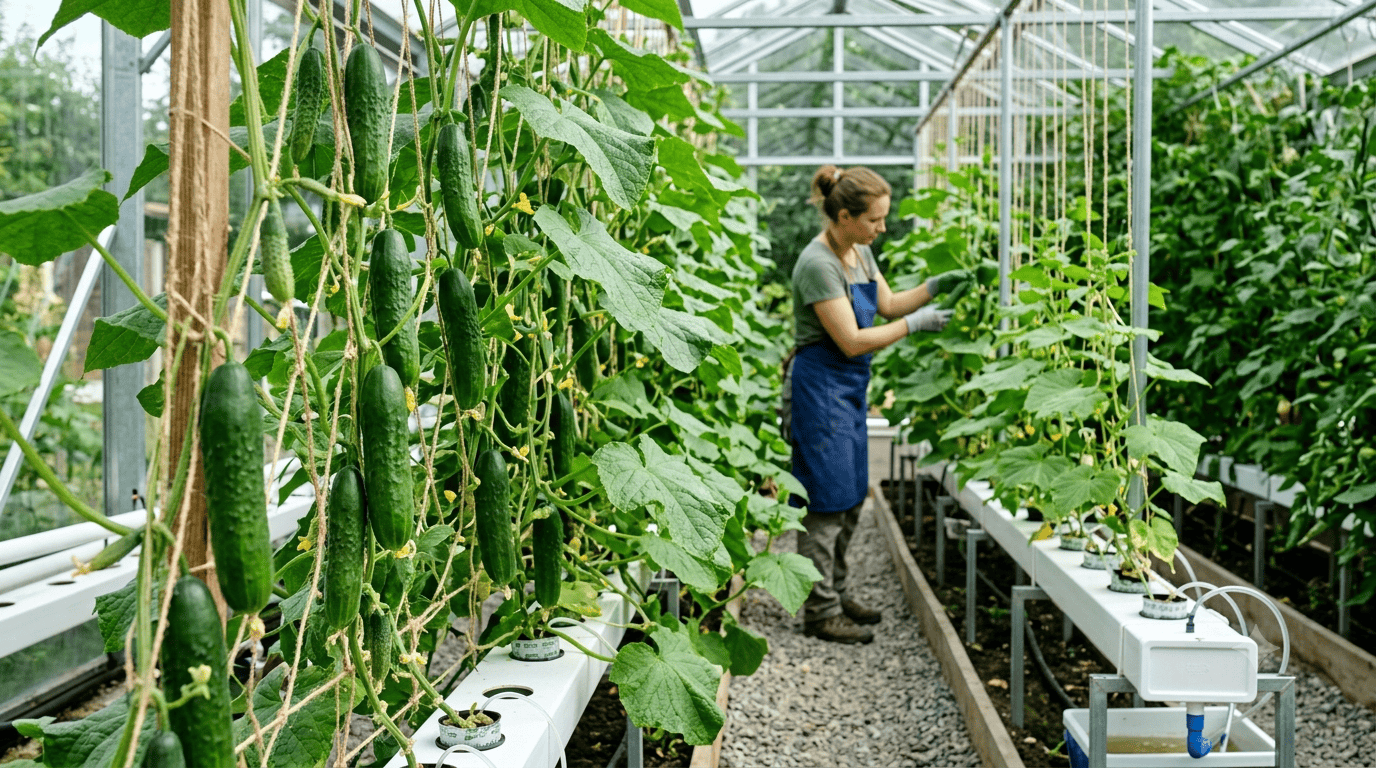
Hydroponic cucumbers can grow faster, use water efficiently, and give growers tighter control over nutrients. But that control comes with work. Strong vines need steady irrigation, proper support, and a climate that stays in range. The cucumber variety matters, too.
Get those details right, and hydroponics can support consistent, high-density production. Get them wrong, and problems can spread through the crop quickly. Read on to see where hydroponic cucumbers can help, and what growers need to watch.
Quick Reads: Hydroponic Cucumber Benefits
Hydroponic cucumbers can grow faster, use less water, and produce more consistently under controlled conditions. The main advantage is tighter control over the root zone and growing space.
- Faster growth: Roots get direct access to water, oxygen, and nutrients.
- Better space use: Recirculation can reduce water waste, while trellising uses vertical space.
- More consistent conditions: Controlled growing can reduce issues from soil, drought, and weather.
How Can Hydroponic Cucumbers Improve Growth and Yield?
Hydroponic cucumbers can grow fast and produce good yields when they receive the right nutrients, water, light, temperature, and root oxygen.
Can hydroponics shorten the cucumber production cycle?
Controlled nutrients and climate can help cucumbers grow faster and more evenly. That’s why hydroponics is often used for high-output growing. USDA ERS research found that some hydroponic cucumber trials produced much higher yields than open-field production.
But results vary. Research trials use specific conditions that may not match every commercial farm.
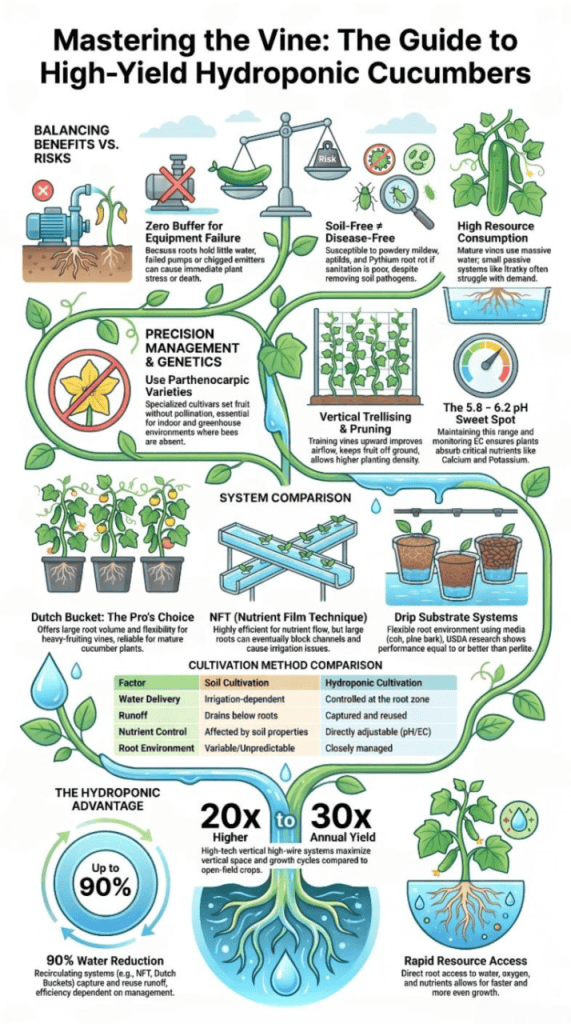
In high-tech commercial greenhouse trials, multi-crop vertical high-wire systems have demonstrated up to 20 to 30 times higher annual yield per acre than single-season open-field crops. However, individual grower yields depend on light daily light integral (DLI), temperature control, and pruning discipline. That shows the possible output of controlled systems, not a typical farm result.
In real production, yields can change based on many factors, like:
- the production system used
- local climate conditions
- the cucumber variety
- crop management (how growers handle feeding, watering, and harvesting)
Can hydroponic systems produce more cucumbers per square foot?
High-density cucumber production works because vines can grow upward instead of taking over the floor.
Commercial high-wire systems make use of this habit. They save floor space while keeping fruit within reach for harvest. Indoor farms can use the same approach, especially when the growing area is tight.
But there’s a tradeoff. Fast-growing vines need frequent irrigation, sturdy trellising, and regular pruning as the canopy fills out.
Why Does Hydroponic Cucumber Production Use Less Water?
Hydroponic systems can save water because the nutrient solution goes straight to the roots. Unused water can also be collected and reused.
| Growing factor | Soil cultivation | Hydroponic cultivation |
| Water delivery | Irrigation-dependent | Controlled at the root zone |
| Runoff | Can drain below roots | Can be captured and reused |
| Nutrient control | Affected by soil properties | Directly adjustable |
| Root environment | More variable | Closely managed |
| Water efficiency | Highly variable | Potentially very high |
Recirculating systems such as Nutrient Film Technique (NFT) and Dutch Buckets manage water in different ways. Both can reduce water waste when properly designed and maintained.
USDA researchers have evaluated brackish water for hydroponic fertigation in arid regions, though elevated electrical conductivity (EC) from sodium requires strict osmotic management to avoid blossom-end stress and leaf tip burn
You may see claims of up to 90% lower water use. Treat that number with care. Actual use depends on drainage, evaporation, humidity, recirculation, and reservoir management.
So measure water use at the farm level. A headline percentage can’t tell the whole story.
How Does Precise Nutrition Benefit Hydroponic Cucumbers?

Hydroponics allows growers to adjust nutrient concentrations as cucumbers move from vegetative growth into heavy fruit production.
Why does nutrient precision matter?
Cucumbers need high nutrient levels during active vine growth and fruiting. Monitor pH, EC, water quality, and plant response to catch problems early.
Key nutrients include nitrogen, potassium, calcium, magnesium, phosphorus, and micronutrients. Calcium nitrate is common, while potassium demand can rise with heavier fruiting.
For mature plants, pH around 5.8 to 6.2 is a common starting range. EC depends on the cultivar, growth stage, water quality, and nutrient mix.
Can incorrect nutrients reduce the benefits?
Yes. Excessive EC can cause salt stress, while nutrient imbalances may lead to leaf burn, chlorosis, poor fruit development, or slower growth.
The 500 vs. 700 PPM scale can also cause confusion. PPM readings are calculated from EC, and meters may use different conversion factors. So when following a nutrient recipe, use EC as the main reference.
Treat nutrient recipes as starting points. Water quality, cultivar, climate, substrate, irrigation frequency, and plant age can all change what the crop needs.
Which Hydroponic System Works Best for Cucumbers?
Vigorous cucumber vines need substantial root space, water, oxygen, and structural support, so system choice Vigorous cucumber vines need plenty of root space, water, oxygen, and support. So the system you choose affects day-to-day reliability as much as yield potential.
| System | Main advantage | Main concern |
| Dutch Bucket | Large root volume | Needs more space and equipment |
| NFT | Efficient nutrient flow | Roots can block channels |
| Kratky | Passive and simple | Refilling gets harder as plants mature |
| Drip substrate | Flexible root environment | Emitters can clog |
Dutch Bucket systems suit fruiting cucumbers well. Each bucket gives the roots more room, while drip irrigation allows controlled fertigation.
USDA research has also tested cucumber production in Dutch Buckets with different substrates. Pine bark, coir, and peat performed competitively with perlite in one study, showing that substrate choice can affect drainage, yield, and fruit quality.
Research from USDA Agricultural Research Service shows
“Organic substrates showed a similar or better growth rate in comparison to perlite with respect to vegetative and reproductive growth. Cucumber yield is equal to or greater than perlite when grown with organic substrates.” – USDA Agricultural Research Service
Kratky cucumbers can work on a small scale. But mature vines use much more water, and refilling the reservoir too aggressively can reduce root aeration.
NFT can provide good nutrient flow, too. Yet large cucumber roots may obstruct the channels. For that reason, Dutch Buckets and drip-fed substrates can offer more root-zone capacity.
Why Are Parthenocarpic Varieties Important for Indoor Cucumbers?
Parthenocarpic cucumber varieties can produce fruit without pollination, which makes them a strong choice for indoor and greenhouse growing.
What happens with standard cucumber varieties indoors?
Many traditional cucumber varieties produce separate male and female flowers. They usually need pollination for female flowers to develop into normal fruit.
Parthenocarpic varieties work differently. They can set fruit without pollen, but some may develop seeds or misshapen fruit if they are pollinated. Always check the variety before growing.
University of Minnesota Extension provides:
“Cucumber flowering and the role of parthenocarpic varieties in protected growing” – University of Minnesota Extension
Which varieties should growers consider?
Growers should look for parthenocarpic cucumbers bred for greenhouse or protected production. European and Persian types can also be suitable for hydroponic systems, depending on the cultivar.
Names such as Diva and Quick Snack come up often among indoor growers. But cultivar performance can vary with the seed supplier and growing conditions.
This matters because seedless cucumber production starts with genetics. The plant must be able to set fruit without normal fertilization.
Choose the right cultivar early. It can remove much of the pollination work before flowering even begins, whereas non-parthenocarpic varieties require growers to learn how to hand-pollinate cucumber flowers to ensure consistent fruit set indoors.
How Can Hydroponics Reduce Soil-Borne Disease Pressure?

Removing soil can reduce exposure to some soil-based pathogens and nematodes, but hydroponics does not make cucumbers disease-free.
Does hydroponics eliminate pests?
No. Aphids, thrips, whiteflies, mites, and greenhouse diseases can still affect crops.
The benefit is better control. Growers can use clean tools, sanitation, filtered entry points, suitable media, airflow control, and regular plant checks to catch problems earlier.
What changes in a greenhouse?
Hydroponics can make pest monitoring easier, but it doesn’t remove disease risks. Good sanitation, clean entry points, regular inspections, and quick action still matter.
USDA research has documented diseases in hydroponic cucumbers, including Diaporthe stem canker and fruit rot. Powdery mildew can also spread when foliage is dense and humidity stays high. Soil-free doesn’t mean disease-free.
Can Hydroponic Cucumbers Produce More Consistent Fruit?

Credits: Alabama Extension
Hydroponic cucumbers can be more consistent when growers keep water, nutrients, and growing conditions steady. Less stress can help reduce uneven growth and quality issues.
Why does stable watering matter?
Cucumbers need a steady water supply. Long periods of water stress can affect growth and fruit quality. Good irrigation keeps the root zone in better shape and supports ongoing fruit development.
It may also help limit bitterness in some cases. Cucurbitacin compounds cause bitter flavors, and plant stress can affect how much it develops.
Does hydroponics guarantee better flavor?
No. Flavor and texture still depend on the variety, harvest time, temperature, nutrients, water, and overall plant health.
A greenhouse can produce very uniform cucumbers, but that comes from careful management. Growing without soil does not automatically mean better taste.
How Does Vertical Trellising Make Hydroponic Cucumbers More Space-Efficient?
Vertical training lets cucumber vines use overhead space instead of spreading across the floor.
- Train vines upward on strong trellises.
- Keep airflow around dense foliage.
- Remove unwanted growth when needed.
- Keep fruit easy to harvest.
- Position lights around the canopy.
University of Minnesota Extension notes that trellising can allow closer cucumber spacing and may produce straighter fruit.
This matters even more indoors, where every square foot counts and knowing how to build a DIY cucumber trellis keeps heavy vine canopies fully supported overhead.
But cucumbers grow fast. A small transplant can become a large canopy that needs regular attention. Vertical training saves space, but it also makes crop management easier to handle.
What Challenges Can Offset the Benefits of Hydroponic Cucumbers?

Hydroponics replaces some soil-related problems with equipment, monitoring, and environmental-management demands.
Why can mature cucumbers overwhelm small systems?
Large cucumber vines produce heavy foliage and fruit while using a lot of water. A small reservoir may need frequent checks and refills.
That is why mature cucumbers often struggle in small passive setups. Their roots need both continuous moisture and high oxygenation, which is why many growers transition to growing cucumbers in a DWC system with active air stones to keep aggressive root zones properly aerated.
What happens when pumps or emitters fail?
Hydroponic cucumbers can react quickly when irrigation stops because their roots hold little stored water.
A clogged emitter, failed pump, blocked filter, or low reservoir can stress plants fast. Pythium root rot can also become a problem when oxygen levels drop or equipment is not kept clean.
Add backups for key parts. Check pumps, filters, emitters, water levels, and backup power before the crop relies on them.
How Should Growers Balance the Benefits Against Hydroponic Risks?
Hydroponic cucumbers work best when the cultivar, system, nutrient program, climate, and trellis are designed around the plant’s vigorous growth.
| Benefit | What enables it | Main risk |
| Faster growth | Stable environment | Rapid resource consumption |
| Water efficiency | Recirculation | Pump dependence |
| High density | Vertical trellising | Overcrowding |
| Precise nutrition | EC and pH monitoring | Nutrient imbalance |
| Indoor fruiting | Parthenocarpic cultivars | Poor variety selection |
The biggest advantage is control. Growers can adjust the root zone instead of relying on soil conditions.
But control also means more care. Fast-growing cucumbers can quickly suffer if an irrigation line fails or the nutrient mix is off.
USDA research continues to test substrates and fertigation methods. A 2026 study found that wood-fiber and coir mixes performed as well as, or better than, rockwool in some cucumber propagation trials.
What Should Beginners Know Before Growing Hydroponic Cucumbers?
The biggest benefit of hydroponic cucumbers is control, but it also needs regular care. Pick the right variety, provide enough root space, support the vines, and check the nutrient solution often.
Use a system made for fruiting crops. A small countertop setup may not support full-sized cucumber plants. Parthenocarpic varieties, steady irrigation, good trellising, and regular reservoir checks can help avoid common issues.
USDA Agricultural Research Service studies cover cucumber growing systems, substrates, and greenhouse production.
University of Minnesota Extension also provides practical information on
“cucumber flowering and the role of parthenocarpic varieties in protected growing” – University of Minnesota Extension
Hydroponics works best when the system fits the plant’s needs.
FAQs
How do hydroponic cucumbers improve growing efficiency?
Hydroponic cucumbers improve growing efficiency by using controlled water delivery, precise hydroponic cucumber nutrients, and better use of available space. Growing cucumbers in hydroponics allows growers to manage pH levels for hydroponic cucumbers, EC target for cucumbers, and root zone aeration more accurately. These systems can increase hydroponic cucumber yield, especially in indoor cucumber farming and controlled environment agriculture where growing conditions remain stable.
Are Dutch bucket cucumbers suitable for small growing spaces?
Dutch bucket cucumbers are suitable for small growing spaces because the Dutch bucket system supports vertical growth and efficient water use. This setup works well for urban hydroponic farming and high density cucumber planting. Using vertical cucumber trellising and drip irrigation Dutch buckets helps growers train cucumber vines upward, save floor space, and improve hydroponic harvest yield per square foot.
Can hydroponic cucumbers produce better tasting fruit?
Hydroponic cucumbers can produce better tasting fruit when growers maintain balanced hydroponic cucumber nutrients, proper lighting, and stable growing conditions. Hydroponic cucumber taste is affected by cultivar selection, potassium demand during fruiting, water quality, and harvest timing. Managing cucumber bitterness caused by cucurbitacin levels through proper nutrition and stress control can help produce crisp, flavorful cucumbers.
What factors affect hydroponic cucumber yield?
Hydroponic cucumber yield is affected by temperature, humidity, nutrient balance, lighting, and plant training methods. Maintaining temperature requirements for hydroponic cucumbers and proper relative humidity in greenhouse cucumbers helps support healthy growth.
Selecting parthenocarpic cucumbers or European cucumber varieties can improve fruit production. Proper cucumber vine pruning, female flower production, and automated nutrient dosing also help maintain consistent harvests.
How does hydroponic cucumber farming prevent common problems?
Hydroponic cucumber farming can reduce many soil-related problems by using sterile hydroponic media and eliminating soil-borne diseases. However, growers still need proper hydroponic reservoir management, root rot prevention, and pest monitoring. Preventing Pythium root rot in hydroponics requires good water quality, root oxygen levels, and sanitation. Managing powdery mildew hydroponics issues, aphid control in greenhouses, and nutrient lockout diagnosis helps maintain healthy cucumber plants.
Why Hydroponic Cucumbers Can Be Worth Growing
If your cucumber plants struggle with slow growth or wasted space, hydroponics can feel like a better way to grow. It’s not simple.
With the right setup, Tophydroponicgarden can help you create a hydroponic cucumber system that fits your goals. It gives you a practical starting point to manage your crop with more confidence and improve consistency over time.
References
- https://extension.umn.edu/pollination/requirements
- https://jipmerlibrary.ovidds.com/resolver
Related Articles
- https://tophydroponicgarden.com/growing-cucumbers-in-a-dwc-system/
- https://tophydroponicgarden.com/how-to-hand-pollinate-cucumber-flowers/
- https://tophydroponicgarden.com/how-to-build-a-diy-cucumber-trellis/
Was this helpful?

I’m Barrie L., a passionate hydroponic gardening enthusiast dedicated to cultivating thriving, soil-less gardens. With a focus on all things hydroponic, I share my expertise on innovative growing techniques and sustainable practices through my blog, tophydroponicgarden.com. As a seasoned hydroponics specialist, my goal is to inspire and guide fellow gardeners in harnessing the power of water-based cultivation for bountiful and eco-friendly harvests. I’m also an author of the book “Hydroponics For Absolute Beginners: Your Step By Step Guide For How To Create An Hydroponics System At Home Without Soil, For Growing Vegetable, Fruit And Herbs.” which is sold on Amazon. Join me on a journey of redefining the way we cultivate plants, one nutrient-rich solution at a time. Happy growing!