

A hydroponic system grows plants without soil by feeding their roots directly with nutrient-rich water.
To work well, it depends on a set of simple parts working together, almost like a small, well-run town.
The reservoir stores the water and nutrients, the pump keeps everything moving, the growing medium anchors the roots, the lights replace the sun, and the monitoring tools help you keep watch and adjust.
When these pieces are set up correctly, you get healthy growth instead of trial-and-error guessing. Keep reading to see how each part supports a strong, soil-less garden.
Key Takeaways
- The reservoir and nutrient solution are the system’s lifeblood, requiring precise balance.
- Circulation and aeration are non-negotiable for healthy root systems.
- Lighting and monitoring tools replicate and manage the plant’s ideal environment.
The Foundation of a Soil-Less Garden

You stand in a room filled with lush, green plants, their roots dangling not in dirt but in a carefully managed stream of water. There’s no mess, no weeds, just pure growth. This isn’t magic, it’s hydroponics.
It works because a handful of core components replace the functions of soil, creating a controlled environment where plants can focus their energy on growing upward, not searching for nutrients below [1].
The Reservoir and Nutrient Solution: The System’s Lifeblood
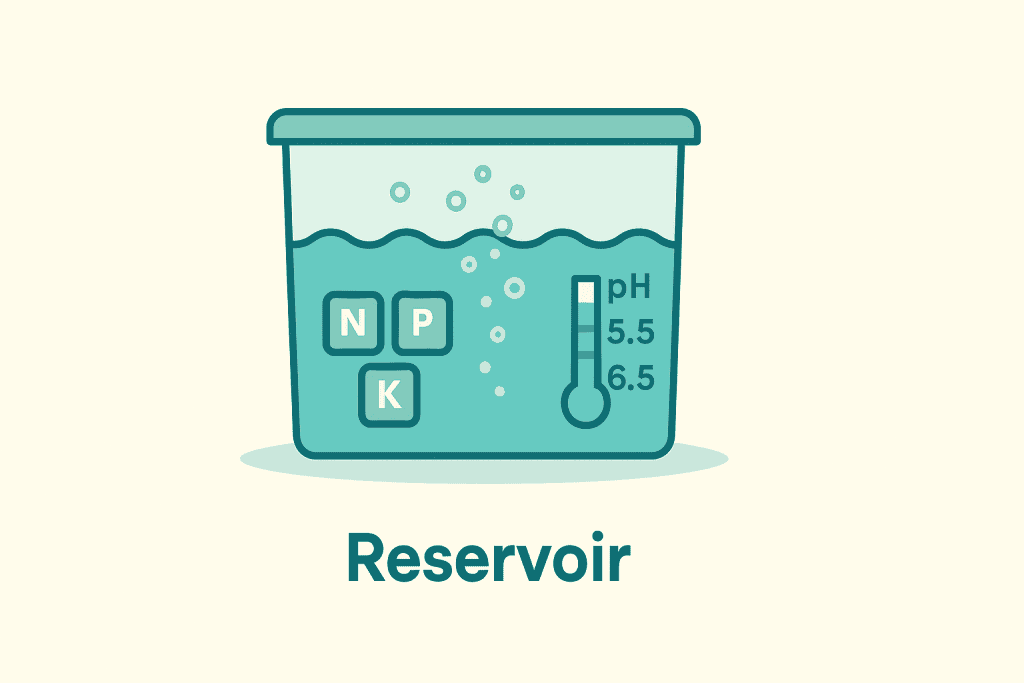
Every system needs a center, a place where everything begins. In hydroponics, that’s the reservoir. It’s typically a large, opaque container that holds the nutrient solution.
The opacity is crucial, it prevents light from penetrating and encourages algae growth, which can compete with your plants for resources and clog your system.
Inside this reservoir, you mix water with a carefully formulated nutrient solution. This isn’t just plant food, it’s a complete diet. The primary nutrients are Nitrogen (N), Phosphorus (P), and Potassium (K), but it also includes a suite of micronutrients like calcium and magnesium.
The water itself needs to be prepared. It should be oxygenated, and its pH level must be adjusted carefully since pH importance in hydroponics cannot be overstated.
Most plants prefer a slightly acidic environment, with a pH between 5.5 and 6.5 for common vegetables and herbs. If the pH is off, plants can’t absorb the nutrients you’re providing, no matter how perfect the mix is.
- Primary Nutrients: Nitrogen, Phosphorus, Potassium
- Key Factors: Opacity to block light, pH level (5.5-6.5), oxygen content.
The Growing Medium and Support: The Plant’s Anchor

Credits: Everything Hydroponics
Since there’s no soil, plants need something to hold them upright. This is the job of the growing medium. It’s an inert material, meaning it doesn’t provide any nutrients itself.
Its sole purpose is to support the root system and the plant’s base, allowing the nutrient solution to flow around the roots while still providing stability. The medium sits within net pots or grow trays, which are then placed into the system.
There are several common types of media, each with its own characteristics. Clay pebbles are lightweight and provide excellent aeration and drainage. Rockwool, made from spun rock fibers, holds water and air well but requires careful handling.
Coco coir, a renewable resource from coconut husks, has great water retention. Perlite is a volcanic glass that is super lightweight and helps aerate the root zone.
The choice often comes down to the type of hydroponic system you’re using and the specific needs of your plants.
Circulation and Control: The Heart and Lungs
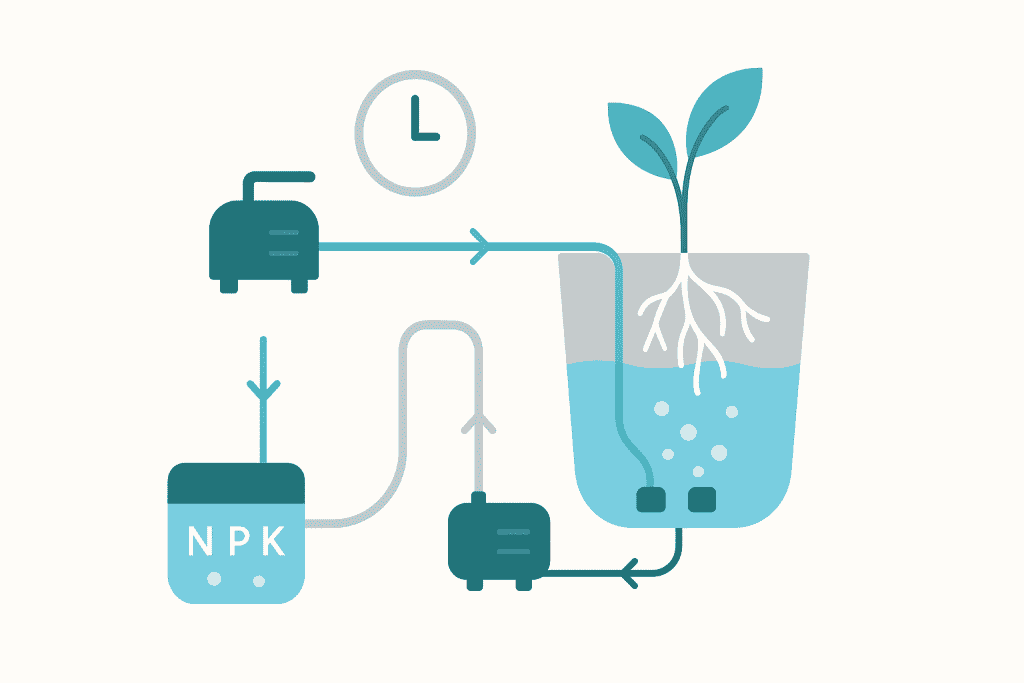
Water sitting stagnant is a death sentence for roots. They need oxygen as much as they need water. This is where circulation and aeration come in.
A submersible water pump is placed in the reservoir to move the nutrient solution through tubes or channels to the plants. This can be a continuous flow or, more commonly, managed by a timer for automated cycles, like flooding the grow tray for 15 minutes every hour.
Just as important is the air pump. Connected to air stones that sit at the bottom of the reservoir, it bubbles air through the water, oxygenating the nutrient solution.
This circulation and nutrient solution understanding are critical to keeping plants thriving and avoiding root diseases.
This constant supply of oxygen to the root zone prevents rot and encourages robust, healthy root development. Think of the water pump as the circulatory system and the air pump as the respiratory system, both are essential for life.
The pump pushes water to the roots. The timer regulates this flow, creating cycles of feeding and rest. This automation is key to a low-maintenance system.
The air pump and stones are your insurance policy against root suffocation. Without this oxygen, roots will quickly deteriorate.
- Circulation: Submersible pump, delivery tubes, timer.
- Aeration: Air pump, air stones, bubbles for oxygen.
Lighting and Monitoring: The Artificial Sun and Its Manager
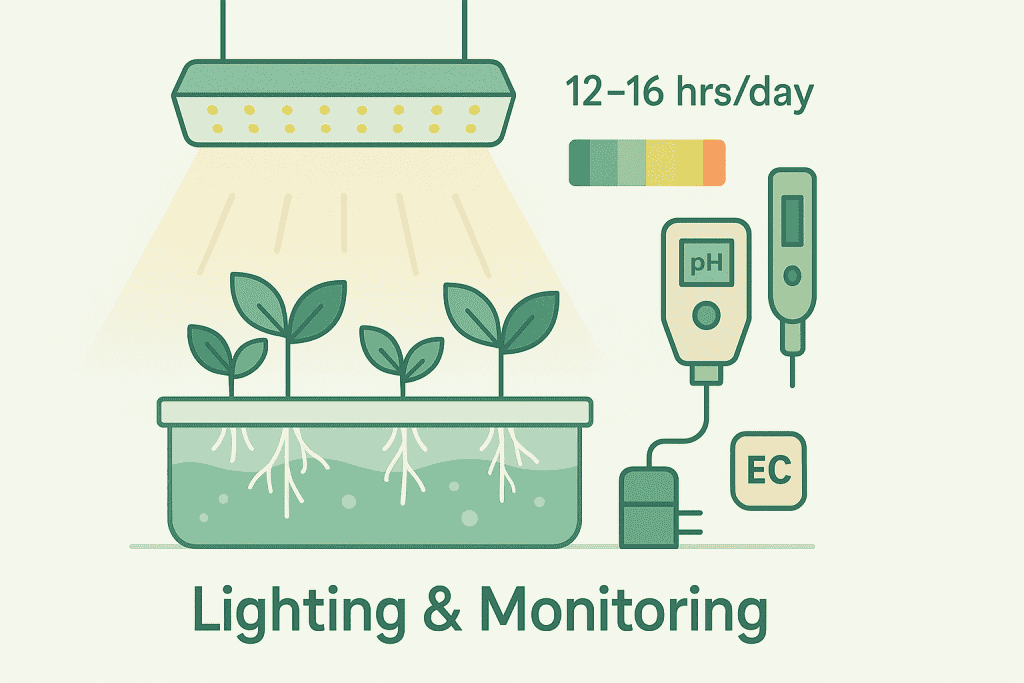
For indoor setups, grow lights mimic the sun. Grow lights provide the energy for photosynthesis. The goal is to mimic the full spectrum of sunlight that plants would naturally receive.
Plants need a long “day,” typically 12 to 16 hours of light exposure daily, followed by a period of darkness. But providing light isn’t enough, you also need to manage the environment you’ve created. This is where monitoring your hydroponic system with pH and EC meters becomes essential.
A pH meter ensures your nutrient solution is in the optimal range for nutrient uptake.
The EC meter measures the concentration of nutrients in the water, telling you if the solution is too strong or too weak.
Choosing Your Components: A Practical Framework
Selecting the right components isn’t about finding the “best” one, but the best one for your specific situation. Your choices will be guided by what you want to grow, the space you have available, and your budget.
A small herb garden on a kitchen counter has different needs than a full-scale tomato operation in a garage. Here is a simple framework to guide your choices:
- For beginners or small spaces: A simple Deep Water Culture (DWC) system with a bucket, an air pump, net pots, and clay pebbles is a great start. Use LEDs for efficiency.
- For larger plants or higher yields: An ebb and flow system with a large reservoir, a submersible pump on a timer, and rockwool cubes may be more suitable.
- Priority on water retention: If you worry about pump failures, a medium like coco coir can hold moisture longer, giving you a buffer.
The most important tool, however, is observation. Watch your plants. They will tell you if something is wrong. Yellowing leaves, stunted growth, these are signs to check your pH, your nutrient strength, or your light distance.
Your Blueprint for Growth
Understanding the basic components of a hydroponic system demystifies the process. It’s not a black box of technology, but a logical assembly of parts that each serve a clear purpose.
The reservoir feeds, the medium supports, the pump and air stone breathe life, the lights energize, and your monitoring keeps it all in check [2].
Start with these fundamentals. Get to know how each one works, and how they depend on each other. Then you can confidently build the system that will turn that vision of a lush, soil-less garden into your reality.
FAQ
How can I tell which system components matter most when I want to understand how a system works?
You can start by identifying the basic system elements that shape how the system behaves. Look at the system inputs and system outputs, then follow the system flow to see how work moves through the system.
Check the subsystems and system interactions because they reveal the system purpose, system functions, and key system performance factors.
Why do system boundaries matter when I study a system model for the first time?
System boundaries show what is part of the system environment and what is not. They help you perform clear system analysis and system evaluation because you can focus on the system behavior and system dynamics inside the boundary.
Strong boundaries also reveal system dependencies, system constraints, and system variables that guide how system parts work together.
How do system design elements help me understand a system’s structure and layout?
System design elements explain the system structure by showing how the system modules, system interface points, and system workflow fit together.
These elements support the system blueprint and system specification. When you understand them, you can read a system diagram, follow system mapping steps, and see how the system architecture layers support system operations and system functionality.
What should I look for when checking system reliability in a growing or changing system?
You should look at system stability and system efficiency during each system lifecycle stage. Watch how the system operation units and the system control loop manage changes.
System monitoring tools help you track the system transformation process, system energy flow, and system coordination. These details show whether the system composition can stay reliable under real conditions.
How do system integration and system configuration affect how well a system works over time?
System integration connects the hardware components, software components, logical components, and physical components so they function as one system mechanism. System configuration shapes the system architecture and overall system framework.
When the system connectivity is strong and the input process output model supports the system objectives and system objective functions, the system can achieve steady system optimization.
Conclusion
A hydroponic system works because each component does a clear job. The reservoir delivers nutrients, the medium supports the roots, the pumps keep water and oxygen moving, the lights provide energy, and the monitoring tools help you maintain balance.
When these parts work together, the system becomes predictable and easy to manage. Start with these basics, observe your plants, and make small adjustments. With consistency, you’ll build a reliable, soil-less garden that grows year-round.
References
- https://www.agrijoy.in/post/components-of-hydroponics
- https://www.agrijoy.in/post/components-of-hydroponics
Related Articles
- https://tophydroponicgarden.com/how-is-ph-important-in-hydroponics/
- https://tophydroponicgarden.com/understanding-nutrient-solutions-for-plants/
- https://tophydroponicgarden.com/how-to-build-a-simple-hydroponic-setup/
Was this helpful?

I’m Barrie L., a passionate hydroponic gardening enthusiast dedicated to cultivating thriving, soil-less gardens. With a focus on all things hydroponic, I share my expertise on innovative growing techniques and sustainable practices through my blog, tophydroponicgarden.com. As a seasoned hydroponics specialist, my goal is to inspire and guide fellow gardeners in harnessing the power of water-based cultivation for bountiful and eco-friendly harvests. I’m also an author of the book “Hydroponics For Absolute Beginners: Your Step By Step Guide For How To Create An Hydroponics System At Home Without Soil, For Growing Vegetable, Fruit And Herbs.” which is sold on Amazon. Join me on a journey of redefining the way we cultivate plants, one nutrient-rich solution at a time. Happy growing!