

You need hydroponic base nutrients to grow plants without soil. They are the complete set of essential minerals, the macronutrients and micronutrients, dissolved in water that your plants’ roots absorb directly.
Think of them as a perfectly balanced meal, replacing everything the plant would normally get from the earth. Getting this foundation right is the single most important factor for a healthy, productive hydroponic garden.
Everything else, from pH to lighting, depends on the plants having access to the right food. Keep reading to learn exactly what these nutrients are, why each one matters, and how to use them to avoid common pitfalls and maximize your harvest.
Key Takeaways
- Base nutrients supply all 14 essential mineral elements plants can’t get from air and water alone.
- The primary macronutrients, Nitrogen (N), Phosphorus (P), and Potassium (K), drive leaf growth, root development, and overall plant health.
- Micronutrients like iron and boron are required in tiny amounts but are critical for processes like photosynthesis and cell formation.
Hydroponic Base Nutrient Essentials

Walking through a commercial greenhouse, the smell is clean, almost sterile. Rows of lush green tomatoes climb upwards, their roots buried not in dirt, but in inert rockwool cubes, fed by a carefully calculated cocktail of minerals dissolved in water.
This is the reality of modern hydroponics, a system that replaces the complex chemistry of soil with a precise, human-controlled recipe. The success of this entire operation hinges on one thing: the hydroponic base nutrient solution.
It is the lifeblood of the system. Without it, the plants would starve, lacking access to the fundamental building blocks they need to construct their cells, capture energy, and produce fruit.
The Foundation: Macronutrients
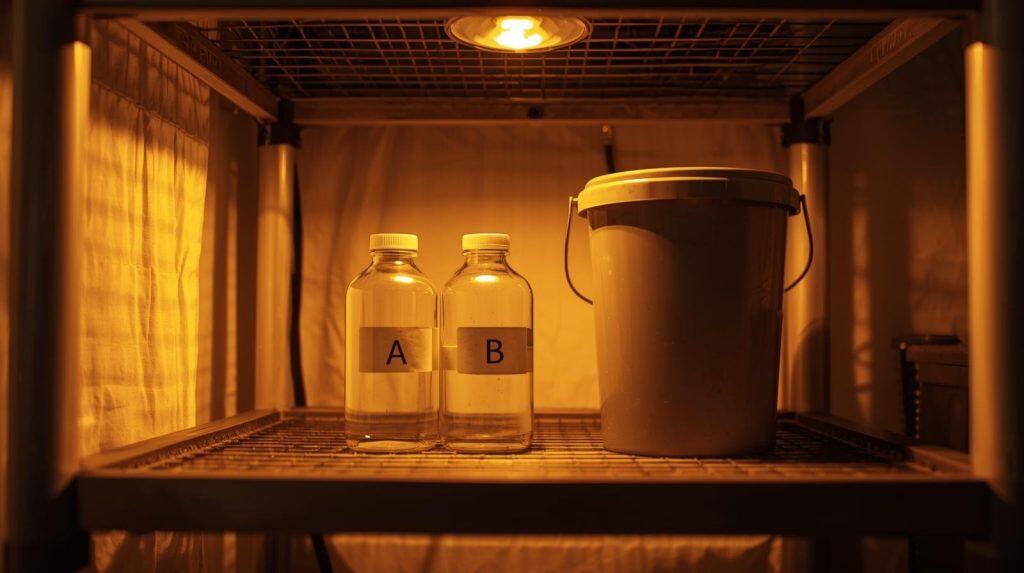
Nitrogen is the engine of green growth. It is a core component of chlorophyll, the molecule that captures sunlight, and of amino acids, the building blocks of proteins. A plant with ample nitrogen grows vigorous leaves and stems.
But too much, especially early on, can make plants “bullish”, overly vegetative with thick, distorted stems and poor fruit set. Maintaining moderate nitrogen levels (around 70 ppm) is crucial, especially when understanding how plants absorb nutrients without soil, ensuring balanced growth without excess vegetative trade-offs.
Phosphorus is crucial for energy transfer and root development. It is part of DNA and ATP, the molecule that stores energy in cells. A strong root system, essential in hydroponics where the medium provides no physical anchor, depends on adequate phosphorus. It also plays a key role in flowering and fruiting.
Potassium is a regulator. It is not built into plant structures but activates dozens of enzymes. It helps regulate the opening and closing of stomata, the plant’s pores, which manages water uptake. This makes potassium vital for disease resistance and the overall quality of fruits and flowers.
The secondary macronutrients are just as essential, just needed in slightly smaller amounts.
- Calcium is the mortar in the cell walls, providing structural integrity. A classic sign of calcium deficiency is blossom end rot in tomatoes, where the bottom of the fruit turns black and leathery.
- Magnesium sits at the center of every chlorophyll molecule, making it non-negotiable for photosynthesis.
- Sulfur is a component of certain amino acids and vitamins, influencing protein synthesis and overall plant health [1].
The Vital Spark: Micronutrients

Credit : New Agrarian
If macronutrients are the lumber, micronutrients are the nails and screws. They are required in minute concentrations, sometimes just fractions of a part per million, but their absence can bring growth to a halt. Iron is critical for chlorophyll formation and electron transport during photosynthesis. Its deficiency often shows as yellowing between the veins of young leaves.
Manganese and Zinc act as co-factors for enzymes, facilitating countless metabolic processes. Boron is involved in cell division and the movement of sugars within the plant. Copper plays a role in lignin formation, which strengthens cell walls, and in respiration. Molybdenum is essential for the plant’s ability to use nitrogen, helping convert nitrate into ammonia.
A quality base nutrient will include a balanced package of all these micronutrients. They are often chelated, meaning they are bound to organic molecules that keep them available to the plant roots even if the pH fluctuates slightly.
This careful balance reflects the foundational practices dating back to those who introduced hydroponics, pioneering soilless growing techniques that still guide nutrient management today.
Your Practical Nutrient Checklist
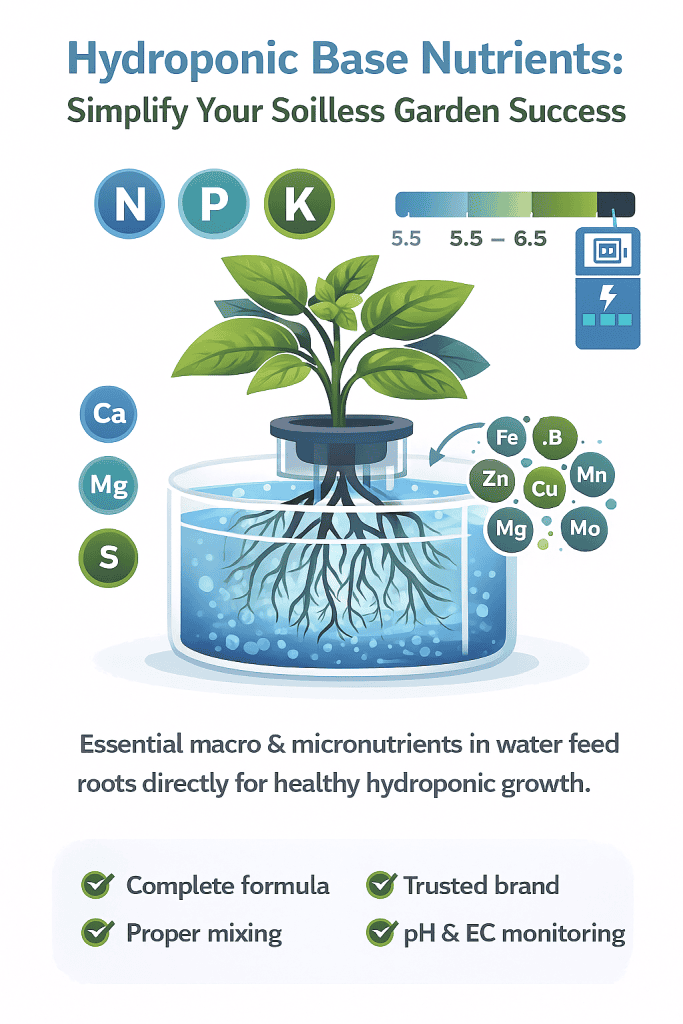
Navigating the world of hydroponic nutrients does not need to be overwhelming. Here is a straightforward list to guide your choices and management.
- Choose a Complete Formula: Ensure your base nutrient contains all essential macro and micronutrients listed above.
- Start with a Trusted Brand: For beginners, a pre-mixed liquid or powder solution from a reputable hydroponics company is the easiest path to success.
- Understand NPK Ratios: Select a formula matched to your plant type and growth stage (e.g., higher nitrogen for leafy greens, higher potassium for fruiting plants).
- Mix Carefully: Always add nutrients to water, not the other way around, and stir thoroughly to dissolve. Proper mixing and the type of water used can influence nutrient availability, so knowing what type of water to use for hydroponics is essential for optimal nutrient uptake.
- Monitor pH and EC: Keep solution pH between 5.5 and 6.5 for optimal nutrient uptake. Use an EC meter to ensure nutrient concentration is within the recommended range for your crops [2].
FAQ
What is inside a hydroponic nutrient solution and why does it matter?
You mix water with a hydroponic nutrient solution to give plants macronutrients in hydroponics like nitrogen in hydroponics, phosphorus nutrient solution, and potassium in hydroponics. You also add micronutrients for plants such as iron chelates, manganese sulfate, zinc sulfate hydroponics, and boron nutrient hydroponics. These elements support steady nutrient uptake in hydroponics and help prevent plant nutrient deficiency hydroponics.
How do you read nutrient solution pH and electrical conductivity in hydroponics?
You check nutrient solution pH to keep minerals available. You check electrical conductivity hydroponics to see the hydroponic nutrient concentration. These readings help you adjust hydroponic fertilizer salts and nutrient solution formulation.
You protect plants from hydroponic nutrient toxicity and support balanced nutrient solution levels so roots take in essential elements hydroponics with fewer problems.
How do you mix hydroponic fertilizer components safely?
You mix soluble fertilizers hydroponics in clean water. You add calcium nitrate nutrient and magnesium sulfate fertilizer separately so you avoid low nutrient solution solubility. You use nutrient solution mixing steps that fit your hydroponic nutrient programs.
You check hydroponic fertilizer compatibility so the hydroponic nutrient solution stays clear and supports strong hydroponic plant nutrition.
What signs show nutrient problems in different hydroponic systems?
You watch leaves in nutrient film technique nutrients, deep water culture nutrients, aeroponics nutrient solution, and drip system nutrients. You look for hydroponic nutrient deficiency symptoms like pale leaves or slow growth.
You also check for hydroponic nutrient toxicity when tips burn. You adjust hydroponic nutrient ratios and micronutrient supplementation to restore mineral nutrients for plants.
How do you manage a hydroponic nutrient reservoir over time?
You keep hydroponic nutrient reservoirs filled with clean water so nitrate in hydroponics, ammonium in nutrient solution, phosphate in hydroponics, and potassium nitrate fertilizer stay stable. You track hydroponic nutrient precision with simple tests.
You refresh the mix so hydroponic plant feeding stays steady. You store solutions correctly to protect hydroponic nutrient analysis and long term nutrient uptake.
Conclusion
Hydroponic base nutrients are not a mystery. They are a well-understood substitution for soil, providing every mineral element a plant requires for its entire life cycle. The control this offers is the great advantage of hydroponics. You are not guessing at what is in the ground, you are directly serving each meal.
Master this foundation, and you have mastered the most critical variable in soilless gardening. Your plants will respond with a vigor and productivity that soil-grown plants can rarely match. Now that you know what is in the bottle, you can mix your solution with confidence.
References
- https://cigrjournal.org/index.php/Ejounral/article/download/8577/4083/40279
- https://pmc.ncbi.nlm.nih.gov/articles/PMC10625363
Related Articles
- https://tophydroponicgarden.com/how-plants-absorb-nutrients-without-soil/
- https://tophydroponicgarden.com/what-type-of-water-to-use-for-hydroponics/
- https://tophydroponicgarden.com/who-introduced-hydroponics/
Was this helpful?

I’m Barrie L., a passionate hydroponic gardening enthusiast dedicated to cultivating thriving, soil-less gardens. With a focus on all things hydroponic, I share my expertise on innovative growing techniques and sustainable practices through my blog, tophydroponicgarden.com. As a seasoned hydroponics specialist, my goal is to inspire and guide fellow gardeners in harnessing the power of water-based cultivation for bountiful and eco-friendly harvests. I’m also an author of the book “Hydroponics For Absolute Beginners: Your Step By Step Guide For How To Create An Hydroponics System At Home Without Soil, For Growing Vegetable, Fruit And Herbs.” which is sold on Amazon. Join me on a journey of redefining the way we cultivate plants, one nutrient-rich solution at a time. Happy growing!