

Hydroponic companion plants are crops that share similar EC requirements, pH ranges, light intensity needs, root-space demands, and growth rates, allowing them to thrive within the same nutrient solution. In a recirculating system, compatibility matters far more than old gardening myths.
Pairing compatible crops reduces nutrient adjustments, simplifies reservoir management, and helps maintain more stable plant growth throughout the production cycle. And that matters.
Research shows hydroponic systems can use up to 90% less water than traditional farming while still producing strong harvests. Want better plant combinations and fewer growing headaches? Keep reading.
Hydroponic Companion Planting Quick Wins
Successful hydroponic companion planting depends on choosing plants with similar nutrient, pH, and environmental needs. These three principles summarize the most important strategies for creating compatible plant combinations in a hydroponic system.
- Match EC, pH, and light requirements before pairing plants to ensure they thrive under the same growing conditions.
- Pair plants with similar growth habits, such as leafy greens with herbs or fruiting crops with other fruiting crops.
- Smart growers separate heavy feeding plants from light feeding plants. This strict separation prevents nutrient deficiencies. You must prioritize water chemistry over old soil-gardening myths to keep your reservoir stable.
Hydroponic Companion Planting Explained
Hydroponic companion planting means growing crops with compatible EC requirements, pH preferences, nutrient demand, root development, and lighting needs within the same system.
Unlike soil gardening, companion planting in water gardening revolves around shared environmental requirements. Roots are exposed to the same nutrient solution, meaning every plant affects reservoir stability.
Optimized indoor systems accelerate plant growth. In fact, clean water delivery allows crops to mature up to three times faster than standard soil-grown plants.
Controlled Environment Agriculture (CEA) places less emphasis on soil biology and more emphasis on nutrient management, airflow, and lighting consistency. Properly grouping your crops provides three distinct advantages:
- Vertical stacking can significantly increase plant density, with some commercial systems reporting 5–8× more plants within the same floor footprint.
- Synchronized harvest dates simplify your weekly cleanup schedule.
- Clean water systems minimize common soil-borne insect outbreaks.
How Hydroponic Companion Planting Differs from Soil Gardening

Hydroponics removes many of the factors traditionally associated with companion planting.
- No significant nitrogen-fixing advantage inside shared nutrient solutions
- Minimal mycorrhizal interactions
- Reservoir EC, pH stability, dissolved oxygen, and nutrient concentration become the primary considerations
Because of this, successful companion planting hydroponic systems depend on resource compatibility rather than folklore.
The Best Companion Plants for Hydroponics
Plants with similar nutrient demands, growth rates, and environmental requirements make the best companion plants for hydroponics.
Some vertical systems report 5–8× more plants in the same footprint compared with conventional growing methods.
| Pairing | Why It Works |
| Basil + Tomatoes | Similar warmth and light requirements; Basil helps repel some common pests that affect tomatoes, such as whiteflies and tomato hornworms, and may support healthier growth and better yields in companion planting setups. Preferred pH: 5.8–6.8, EC: 2.0–3.0, high-light crops. |
| Lettuce + Radishes | Radishes mature quickly and can provide temporary shading. Radishes mature in 25–35 days and can provide temporary canopy cover while lettuce establishes. |
| Cilantro + Peppers | Compatible nutrient demands. Both tolerate moderate EC levels and perform well under similar temperature conditions. |
| Spinach + Parsley | Similar pH and EC preferences |
| Kale + Dill | Thrive in comparable growing conditions |
These hydroponics plants that grow well together succeed because they require similar care schedules.
Which pairing is considered the classic hydroponic combination?
The most popular hydroponic garden companion pairing remains:
- Tomatoes and basil hydroponic companion
- Widely used in greenhouse production
- Similar environmental preferences
- Frequently recommended for home growers
Many growers also report a tomato basil hydroponic flavor boost when harvested together.
Matching EC and pH Is Essential Before Pairing Plants
| Plant | EC Range | pH Range |
| Lettuce | 0.8 – 1.2 | 5.5 – 6.5 |
| Basil | 1.0 – 1.6 | 5.5 – 6.5 |
| Spinach | 1.8 – 2.3 | 6.0 – 7.0 |
| Tomatoes | 2.0 – 3.5 | 5.8 – 6.8 |
| Peppers | 1.8 – 2.5 | 5.8 – 6.5 |
| Cucumber | 1.7 – 2.4 | 5.8 – 6.5 |
EC and pH compatibility determine whether plants can successfully share a nutrient solution.
Plants absorb nutrients most efficiently when EC levels remain within their recommended range. Deviations can reduce nutrient uptake efficiency and growth performance. If one crop prefers low nutrient concentrations and another prefers high concentrations, one plant usually suffers.
Pro Tip: EC compatibility matters more than traditional companion planting charts.
For example:
- Lettuce commonly prefers lower EC ranges
- Tomatoes require substantially stronger nutrient solutions
- Shared reservoirs often require nutrient compromises that leave one crop underfed and the other overfed
EC mismatch is widely recognized in hydroponic systems as one of the key factors that can lead to poor crop performance when multiple plant types share the same reservoir.
Problems Caused by Mismatched Nutrient Requirements
Common symptoms include:
- Slower growth
- Nutrient deficiencies
- Poor flavor development
- Reduced yields
- Increased maintenance
This is why hydroponic nutrient friendly companions should always be selected based on EC and pH compatibility first. For example: Lettuce (EC 0.8-1.2) cannot share reservoir with Tomatoes (EC 2.0-3.5)
Leafy Greens and Herbs That Grow Well Together
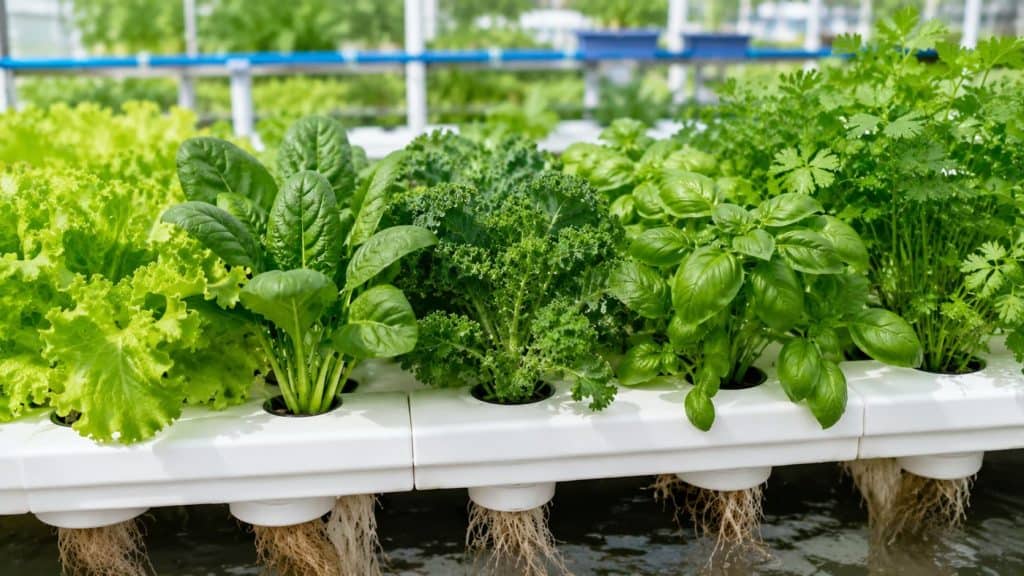
Leafy greens and herbs are among the most reliable hydroponic companion planting combinations. especially when selecting crops from best leafy greens for hydroponic growth that share similar nutrient requirements and growth conditions.
These crops typically share nutrient requirements, root sizes, and lighting preferences. Most leafy greens and herbs perform best between pH 5.5–6.5 with relatively low-to-moderate EC requirements.
Best combinations:
- Lettuce + Basil
- Lettuce + Cilantro
- Spinach + Parsley
- Kale + Dill
- Arugula + Parsley
These pairings represent some of the best hydroponic plant pairings for beginners.
Why Leafy Greens and Herbs Are Ideal for Beginners
- Similar nutrient requirements
- Comparable root structures
- Compatible light needs
- Excellent for NFT hydroponic companion planting
Tomatoes, Peppers, and Cucumbers Can Share the Same System
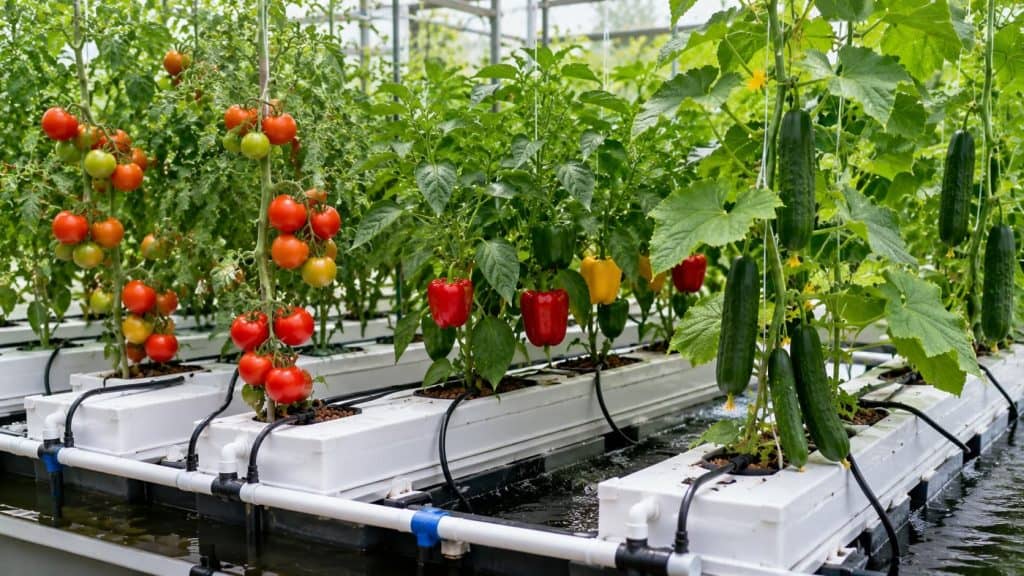
Yes, fruiting crops often perform well together because they have similar nutrient intensity and lighting requirements.
Commercial growers often group these crops because their nutrient schedules, flowering requirements, and EC targets remain similar throughout production.
Compatible Fruiting Crops for Hydroponics
Tomatoes Bell peppers Jalapenos Bush cucumbers These are among the strongest companion crops for hydroponic gardening.
Benefits
- Similar feeding schedules
- Comparable lighting needs
- Consistent reservoir management
- Similar growth rates
Commercial greenhouse operators frequently combine these crops in DWC and media-bed systems.
When Fruiting Crops Should Be Grown Separately
- Severe root crowding develops
- Light competition increases
- Reservoir stability declines
Monitoring root mass remains essential when selecting hydroponic root size companion plants.
Flowers Can Support Hydroponic Companion Planting
Yes, certain flowers can help hydroponic companion planting by supporting biodiversity, attracting beneficial insects, and improving pest management.
- Calendula: supports beneficial insect populations that improve plant health.
- Nasturtium: works as a trap crop by attracting pests away from main plants.
- Borage: attracts pollinators and supports overall garden balance.
Marigolds are effective at reducing pest pressure in outdoor hydroponic systems where airflow and insect exposure are present, particularly against pests such as aphids and root-associated insects.
However, in sealed indoor hydroponic environments with controlled lighting and limited pest exposure, their impact is minimal.
In these conditions, pest management is typically achieved through environmental control rather than companion planting.
Why Marigolds Remain Popular in Hydroponics
- Produces aromatic compounds commonly associated with insect deterrence in outdoor growing environments
- Easy integration into mixed systems
- Popular alongside vegetables
The Companion Planting Myth Debate in Hydroponics
Some growers argue traditional companion planting claims do not translate directly into hydroponic systems.
Critics point out that hydroponics lacks many soil-based interactions.
Why Some Growers Question Companion Planting
- Significantly reduced soil biological interactions compared with traditional soil systems
- No nitrogen-fixing advantage
- Limited scientific support for some traditional claims
Many growers describe traditional companion planting advice as outdated when applied directly to recirculating systems.
Research from National Institutes of Health (NIH)
“improved water use efficiency by 38%,” the control group, which was a monoculture with a full nutrient supply, “achieved the highest overall biomass”. – National Institutes of Health (NIH)
Companion Planting Practices That Still Work
- Matching EC and pH
- Managing light competition
- Improving airflow
- Strategic crop placement
Educational creators such as Epic Gardening frequently emphasize that hydroponic success depends far more on system design than folklore.
From our experience, growers who focus on compatibility outperform growers who focus solely on traditional companion charts.
Hydroponic Companion Pairings to Avoid
Avoid combinations with conflicting nutrient demands, lighting needs, or growth rates, because these mismatches can quickly destabilize a shared hydroponic system.
When one plant requires high EC levels while another thrives in low EC conditions, the nutrient solution becomes a compromise that leaves at least one crop underperforming.
The same issue occurs when tall, fast-growing plants shade slower crops, limiting light exposure and reducing overall photosynthesis efficiency. Differences in growth speed can also create competition for space and nutrients, where vigorous crops dominate the reservoir and restrict access for more delicate plants.
For stable production and consistent yields, it is always better to group crops with similar feeding strength, light intensity requirements, and harvest timelines.
Problematic Hydroponic Plant Pairings
- Lettuce + Tomatoes
- Strawberries + Heavy Feeders
- Mint + Most Shared Systems
- Tall crops + Short light-demanding crops
Why Mint Is Difficult to Grow in Shared Systems
- Aggressive growth
- Resource competition
- Difficult maintenance
making overcrowding problems more noticeable.
Mint hydroponic companion caution is particularly important for smaller home systems.
Allelopathy Can Influence Hydroponic Companion Plants
Some plants may release natural compounds that can affect nearby plants, but most hobby hydroponic growers don’t experience major problems from this. It is usually only more noticeable in large systems where many plants share the same water.
Unlike soil gardens, recirculating hydroponic systems can circulate plant exudates throughout the reservoir.
As noted by Biologia Plantarum
“rice seedlings may produce growth inhibiting substances, acting as allelochemicals to other plants, and release them from their roots into the environment”. – Biologia Plantarum
Crops Commonly Associated With Allelopathy
- Basil
- Tomatoes
- Lettuce
- Arugula
Potential concerns include:
- reduced root growth
- lower nutrient uptake efficiency
- growth suppression reduced yields
Researchers studying commercial CEA systems are investigating whether root exudates accumulate in recirculating nutrient solutions and influence neighboring crops.
When Growers Should Consider Allelopathy
- Monitor plant performance
- Test new pairings before scaling
- Separate reservoirs when issues appear
Of course, most hobby growers never encounter severe allelopathic problems. That said, large recirculating systems should remain aware of the possibility.
Choosing the Best Hydroponic System for Companion Planting
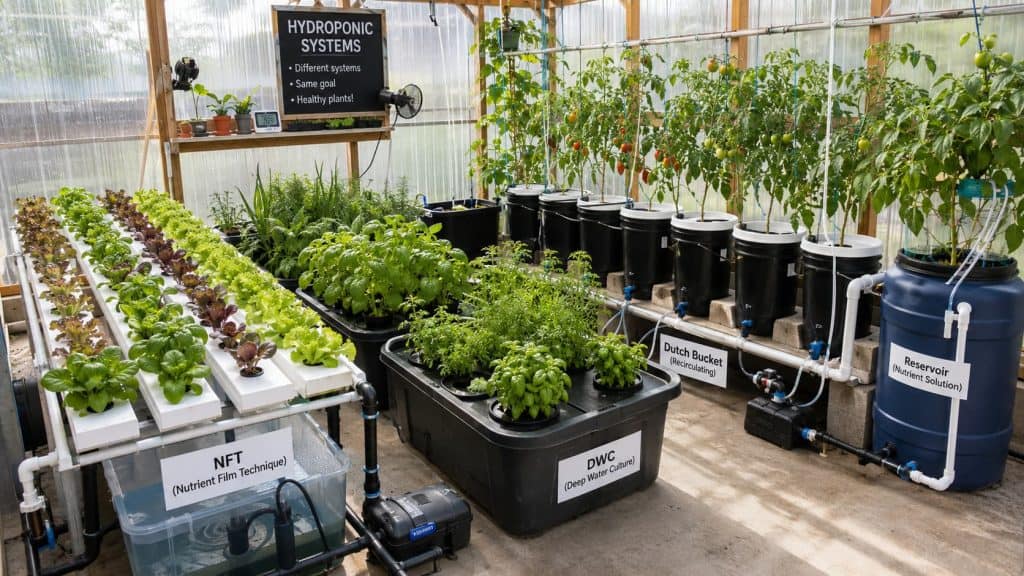
Which hydroponic system works best for companion planting depends on root mass, nutrient demand, and crop size. Each system supports different types of plant combinations based on how they handle space and water flow.
- NFT (Nutrient Film Technique) is best suited for leafy greens and herbs because these crops have small, shallow root systems making it one of the most efficient setups among hydroponic systems designed for controlled nutrient and oxygen delivery. That allows efficient access to the thin nutrient film without clogging channels or restricting flow.
- DWC (Deep Water Culture): Works well for lettuce, herbs, and strawberries that thrive in stable, oxygen-rich water conditions.
- Media Bed systems: Ideal for mixed crops and fruiting plants since they can support larger root structures and higher nutrient demands.
- Vertical towers: Best for herbs, greens, and strawberries where space efficiency and stacked planting are priorities.
Why Vertical Towers Are Popular for Companion Planting
- Excellent space efficiency
- Easy crop stacking
- Higher production density
Some vertical systems report 5–8× more plants in the same footprint.
This makes vertical towers especially attractive for hydroponic system plant neighbors with similar requirements.
Building a Successful Hydroponic Companion Planting Plan
Begin by grouping plants with matching environmental needs, then optimize airflow and spacing, especially when using best indoor hydroponic kits that already streamline nutrient delivery and system management for beginners.
A Simple Process for Beginners
- Choose one crop category.
- Match EC ranges.
- Match pH preferences.
- Verify lighting requirements.
- Check root-space needs.
- Monitor weekly performance.
How to Expand Your Hydroponic Companion Garden Successfully
- Expand gradually
- Test new pairings separately
- Track yields
- Record nutrient changes
The EPCOT Behind the Seeds growing program demonstrates how thoughtful crop organization can improve efficiency and productivity.
NFT Hydroponic System Overview

Credits: Hope Innovations
NFT (Nutrient Film Technique) is a hydroponic growing method where a very thin layer of nutrient solution continuously flows through sloped channels, delivering water, nutrients, and oxygen directly to plant roots without using soil.
This system works best for fast-growing leafy crops like lettuce, basil, and spinach because their roots can efficiently absorb nutrients from the shallow film while still accessing oxygen from the air.
NFT systems are widely used in modern hydroponics due to their water efficiency, space-saving design, and ability to support rapid plant growth in controlled environments.
FAQ
Can different growth speeds affect hydroponics companion plants?
Yes. Growth speed is an important factor when selecting hydroponics companion plants. Fast-growing crops can create canopy shading, reduce airflow, and outcompete neighboring plants for light. When choosing hydroponics plants that grow well together, select crops with similar growth rates and harvest schedules. This approach makes plant care more consistent and reduces competition within the companion planting hydroponic system.
Are there companion plants for hydroponic lettuce besides herbs?
Yes. Companion plants for hydroponic lettuce include spinach, arugula, kale, and radishes because these crops prefer similar nutrient concentrations, pH ranges, and growing temperatures. Pairing radishes with butterhead lettuce works well because both crops mature quickly and prefer similar environmental conditions. These fast-growing varieties share identical environmental needs, meaning you can harvest the entire system at the exact same time without wasting resources.
How do I choose the best hydroponic plant pairings?
The best hydroponic plant pairings share similar nutrient requirements, pH preferences, light exposure needs, and root growth habits. For example, hydroponic pH compatible plants companion groups are easier to manage because they thrive within the same nutrient solution range. A reliable hydroponic companion planting guide also recommends matching crops with similar growth rates to reduce competition and simplify maintenance.
Can fruiting crops share a system with leafy greens?
No, I highly advise against it in single-reservoir systems. Fruiting crops require a heavy bloom-stage nutrient profile ($EC\ 2.0 – 3.5$) that will immediately trigger tip-burn and bitter bolted leaves in delicate leafy greens like spinach or romaine ($EC\ 0.8 – 1.2$). Before creating a hydroponic vegetable companion pairing, compare nutrient demand, light requirements, and growth patterns to ensure long-term compatibility.
What combinations should I avoid in hydroponic systems?
Avoid hydroponic companion planting combinations that involve crops with conflicting nutrient needs, different light requirements, or aggressive growth patterns. Mint is a common example of a plant that is best grown separately in hydroponic systems because it grows quickly and can easily take over shared space. Plants with strong or aggressive root systems can also limit root space, compete for nutrients, and make system maintenance more difficult for neighboring crops.
Focus on Compatibility for Hydroponic Success
If you’ve ever dealt with slow growth or plants that struggle to thrive, there’s a good chance the pairing wasn’t the right fit. That’s the key takeaway. The best hydroponic companion plants work well together because they need similar nutrients, light levels, and root space, making the system easier to manage and more consistent over time.
Start with proven combinations like lettuce and basil, spinach and parsley, or tomatoes and peppers, then build from there as you gain experience. Monitor pH, EC, dissolved oxygen, airflow, root development, and nutrient uptake patterns as you evaluate new pairings.
When compatibility guides your choices, your hydroponic garden becomes simpler to maintain and delivers better results with less guesswork.
References
- https://pmc.ncbi.nlm.nih.gov/articles/PMC12252025/
- https://bp.ueb.cas.cz/artkey/bpl-200301-0066_Rice-Seedlings-Release-Allelopathic-Substances.php?back=%2Fsearch.php?query%3Dgrowth%2Bregulators%2Bin%253Aname%2Bkey%2Babstr%26sfrom%3D450%26spage%3D30
Related Articles
- https://tophydroponicgarden.com/best-leafy-greens-for-hydroponic-growth/
- https://tophydroponicgarden.com/hydroponic-systems/
- https://tophydroponicgarden.com/best-indoor-hydroponic-kits/
Was this helpful?

I’m Barrie L., a passionate hydroponic gardening enthusiast dedicated to cultivating thriving, soil-less gardens. With a focus on all things hydroponic, I share my expertise on innovative growing techniques and sustainable practices through my blog, tophydroponicgarden.com. As a seasoned hydroponics specialist, my goal is to inspire and guide fellow gardeners in harnessing the power of water-based cultivation for bountiful and eco-friendly harvests. I’m also an author of the book “Hydroponics For Absolute Beginners: Your Step By Step Guide For How To Create An Hydroponics System At Home Without Soil, For Growing Vegetable, Fruit And Herbs.” which is sold on Amazon. Join me on a journey of redefining the way we cultivate plants, one nutrient-rich solution at a time. Happy growing!