

Water Pumps for Large Systems matter because bigger hydroponic setups can fail quickly when water movement is uneven. From checking larger NFT and drip layouts, I’ve noticed weak plant growth often starts with a pump that looks powerful on paper but cannot handle the real tubing length, lift height, or flow demand.
A large system needs steady circulation, enough head height, clean plumbing, and easy pump access. The right pump keeps nutrient solution moving to the farthest plants without overheating the reservoir or creating clogs. Read below before choosing or upgrading your pump.
The Smart Pump Guide for Large Hydroponic Setups
- Size the pump for real flow: Large systems need enough flow after tubing length, vertical lift, elbows, filters, and manifolds reduce the rated output.
- Match the pump to the system: NFT, drip, Dutch bucket, tower, and recirculating systems do not all need the same pressure or flow pattern.
- Plan for maintenance and backup: A large system should have pump access, filter cleaning, spare parts, and a plan for flow failure.
The goal is not to buy the strongest pump possible. The goal is to choose a pump that keeps nutrient delivery stable without wasting energy or creating new system problems.
Why Large Hydroponic Systems Need Better Pump Planning
A small hydroponic system can sometimes survive minor pump mistakes. A large system has less room for guessing. If one pump feeds many channels, buckets, towers, or drip lines, weak flow can affect a large crop before you notice the problem.
USDA National Agricultural Library explains:
“Hydroponics is the technique of growing plants using a water-based nutrient solution rather than soil.” – USDA National Agricultural Library
That water-based nutrient solution needs controlled movement. In large systems, uneven movement can create dry roots, underfed plants, clogged lines, and inconsistent growth from one section to another.
Pump planning also affects cleaning. Bigger reservoirs collect more residue, algae, roots, and sediment. If the pump is too small, hard to reach, or poorly placed, maintenance becomes slower and crop risk increases.
For large setups, the pump should be treated as part of the system design, not as an accessory added at the end.
What Makes a Pump Suitable for a Large System?

A good pump for a large hydroponic system is not judged by flow rate alone. The box may say a pump moves 1,000 gallons per hour, but that rating usually drops once the pump pushes water upward or through long tubing.
Large systems need a pump that can handle real working conditions. That means checking flow rate, head height, tubing diameter, duty cycle, heat output, and how easy the pump is to service.
You also need to know how your water returns. Gravity return systems need a clean drain path. Drip systems need pressure and balanced emitters. NFT systems need steady shallow flow, not a violent stream.
If you are comparing basic pump types, Top Hydroponic Garden’s water pumps guide can help you understand submersible and inline pump options before scaling up.
Submersible vs Inline Pumps for Large Hydroponic Systems
Large systems can use submersible or inline pumps. Submersible pumps sit inside the reservoir. Inline pumps sit outside the reservoir and connect through intake and outlet plumbing.
Submersible pumps are easier to install, but they can add heat to the nutrient solution and may be harder to clean when roots or debris build up. Inline pumps are easier to access and often better for long runs, but they need better plumbing and leak control.
| Pump Type | Best Placement | Main Strength | Watch Out For |
|---|---|---|---|
| Submersible pump | Inside the reservoir | Simple setup and quiet operation | Heat transfer, debris intake, and harder cleaning |
| Inline pump | Outside the reservoir | Easier access and stronger flow options | Leaks, priming issues, and plumbing mistakes |
| Magnetic drive pump | Recirculating nutrient systems | Reliable and often energy efficient | Flow can drop with high head height |
| External centrifugal pump | Larger multi-zone systems | Handles bigger water movement needs | Requires careful sizing and installation |
For many home growers scaling up, a strong submersible pump can still work. For larger racks, multiple zones, or long tubing runs, an inline pump may be easier to maintain.
The best choice depends on the layout. Do not choose the pump only because it is popular. Choose it because it can serve your system height, reservoir size, crop count, and cleaning routine.
Flow Rate, Head Height, and Real Output
Pump sizing starts with flow rate, but head height decides whether that flow actually reaches the plants. Head height means the vertical distance the pump must push water. The higher the lift, the lower the real flow.
Long tubing also reduces output. Bends, elbows, filters, manifolds, and narrow tubing all create resistance. This is why two systems using the same pump can perform very differently.
When choosing Water Pumps for Large Systems, do not read only the maximum GPH number. Look for the pump curve or head-height chart. That chart shows how much flow remains at different heights.
| System Factor | How It Affects Pump Output | Better Setup Move |
|---|---|---|
| Vertical lift | Reduces flow as height increases | Choose a pump rated above your actual lift |
| Long tubing | Adds friction loss | Keep tubing runs short and direct |
| Small tubing diameter | Restricts water movement | Match tubing size to pump outlet and system demand |
| Too many elbows | Creates extra resistance | Use gentle curves instead of sharp turns |
| Dirty filter or intake | Weakens flow over time | Clean filters before flow visibly drops |
If the last channel looks weaker than the first one, the pump may not be the only problem. Check tubing length, manifold balance, clogged filters, and return flow before replacing equipment.
A slightly larger pump can help, but oversized pumps can also create heat, noise, splashing, and unnecessary energy use.
Water Pumps for Large NFT Systems
Nutrient film technique depends on steady movement. In NFT, a shallow stream of nutrient solution passes through channels and returns to the reservoir. If the pump fails or flow becomes uneven, roots can dry out quickly.
University of Minnesota Extension lists a pump as one of the parts used in small-scale hydroponics:
“A pump to circulate the nutrient solution.” – University of Minnesota Extension
For large NFT systems, the pump should feed the high end of the channels with enough flow to reach every lane evenly. Avoid sending strong flow to the closest channel while far channels receive weak delivery.
A manifold can help split flow, but it must be balanced. Use small valves if needed so each channel receives similar movement. Always check the farthest channel first because that is where flow problems often show up.
If you want a more specific pump-focused article, Top Hydroponic Garden’s guide to water pumps for nutrient delivery can help connect pump strength with nutrient movement.
Water Pumps for Drip, Dutch Bucket, and Tower Systems
Drip systems need a different pump strategy. Instead of feeding open channels, the pump pushes nutrient solution through tubing, emitters, and sometimes filters. That creates more resistance than a simple open-flow setup.
Large Dutch bucket systems need reliable pressure because each bucket depends on a drip line. If pressure drops near the end of the row, some plants receive less solution than others.
Hydroponic towers may need stronger lift. The pump has to push nutrient solution upward before it trickles down through the planting pockets. If the pump is underpowered, the upper plants may dry out first.
For these systems, think about pressure, flow, and clog prevention together. A pump that works well in a short NFT channel may not perform the same way in a tall tower or long drip row.
If you are still organizing the full setup, Top Hydroponic Garden’s guide on what equipment is needed for hydroponics can help you match the pump with tubing, reservoirs, grow media, lights, and testing tools.
Reservoir Size and Pump Heat Matter
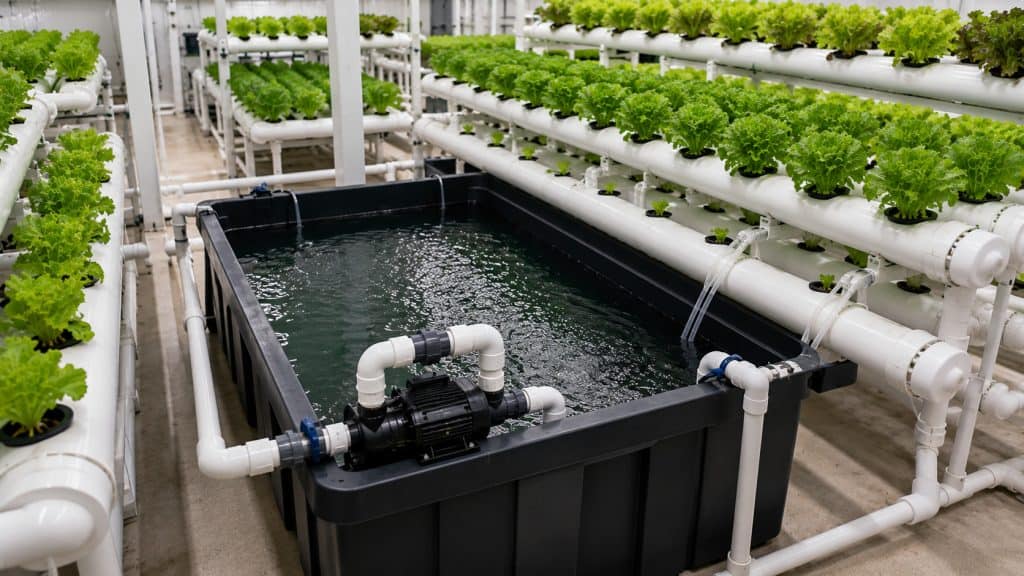
Pumps create heat. In a small reservoir, that heat can raise water temperature quickly. In a large reservoir, the effect may be slower, but continuous pump operation still matters.
Warm nutrient solution can stress roots and reduce oxygen availability. If the pump sits inside the reservoir, watch water temperature during long run times. If the reservoir keeps warming up, consider better airflow, shading, or an external pump.
Reservoir size also affects stability. A larger volume usually changes more slowly, but it still needs circulation. Dead zones can form when the pump pulls from one area and returns water poorly.
Place return lines so the solution mixes through the tank instead of flowing straight back to the pump intake. This helps keep pH, EC, and temperature more even.
Backup Planning for Large Hydroponic Pumps
A pump failure in a small bucket is annoying. A pump failure in a large system can damage an entire crop. That is why backup planning matters more as the system grows.
For large NFT or drip systems, keep a spare pump or replacement impeller if possible. If your system depends on one pump, that pump becomes a single point of failure.
Some growers split large systems into zones. Instead of one pump feeding everything, two smaller pumps can reduce risk. If one pump fails, not every plant loses flow at the same time.
Timers, smart plugs, and alarms can help, but they should not replace visual checks. Listen for pump noise, check flow at the farthest outlet, and inspect the reservoir daily.
A backup plan does not need to be complicated. It can be as simple as a spare pump, extra tubing, clean filters, and a written note showing where each line connects.
Watch Large Pump and Reservoir Layout Before Building

Credits: RangerRob Country Living
A visual setup can help you understand how pump placement, return lines, and tubing layout work together. Watch how the reservoir sits below the grow channels and how the pump sends nutrient solution upward before gravity brings it back.
Use the video as a layout reference, not a fixed formula. Your reservoir volume, channel height, tubing diameter, and crop type may be different.
Common Pump Sizing Mistakes
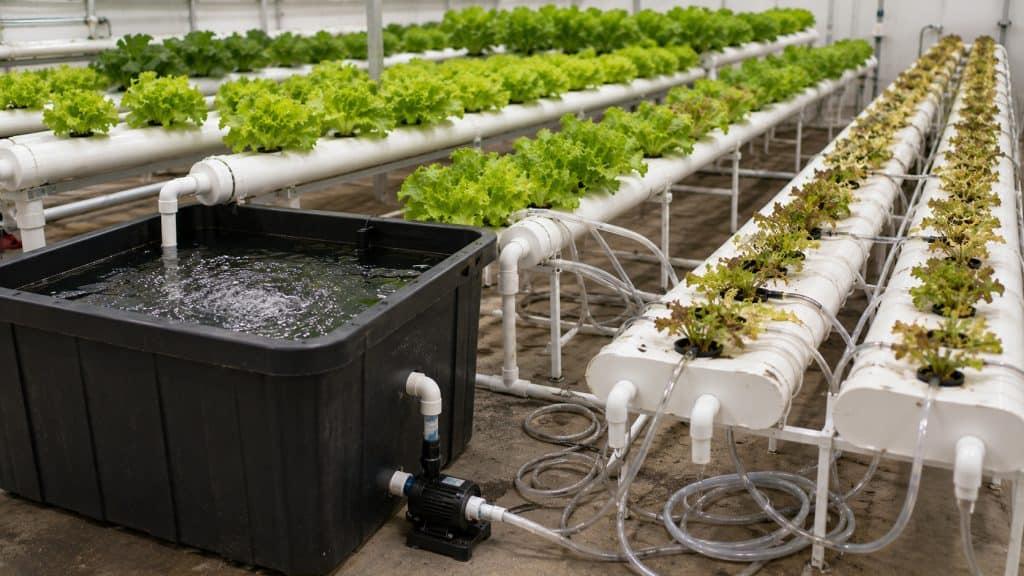
The first mistake is buying only by gallons per hour. A high GPH number does not mean much if the pump cannot handle the height and resistance in your actual system.
The second mistake is ignoring tubing size. Narrow tubing can choke a strong pump. If the outlet is large but the tubing is tiny, flow drops before it reaches the plants.
Another mistake is overpumping. Too much flow can splash, waste energy, disturb roots, warm the solution, and create noise. More power is not always better.
Many growers also forget cleaning access. If a pump is hard to reach, maintenance gets delayed. A dirty pump slowly becomes a weak pump.
The last mistake is running one pump for too many zones without checking the farthest point. Always test the end of the system, not just the area closest to the reservoir.
Large System Pump Troubleshooting Chart
Use this chart when plants grow unevenly, channels run dry, or the pump sounds different than usual.
| Problem | Likely Cause | First Fix |
|---|---|---|
| Weak flow at far channels | Head height, tubing friction, or poor manifold balance | Check pump curve, shorten tubing, and balance outlets |
| Pump runs loudly | Low reservoir level or air entering the intake | Top up reservoir and confirm the intake stays covered |
| Plants near pump grow better | Uneven flow distribution | Add valves or redesign the manifold |
| Reservoir gets warm | Submersible pump heat or poor airflow | Improve cooling or consider external pump placement |
| Emitters clog often | Debris, algae, or poor filtration | Clean the filter, block light, and flush lines |
| Pump loses output over time | Dirty intake, worn parts, or mineral buildup | Clean the pump and inspect the impeller |
Troubleshoot one change at a time. If you replace the pump, tubing, filter, and timer all at once, you may not know which part actually fixed the issue.
A large system should feel predictable. If flow changes every few days, something in the layout, pump access, or cleaning routine needs attention.
Maintenance Routine for Large Hydroponic Pumps
Large pumps need scheduled maintenance, not emergency cleaning. Add pump checks to your regular hydroponic garden routine so flow problems are caught early.
Check the intake screen weekly. Look for roots, algae, leaves, and loose media. If the system uses a filter, rinse it before flow drops.
Inspect tubing and fittings for leaks. A slow leak can lower reservoir volume, change flow pressure, and create electrical risk near the grow area.
Record changes in sound, flow, and water temperature. Small changes often warn you before full pump failure.
Top Hydroponic Garden’s hydroponic garden maintenance guide is a useful next step if you want pump checks to fit into a complete system-care routine.
FAQ
What size water pump do I need for a large hydroponic system?
The right size depends on reservoir volume, vertical lift, tubing length, crop type, and system design. Check the pump curve, not only the maximum GPH rating, because real flow drops as height and resistance increase.
Are submersible pumps good for large hydroponic systems?
Submersible pumps can work for some large systems, especially simple reservoir layouts. However, they can add heat and may be harder to clean than inline pumps in larger or more complex systems.
Is an inline pump better for large hydroponics?
An inline pump can be better when you need stronger flow, easier maintenance access, or external plumbing. It needs careful installation because leaks, priming issues, and bad fittings can cause problems.
Should a large hydroponic pump run all the time?
It depends on the system. NFT usually needs continuous flow, while drip and ebb-and-flow systems may use timed cycles. Always match pump timing to root moisture needs and system type.
Can a pump be too powerful for hydroponics?
Yes. Too much pump power can cause splashing, root disturbance, heat, noise, and wasted energy. Large systems need steady, even flow, not uncontrolled pressure.
Better Pumps Keep Large Hydroponic Systems Stable
Water Pumps for Large Systems should be chosen for real working conditions, not just the biggest number on the label. A large hydroponic setup needs steady flow after height, tubing, filters, and manifolds reduce output.
The best pump plan is practical. Match pump type to system design, keep tubing efficient, watch temperature, and make maintenance easy. A pump that is easy to inspect is usually easier to trust.
For Top Hydroponic Garden readers, the safest move is to test the whole system before planting heavily. Run the pump, check the farthest outlet, listen for noise, and confirm return flow. A stable pump setup protects the crop before problems start.
References
- https://www.nal.usda.gov/farms-and-agricultural-production-systems/hydroponics
- https://extension.umn.edu/how/small-scale-hydroponics
Related Articles
- https://tophydroponicgarden.com/water-pumps/
- https://tophydroponicgarden.com/what-equipment-is-needed-for-hydroponics/
- https://tophydroponicgarden.com/hydroponic-garden-maintenance/
Was this helpful?

I’m Barrie L., a passionate hydroponic gardening enthusiast dedicated to cultivating thriving, soil-less gardens. With a focus on all things hydroponic, I share my expertise on innovative growing techniques and sustainable practices through my blog, tophydroponicgarden.com. As a seasoned hydroponics specialist, my goal is to inspire and guide fellow gardeners in harnessing the power of water-based cultivation for bountiful and eco-friendly harvests. I’m also an author of the book “Hydroponics For Absolute Beginners: Your Step By Step Guide For How To Create An Hydroponics System At Home Without Soil, For Growing Vegetable, Fruit And Herbs.” which is sold on Amazon. Join me on a journey of redefining the way we cultivate plants, one nutrient-rich solution at a time. Happy growing!