

You look at those vibrant green leaves and plump tomatoes in a commercial greenhouse and wonder what secret sauce they’re using. The secret isn’t magic, it’s math. Hydroponic nutrient formulas are precise recipes of mineral salts dissolved in water, providing everything a plant would normally get from soil, but with far greater control.
Getting this formula right is the single most important factor between a struggling plant and a prolific one. It’s about speaking the plant’s language, delivering the exact nutrients it craves at each stage of its life. Keep reading to translate those fertilizer labels and university recipes into a thriving garden.
Key Takeaways
- Formulas balance 14 essential minerals, tailored to specific crops and growth stages.
- Precise measurement in parts per million (ppm) prevents deficiencies and toxicities.
- Managing pH and electrical conductivity (EC) is non-negotiable for nutrient uptake.
What Are Hydroponic Nutrient Formulas?

Think of it as a perfectly balanced meal, delivered directly to the roots. Since there’s no soil to act as a nutrient bank, you become the chef. A hydroponic nutrient formula is a solution containing all the essential elements a plant needs to grow. These are mineral salts, things like calcium nitrate or monopotassium phosphate, that dissolve completely in water.
The plant doesn’t eat the salt itself. It absorbs individual ions, like nitrate (NO³⁻) for nitrogen or potassium (K⁺). This is why precision matters. Too much of one ion can block the uptake of another, a problem known as nutrient lockout.
It’s not just about feeding the plant, it’s about creating an environment where it can feed itself efficiently. The goal is to mimic the ideal soil conditions without any of the guesswork or inconsistencies.This level of control is what differentiates nutrient solutions for plants in hydroponics from traditional soil feeding methods, enabling growers to tailor precise mineral balances for optimal growth.
The Language of Plant Nutrition

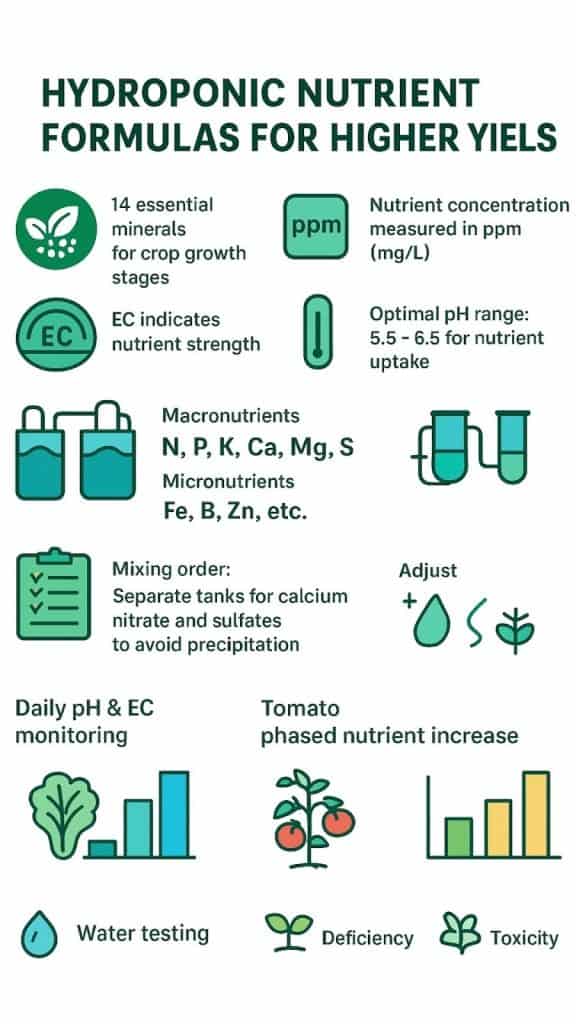
Before you can mix a formula, you need to understand the vocabulary. The elements are split into two groups based on how much the plant uses. The macronutrients are the big three you see on every fertilizer bag: Nitrogen (N), Phosphorus (P), and Potassium (K). But that’s not the whole story. Calcium (Ca), Magnesium (Mg), and Sulfur (S) are also macronutrients, required in relatively large amounts [1].
Then come the micronutrients. These are the trace elements, needed in tiny quantities but absolutely vital. Iron (Fe) for chlorophyll, Boron (B) for cell walls, Zinc (Zn) for enzyme production. Miss one, and the whole system can falter.
The unit of measurement is parts per million (ppm), which is essentially milligrams per liter. It’s a way to talk about very small concentrations with accuracy.
You’ll also live by two acronyms: pH and EC. pH measures how acidic or basic your solution is on a scale from 0 to 14. For most hydroponic crops, you want a slightly acidic range, between 5.5 and 6.5.
Outside this window, nutrients become unavailable, no matter how much you add. EC, or electrical conductivity, measures the total concentration of dissolved salts. It tells you the solution’s strength.
A low EC might mean the plants are hungry, a high EC could mean they’re being burned. Understanding how pH is important in hydroponics helps maintain nutrient availability, preventing lockout and ensuring your plants absorb what they need at each growth stage.
A Step-by-Step Guide to Formula Management

Credit : ZipGrow
You don’t start by throwing salts in a bucket. The process is methodical, from planning to daily maintenance.
First, you identify what your plants need. A young lettuce plant has different demands than a fruiting tomato vine. Leafy greens want more nitrogen for lush growth.
Fruiting plants like peppers and tomatoes demand more potassium and phosphorus for flower and fruit development. Universities like the University of Florida provide detailed stage-by-stage recipes for these very reasons.
Next, you choose your approach. Will you use a pre-mixed commercial formula or build your own from raw ingredients? Pre-mixed solutions are convenient, great for beginners. But they offer little flexibility.
Building your own from individual fertilizer salts, while initially more complex, gives you ultimate control. You can adjust for your specific water quality and correct problems as they arise.
The actual mixing has a specific order. You always dissolve fertilizers one at a time, ensuring each is fully dissolved before adding the next. A common practice is to mix calcium nitrate by itself in one container (often called the “B” tank).
The sulfates and phosphates go in another (the “A” tank). This prevents calcium from reacting with sulfate or phosphate and forming a cloudy, insoluble precipitate that clogs your system and robs your plants of nutrients.
Such careful formulation techniques are essential, whether you’re growing leafy greens or more complex crops like trees, as seen in can you grow trees with hydroponics systems, where nutrient accuracy is critical to success.
Practical Applications and Adjustments
The theory comes alive when you apply it to real plants. Here’s how it looks in practice.
For a crop like hydroponic lettuce, a simple, balanced formula often works well. Something like the Modified Sonneveld’s recipe, which aims for around 150 ppm of Nitrogen, 31 ppm of Phosphorus, and 210 ppm of Potassium. It’s a gentle formula that promotes fast, healthy leaf growth without stressing the plant.
Tomatoes are a different beast. They are heavy feeders that need a phased nutrient approach. The Ohio State University extension recommends a recipe that starts with lower nutrients for young plants (like 90 ppm N) to prevent overly vegetative growth.
As the plant matures and starts fruiting, the formula shifts, ramping up to 190 ppm N and 350 ppm K to support the energy-intensive work of producing fruit and preventing issues like blossom end rot.
Your water source is a critical, often overlooked, part of the formula. If your tap water is hard, it might already contain 50 ppm of calcium. If you blindly follow a recipe that calls for 150 ppm Ca, you’ll end up with 200 ppm, which could be too high [2].
The smart move is to get your water tested. Then, you subtract the nutrients already present in the water from your recipe’s totals. This is the kind of fine-tuning that separates good results from great ones.
- Nitrogen (N): Fuels leafy, vegetative growth.
- Phosphorus (P): Essential for strong roots and flowering.
- Potassium (K): Supports overall plant health and fruit quality.
- Calcium (Ca): Builds strong cell walls.
- Magnesium (Mg): The central atom in chlorophyll for photosynthesis.
FAQ
What makes a hydroponic formula different from regular plant food?
A hydroponic formula uses hydroponic nutrients that dissolve fast in water. You work with a nutrient solution that holds macronutrients, micronutrients, trace elements, and clear ppm concentrations. You also watch EC levels and pH balance. You often compare mixes like the Hoagland solution or Steiner formula to build nutrient recipes that match your water quality.
How can you read ppm concentrations in a nutrient solution?
You track nitrogen ppm, phosphorus ppm, potassium ppm, calcium ppm, magnesium ppm, and sulfur ppm with a nutrient calculator or TDS meter. You test electrical conductivity to see ion balance. You check chloride levels and CaMg balance. This helps you avoid nutrient lockout and deficiency symptoms in any vegetative stage or flowering stage.
Why do growers mix nutrients in a certain order?
You avoid precipitation by adding ingredients like calcium nitrate, potassium nitrate, magnesium sulfate, or monopotassium phosphate in a careful mixing order. You also watch fertilizer solubility and stock solutions. You prevent clouding when you use RO filtration or reverse osmosis water. You keep chelate stability when handling iron chelate or DTPA iron.
How do growth stages change your nutrient recipes?
You adjust NPK ratio, KCa antagonism, and anion ratios for each growth stage. You change nutrient uptake targets for leafy greens formula, tomato nutrient mix, lettuce recipe, cucumber solution, pepper formula, or strawberry hydroponics. You also change ppm concentrations to match the vegetative stage, flowering stage, or fruiting stage.
What helps you manage a reservoir over time?
You test pH adjustment with phosphoric acid, nitric acid, or sulfuric acid. You check EC levels to track plant ions. You refresh weekly to avoid toxicity levels. You use injectors dosatron for steady dosing. You monitor nutrient charts from commercial mixes or DIY nutrients. You watch essential elements and elemental analysis to keep ion balance steady.
Conclusion
Understanding hydroponic nutrient formulas turns gardening from an art into a science. It replaces uncertainty with data. You move from wondering why a plant is yellow to knowing it likely needs a magnesium boost, or from guessing on fertilizer amounts to calculating exact ppm.
This knowledge is the difference between hoping your plants grow and knowing they will. Start with a trusted recipe, monitor diligently, and don’t be afraid to adjust. Your plants will show their gratitude with every new leaf and fruit.
References
- https://extension.psu.edu/hydroponics-systems-and-principles-of-plant-nutrition-essential-nutrients-function-deficiency-and-excess
- https://extension.psu.edu/hydroponics-systems-and-principles-of-plant-nutrition-essential-nutrients-function-deficiency-and-excess
Related Articles
- https://tophydroponicgarden.com/understanding-nutrient-solutions-for-plants/
- https://tophydroponicgarden.com/how-is-ph-important-in-hydroponics/
- https://tophydroponicgarden.com/can-you-grow-trees-with-hydroponics/
Was this helpful?

I’m Barrie L., a passionate hydroponic gardening enthusiast dedicated to cultivating thriving, soil-less gardens. With a focus on all things hydroponic, I share my expertise on innovative growing techniques and sustainable practices through my blog, tophydroponicgarden.com. As a seasoned hydroponics specialist, my goal is to inspire and guide fellow gardeners in harnessing the power of water-based cultivation for bountiful and eco-friendly harvests. I’m also an author of the book “Hydroponics For Absolute Beginners: Your Step By Step Guide For How To Create An Hydroponics System At Home Without Soil, For Growing Vegetable, Fruit And Herbs.” which is sold on Amazon. Join me on a journey of redefining the way we cultivate plants, one nutrient-rich solution at a time. Happy growing!