

If your strawberries are struggling, the first step is always figuring out what’s wrong. Many problems, like yellow leaves or rotten fruit, come down to water, disease, or where you planted them.
Once you spot the symptoms, you can usually fix it. Here’s how to diagnose the most common issues and what to do about them.
Strawberry Rescue Snapshot
- How to identify diseases, pests, nutrient deficiencies, and environmental stress in strawberries.
- Root rot, Leaves wilt and turn dull blue-green while soil is wet. Roots are black and mushy. Crown rot, Plant center (crown) turns dark brown/black and gets soft. New leaves don’t grow. Gray mold, Berries get soft brown spots with fuzzy gray coating. Spreads fast in cool, damp weather.
- Practical solutions to restore plant vigor and improve fruit quality.
Common Strawberry Issues Can Reduce Plant Health and Fruit Production
Most strawberry troubles fall into a few main categories. You’ll often see things go wrong with the fruit itself, like it doesn’t form or it rots. The leaves might get spots, turn colors, or die back.
Problems underground can rot the roots or the plant’s center. Bugs like slugs or sap-sucking insects are a constant hassle. And sometimes, the weather or the spot you chose just stresses the plants out.
Common symptoms include:
- No flowers or fruit
- Flowers appear but berries never develop
- Yellow strawberry leaves
- Strawberry leaf spot
- Powdery mildew on strawberries
- Gray mold on strawberries
- Strawberry plants wilting
- Small strawberry fruit
- Misshapen strawberries
- Strawberry fruit rot
- Strawberry plant stunting
According to University of California IPM
“Good air circulation is essential for dampening the effects of gray mold. Plant strawberries in full sun and space them properly to allow plants to dry quickly after a rain or irrigation.” – University of California IPM
Why do strawberry problems happen?
Most strawberry production issues develop because of:
- Poor pollination
- Incorrect watering practices
- Nutrient imbalances
- Pest pressure
- Fungal diseases
- Overcrowding
- Poor sunlight exposure
From our experience, growers frequently overlook airflow and drainage. Healthy-looking plants can decline rapidly when roots remain saturated for extended periods.
Strawberry Plants May Produce Flowers Without Developing Fruit
Flowers without fruit usually indicate pollination problems or environmental stress.
Is poor pollination the cause?
Poor pollination is a top reason flowers don’t turn into fruit. Strawberries need pollen moved from one part of the flower to another. If it doesn’t happen, you get small, misshapen berries or none at all. Bad weather, like cold rain, or not enough bees and other pollinators visiting can cause it.
Signs include:
- Flowers bloom normally
- Petals drop
- No berry formation
- Hollow or misshapen fruit develops
When you grow strawberries inside, in a greenhouse, or with hydroponics, bees usually can’t get to the flowers. This creates a pollination shortage. The pollen isn’t moved around, so the fruit doesn’t set properly. You might end up with tiny, oddly-shaped berries or no fruit at all.
When managing our indoor winter hydroponic trays, we quickly realized that manual pollination isn’t just about swirling a brush around.
The trick is timing: strawberry pollen sheds best midday when relative humidity drops below 70%. We use a No. 4 camel-hair artist brush, gently sweeping the bristles around the golden center (the stamens) of an open flower, and then dabbing it directly onto the green cone (the pistils) of adjacent blossoms.
Doing this every other day consistently increased our berry size by nearly 40% compared to letting the indoor air do the work
Research shows a clear difference. Strawberries pollinated by bees grow larger and have a better, more even shape. Flowers that don’t get good pollination make smaller, lumpy, or misshapen fruit.
Could environmental stress be affecting fruit set?
Yes. Several stress factors reduce fruit development:
- Strawberry heat stress
- Inconsistent irrigation
- Poor airflow
- Hydroponic strawberry nutrient imbalance
- Nutrient deficiencies
High temperatures above 85°F (29°C) can reduce pollen viability and lower fruit set rates.
Strawberry Plants May Fail to Flower Under Poor Growing Conditions

If your plant isn’t making many flowers, check a few things. It might not be getting enough sunlight. The soil could be missing key nutrients, especially phosphorus. Some strawberry types naturally flower less. Also, if the plant is putting all its energy into making runners, it won’t have much left for flowers.
Are they getting enough sunlight?
Strawberries require 6–10 hours of direct sunlight daily.
Plants receiving less light often display:
- Weak growth
- Few flower buds
- Reduced yields
A shaded location remains one of the leading causes of poor flowering.
Is excess nitrogen causing the problem?
Strawberry nitrogen deficiency can reduce growth, but excessive nitrogen causes a different issue.
Symptoms include:
- Dense leafy growth
- Few flowers
- Delayed fruiting
Many growers accidentally create this problem using lawn fertilizers near strawberry beds.
Could runners be stealing energy?
Yes.
Excessive strawberry runners redirect resources away from flowering and fruit production.
When growers complain about strawberry runners not producing fruit, overcrowding is frequently responsible.
Remove runners if your goal is maximum harvest rather than propagation.
Yellow Strawberry Leaves Often Indicate Growing or Nutrient Problems
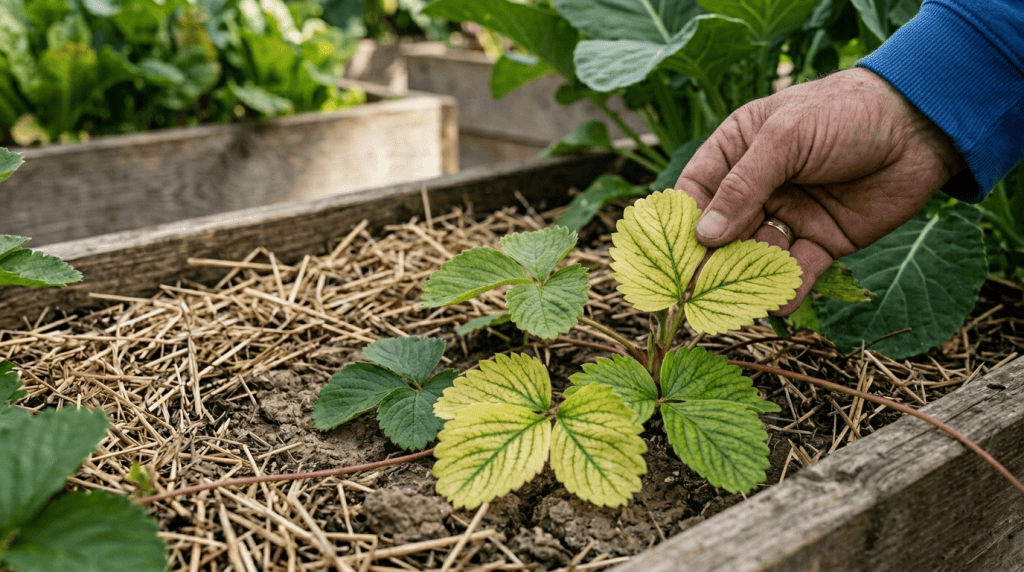
When a strawberry bed begins turning yellow, it’s usually a cry for help from the root zone. In nine out of ten cases I diagnose, the culprit is waterlogged soil starving the roots of oxygen.
If you dig up a struggling plant and find mushy, black roots instead of firm, white ones, you’re looking at root rot. To fix this, stop watering immediately and let the top two inches of soil dry out completely.
If your soil is heavy clay, rescue the remaining healthy crowns by transplanting them into a raised bed or a container mix amended with perlite, strawberries simply will not tolerate sitting in stagnant water.
Is overwatering causing root stress?
Overwatering strawberries can create:
- Waterlogged strawberry roots
- Oxygen deprivation
- Root decay
- Leaf yellowing
Poor drainage dramatically increases disease risk.
Could soil pH be the issue?
Strawberries perform best between pH 5.5 and 6.8.
Outside this range, nutrient uptake declines, resulting in:
- Strawberry chlorosis
- Strawberry iron deficiency
- Strawberry nutrient lockout
- Persistent yellowing
Many gardeners add iron supplements unnecessarily when the true problem is pH.
How do you fix yellow leaves?
- Improve drainage
- Test pH
- Apply nutrients based on soil tests
- Remove severely damaged foliage
Common deficiency symptoms include:
- Strawberry iron deficiency: yellow leaves with green veins
- Strawberry magnesium deficiency: yellowing between veins on older leaves
- Strawberry nitrogen deficiency: pale overall growth
- Strawberry potassium deficiency: leaf-edge browning
Several Diseases Can Cause Discolored Spots on Strawberry Leaves
Leaf spotting diseases are among the easiest strawberry disease identification challenges.
Could it be leaf spot disease?
Strawberry leaf spot typically appears as:
- Purple spots
- Red lesions
- White centers later
Wet conditions accelerate spread.
According to Purdue University Extension
“Strawberry leaf spot, caused by the fungus Mycosphaerella fragariae, is easily recognized by small, conspicuous spots. They begin as deep purple to reddish-purple, and as they mature, the center of the spot turns light brown to gray or white while maintaining a dark purple border.” – Purdue University Extension
Is leaf scorch responsible?
Strawberry leaves turning brown may result from leaf scorch.
Symptoms include:
- Dark purple lesions
- Curling foliage
- Dry leaf margins
- Premature leaf death
How can you prevent fungal leaf diseases?
Disease prevention relies heavily on cultural practices.
- Improve air circulation
- Remove infected leaves
- Avoid overhead watering
- Sanitize plant debris
Other important diseases include:
- Anthracnose strawberry disease
- Angular leaf spot strawberry
- Powdery mildew on strawberries
A disease-free planting site remains one of the strongest defenses against recurring outbreaks.
Diseases and Excess Moisture Commonly Cause Strawberry Fruit Rot
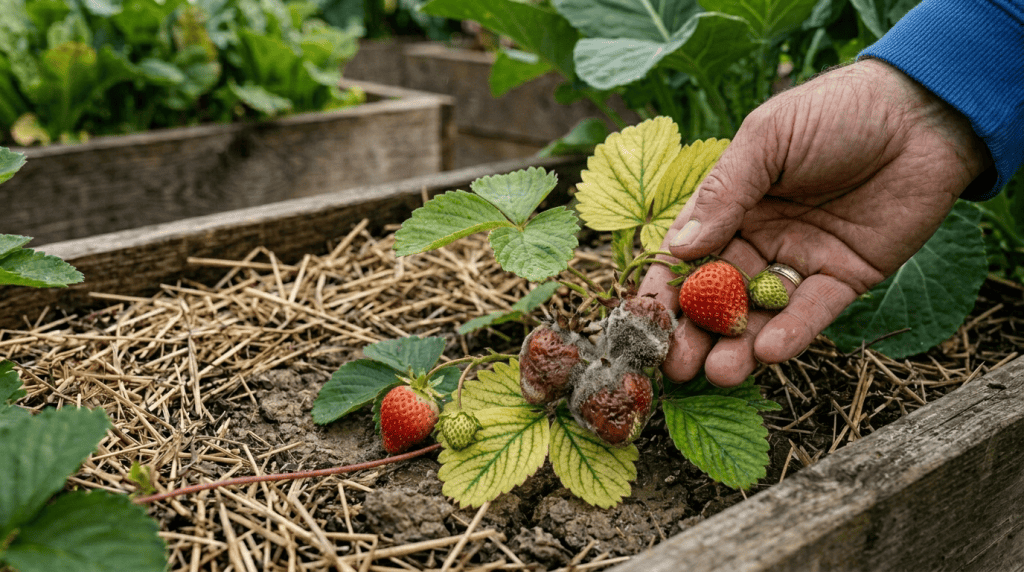
Fruit rot develops rapidly under humid conditions.
Is gray mold affecting the fruit?
Gray mold on strawberries, also called botrytis fruit rot, causes:
- Soft berries
- Gray fuzzy growth
- Rapid fruit collapse
Botrytis is among the most destructive strawberry diseases worldwide.
Could poor airflow be the culprit?
Dense canopies trap moisture around fruit.
Consequences include:
- Increased fungal growth
- Slow drying after rain
- Higher disease pressure
How do you stop fruit rot?
Remove infected berries immediately.
Additional steps include:
- Mulch beneath fruit
- Improve spacing
- Switch to drip irrigation
- Increase sunlight penetration
Common fruit disorders include:
- Strawberry fruit discoloration
- Soft strawberries on plant
- Strawberry fruit cracking
- Hollow strawberry fruit
- Sunscald on strawberries
Is Overhead Watering Causing Strawberry Diseases?
In many cases, yes.
Why is overhead irrigation risky?
Wet foliage encourages:
- Powdery mildew on strawberries
- Anthracnose strawberry disease
- Gray mold on strawberries
Leaves that remain wet overnight create ideal fungal conditions.
What are the benefits of drip irrigation?
Drip systems:
- Deliver water directly to roots
- Keep foliage dry
- Reduce disease pressure
- Improve water efficiency
Commercial growers frequently rely on drip irrigation for disease management.
How often should strawberries be watered?
The answer depends on weather and soil.
Avoid:
- Waterlogged soil
- Long dry periods
- Extreme fluctuations
Consistent moisture supports stronger root systems and improved fruit quality.
Common Strawberry Pests Can Reduce Plant Health and Fruit Quality
Several insects and animals can significantly reduce harvests.
How do aphids affect strawberry plants?
Aphids on strawberry plants cause:
- Sticky residue
- Distorted growth
- Reduced vigor
Heavy infestations may spread plant viruses.
What are the signs of spider mites?
Spider mites on strawberries create:
- Fine webbing
- Yellow speckling
- Weak foliage
Hot, dry conditions favor outbreaks.
How can you control common strawberry pests?
Use integrated management methods.
- Strong water sprays
- Insecticidal soap
- Neem oil
- Diatomaceous earth
Common pests include:
- Thrips on strawberries
- Whiteflies on strawberries
- Slugs eating strawberries
- Snails damaging strawberries
- Strawberry weevil damage
- Tarnished plant bug strawberries
- Stink bug damage on strawberries
- Birds eating strawberries
In organic growing, your best tool is watching your plants closely, and early. Catch bugs or diseases the moment they show up. You can then use things like sprays made from soap or neem oil, or just pick the pests off by hand, before they get out of control.
Strawberry Runners May Divert Energy Away From Fruit Production
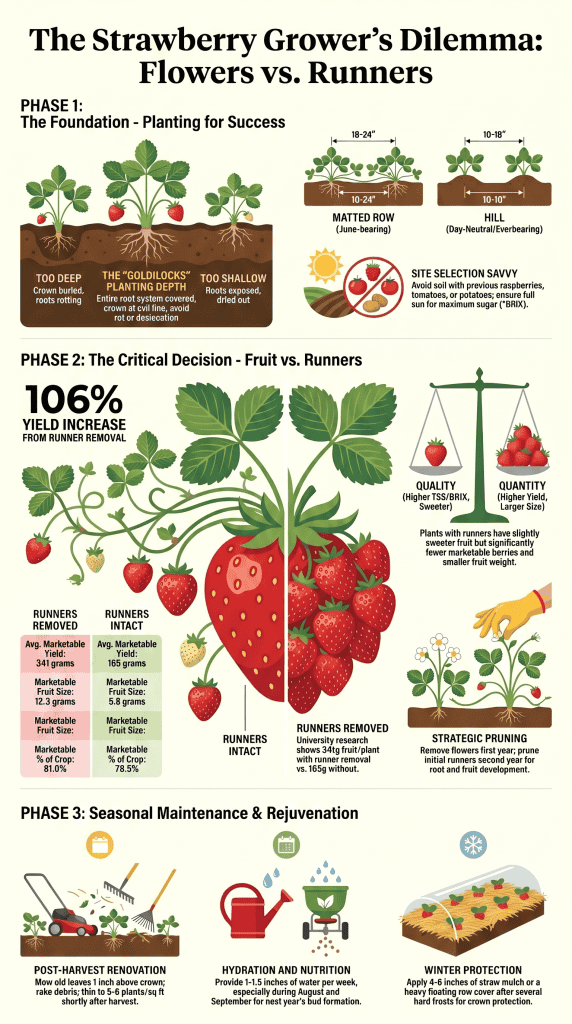
Why do runners affect fruit production?
Runners compete for:
- Water
- Nutrients
- Sunlight
- Growing space
As beds fill, fruit production often declines.
When should runners be removed?
Remove runners:
- During fruiting periods
- When maximizing yield
- When beds become crowded
Should runners ever be kept?
Absolutely.
Keep runners when:
- Expanding plantings
- Replacing aging plants
- Establishing new rows
Balancing propagation and production improves long-term harvest performance.
Several Factors Can Cause Strawberry Beds to Decline Over Time
Older beds often experience multiple stress factors simultaneously.
Does disease buildup occur over time?
Yes.
Soil-borne diseases become more common, including:
- Verticillium wilt strawberry
- Red stele root disease
- Strawberry root rot
- Crown rot in strawberries
Crop rotation helps reduce disease pressure.
Can overcrowding reduce yields?
Overcrowded beds suffer from:
- Reduced airflow
- Increased humidity
- Nutrient competition
- Higher pest populations
How can you refresh an aging strawberry bed?
Effective renewal practices include:
- Rotating locations
- Replacing old crowns
- Adding compost
- Replanting healthy runners
A problem called autotoxicity can happen when strawberries are grown in the same soil year after year. The old plants release compounds that build up and make it hard for new ones to grow. They become weak, stunted, and more likely to get sick. Rotating your patch to a new spot every few years is the fix.
Strawberry Problem Diagnosis Table
| Symptom | Likely Cause | Recommended Fix |
| Yellow leaves | Strawberry iron deficiency, pH issues, overwatering | Test pH, improve drainage, apply iron if needed |
| White powder on leaves | Powdery mildew on strawberries | Improve airflow, use labeled fungicides |
| Gray fuzzy fruit | Gray mold on strawberries | Remove infected berries, reduce humidity |
| Wilting plants | Strawberry root rot, drought, crown damage | Inspect roots and improve drainage |
| Small fruit | Poor pollination, nutrient stress | Hand-pollinate and correct fertility |
| Misshapen berries | Poor strawberry pollination, tarnished plant bug | Improve pollination and monitor pests |
| Brown leaf edges | Strawberry potassium deficiency, fertilizer burn | Adjust nutrition and EC levels |
| Plant stunting | Disease, nutrient lockout, root damage | Inspect roots and test soil |
| Soft fruit | Botrytis, excess moisture | Improve spacing and irrigation practices |
| No flowers | Shade, excess nitrogen, overcrowding | Increase sunlight and remove runners |
Many Strawberry Problems Can Be Avoided With Preventive Care

Credit: Sustainable Hydroponic and Soilless Strawberry Production Systems
Prevention is easier than treatment.
Are you planting in the right location?
Choose sites with:
- Full sun
- Well-draining soil
- Good airflow
The right location dramatically lowers disease pressure.
Are your maintenance practices helping or hurting?
Many problems result from routine mistakes.
Examples include:
- Burying crowns too deeply
- Allowing mulch to touch crowns
- Ignoring runners
- Excess fertilization
What preventive habits matter most?
The most effective habits include:
- Using disease-free plants
- Weekly pest inspections
- Consistent watering
- Proper mulching
- Avoiding excessive nitrogen
Identifying the Root Cause Is Essential When Strawberry Problems Persist
Persistent issues require a systematic diagnosis.
Have you ruled out environmental issues?
Evaluate:
- Sunlight levels
- Water quality
- Drainage
- Temperature stress
Sometimes what looks like a disease is actually weather stress or transplant shock. Frost or a sudden cold snap can blacken leaves and flowers just like a fungus. Intense heat can wilt and scorch them. A new plant that’s struggling to establish might also droop and turn colors. It’s easy to confuse these with an infection.
Could a disease outbreak be spreading?
Warning signs include:
- Symptoms worsening rapidly
- Multiple plants affected
- Repeated fruit rot
- Recurring leaf diseases
When should fungicides be considered?
Consider fungicides when:
- Disease is widespread
- Wet conditions continue
- Cultural controls fail
- Product labels specifically list strawberry use
Rotating fungicide groups helps reduce resistance development.
Certain Growing Mistakes Have a Major Impact on Strawberry Health and Yield
Several avoidable mistakes account for a large percentage of strawberry failures.
Are you planting crowns too deep?
Strawberry crown damage frequently results from deep planting.
Problems include:
- Crown rot
- Slow growth
- Plant decline
The crown should remain visible above soil level.
Is mulch touching the crown?
Mulch placed directly against crowns can:
- Trap moisture
- Increase disease risk
- Encourage rot
Maintain approximately one inch of space around the crown.
Are old plants being left too long?
Older plantings often produce:
- Smaller harvests
- More disease problems
- Lower vigor
Replacing aging plants every few years supports stronger production.
FAQ
Why are my strawberry leaves turning yellow and curling?
Yellow strawberry leaves and strawberry leaf curling usually indicate a specific problem with water, nutrients, or root health. Overwatering strawberries can deprive roots of oxygen, while underwatering strawberries causes moisture stress.
Strawberry nitrogen deficiency often produces pale older leaves, whereas strawberry iron deficiency causes yellowing between veins on newer leaves. Strawberry chlorosis may also develop when roots cannot absorb nutrients properly because of poor growing conditions.
How can I tell whether pests or diseases are damaging my strawberry plants?
Strawberry pest identification starts by checking for insects, feeding damage, or distorted growth. When scouting your patch, look closely for distinct pest signatures. Aphids leave behind a signature sticky honeydew on the lower foliage that quickly attracts black sooty mold.
Two-spotted spider mites are trickier; you’ll usually spot their fine, silk-like webbing on the undersides of leaves before you notice the yellow speckling on top.
If you notice your blossoms turning brown prematurely or the emerging fruit looking scarred and bronzed, shake the flower over a sheet of white paper, if tiny, slender golden specks crawl out, you are dealing with a thrips infestation.
What causes strawberries to stay small, misshapen, or fail to ripen properly?
Small strawberry fruit and misshapen strawberries often result from poor strawberry pollination during flowering. Incomplete pollination prevents parts of the fruit from developing normally. Strawberry flowers not producing fruit may occur when flowers are damaged by weather, pests, or nutrient deficiencies.
Strawberries not ripening properly can result from insufficient sunlight, excessive heat, or plant stress. These conditions frequently contribute to strawberry fruit discoloration and other strawberry fruit quality issues.
Why do healthy-looking strawberry plants suddenly wilt?
Strawberry plants wilting can occur when roots or crowns become damaged. Strawberry root rot develops in saturated soil and reduces the plant’s ability to absorb water. Crown rot in strawberries affects the central growing point and can quickly weaken the plant.
Diseases such as verticillium wilt strawberry and red stele root disease also interfere with water movement. Waterlogged strawberry roots caused by poor strawberry drainage are among the most common causes of sudden wilting.
How do I recover strawberry plants after environmental or nutrient stress?
Effective strawberry plant recovery tips depend on identifying the original source of stress. Strawberry heat stress can damage flowers and fruit, while frost damage on strawberries often injures blossoms and young leaves. Strawberry transplant shock may temporarily slow growth after planting.
Fertilizer burn on strawberries can damage roots and leaf edges, especially when excessive nutrients are applied. Correcting strawberry pH problems, strawberry EC issues, and strawberry nutrient lockout helps restore normal nutrient uptake and encourages healthy new growth.
Keep Your Strawberry Plants Healthy and Productive
Dealing with strawberry problems can be frustrating, especially when leaves start changing color or the fruit doesn’t look right. The good news is that most issues come from a few common causes, and once you know what’s behind them, they’re usually much easier to fix. Catching problems early matters.
If you want fewer setbacks and better harvests, focus on simple habits that support strong plant growth. Tophydroponicgarden can be a helpful place to find practical tips and guidance when you need answers. A little attention now can save you a lot of trouble later, helping your strawberry plants stay productive season after season.
References
- https://ipm.ucanr.edu/home-and-landscape/strawberry/#gsc.tab=0
- https://extension.purdue.edu/
Related Articles
- https://tophydroponicgarden.com/how-to-grow-hydroponic-strawberries-at-home/
- https://tophydroponicgarden.com/best-strawberry-varieties-for-hydroponics/
- https://tophydroponicgarden.com/can-using-tap-water-cause-problems/
Was this helpful?

I’m Barrie L., a passionate hydroponic gardening enthusiast dedicated to cultivating thriving, soil-less gardens. With a focus on all things hydroponic, I share my expertise on innovative growing techniques and sustainable practices through my blog, tophydroponicgarden.com. As a seasoned hydroponics specialist, my goal is to inspire and guide fellow gardeners in harnessing the power of water-based cultivation for bountiful and eco-friendly harvests. I’m also an author of the book “Hydroponics For Absolute Beginners: Your Step By Step Guide For How To Create An Hydroponics System At Home Without Soil, For Growing Vegetable, Fruit And Herbs.” which is sold on Amazon. Join me on a journey of redefining the way we cultivate plants, one nutrient-rich solution at a time. Happy growing!