

Safe pH Levels for Leafy Vegetables matter because leafy greens react fast when nutrient solution drifts too acidic or too alkaline. From checking beginner hydroponic setups, I’ve noticed yellow leaves and weak roots often start with pH, not “bad seeds” or weak fertilizer.
For most hydroponic leafy vegetables, the safe range usually sits around slightly acidic to near neutral. Lettuce often performs well around pH 6.0–7.0, while many leafy greens stay easier to manage near the 5.5–6.5 range. Read below to set a safer pH routine before your greens show stress.
The Practical Guide to Safe pH for Leafy Greens
- Keep pH slightly acidic: Most hydroponic leafy vegetables grow best when the nutrient solution stays near the slightly acidic range.
- Test before adjusting: Always measure pH after nutrients are mixed because fertilizer can change the final reading.
- Adjust slowly: Big pH corrections can shock roots, so small changes and retesting are safer than quick fixes.
The goal is not to chase a perfect number every hour. The goal is to keep leafy greens inside a safe pH window long enough for stable nutrient uptake.
Why pH Matters for Leafy Vegetables
pH affects how easily roots can access nutrients in the solution. If the pH drifts too far, nutrients may still be present, but the plant may struggle to use them. This is why leafy greens can look deficient even when the reservoir contains fertilizer.
Leafy vegetables grow quickly, so problems show up fast. Lettuce, spinach, kale, bok choy, and Swiss chard can move from healthy to pale or weak within a short time if water quality stays unstable.
Safe pH management is especially important in hydroponics because the root zone depends directly on the nutrient solution. There is no garden soil to buffer every mistake. A small reservoir can drift faster than a larger one, especially when water level drops or nutrients are topped up unevenly.
For beginners, pH should be treated as a routine check, not an emergency task. Testing a few times each week helps you catch drift before the leaves show obvious damage.
What pH Range Is Safe for Leafy Vegetables?

A safe pH range for many hydroponic leafy vegetables is usually around 5.5 to 6.5, with lettuce often listed around 6.0 to 7.0 in extension guidance. The best target depends on crop type, nutrient formula, water source, and growing system.
Hydroponic nutrient guidance explains:
“The pH of a nutrient solution influences the availability of nutrients, so it should be maintained in the optimum range.” – Oklahoma State University Extension
For home growers, a practical target is to keep most leafy greens close to pH 5.8–6.5 unless your crop guide recommends a different range. This gives roots access to nutrients while leaving a little room for normal daily drift.
Do not panic if one reading is slightly outside the target. Recheck the meter, stir the solution, and test again before adjusting. One odd reading is less important than a repeated drift pattern.
Safe pH Levels by Leafy Vegetable Type
Different leafy vegetables can tolerate slightly different ranges. Lettuce is usually forgiving when the system is stable, while spinach and kale may respond poorly when pH swings combine with heat, weak light, or poor oxygen.
| Leafy Vegetable | Practical pH Range | Why It Matters | Beginner Note |
|---|---|---|---|
| Lettuce | 6.0–7.0 | Common hydroponic crop with clear growth response | Keep readings stable and avoid sudden swings |
| Spinach | 5.8–6.5 | Can react to stress from heat and nutrient imbalance | Watch yellowing and slow new growth |
| Kale | 5.8–6.5 | Strong grower but still needs nutrient access | Keep pH steady during rapid leaf growth |
| Bok choy | 6.0–6.5 | Fast leafy crop with moderate nutrient demand | Check pH more often in small reservoirs |
| Swiss chard | 6.0–6.5 | Larger leaves need consistent nutrition | Avoid extreme pH drift during growth |
| Arugula | 5.8–6.5 | Quick crop with tender leaves | Harvest before stress causes tough flavor |
Use this table as a starting point, not a strict rule. Your water source and nutrient formula can change how quickly pH moves.
If you grow several greens together, choose a middle target around pH 6.0–6.3. That range usually keeps mixed leafy greens easier to manage.
Lettuce Is the Best pH Starting Point
Lettuce is one of the easiest crops for learning hydroponic pH because it grows quickly and shows stress clearly. If lettuce begins to pale, stall, or develop weak roots, pH should be one of the first things you check.
UF/IFAS lettuce guidance gives a practical benchmark:
“For lettuce, the ideal EC ranges from 1.4 to 1.8 mS/cm and a pH of 6.0–7.0.” – UF/IFAS Extension
This does not mean every leafy green must sit at exactly the same number. It means lettuce gives beginners a useful reference point for reading the reservoir. When lettuce grows evenly, your testing routine, nutrient strength, and pH control are probably moving in the right direction.
If you already use Top Hydroponic Garden’s leafy greens guide, pair those crop choices with a simple pH log. Tracking pH beside leaf color and growth speed makes troubleshooting much easier.
What Happens When pH Is Too Low?
Low pH means the nutrient solution is too acidic. Leafy vegetables may show stress through slow growth, root damage, weak leaves, or nutrient imbalance. In some cases, a low pH reading can make certain nutrients too available while reducing access to others.
The tricky part is that low pH problems can look like other issues. A grower may blame fertilizer strength, poor lighting, or seed quality before checking the reservoir. That wastes time and can lead to overcorrecting the wrong thing.
If pH is too low, do not pour a large amount of pH Up straight into the root zone. Mix a small amount in the reservoir, circulate the solution, wait, and test again. Leafy greens prefer stability, not dramatic rescue moves.
Also check what caused the drop. Nutrient strength, old solution, root activity, and water source can all affect pH over time.
What Happens When pH Is Too High?
High pH means the solution is too alkaline. This can reduce nutrient availability and make leafy vegetables look hungry even when fertilizer is present. Iron, manganese, and other micronutrient issues often become easier to notice when pH stays high.
Common signs include yellowing new growth, pale leaves, slow growth, and weak root performance. These symptoms can overlap with low EC, poor light, or cold water, so always test before adjusting.
High-alkaline tap water can push pH upward after nutrients are mixed. If this happens often, record your source water pH and alkalinity behavior. Some growers need more frequent testing because their water naturally resists pH changes.
If pH is too high, lower it slowly with a hydroponic pH Down product. Avoid random household acids unless your system guide specifically allows them. Consistency matters more than shortcuts.
How to Test pH Without Guessing
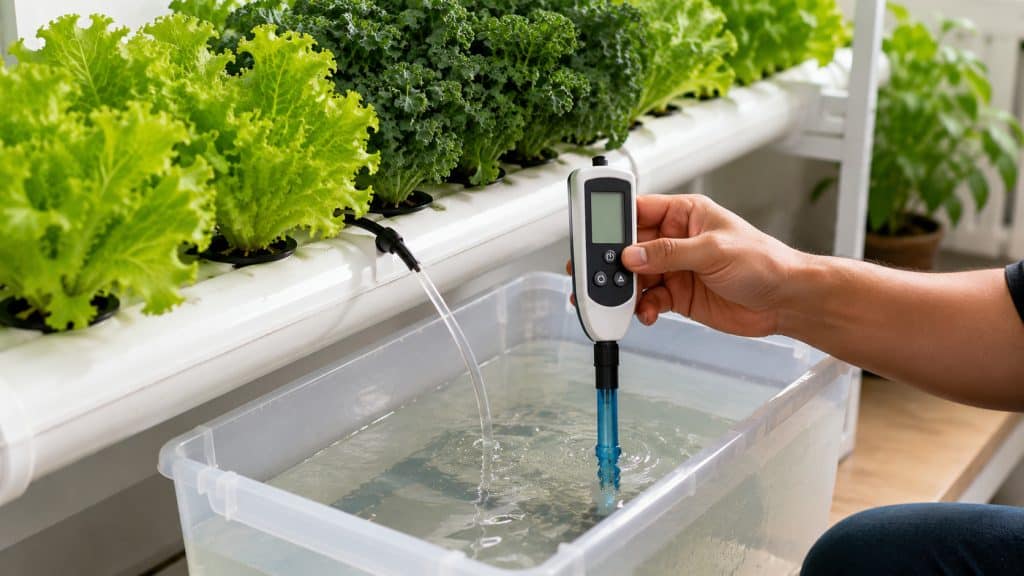
Testing pH is simple, but sloppy testing creates bad decisions. Always test after nutrients are fully mixed. If you test plain water first and then add fertilizer, the final pH may change.
Use a calibrated digital pH meter or a clean liquid test kit. Digital meters are convenient, but they need care. Rinse the probe, store it correctly, and calibrate it when readings seem strange.
Test from the reservoir, not from a random puddle in a tray. Stir or circulate the solution first so the sample represents the whole system. If the reading looks unusual, test again before making changes.
Top Hydroponic Garden’s article on accurate pH testing for hydroponics can help you build a better testing routine if your readings keep changing.
pH Adjustment Mistakes Beginners Make
Many pH problems come from overadjusting. A beginner sees pH 7.1, panics, adds too much pH Down, and ends up at 5.0. Then they add pH Up, and the reservoir swings again. That back-and-forth stresses roots more than the original mild drift.
| Mistake | Why It Hurts Leafy Greens | Better Fix |
|---|---|---|
| Adjusting before nutrients are mixed | Final pH changes after fertilizer is added | Mix nutrients first, then test |
| Adding too much pH Up or Down | Causes sudden root-zone swings | Adjust in tiny amounts and retest |
| Ignoring source water | Tap water may push pH upward repeatedly | Track source water behavior |
| Testing with a dirty probe | Gives unreliable readings | Rinse and calibrate the meter |
| Chasing exact numbers daily | Creates unnecessary swings | Stay inside a safe range |
The best routine is calm. Mix, circulate, test, adjust lightly, and wait before retesting.
If pH keeps drifting every day, the issue may be water quality, reservoir size, nutrient strength, or old solution.
Watch pH Testing Before Adjusting Your Reservoir

Credits: Tikki O.
A short visual guide can help beginners understand the testing and adjustment process before adding anything to a real reservoir. Watch how the sample is tested, how pH Up or pH Down is added carefully, and why retesting matters.
Use the video as a method reference, not as a fixed target for every crop. Your leafy vegetables, water source, nutrient formula, and system size can change the best pH routine.
How Often Should You Check pH?
For small hydroponic leafy vegetable systems, checking pH two to three times per week is a safe starting point. During early setup, nutrient changes, or visible plant stress, daily checks can help you understand how fast the reservoir moves.
Large reservoirs usually drift more slowly. Small countertop units, mason jar systems, and compact NFT setups can change faster because a small amount of water is affected more by plant uptake and evaporation.
Check pH after topping up water, after changing nutrients, and after adding new plants. These moments often shift the reading more than normal daily growth.
If readings stay stable for a few weeks, you can reduce testing slightly. But do not stop completely. Safe pH Levels for Leafy Vegetables depend on regular monitoring, not guessing by leaf color alone.
Keeping pH Stable in Leafy Green Systems
Stable pH starts with clean water, correct nutrient mixing, and a reservoir that is large enough for the plants. A tiny reservoir changes faster than a larger one, especially when lettuce or kale drinks heavily.
Do not top up with random amounts of plain water and fertilizer without testing. Plain water can dilute nutrients and shift pH. Strong nutrient mix can push EC and pH in another direction. Test after the reservoir has circulated.
Keep roots healthy too. Decaying roots, algae, warm water, and poor oxygen can make pH harder to manage. If the reservoir smells bad or roots look slimy, pH adjustment alone will not solve the real problem.
Top Hydroponic Garden’s guide to pH control for hydroponic grow media is a useful next read if you want to understand why grow media and water chemistry affect pH stability.
Common pH Symptoms in Leafy Vegetables
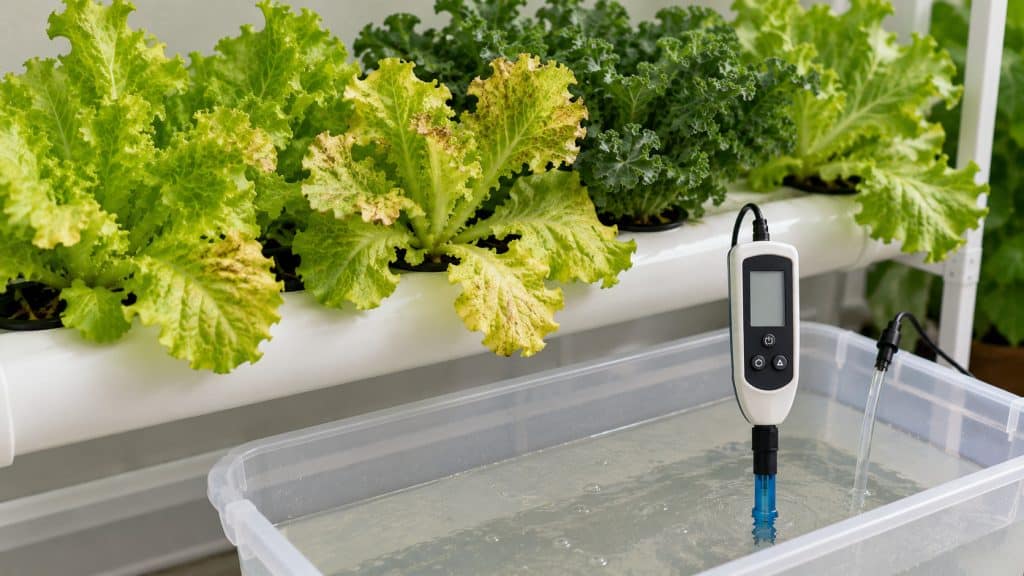
pH imbalance can show up in several ways, but symptoms overlap with other hydroponic problems. That is why testing matters. Never diagnose only by looking at leaves.
Yellow new leaves may point to nutrient availability issues. Brown edges can come from nutrient strength, water stress, or pH drift. Slow growth may be caused by low light, cold solution, weak roots, or poor pH.
The safest troubleshooting order is simple. First check pH and EC. Then inspect roots, water temperature, light, and flow. Do not add more fertilizer just because leaves look pale.
If you grow multiple leafy vegetables together, compare plants. If all crops show stress at once, the reservoir is likely involved. If only one plant struggles, spacing, roots, disease, or plant variety may be the real cause.
FAQ
What are safe pH levels for leafy vegetables?
Safe pH levels for leafy vegetables in hydroponics usually fall around 5.5–6.5, while lettuce is often managed around 6.0–7.0. The best target depends on crop type, water source, and nutrient formula.
Is pH 7 too high for hydroponic lettuce?
pH 7 can still be within some lettuce guidance, but many growers prefer staying closer to 6.0–6.5 for easier nutrient availability. If growth looks good and readings are stable, one pH 7 reading is not always an emergency.
What happens if pH is too low for leafy greens?
If pH is too low, leafy greens may develop root stress, slow growth, and nutrient imbalance. Adjust slowly with a hydroponic pH Up product and retest after the solution circulates.
How often should I test pH for leafy vegetables?
Test pH two to three times per week for most small hydroponic leafy green systems. Check more often after nutrient changes, water top-ups, or visible plant stress.
Should I adjust pH before or after adding nutrients?
Adjust pH after adding and mixing nutrients. Fertilizer can change the final reading, so adjusting plain water first can lead to inaccurate pH control.
Stable pH Keeps Leafy Greens Easier to Grow
Safe pH Levels for Leafy Vegetables are not about chasing one perfect reading. They are about keeping the root zone steady enough for lettuce, spinach, kale, bok choy, and other greens to absorb nutrients without stress.
Start with a practical range, test after mixing nutrients, and adjust slowly. If leaves turn yellow or growth slows, check pH and EC before adding more fertilizer.
For Top Hydroponic Garden readers, the best habit is simple: keep a small pH log, watch the roots, and make careful changes. Stable pH makes leafy vegetables easier to grow and easier to troubleshoot.
References
- https://extension.okstate.edu/fact-sheets/electrical-conductivity-and-ph-guide-for-hydroponics
- https://ask.ifas.ufl.edu/publication/HS1422
Related Articles
- https://tophydroponicgarden.com/leafy-greens/
- https://tophydroponicgarden.com/accurate-ph-testing-for-hydroponics/
- https://tophydroponicgarden.com/ph-control-for-hydroponic-grow-media/
Was this helpful?

I’m Barrie L., a passionate hydroponic gardening enthusiast dedicated to cultivating thriving, soil-less gardens. With a focus on all things hydroponic, I share my expertise on innovative growing techniques and sustainable practices through my blog, tophydroponicgarden.com. As a seasoned hydroponics specialist, my goal is to inspire and guide fellow gardeners in harnessing the power of water-based cultivation for bountiful and eco-friendly harvests. I’m also an author of the book “Hydroponics For Absolute Beginners: Your Step By Step Guide For How To Create An Hydroponics System At Home Without Soil, For Growing Vegetable, Fruit And Herbs.” which is sold on Amazon. Join me on a journey of redefining the way we cultivate plants, one nutrient-rich solution at a time. Happy growing!