

Indoor hydroponic gardens grow fresh herbs at home. They also require more maintenance and cost than many people expect.
These systems use water reservoirs, nutrient solutions, and LED lights instead of soil. Some sit neatly on a counter, like the AeroGarden Bounty. Others stand tall, like the towers from Lettuce Grow. They all promise quick harvests. Results vary. So do the long term costs. It is worth slowing down before you choose one.
What This Review Shows About Indoor Hydroponic Gardens: A Comprehensive Review of Popular Indoor Hydroponic Gardens
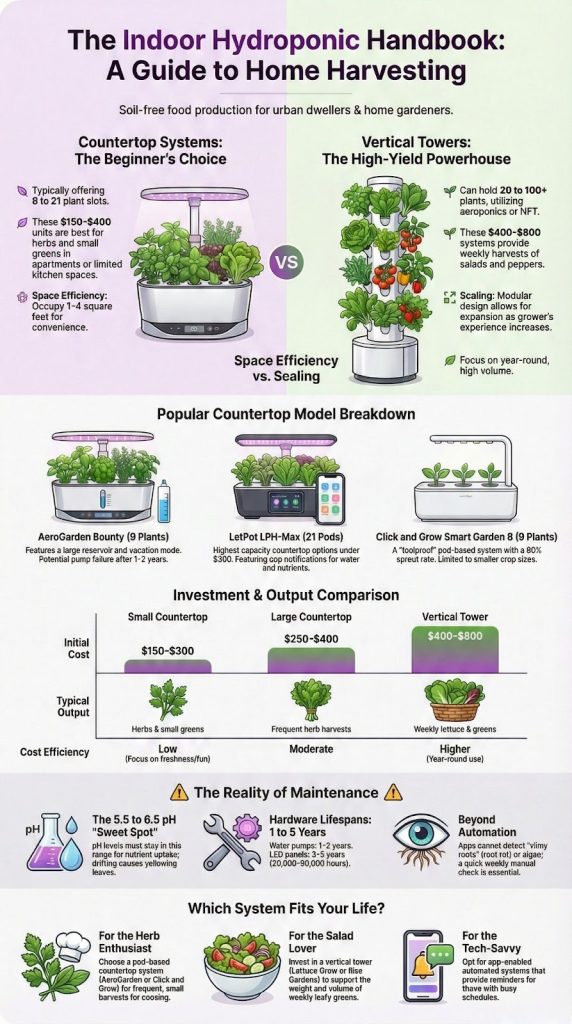
- While countertop hydroponic systems are often user-friendly and well-suited for growing herbs, their limited plant capacity can constrain the overall food production potential. Typical countertop systems range from 9 to 21 plant slots, which may not be sufficient for households seeking to cultivate a wider variety of produce.
- Vertical towers hold far more plants. In some cases more than 100. They can produce serious amounts of lettuce and even tomatoes, if managed well.
- Automation helps with reminders and light cycles. Still, daily pH checks, weekly nutrient refresh. Pumps fail. Nutrients drift. Plants respond quickly, for better or worse.
Indoor Hydroponic Gardens Serve Specific Urban and Suburban Growers
Indoor hydroponic gardens often grouped under different types of indoor hydroponic kits are soil-free systems that use water, hydroponic nutrient solutions, and energy-efficient LED grow lights to cultivate a variety of fresh produce within a compact indoor footprint, typically ranging from 1 to 4 square feet.
These systems replace soil with water reservoirs, air stone bubbling, and full spectrum lights. Most beginner hydro kits similar to models highlighted in top-rated indoor hydroponic kits for beginners include seed pod refills, automated watering systems, and smart garden app reminders.
Based on my personal experience and insights from credible sources, such as a review by Reviewed, a division of USA Today, indoor hydroponic gardens can provide year-round access to fresh herbs, greens, and other produce, which can be a valuable asset for urban and suburban gardeners with limited outdoor space.
The USDA states that it provides ‘technical and financial assistance for a variety of growing operations, including community farms and gardens, rooftop, indoor, and vertical farms, and hydroponic, aeroponic, and aquaponic facilities.’ The USDA cites water efficiency and reduced land use as key benefits driving this expansion through its urban agriculture initiatives.
Indoor hydroponic systems are especially useful for:
- Apartment hydro setup in dense cities such as Jakarta or New York
- Kitchen countertop growers focused on basil hydroponic growth
- Families scaling into vertical hydroponics for lettuce and peppers
This article provides a comprehensive review of popular indoor hydroponic gardens, helping you make an informed decision.
This article provides a comprehensive review of popular indoor hydroponic gardens, highlighting their advantages and disadvantages for various types of growers.
They also appeal to hobby growers transitioning from soil gardening into deep water culture indoor methods. The learning curve is mild at first. Precision becomes more important as plant size increases.
Countertop Hydroponic Systems Offer Varied Value Based on Capacity and User Needs
For small kitchens, AeroGarden Bounty, Click and Grow Smart Garden 9, LetPot LPH-Max, and iDoo hydroponic garden frequently appear in popular home hydroponic kit comparisons, offering between 9 and 21 pods at roughly $200 to $400.
The AeroGarden Bounty Elite model supports 9 plants, includes a tomato hydro trellis, and features a vacation mode garden setting. Reviews from Consumer Reports consistently rank AeroGarden high for maintenance simplicity, though Reddit threads cite AeroGarden pump burnout after 1 to 2 years.
The Click and Grow Smart Garden 9 pods system uses proprietary capsules. Independent testers report sprouting rates close to 90 percent, especially for lettuce indoor growth and basil hydroponic yield. Plant size remains modest due to smaller reservoir capacity.
The LetPot LPH-Max expands to 21 pods under $300, making it one of the highest capacity countertop options. LetPot app alerts notify users about water levels and nutrients. However, YouTube spinach DWC results show slower growth compared to iDoo in side by side tests.
The iDoo hydroponic garden often appears in homegarden comparison videos. iDoo models typically use purple LED grow lighting and require more manual pH balance hydro monitoring. Users praise fast microgreens indoor hydro output but note less refined build quality.
Here is a side by side breakdown:
| Model | Capacity | Strength | Weakness | Approx. Price |
| AeroGarden Bounty | 9 plants | Large reservoir, vacation mode, trellis | Pump failure issues reported | $200–$300 |
| Click and Grow Smart Garden 9 | 9 plants | Foolproof pod based garden | Smaller crops only | $200–$400 |
| LetPot LPH-Max | 21 pods | High capacity, app notifications | Slower spinach DWC results | Under $300 |
| iDoo hydroponic garden | 12 pods typical | Fast yields, budget friendly | Manual monitoring required | Under $200 |
These counter garden systems shine in these areas:
- Soil-less Herb Production: Perfect for beginners aiming to grow basil, mint, or kale.
- Space Efficiency: Great for small apartments where traditional gardening isn’t feasible.
They excel at beginner automation. They do not match advanced tower system output.
Scaling up changes expectations dramatically. A typical 9–12 pod system can supply enough herbs for weekly home use, while larger countertop units can harvest one full head of lettuce every 2–3 weeks.
Vertical Hydroponic Towers Provide Higher Yield Potential Through Advanced Design
Vertical towers hold far more plants than countertop systems. Many vertical towers use aeroponics or nutrient film technique (NFT) to grow more plants in less space. Aeroponics systems, like the Lettuce Grow Farmstand, use a misting mechanism to deliver a fine nutrient-rich spray directly to the plant roots, rather than submerging them in a water reservoir.
This method can increase oxygen availability and nutrient uptake, leading to faster growth and higher yields. On the other hand, aeroponics systems require more complex monitoring and maintenance to prevent issues like root rot.
Nutrient film technique (NFT) towers, such as those from Rise Gardens, circulate a shallow stream of nutrient solution continuously over the plant roots. This approach eliminates the need for a large water reservoir and can support a greater number of plants per square foot. However, NFT systems are more sensitive to power outages and pump failures, which can quickly stress the plants.
In addition to the technical design, many vertical hydroponic towers also feature modular, stackable configurations. This allows users to customize and expand their system as their needs or experience grows, making them a more scalable solution compared to fixed countertop units.
Common User Complaints Center on Maintenance and Component Longevity

Credits: YourEverydayJoey
Most complaints do not start with broken equipment. They start with skipped maintenance. Hydroponic systems need daily visual/pH checks, weekly deeper maintenance. Miss a check. Problems appear quickly.
Frequent issues related to pump failures are a common complaint among users, highlighting the importance of regular maintenance to avoid operational disruptions. The pump runs constantly. After a year or two it may wear out. Replacement parts are not expensive, but a delay can stress roots. In most home systems, water pumps need replacement every 1–2 years depending on runtime and cleaning frequency.
LED panels also lose strength over years. The change is gradual. Plants grow taller and thinner. Leaves shrink. You may not notice at first. Most built-in grow lights are rated for 20,000–50,000 hours, which equals roughly 3–5 years of regular daily use.
Water chemistry causes confusion. Organic nutrients can create cloudy water in a closed tank. Many growers choose mineral nutrients because they behave more predictably. pH drifting outside 5.5 to 6.5 prevents nutrient uptake. Leaves yellow. Veins stay green. It looks like a deficiency, even when food is present.
Algae usually means light is leaking into the reservoir. Root rot develops when water stays too warm or lacks oxygen. Some people add small amounts of hydrogen peroxide. It can help briefly. Too much harms roots.
These systems are not appliances you ignore. An app reminder cannot see slimy roots. A quick weekly check does more than any notification. According to the U.S. Department of Energy, LED grow lights are significantly more efficient than traditional options, utilizing ‘up to 90% less energy’ than incandescent alternatives.
Maintenance and Long-Term Considerations
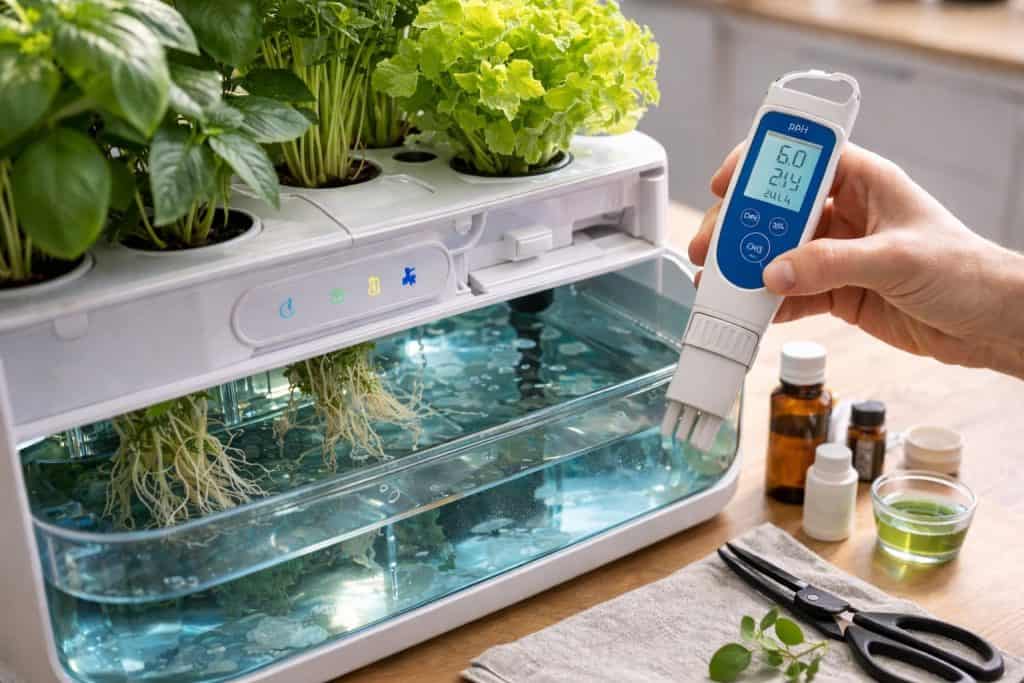
Hydroponic systems need regular maintenance. While the automation features of many systems can simplify the process, it is essential for users to understand the importance of regular maintenance to ensure the longevity and productivity of their hydroponic garden.
Pumps run constantly and often fail after 1–2 years. To prevent this, it is recommended to inspect the pump regularly and replace it if necessary, as the constant operation can lead to wear and tear over time.
Another key consideration is the degradation of LED grow lights over the years. LED grow lights slowly lose strength, which reduces plant growth over time. Monitoring the light levels and replacing the LED panels as needed can help maintain optimal growing conditions.
Water chemistry matters. pH, EC, and oxygen levels affect plant growth. Factors such as pH balance, electrical conductivity (EC), and oxygenation must be closely monitored and adjusted as necessary to ensure the plants are receiving the appropriate nutrients and growing conditions. Neglecting these aspects can lead to issues like root rot, algae growth, and nutrient deficiencies.
By understanding these long-term maintenance requirements and incorporating them into their gardening routine, regular maintenance keeps plants healthy and harvests consistent, maximizing the benefits of this innovative technology.
The Cost-Effectiveness of Indoor Hydroponic Gardens Depends on Scale and Use
For small countertop units, usually not. Spend 300 dollars to grow herbs and you will need many harvests to match store prices. The value often lies in freshness and convenience. And enjoyment. That counts for something.
CNN Underscored observes that an indoor hydroponic garden can serve as a pragmatic home investment, yielding fresh produce throughout the year and minimizing food waste.
Larger towers change the calculation. A 600 dollar system holding 30 plants spreads the cost across many harvests. Leafy greens offer the best return. One lettuce plant picked over several weeks can replace multiple store bought boxes.
Herbs like basil, cilantro, and dill also make sense. They spoil quickly at the supermarket. Growing them at home reduces waste.
| System Type | Initial Cost | Ongoing Costs | Typical Output | Cost Efficiency |
| Small Countertop (9–12 pods) | $150–$300 | Seed pods, nutrients | Herbs and small greens | Low (value mainly in freshness and convenience) |
| Large Countertop (15–21 pods) | $250–$400 | Pods, nutrients, occasional replacements | More frequent herb harvests | Moderate |
| Vertical Tower (30+ plants) | $400–$800 | Nutrients, electricity, routine maintenance | Weekly lettuce and leafy greens | Higher when used year-round |
Ongoing costs add up. Branded seed pods often cost between 2 and 5 dollars each. Some growers reuse pods with their own seeds and growing cubes. Nutrients are another repeat purchase. Most countertop systems use around 20–40 watts of power, typically adding about $2–$6 per month to electricity costs. Buying concentrated powders in bulk lowers the cost over time.
Electricity use for LED lights is modest. A few extra dollars per month in many cases. The real difference comes from consistency. For households that regularly buy fresh herbs, many systems recover their initial cost within 6–12 months compared to store purchases.
If the garden runs year round and replaces greens you buy every week, the math improves. If it sits empty for months, the cost per harvest stays high.
Key Factors to Consider Before Purchasing an Indoor Hydroponic System
Start with space. A countertop unit needs a stable surface and an outlet. Keep it away from strong heat or cold drafts. A tall tower needs ceiling height. Plants grow upward. They need room.
Then think about what you actually eat. If you mostly cook with herbs, a simple pod system is enough. If you want strawberries or peppers, choose a system built for fruiting plants. Many smaller models cannot support that weight or height.
Be honest about maintenance habits. Some systems connect to apps and send reminders. Rise and AeroGarden offer those features. Manual systems require you to test pH and nutrient levels each week. They cost less. They demand more attention.
You can add simple upgrades. An aquarium air stone increases oxygen in the water. In warm rooms, a water chiller helps keep temperatures stable. Some growers connect plants to a small fish tank in an aquaponics setup, where fish waste feeds the roots. It sounds ambitious. It can work.
Hydroponics rewards observation. Small adjustments. Regular checks. If you enjoy tending plants, even indoors, this can be satisfying. If you want something you never think about, it may feel like one more chore. And that feeling matters.
Best Indoor Hydroponic Systems by User Type
If you are comparing options, the right system depends less on features and more on how you plan to use it. Here is a quick guide based on real usage patterns.
Best for beginners:
AeroGarden Bounty or Click and Grow Smart Garden 9
These systems require minimal setup and provide reliable results for herbs and small greens.
Best for small apartments:
Click and Grow Smart Garden or iDoo
Compact footprint and low water volume make them easier to manage in tight spaces.
Best value for higher capacity:
LetPot LPH-Max
With up to 21 pods, it offers one of the highest plant counts in the countertop category.
Best for weekly salads and larger harvests:
Lettuce Grow Farmstand
Designed for higher output and scalable production of leafy greens.
Best for long-term scaling and modular growth:
Rise Gardens
Modular design allows expansion over time as your needs increase.
Choosing based on your actual eating habits and available space usually matters more than choosing the most advanced system.
| Your Situation | Recommended System Type | Why |
| Limited kitchen space | Small countertop unit | Compact and easy to manage |
| Mostly growing herbs for cooking | Pod-based countertop system | Designed for small, frequent harvests |
| Want weekly salads for a household | Vertical tower system | Higher plant capacity and yield |
| Planning to grow fruiting plants (tomatoes, peppers, strawberries) | Modular or vertical system | Supports plant height and weight |
| Prefer minimal maintenance | App-enabled automated system | Provides reminders and easier monitoring |
| Comfortable with manual care | Basic manual system | Lower cost but requires regular checks |
FAQs
What should beginners know before buying an indoor hydroponic system?
Beginners should choose an indoor hydroponic system that includes LED grow lights, an automated watering system, and clear setup guidance. A beginner hydro kit or countertop herb garden is ideal for apartment hydroponics because it saves space.
Check the water reservoir size, maintenance ease, and availability of seed pod replacement. Learn basic soil-free gardening, including pH balance hydro and proper hydroponic nutrients management.
How do I increase hydroponic vegetables yield at home?
To increase hydroponic vegetables yield, provide strong full spectrum LED lighting instead of relying only on purple grow lights. Monitor nutrient strength using an EC meter hydroponics tool and maintain proper pH balance hydro levels.
In deep water culture or DWC hydroponics, ensure proper air stone oxygenation and stable reservoir temperature. Regular pruning hydro plants and tracking harvest time hydro improve yield per plant and overall ROI hydroponics.
How can I prevent root rot and algae in DWC systems?
Root rot prevention in deep water culture requires consistent oxygen supply and clean equipment. Use air stone oxygenation and perform regular airstone maintenance. Maintain stable reservoir temperature and prevent seedling drowning by keeping roots submerged with oxygenation.
For algae control hydro, block light from reaching the nutrient solution. Some growers apply hydrogen peroxide hydro carefully to manage bacterial issues DWC.
Is vertical hydroponics suitable for small apartments?
Vertical hydroponics is highly suitable for apartment hydroponics because it creates a space saving garden. An advanced hydro tower or modular hydro system allows vertical hydroponics expansion without occupying large floor areas.
Systems that use nutrient film technique or an NFT system efficiently support lettuce indoor growth and basil hydroponic yield. An aeroponics tower also supports dense planting in limited spaces.
What maintenance problems should I expect long term?
Long-term maintenance may include pump failure hydroponic issues, so inspect pumps regularly to avoid burnout. Monitor pH balance hydro and refill hydroponic nutrients as plants grow. Check water reservoir size and clean it routinely to prevent bacterial issues DWC.
In pod hydroponic garden setups, replace seed pods when needed. Practice pest management indoors to control aphid hydroponic problems and use a fungus gnat trap when necessary.
Indoor Hydroponic Gardens: What Actually Makes Them Worth It
You buy an indoor hydroponic garden expecting easy harvests, but the reality shows up fast. Pumps run all day, water levels drop, and pH drifts when you ignore it for a week. Plants react quickly, sometimes overnight. It can feel like a small science project sitting on your kitchen counter.
Still, when you choose the right setup for how you actually cook, it becomes much more rewarding. If you want simple herbs, a small countertop system from brands like AeroGarden or Click and Grow can do the job without taking over your kitchen. Pick the system that fits your space and habits, then the harvests start to make sense.
References
1. https://www.usda.gov/farming-and-ranching/agricultural-education-and-outreach/urban-agriculture-and-innovative-production
2. https://www.miilkiiagrow.com/blog/top-hydroponic-grow-lights-for-indoor-plant-growth/
Related Articles
- https://tophydroponicgarden.com/indoor-hydroponic-kits/
- https://tophydroponicgarden.com/best-indoor-hydroponic-kits/
- https://tophydroponicgarden.com/top-5-home-hydroponic-kits/
Was this helpful?
