

Credit: Unsplash.com (Photo by laura s)
Getting pH right in hydroponics isn’t rocket science, but it sure feels that way sometimes. Those stubborn numbers bounce around like a kid after too much sugar, throwing nutrient absorption into chaos just when plants need stability the most, especially since low pH can significantly reduce uptake of nitrogen, phosphorus, potassium, calcium, and magnesium (1).
One grower even reported pH dropping from 6.0 to 4.1 within five days, even though EC stayed constant, causing repeated interventions. Most growers learn this the hard way. You can’t just set it and forget it. Between the roots doing their thing and bacteria throwing their own little party in the reservoir, pH levels shift faster than anyone would like. Reducing pH swings in hydroponics comes down to consistent tweaks backed by some basic know-how about what makes pH tick.
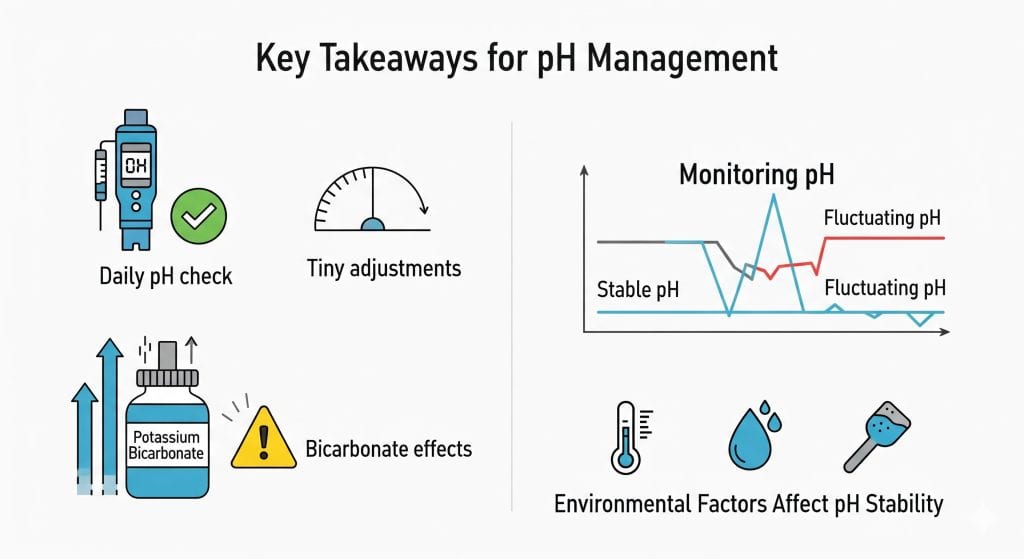
Key Takeaways
- Check that pH meter daily and make tiny adjustments. Way better than waiting for things to go sideways
- Bicarbonates (e.g., potassium bicarbonate) increase alkalinity and can help reduce pH swings.But they also tend to raise pH. Add slowly and monitor, because too much buffering or buildup can cause precipitation and nutrient issues.
- Room temp, what’s in your water, even how you mix nutrients. It all adds up to steadier pH readings
Keeping Those pH Numbers Where They Should Be
Look, nobody’s excited about checking pH levels every morning, but it’s like brushing your teeth, skip it and you’ll regret it. A decent pH meter (not those cheap yellow ones from Amazon) shows you what’s really going on before your plants start complaining.
Most people rush in with pH adjusters like they’re putting out a fire, dumping in way too much and watching the numbers swing back and forth. Not smart.
Here’s what actually works: tiny adjustments, maybe a few drops at a time.Takes longer? Sure. But your plants won’t freak out from sudden changes. Plus you won’t waste time fixing problems you created by being impatient.
Speaking of meters, they lie sometimes. Well, not exactly lie, but they drift off course if you don’t calibrate them. Every few days, dip that probe in some calibration solution (costs like $10 for a bottle that’ll last months). Trust me, it’s cheaper than replacing dead plants because your meter was off by 0.5.
Most crops like their pH between 5.5 and 6.5. Kind of like Goldilocks, not too high, not too low. Let it drift past those numbers and watch your plants struggle to eat properly. Nobody wants that.
Using Buffers to Keep pH in Check
Think of buffers like shock absorbers for your nutrient solution, helping with pH stability. Potassium bicarbonate’s probably the go-to – it’s not just keeping things stable, it’s feeding your plants potassium at the same time. Pretty neat trick. Add it slow though, you’re not seasoning soup here.
Some growers swear by calcium carbonate and magnesium sulfate too. They make your solution more stubborn about changing pH. It’s like adding weight to a boat, it takes more force to rock it. These minerals stick around, fighting off those wild pH swings that happen when roots get busy or bacteria decide to have a party in your reservoir.
But here’s the thing. Don’t get carried away. Too many buffers and you’ll end up with nutrient lockout or worse, gunky deposits in your lines (good luck cleaning that mess). Start small, maybe quarter-strength of what the bottle suggests, and watch how your system responds. Better to need a little more than deal with too much.
Getting Your Nutrient Mix Just Right

Dead spots in your nutrient tank are trouble waiting to happen. Mix that solution up. Get some air stones bubbling or give it a good stir every now and then. It’s like stirring a pot of soup, you don’t want all the good stuff sitting at the bottom while the top’s running thin.
That nutrient solution isn’t wine. It doesn’t get better with age. After a week or two, it’s time for fresh stuff. Plants are picky eaters, they’ll suck up some nutrients and ignore others, leaving you with this weird chemical soup that’s nothing like what you started with. Plus those microscopic bugs in there? They’re changing things up too.
Don’t cheap out with regular fertilizer thinking it’ll do the same job. Hydroponic nutrients are different. They’re built to play nice together and keep pH steady. Regular garden fertilizer in a hydro setup? That’s asking for pH numbers that bounce around like a ping pong ball. Stick with the right stuff, even if it costs a few bucks more.
What’s Really Going On With pH in Your Grow Room

credit: Kam Siu
Most folks running hydro setups don’t get what’s happening under the surface. There’s this constant give and take with pH that’s pretty wild when you think about it. Like some kind of invisible chemistry experiment that never stops.
The Environmental Stuff That Drives pH Crazy
Room temp’s a bigger deal than most people think. Keep it between 20 °C and 25 °C or 68 °F to 77 °F, or things get messy fast. In hydroponic setups, nutrient solution temperatures below 24 °C help maintain dissolved oxygen and prevent pathogen outbreaks, keeping pH more steady (2).
When it’s too warm, all those tiny bacteria, the mesophiles, really wake up. They thrive between 20 °C and 45 °C, accelerating metabolic activity that can trigger wild pH swings. And don’t even get me started about air circulation. Sure, everyone knows ventilation keeps things cool, but here’s what they don’t tell you.
Stale air in your grow room’s loaded with CO₂, and as it dissolves into your nutrient solution it forms carbonic acid. In real greenhouse studies, higher CO₂ levels didn’t directly shift pH significantly, but the chemistry is basic, CO₂ + water = H₂CO₃, which can lower pH if unchecked.
Working Smarter with pH Management
Nobody’s got time to babysit pH readings all day. That’s where knowing how to adjust pH in hydroponics and using smart systems comes in. Once you’re past a couple of plants, automation starts making a lot of sense. These systems are like having someone who never sleeps watching your nutrient levels.
The newer pH controllers are pretty slick. They’re adding tiny drops of pH up or down before things get out of whack. Way better than stumbling around half-asleep trying to adjust things by hand. Plus they keep track of everything, so when something goes wrong, you can figure out why.
Yeah, good controllers aren’t cheap. But lose one crop to pH problems and you’ll wish you’d spent the money sooner. Anyone growing more than just a couple plants should probably think about it. It’s not rocket science, but it matters. Get these environmental things under control, and your pH stays put. Happy pH means happy plants. Simple as that.
FAQ
How do I find the best ph and ideal range for hydroponics, and what happens to plant health or plant growth if the ph level, ph ranges, or ec and ph move away from the proper ph or desired ph?
The best ph for most hydroponic systems falls in an ideal range of about 5.5 to 6.5. Staying within this proper ph keeps nutrient uptake smooth so plants grow well. If ph ranges drift higher or lower, or if ec and ph are out of balance, roots may struggle to absorb key minerals. This often leads to slow plant growth, poor plant health, or even yellowing leaves. Keeping ph level close to the desired ph helps prevent these problems.
Why does ph drift or rapid ph changes happen in solution ph, and how can growers adjust ph, use ph buffers, or a ph adjuster like citric acid to stabilize ph, maintain ph balance, and keep the ph stable in real time?
ph drift and rapid ph changes happen when roots release acids or bases, when bacteria are active, or when nutrients break down in the water. To manage ph, growers can adjust ph slowly, use ph buffers, or add a small amount of a ph adjuster like citric acid. These steps help stabilize ph and maintain ph balance. A steady check in real time, either by simple tools or monitoring systems, helps keep the ph stable without sudden swings that stress plants.
What’s the difference between ph meters, ph paper, test kits, or a ph test kit when I test ph or do ph testing, and how often should I check ph or manage ph testing to get a correct ph reading for specific ph control?
ph meters give real time digital readings and are great for managing ph daily. ph paper and test kits are less precise but fine for small scale systems. A ph test kit usually combines liquid drops or strips for a quick view of solution ph. To get a correct ph reading, check ph often—ideally once a day in active systems. Regular ph testing helps you spot shifts early and keep solution ph within the specific ph range that supports healthy plants.
Can low ph or higher ph in ro water, plain water, or water ph affect ph balance, and what is the safest way to lower ph or lower the ph with a small amount of citric acid or other ph adjuster without causing root damage?
Yes, both low ph and higher ph can throw off ph balance, especially in ro water or plain water since they have less buffering power. To lower ph safely, use a small amount of citric acid or another gentle ph adjuster. Always add slowly, mix well, and recheck the water ph before adding more. Moving ph too quickly can cause root damage or shock. The goal is to lower the ph gradually until it sits in the optimal ph range without stressing the plants.
How do low ec, desired ec, ec meter readings, or wide range ph ranges affect plants grow in small scale systems, and what role does cal mag, water level, or ph and ec management play in preventing root rot while keeping stable ph?
Low ec means fewer nutrients, while a desired ec keeps feeding balanced. Using an ec meter helps track these levels along with ph control. If wide range ph ranges go unchecked, nutrient uptake suffers and plants grow poorly. Adding cal mag can support plant health when deficiencies appear. Water level management matters too—stagnant water can invite root rot. In small scale systems, combining good ph and ec management with steady monitoring helps prevent disease and keeps stable ph, giving roots the best environment to thrive.
How does the ph of your water, water source, and water quality affect ph in hydroponics, and why should growers check the ph and monitor the ph levels regularly to avoid ph imbalances and ph fluctuations?
The ph of your water depends a lot on the water source and overall water quality. Poor balance can affect ph in hydroponics, leading to ph imbalances or ph fluctuations that stress plants. When you check the ph and monitor the ph levels regularly, you catch small shifts early. This makes it easier to keep the ph of your water within the desired range, giving hydroponic plants steady access to nutrients and protecting them from sudden swings that slow growth.
Why do hydroponic setups like water culture or ebb and flow systems experience ph fluctuations over time, and how can buffering capacity or a buffer solution help maintain optimal hydroponics ph and ensure optimal plant performance?
In hydroponic setups such as water culture or ebb and flow, roots and microbial activity change the water chemistry, causing ph fluctuations over time. This can throw hydroponics ph off balance and affect how well plants absorb nutrients. Adding buffering capacity through a buffer solution helps maintain optimal ph stability. Keeping ph close to the desired range makes it easier to ensure optimal nutrient use, which supports plant performance and reduces stress on the system.
What role does adjusting ph, using ph down solutions like phosphoric acid, or adjusting the ph with reverse osmosis water play in ph management, and how do cannabis growers or leafy greens avoid stunted growth?
Adjusting ph is part of everyday ph management. Growers often use ph down solutions such as phosphoric acid, or rely on reverse osmosis water for a clean start. By carefully adjusting the ph, both cannabis growers and those raising leafy greens can keep nutrient solutions in the optimum range. Without control, plants risk stunted growth and weaker yields. Steady ph management makes it easier to match the nutrient ratio to each growth phase, keeping hydroponic plants thriving.
How do testing equipment like an electronic ph meter or a liquid ph test help in adjusting the ph, and why is understanding ph, testing equipment, and adjusting the ph so important for healthy growth in a hydroponic system?
Testing equipment matters in every hydroponic system. An electronic ph meter gives fast readings, while a liquid ph test offers a simple way to check the ph. Both help when adjusting the ph to avoid swings. Understanding ph and knowing how to use testing equipment keeps the hydroponics ph within the optimum range. This balance supports healthy growth, improves ion availability, and lets hydroponic plants absorb nutrients more efficiently. The better you test and adjust, the stronger the plants thrive.
Conclusion
You know what? There’s no magic trick to keeping pH perfect. Plants do their thing, bacteria do theirs, and that’s just how it goes. Your job isn’t to stop it completely. Just keep those swings tiny enough that your plants shrug them off.
Some days you’ll check those numbers and wonder why you bothered. Do it anyway. A good buffer here, decent environment control there, and maybe automation if you’re past the hobby stage. Whatever works.
Real talk though. Your pH meter’s probably sitting somewhere getting crusty right now. Go grab it. Seriously. Give it a good cleaning, because we both know it needs it. And while you’re at it, find an old notebook. Nothing special, just something to track those daily numbers. Next time you mix up nutrients, throw in a pinch of potassium bicarbonate. Not much. Just enough.
Simple stuff. But it works. And isn’t that what matters? Watch your plants perk up in a couple weeks. They’ll tell you if you’re doing it right.
Related Articles
- https://tophydroponicgarden.com/ph-adjusters/
- https://tophydroponicgarden.com/hydroponic-ph-stability-tips/
- https://tophydroponicgarden.com/how-to-adjust-ph-in-hydroponics/
References
- https://cdnsciencepub.com/doi/10.1139/cjps-2023-0034
- https://en.wikipedia.org/wiki/Deep_water_culture
Was this helpful?

I’m Barrie L., a passionate hydroponic gardening enthusiast dedicated to cultivating thriving, soil-less gardens. With a focus on all things hydroponic, I share my expertise on innovative growing techniques and sustainable practices through my blog, tophydroponicgarden.com. As a seasoned hydroponics specialist, my goal is to inspire and guide fellow gardeners in harnessing the power of water-based cultivation for bountiful and eco-friendly harvests. I’m also an author of the book “Hydroponics For Absolute Beginners: Your Step By Step Guide For How To Create An Hydroponics System At Home Without Soil, For Growing Vegetable, Fruit And Herbs.” which is sold on Amazon. Join me on a journey of redefining the way we cultivate plants, one nutrient-rich solution at a time. Happy growing!