

Lettuce needs the right pH to take up nutrients and grow well. Soil lettuce prefers a pH between 6.0 and 6.5, while hydroponic lettuce does best around 5.5 to 6.5. Because lettuce grows fast and has shallow roots, it’s very sensitive to pH changes.
When pH moves too far out of range, the plant can’t absorb key nutrients, which leads to issues like weak leaves and tipburn. Whether you’re growing romaine or butterhead, keeping pH right helps your lettuce stay healthy and produce better yields. Want to learn the best pH targets and how to avoid common problems? Keep reading.
Quick Greens: The Lettuce pH Cheat Sheet
Getting crisp, heavy heads of lettuce comes down to keeping your root zone in a stable chemical sweet spot whether you grow in backyard dirt or indoor water loops.
- Hit the soil sweet spot: Keep your soil pH between 6.0 and 6.5 so your lettuce can easily drink up all its essential nutrients.
- Dial in your hydroponic water: Aim for a pH between 5.5 and 6.5 in water systems, though many growers target 5.8 because it often supports consistent nutrient uptake and healthy growth.
- Stop chasing perfect numbers: Focus on keeping things stable rather than constantly dumping in adjusters to chase an exact decimal point all season long.
Optimal Lettuce pH Ranges for Soil and Hydroponic Systems
Lettuce grows best within slightly different pH ranges depending on whether you grow it in soil or a hydroponic system.
Soil-grown lettuce generally performs well when soil pH remains between 6.0 and 6.8. In hydroponic systems, growers usually aim for a pH between 5.5 and 6.5, with many targeting 5.8 to 6.0 for steady nutrient uptake.
Soil vs. Hydroponic Lettuce pH Requirements
| Growing Method | Recommended pH Range |
| Soil-grown lettuce | 6.0-6.5 |
| Commercial soil production | 6.0-6.8 |
| Hydroponic lettuce | 5.5-6.5 |
| Common hydroponic target | 5.8-6.0 |
Butterhead, romaine, and leaf lettuce all prefer similar pH conditions. Most varieties handle small fluctuations without major problems.
The difference between soil and hydroponic recommendations comes down to how nutrients behave. Soil contains organic matter and microorganisms that help buffer pH changes. Hydroponic nutrient solutions react much faster, so pH tends to shift more easily.
Understanding this difference makes it easier to interpret lettuce pH charts and choose the right target for your growing method. Many growers start by establishing the ideal hydroponic range before fine tuning their lettuce-specific nutrient program.
How Nutrient Availability Changes Across pH Levels

pH affects how easily lettuce roots absorb the nutrients needed for healthy growth.
As noted by Cornell University,
“Soil pH of 6.5 is usually considered optimum for nutrient availability.” –Cornell University.
Nutrient availability changes significantly as pH moves outside the optimal range. When pH becomes too high or too low, lettuce may struggle to absorb key nutrients, leading to deficiency symptoms even when nutrients are present in the growing medium.
Even when nutrients are present, lettuce may struggle to use them if pH falls outside the recommended range.
Nutrients influenced by pH include:
- Nitrogen
- Phosphorus
- Potassium
- Calcium
- Magnesium
- Iron
- Manganese
Common signs of pH problems include:
- Yellowing leaves
- Tip burn
- Slow or stunted growth
- Pale foliage
- Poor head formation
High pH levels can limit iron uptake, causing young leaves to turn yellow while older leaves stay green. Very low pH levels may allow some micronutrients to build up to harmful levels.
Low temperatures can slow transpiration and reduce calcium movement, increasing the risk of tip burn.
High temperatures can also interfere with calcium transport and contribute to tip burn, even when pH remains within the recommended range.
Why “Good Enough” pH Often Beats Chasing Perfection
Keeping pH within a healthy range matters more than trying to maintain the exact same number every day.
Why Stability Matters More Than Precision
Many hydroponic growers report excellent results when they allow pH to move naturally between 5.5 and 6.5 instead of constantly adjusting it to 5.8. Minor fluctuations between 0.2 and 0.5 points within this range are normal and can even help plants access different nutrients more efficiently.
Common beginner mistakes include:
- Adjusting pH several times a day
- Focusing only on meter readings
- Ignoring how plants actually look
- Correcting small changes that do not need fixing
Experienced growers often give the same advice: pay attention to your plants, not just the numbers.
Lettuce does not require perfect pH management to grow well. Stable conditions and regular monitoring usually lead to better results than chasing exact measurements. In most cases, consistency matters more than precision.
How Should You Test and Monitor Soil pH for Lettuce Throughout the Season?
Test your soil before planting lettuce and check it regularly throughout the growing season to catch problems early.
Soil testing schedule depends on fertilizer use and growing intensity: Before planting: Test baseline pH (required).
Every 45-60 days: Monitor pH drift during season. Frequency justification: Ammonium-based fertilizers can gradually lower soil pH over time, making periodic testing important.
Without testing, pH can drop from 6.5 to 5.5 in 6 months undetected. Higher-nutrient soils test every 30 days; low-input organic systems test every 60 days
Common testing methods include:
- Digital soil pH meters
- Soil testing kits
- Laboratory soil analysis
- pH test strips
To get more accurate results:
- Collect samples from several spots in the growing area.
- Mix the samples into one composite sample.
- Use the same sampling depth each time.
- Avoid testing right after applying fertilizer.
Checking soil pH before planting gives you time to make adjustments before nutrient deficiencies affect growth. Regular monitoring also helps you spot gradual changes in soil acidity before they start reducing lettuce quality and yields.
Soil pH Correction Methods and Application Rates for Lettuce
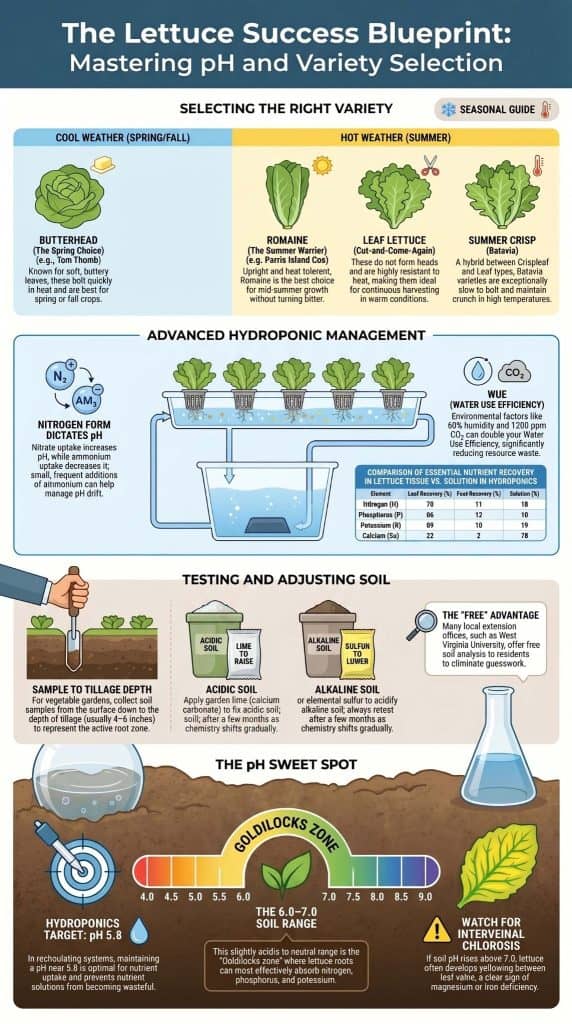
Use lime to raise low soil pH and sulfur-based products to lower high soil pH. Whenever your soil pH drops below 5.0, your lettuce plants immediately struggle to absorb nutrients efficiently.
Fixing this acidic imbalance right away unlocks the soil chemistry, ensuring the plant roots can easily drink up all the essential food they need to grow plush and healthy.
To raise acidic soil pH:
- Apply agricultural lime.
- Use dolomitic lime if your soil also needs magnesium.
- Choose calcitic lime when additional calcium is preferred.
- Add compost to improve soil buffering capacity.
To lower alkaline soil pH:
- Apply sulfur-based amendments gradually.
- Increase organic matter in the soil.
- Retest the soil 3 to 4 weeks after application to track changes
Materials such as compost and peat moss can influence soil pH over time. Unlike hydroponic systems, soil pH changes slowly. Be patient and avoid making large corrections all at once. Small adjustments followed by retesting usually produce better long-term results.
Long-Term Fertilizer Use and Soil Acidification Risks
Repeated applications of ammonium-based nitrogen fertilizers can slowly lower soil pH and make it harder for lettuce to absorb nutrients.
As the University of Maryland Extension explains,
“Fertilizers, whether commercial or from manure sources, will not be effective if soil pH isn’t managed.” –University of Maryland Extension.
This process often happens gradually, making it easy to overlook until plants begin showing signs of stress. Starke Ayres identifies long-term fertilizer use as a common cause of increasing soil acidity in commercial lettuce production.
Warning signs of soil acidification include:
- Lower yields
- Ongoing nutrient deficiencies
- Reduced calcium uptake
- Increased disease pressure
- Poor root development
Adding more fertilizer rarely fixes the real problem if soil pH is out of balance. Regular soil testing and occasional liming help maintain stable growing conditions and support healthy plant growth.
Ignoring long-term pH trends can lead to recurring issues that become harder and more expensive to correct over time.
How Often Should You Check Hydroponic Lettuce pH by System Type?
The ideal testing schedule depends on your hydroponic system and how stable your water conditions are.
Systems with recirculating nutrient solutions usually require more frequent monitoring because pH can shift quickly. Smaller reservoirs under 20 gallons (75 liters) experience faster chemical shifts than larger commercial systems.
Recommended Testing Frequency by System Type
| System Type | Monitoring Frequency |
| Kratky | Initial setup and occasional checks |
| Deep Water Culture (DWC) | Daily |
| NFT | Daily |
| Aeroponics | Daily |
| Recirculating systems | Several times per week |
| Drain-to-waste systems | Before each feeding |
Why Regular Monitoring Matters
Keeping a simple pH log helps you notice trends before they turn into nutrient problems. Monitoring top-off water is also important because replacement water can gradually shift reservoir pH.
Frequent testing does not mean making constant adjustments. In many cases, watching for steady trends and making small corrections only when needed leads to healthier lettuce and more stable growth. Accurate nutrient solution testing also makes it easier to spot gradual changes before they affect nutrient uptake or plant health.
What’s the Safest Way to Adjust Hydroponic Lettuce pH Without Shocking Roots?
Use commercial pH products gradually and retest after each adjustment to avoid stressing your lettuce.
Most hydroponic lettuce grows well with a pH between 5.5 and 6.5, with many growers aiming for 5.8 to 6.0. These values generally fall within the recommended range for leafy vegetables.
Large, sudden pH changes can shock roots and interfere with nutrient uptake. Making small adjustments gives the system time to stabilize and helps you avoid overcorrecting.
A good habit is to check pH after mixing nutrients rather than adjusting plain water first. Nutrients themselves can shift pH significantly. If you need to make changes, work slowly and allow the reservoir to circulate before testing again.
Safe adjustment steps include:
- Mix nutrients completely before testing.
- Measure pH after nutrients are added.
- Add small amounts of pH adjusters.
- Let the solution circulate for 15-30 minutes.
- Retest pH before making further changes.
- Repeat only if needed.
To raise pH:
- Potassium hydroxide products (pH Up)
- Potassium carbonate products
To lower pH:
- Phosphoric acid products
- Nitric acid products
- Sulfuric acid formulations
Some home growers use citric acid or baking soda, but commercial products usually provide more stable and predictable results over time.
Why gradual adjustments matter
Lettuce responds best to stable conditions. A rapid jump exceeding 1.0 pH point within a 12-hour window stresses roots more than a slightly imperfect but steady pH level. Small corrections help maintain nutrient availability and reduce the risk of pH shock.
Why Does Water Alkalinity Make Lettuce pH Control So Difficult?

Credits : Kam Siu
High alkalinity can make pH management frustrating because the water naturally pushes pH back upward after adjustments.Many growers focus only on pH readings without realizing that alkalinity tells a different story.Alkalinity measures water’s buffering capacity in mg/L CaCO₃.
Low-alkalinity water may allow pH to fluctuate more easily, while high-alkalinity water often resists pH adjustments and causes pH drift.
High bicarbonate (typical cause) at >150 mg/L makes pH control frustrating. This explains why two reservoirs with the same pH reading can behave very differently. One may stay stable for days, while the other quickly drifts upward.
Important concepts to understand:
- pH measures how acidic or alkaline the water is.
- Alkalinity measures how strongly the water resists pH changes.
- High bicarbonate levels often cause recurring pH drift.
- Testing alkalinity can reveal hidden water quality issues.
Ways to manage high-alkalinity water include:
- Using reverse osmosis systems
- Acidifying stock solutions when appropriate
- Running a complete water analysis
- Switching to a different water source if needed
Many growers find that once they address alkalinity, maintaining stable pH becomes much easier.
Why pH keeps bouncing back
If you constantly lower pH only to see it rise again a day later, alkalinity is often the reason. Addressing the source of the problem is more effective than repeatedly adding pH-down products.
Why Is Reservoir pH Different From Root-Zone pH in Hydroponic Systems?
The pH in your reservoir does not always match the conditions surrounding the roots.
Roots actively absorb nutrients and release compounds that change the chemistry in the immediate root zone. Microbial activity and nutrient uptake can also shift local pH levels throughout the day.
In some hydroponic systems, root-zone pH may differ slightly from reservoir pH due to nutrient uptake and microbial activity.
Understanding this difference can prevent unnecessary adjustments. Constantly chasing an exact reservoir number may create more instability than allowing small fluctuations.
Rather than focusing on a single reading, monitor overall plant health. Healthy roots, steady growth, and good leaf color often indicate that pH is within an acceptable range.
Focus on the plant, not just the meter
Meters provide useful information, but plants tell the full story. If lettuce looks healthy and grows well, slight pH variations may not require immediate correction.
Environmental Factors Beyond pH: EC, Heat, and Tip Burn
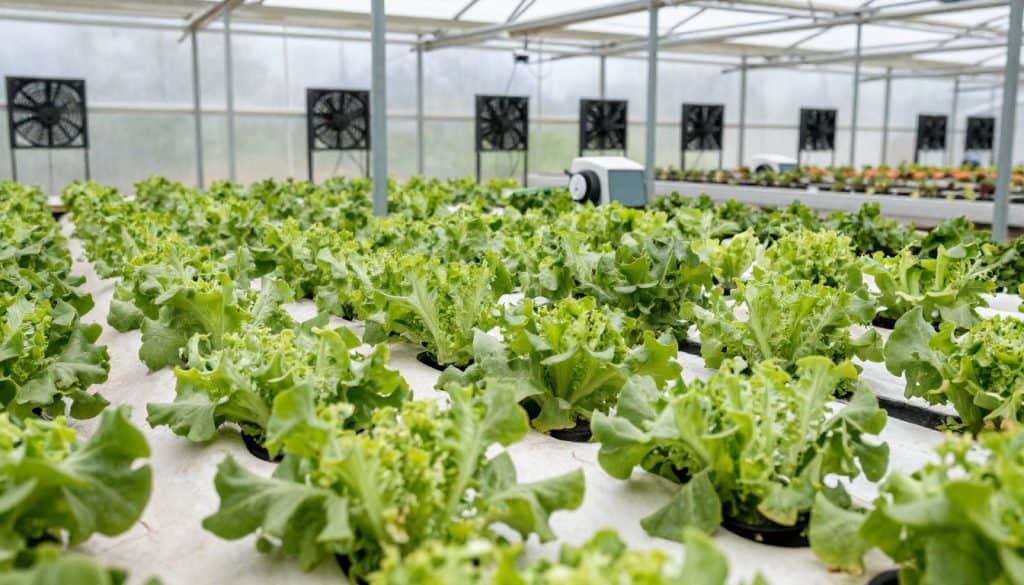
Not every lettuce problem comes from pH. Environmental conditions often play an equally important role.
Many growers blame pH first when they notice tip burn or slow growth. In reality, EC values above 2.0-2.5, water temperatures exceeding 75°F (24°C), and poor airflow commonly contribute to these issues.
EC levels directly impact tip burn risk: Below 1.2 EC: Nutrient deficiency risk increases. 1.2-1.8 EC: Optimal for lettuce (0-5% tip burn). 1.8-2.2 EC: Elevated EC levels can increase plant stress and contribute to tip burn, especially when combined with high temperatures and poor airflow.
Heat affects transpiration, which influences calcium movement within the plant. When calcium cannot reach developing leaves efficiently, tip burn may appear even if nutrients are present.
Common causes of lettuce problems beyond pH
| Factor | Potential Impact |
| High EC | Nutrient stress |
| Heat stress | Increased tip burn risk |
| Poor airflow | Reduced transpiration |
| Limited calcium movement | Internal leaf damage |
Other factors worth evaluating include:
- Root health
- Water temperature
- Air circulation
- Nutrient strength
- Microbial activity around roots
Before adjusting pH repeatedly, look at the entire growing environment. Often, fixing airflow or reducing EC solves the problem faster.
Why tip burn still happens with “perfect” pH
A reservoir with ideal pH cannot overcome poor environmental conditions. Stable temperatures, good airflow, and balanced nutrients work together to support healthy lettuce growth.
Do Different Lettuce Varieties Require Different pH Management Strategies?
Most lettuce varieties grow well within the same general pH range, although some tolerate challenging conditions better than others.
Research indexed by FAO AGRIS suggests that choosing the right cultivar can make crop management easier, especially when dealing with difficult water conditions.
General pH recommendations include:
- Butterhead lettuce: 5.5-6.5
- Romaine lettuce: 5.8-6.5
- Crisphead lettuce: 5.5-6.2
- Loose-leaf lettuce: 5.5-6.5
The differences are relatively small. Most home growers do not need separate nutrient programs for each lettuce type. Instead, maintaining stable conditions within the recommended range usually produces good results.
If your water source stays above pH 7.5, selecting heat-tolerant and tipburn-resistant cultivars may reduce the need for constant adjustments.
Variety choice can make management easier
Some cultivars adapt better to less-than-ideal conditions. Choosing varieties known for resilience may save time and reduce frustration, especially for beginners.
What pH Monitoring Tools Work Best for Home and Commercial Lettuce Growing?
You do not need expensive equipment to maintain proper pH. Reliable tools and regular maintenance matter more than price.
Many home growers achieve excellent results with basic digital pH meters. The key is calibrating them regularly and storing them properly between uses.
Beginner-friendly pH monitoring tools
| Tool | Accuracy | Best For |
| pH test strips | Moderate | Beginners |
| Liquid pH kits | Moderate | Occasional testing |
| Digital pH meters | High | Frequent growers |
Important maintenance practices include:
- Calibrating your meter regularly
- Using pH 4.0 and pH 7.0 buffer solutions
- Performing two-point calibration
- Cleaning the probe as recommended
- Storing probes in storage solution
- Using meters with automatic temperature compensation when possible
Advanced growers may eventually add automated pH controllers and dosing systems, but they are not essential for success.
Consistent measurements lead to better decisions
Even a simple pH pen can produce reliable results when used correctly. Checking pH regularly helps you spot trends early and make adjustments before plants show signs of stress.
FAQ
How do you balance the reservoir water when mixing fresh nutrients for seedlings?
You must adjust your water after you completely mix your nutrients into the reservoir. For young plants, you should maintain a seedling pH range between 5.5 and 6.0.
Because high alkalinity water can distort your readings, you must test your source water first. Mix the plant food, let it circulate, and use your digital pH meter lettuce tool to get a clean baseline.
What should you do when your recirculating system experiences rapid daily reservoir pH drift?
You should clean out your nutrient tank completely to stop organic slime from growing. These quick shifts happen when your nutrient strength EC vs pH levels become unbalanced or when your roots feed heavily.
You need to check your digital pH meter lettuce readings daily. Practice pH shock prevention by making small, gradual changes instead of dumping in huge doses of adjusters.
Why do the edges of my butterhead lettuce leaves look burnt and dry?
This issue points directly to tipburn pH problems, which occur when bad acidity levels cause a calcium deficiency lettuce block.
Even if calcium is present in your water, the wrong lettuce pH range stops your plants from absorbing it. You must keep your setup near a pH 5.8 lettuce target and run a fan to help the leaves breathe.
How can you fix yellowing leaves caused by iron deficiency high pH levels?
When your water drifts above 6.5, you trigger chlorosis pH problems because your plants cannot absorb iron.
This high alkalinity also ruins your phosphorus availability pH levels. To fix the yellow leaves, you should use a liquid pH kit to double-check your tools, and then lower your water back down to an optimal pH leafy greens target.
How do you properly prepare and condition rockwool cubes before planting lettuce seeds?
Raw rockwool is naturally alkaline and will ruin your seedling pH range if you skip the preparation step.
You need to manage rockwool pH buffering by soaking your new cubes in water treated with phosphoric acid lettuce adjusters until the water hits a 5.5 rating. Let the cubes sit overnight, and remeasure pH after circulation to ensure they stay stable.
Keep Your Lettuce pH on Track for Better Growth
When lettuce grows outside the right pH range, it can struggle to absorb nutrients, leading to issues like tipburn, deficiency symptoms, and poor growth.
It happens more often than you might think. Aim for a soil pH of 6.0 to 6.5, while hydroponic systems work best between 5.5 and 6.5, with 5.8 to 6.0 being a reliable target.
You don’t need perfect numbers to grow healthy lettuce. Check pH regularly, make small adjustments when needed, and pay attention to how your plants respond. If you’re looking for extra guidance,
TopHydroponicGarden can help you manage your growing system with more confidence and support better results over time.
References
- https://courses2.cit.cornell.edu/cca/soilFertilityCA/CA5/CA57.html
- https://extension.umd.edu/resource/soil-ph-affects-nutrient-availability/
Related Articles
- https://tophydroponicgarden.com/accurate-ph-testing-for-hydroponics/
- https://tophydroponicgarden.com/safe-ph-levels-for-leafy-vegetables/
- https://tophydroponicgarden.com/what-is-a-good-ph-level-for-hydroponics/
Was this helpful?

I’m Barrie L., a passionate hydroponic gardening enthusiast dedicated to cultivating thriving, soil-less gardens. With a focus on all things hydroponic, I share my expertise on innovative growing techniques and sustainable practices through my blog, tophydroponicgarden.com. As a seasoned hydroponics specialist, my goal is to inspire and guide fellow gardeners in harnessing the power of water-based cultivation for bountiful and eco-friendly harvests. I’m also an author of the book “Hydroponics For Absolute Beginners: Your Step By Step Guide For How To Create An Hydroponics System At Home Without Soil, For Growing Vegetable, Fruit And Herbs.” which is sold on Amazon. Join me on a journey of redefining the way we cultivate plants, one nutrient-rich solution at a time. Happy growing!