

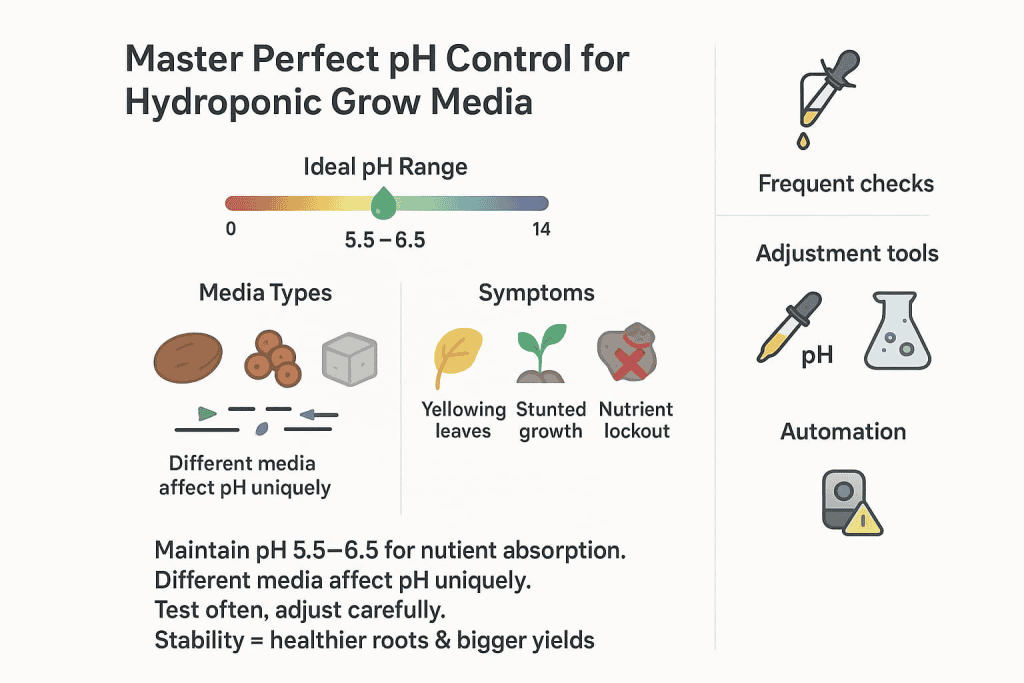
Most hydroponic growers don’t realize it, but pH control for hydroponic grow media can be the difference between thriving plants and a disappointing harvest. Those floating roots need the right acidic environment, usually between 5.5 and 6.5, to actually absorb the nutrients available around them.
It’s kind of like trying to eat soup with your hands tied behind your back if the pH is wrong. Your plants might look okay on the surface, but they’re probably starving underneath.
The crazy part? This whole nutrient lockout thing happens so gradually that by the time yellow leaves show up, plants may already have lost days to weeks of healthy growth, depending on crop and system size. Want to know the real tricks to keeping your pH perfect? Let’s get into it.
Key Takeaway
- Getting that sweet spot of 5.5 to 6.5 pH isn’t just a suggestion. It’s what makes or breaks nutrient absorption in your hydro setup
- Don’t cheap out on pH testing. Grab a decent meter and check often, making tiny tweaks instead of big swings
- Think ahead: pick the right grow media and add some pH buffers to keep things steady. Reducing pH swings early on can save your whole grow from unnecessary stress.
pH Control in Hydroponic Grow Media: Ensuring Optimal Nutrient Uptake
So here’s the deal with hydroponics. It’s all about control, but not in that obsessive way some growers get. The grow media (that stuff that holds your plants up) needs the right pH, or your plants are basically trying to drink a milkshake through a coffee filter.
You’d think just adding nutrients would be enough, but nope. The pH of whatever’s surrounding those roots determines if they can actually grab what they need. Kind of like trying to dissolve sugar in cold tea versus hot tea.
Sometimes the chemistry just doesn’t work unless conditions are right. Get the pH wrong, and those expensive nutrients might as well be floating right past the roots.
How Does pH Affect Nutrient Availability in Hydroponic Grow Media?
What is pH and Its Role in Hydroponic Systems?
Nobody really talks about pH until something goes wrong. Picture this. You’ve got a scale from 0 to 14, where 7 sits right in the middle. Anything below that’s acidic, above is alkaline.
Plants can be pretty particular about their sweet spot, usually wanting things between 5.5 and 6.5. That’s the range where most nutrients are best available in hydro systems.(1)
How Does pH Influence Nutrient Solubility and Uptake?
Here’s what’ll drive you crazy. Your plants might be swimming in nutrients but can’t use any of them because the pH is off. Take iron. It’s right there in the solution, but bump that pH too high and it turns into this useless form the roots can’t touch.
Calcium and magnesium pull the same tricks. Before you know it your plants look terrible, even though you’re feeding them exactly what they need. Growth crawls to a stop. Yields tank. And there you are at 2 AM, trying to figure out why your leaves look like they’ve got some weird disease.
What Are the Effects of pH Imbalance on Hydroponic Grow Media?
This stuff goes deeper than just nutrients. Wrong pH knocks out all those good bacteria that help break everything down. And man, different growing materials can really mess with you.
Peat moss? Coco coir? They’ve each got their own pH agenda. Skip keeping an eye on things and suddenly your water retention goes weird, plants start struggling. Trust me, watching your whole setup fall apart because pH went wrong… Rough stuff.
Look, it’s simple but not easy. Check your pH. Often. Because once things start going sideways, getting back on track is ten times harder than just staying on top of it from the start.
How to Maintain Optimal pH Levels for Different Hydroponic Crops and Growth Stages?

What is the Optimal pH Range for Most Hydroponic Plants?
Look, most growers overcomplicate this stuff. Keep your pH somewhere between 5.5 and 6.5, and you’ll be fine. Regular crops don’t ask for much. Your basic lettuce, tomatoes, cucumbers… they’ll grow just about anywhere in that range. But some specific plants like blueberries want it sour enough to make your face pucker.
How Does Plant Growth Affect pH Over Time?
Plants are quiet troublemakers with pH. Just sitting there, doing their thing, messing up your carefully balanced nutrients. They’ll suck up all the calcium and magnesium they can get, leaving behind this increasingly alkaline soup. Drives me nuts sometimes.
You better get used to adjusting pH regularly. Cause if you slack off, those plants will let you know. First the leaves start looking funny. Then growth slows down. Before you know it your whole crop’s suffering. Not fun.
How to Ensure Consistent pH Stability During Crop Development?
Baby plants don’t care much about perfect pH numbers. But something happens when they start flowering. Suddenly they’re all prima donnas about their growing conditions. Like they went off to college and came back with opinions about everything.
Everyone talks about automated controllers like they’re magic. Sure, they work pretty good. Usually. But I’ve seen too many crop tanks because somebody trusted the computer instead of their eyes. Keep that manual meter close. Trust your gut. Some things just work better the old way.
What Are Advanced Considerations and Common Challenges in pH Control for Hydroponic Grow Media?

credit: Proponics
How Do Different Growth Media Types Influence pH Management?
Every growing medium has its own personality. Coco coir seems friendly enough at first. Holds water great. But sometimes it’ll mess with your pH levels if you don’t treat it right first.
Clay pellets are inert, so they won’t buffer pH. That means your nutrient solution still needs regular checking, since the media won’t stabilize it. Rockwool starts alkaline and can interact with calcium and magnesium until conditioned. Always pre-soak in slightly acidic water before planting.
Gotta match your media to what you’re growing. And how much time you wanna spend checking pH. A smart move is soaking everything in slightly acidic water before you start. Saves you trouble later.
What Are Frequent pH-Related Issues Encountered by Hydroponic Growers?
Problems crop up fast when growers get lazy with measurements. Extension recommendations for circulating hydro systems are to check pH (and EC) daily. Skipping checks for just a couple of days can let gradual nutrient lockout develop.(2)
Often the water microbiology or water source compounds the problem, so test the reservoir and runoff regularly. Worst part is when pH swings kill off beneficial microbes and destabilize nutrient chemistry.
Also note that pH probes and electrodes drift over time, many manufacturers and lab sources recommend routine calibration (some growers calibrate daily; for continuous inline probes, monthly checks are common) and electrodes often last 12-18 months before replacement.
How Can Automation Improve pH Regulation in Hydroponic Systems?
Big operations need automation. Period. Having computers watch your pH beats checking everything by hand. Works great for those massive water systems where you’re dealing with hundreds of gallons.
But computers ain’t perfect. Sensors get weird. Pumps stop working right. Sometimes the whole system just decides to take a day off. That’s why smart growers always keep their old pH meters around. Technology’s great until it isn’t.
FAQ: pH control for hydroponic grow media
How does low pH or high pH in hydroponic grow media affect plants?
When the ph level drifts outside the proper ph range, plant roots struggle to take in nutrients. Low ph can create toxic conditions, while high ph often locks up key minerals. Both extremes can slow growth, reduce crop yield, and even cause root rot if ignored. Keeping a stable ph balance in the root zone helps plants grow stronger and healthier. Regular ph testing with a good ph meter or ph probe makes it easier to catch problems early.
What is the best way to test pH and EC levels in hydroponic systems?
Testing ph and ec often is a good idea since both affect nutrient uptake. You can test ph with a digital ph meter, ph paper, or test strips, while ec levels require an ec meter. Many growers use test kits to track water ph, solution ph, and medium ph together. For small scale setups, simple test strips or a litmus test can help. Larger systems benefit from digital ph meters and ec meters, which provide more accurate ph readings and desired ec ranges.
How do I adjust pH when my water tank drifts from the ideal range?
If the water ph in your water tank is outside the specific ph range, you’ll need to adjust ph carefully. To lower ph, use a mild ph adjuster like citric acid; to raise it, move acidic ph closer to neutral ph. Always make small changes, then test the ph again. The goal is to keep a stable ph that plants ph can handle. Using a ph buffer in solution ph helps maintain ph more evenly, especially in deep water setups.
What role do pH and EC play in keeping plant roots healthy?
Ph and ec work together in hydroponics. The correct ph helps plants grow by making nutrients available, while the desired ec shows how strong the nutrient mix is. High ec can burn roots, while low ec leaves them hungry. Ec and ph both guide the root zone balance, so it’s important to monitor ec levels and ph values together. Testing ph or ec with test kits keeps you within the ideal range. Stable ph and the right ec range both protect against root rot.
Can different grow media change the desired pH balance for plants?
Yes, the medium ph can shift the desired ph ranges. Some materials like rice hulls lean toward ph neutral, while others may pull the ph stable point down or up. Knowing the specific ph needs of your grow medium helps maintain ph balance and ensures plants ph stays healthy. A wide range of grow media can still support plants, but you need to test the ph often and keep ph readings close to the optimal ph. This makes it easier to maintain steady crop yield.
What is the best way to measure and monitor the pH in hydroponics?
Measuring ph often is a good idea since ph imbalances can lead to stunted growth and poor plant nutrient uptake. You can use a liquid ph test, ph adjusters, or even check the ph with simple methods that change color. Digital tools make ph reading easier to monitor the ph during every growth stage. Good water quality matters too, since hard water or low-quality water source can impact the ph. By combining ph management with ec measurement and ec management, you ensure plants receive the desired range for healthy plants and strong plant growth.
How do water systems and growing mediums influence pH management?
Different support systems like ebb and flow, drip systems, or nutrient film setups all impact the ph and water level differently. Inert mediums provide stability but need close ph management, while organic medium with plant material can cause sudden changes in ph. Coconut coir helps maintain healthy root zones, but it needs consistent monitoring. Good drainage in the growing mediums prevents root problems and ensures optimal plant health. Whether growing plants like leafy greens or tomato plant crops, the best hydroponic systems require steady ph balance to ensure plants grow in the optimum range.
What happens when you need to raise the pH or lower the pH quickly?
Sometimes water quality or sudden changes in the water source cause ph imbalances. You may need to raise the ph or lower the ph to reach the desired range. Adjust the ph slowly with safe ph adjusters like phosphoric acid, since quick swings harm healthy plants. A liquid ph test or digital ph reading helps you track changes in ph as they happen. Always monitor the ph closely during each growth stage, since even small shifts can affect plant nutrient uptake and stunted growth. Careful ph management keeps growing plants steady and loving plants thriving.
Why do pH imbalances affect plant nutrient uptake and crop yield?
Ph imbalances in growing media directly impact the ph of the root zone and water quality, which changes how plants receive nutrients. Without proper ph management and ec measurement, plants may suffer stunted growth or weak crop growth. A healthy root system in coconut coir, organic medium, or inert mediums depends on steady ph values within the optimum range. Good ph balance makes sure leafy greens, tomato plant crops, and other loving plants absorb plant nutrient solutions properly. Monitoring ph reading helps ensure optimal conditions so plants thrive, producing strong plant growth and healthy plants.
Conclusion
I swear people make pH control sound like brain surgery or something. It’s not. Just basic plant stuff really. Of course if you ignore it your garden turns into a mess real quick. Nothing worse than watching your plants slowly die because you got lazy with pH checks.
Get yourself a good meter. Not one of those twenty dollar specials from the garden store. Trust me on this one. Check it every morning, maybe while you’re waiting for breakfast. Adjust things if they look off.
Different growing stuff causes different problems… rock wool does its own thing, clay pellets another. Some folks love their fancy pH computers. Whatever. Unless you’re running acres of hydro, stick to the basics.
You really wanna grow something special? Then actually pay attention. Keep a notebook. Watch your plants. They’ll tell you when something’s wrong if you bother looking. Sometimes the tiniest pH changes make the biggest difference. Seriously. Takes practice though. And patience.
God knows I killed enough plants learning this stuff. But once you figure it out… man. Nothing better than walking into your grow room and seeing everything just thriving. Perfect.
Related Articles
- https://tophydroponicgarden.com/adjusting-ph-for-hydroponic-herbs/
- https://tophydroponicgarden.com/hydroponic-ph-ranges-for-specific-plants/
- https://tophydroponicgarden.com/reducing-ph-swings-in-hydroponics/
References:
- https://ucanr.edu/site/uc-master-gardeners-orange-county/hydroponics-orange-county
- https://extension.okstate.edu/fact-sheets/electrical-conductivity-and-ph-guide-for-hydroponics.html
Was this helpful?

I’m Barrie L., a passionate hydroponic gardening enthusiast dedicated to cultivating thriving, soil-less gardens. With a focus on all things hydroponic, I share my expertise on innovative growing techniques and sustainable practices through my blog, tophydroponicgarden.com. As a seasoned hydroponics specialist, my goal is to inspire and guide fellow gardeners in harnessing the power of water-based cultivation for bountiful and eco-friendly harvests. I’m also an author of the book “Hydroponics For Absolute Beginners: Your Step By Step Guide For How To Create An Hydroponics System At Home Without Soil, For Growing Vegetable, Fruit And Herbs.” which is sold on Amazon. Join me on a journey of redefining the way we cultivate plants, one nutrient-rich solution at a time. Happy growing!