

For leafy hydroponic herbs like basil and mint, you want a nutrient mix high in nitrogen and a pH of 5.5 to 6.2. This balance encourages lush leaf growth instead of premature flowering. Get it wrong, and plants grow slowly with pale leaves.
A good feeding program means stronger plants and reliable harvests. Let’s look at how to build and adjust your mix.
Quick Mix Guide for Healthy Hydroponic Herbs
Growing herbs in water is easier when you focus on a few core nutrient principles. Most leafy herbs thrive with a nitrogen-forward nutrient solution, a pH range of 5.5 to 6.2, and a moderate EC level that supports steady growth without overfeeding.
Keep calcium nitrate separate from phosphate and sulfate concentrates until they are diluted in the reservoir, and refresh the nutrient solution every 2 to 4 weeks while monitoring pH and EC.
- Herbs typically perform best with a nitrogen-forward nutrient solution during leafy growth.
- Maintain a pH range of 5.5 to 6.2 and use a moderate EC as a starting point for most herbs.
- Refresh the reservoir every 2 to 4 weeks, and monitor pH and EC regularly to keep nutrients balanced.
What’s In The Perfect Herb Food?
| Nutrient | Typical Target Range |
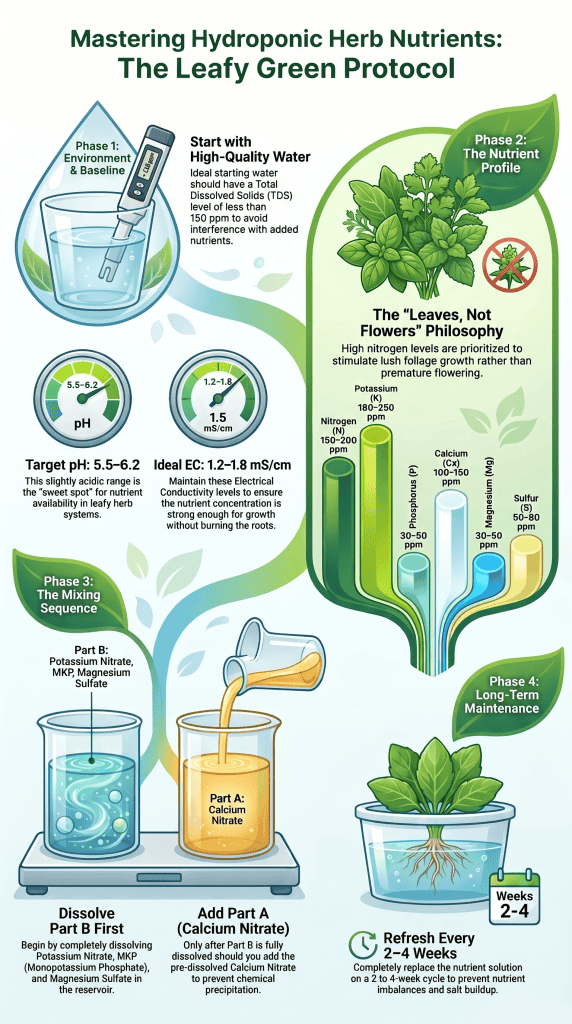
| Nitrogen (N) | 150–200 ppm |
| Phosphorus (P) | 30–50 ppm |
| Potassium (K) | 180–250 ppm |
| Calcium (Ca) | 100–150 ppm |
| Magnesium (Mg) | 30–50 ppm |
| Sulfur (S) | 50–80 ppm |
| pH | 5.5–6.2 |
| EC | 1.2–1.8 mS/cm |
You want leaves, not flowers. So the food should help the plant make more green stuff, not push it to bloom.
Nitrogen is important for leafy growth; too little causes yellowing, and too much can create overly lush, weaker growth. Too much fertilizer can make growth soft or unbalanced.
Research from Canadian Journal of Plant Science shows
“Plants require a high rate of specific macronutrients such as nitrogen to produce more leaves in leafy vegetables.” –
Canadian Journal of Plant Science
Other stuff is important too. Potassium helps regulate water balance and overall plant function. Calcium supports new growth; deficiency can distort young leaves. Magnesium keeps leaves green. If they turn yellow between the veins, you’re probably low on magnesium.
Micronutrients are also essential, even though plants require them in much smaller amounts. Iron supports chlorophyll production and healthy new growth. Manganese assists photosynthesis, while Zinc supports enzyme activity and stem development.
Boron helps form new shoots, Copper supports metabolism, and Molybdenum assists plants in utilizing nitrogen efficiently. Most hydroponic micronutrient blends provide these trace elements automatically.
Your Herb’s Essential Fuel Mix
When building your nutrient profile, target these core elements:
- Nitrogen (N): Drives your primary leaf and stem biomass.
- Phosphorus (P) & Potassium (K): P establishes robust, fuzzy root systems early on, while K acts as the internal hydraulic pump regulating water balance.
- Calcium (Ca) & Magnesium (Mg): Ca builds the actual structural cell walls of new shoots, while Mg keeps your chlorophyll engines green. If you see yellowing between the leaf veins, your Mg levels have bottomed out.
Starting Water Matters

Water quality directly affects nutrient solution performance. Reverse osmosis (RO) water provides the greatest control because it contains very few dissolved minerals.
Even when using an appropriate grow medium for hydroponic herbs, poor water quality can make nutrient management far more difficult.
Hard water often contains calcium and magnesium, which can alter nutrient ratios and increase starting EC. Ideally, source water should have a TDS below 150 ppm before nutrients are added.
Water quality becomes even more important because nutrients interact differently depending on the grow medium used in the system.
If source water exceeds 300 ppm TDS, growers may need to adjust fertilizer rates or use filtration.
Sticking To A Schedule Makes All The Difference
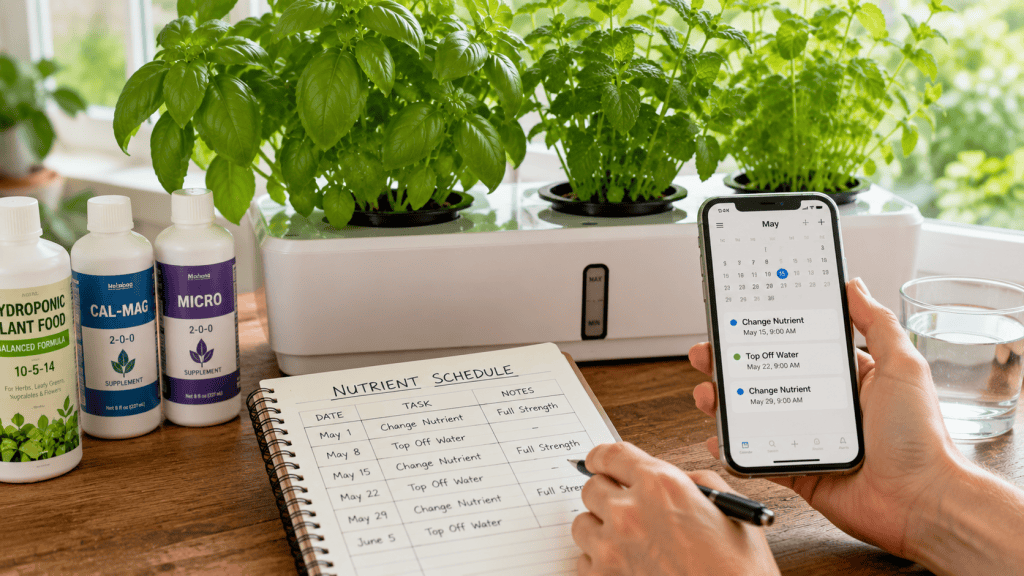
Mixing the perfect nutrient solution is only half the battle. The other half is keeping it that way. Herbs in water don’t have soil to buffer changes, so conditions in the reservoir can shift quickly. If you don’t stay on top of it, a perfectly mixed batch can become unbalanced in just a few days.
Here’s a simple routine to follow. First, check the pH and EC (Electrical Conductivity, which measures nutrient strength) at least twice a week.
Most hydroponic herbs grow well between EC 1.2 and 1.8 mS/cm. Young seedlings often perform better near 0.8 to 1.2 mS/cm, while mature basil, mint, and parsley can tolerate nutrient strengths closer to 1.8 mS/cm.
Think of it like checking the oil in your car, a quick, regular task that prevents bigger problems. If the pH drifts outside the 5.5 to 6.2 range, use a pH up or down solution to gently nudge it back. Don’t make huge corrections; small, frequent adjustments are less stressful for the plants.
Second, plan to completely replace your nutrient solution every two to four weeks. Even with top-ups, salts can build up and micronutrients get depleted. A fresh batch resets everything to an ideal baseline. Mark your calendar so you don’t forget.
Insights from Oklahoma State University Extension indicate
“Nutrient ratios can vary beyond their desired limits over time, causing deficiencies and toxicities. For example, sodium chloride will increase in concentration with the constant addition of water and nutrient adjustments, resulting in toxicities. It is advisable to replace the nutrient solution completely every two weeks.” –
Oklahoma State University Extension
Finally, watch your plants. They’ll tell you what they need. Are the new leaves a vibrant green and growing steadily? Good. Are the leaf tips turning brown or are older leaves yellowing? That’s a signal to check your numbers.
This routine isn’t about perfection; it’s about consistency. A little regular attention prevents most issues and keeps your herbs growing strong without guesswork.
Managing Root Zone Health
Root-zone conditions influence nutrient uptake just as much as nutrient concentration. Most hydroponic herbs perform best when root temperatures remain between 18°C and 22°C (65°F to 72°F).
Warmer water holds less dissolved oxygen, increasing the risk of root stress and disease. Air stones, circulation pumps, and proper reservoir aeration help maintain healthy oxygen levels around the roots.
Example Starting Recipe, Adjust After Testing
This is how you make it from scratch with separate powders. It gives you control and is cheaper in the long run.
A sample starting mix for a 100-gallon system might include:
| What to add | How much |
| Calcium Nitrate | 285 grams |
| Potassium Nitrate | 220g grams |
| Monopotassium Phosphate (MKP) | 65 grams |
| Magnesium Sulfate | 180 grams |
| Micronutrients | 15 grams |
When I dissolve these exact weights into 100 gallons of clean water, it hits a target baseline Electrical Conductivity (EC) of approximately 1.4 mS/cm (or roughly 700 ppm on a 500 scale). This is my personal sweet spot for established basil and mint.
If your source water has a high starting EC, you will need to scale these weights back to avoid overfeeding.
| Nutrient | Approximate Output |
| Nitrogen | ~180 ppm |
| Phosphorus | ~40 ppm |
| Potassium | ~220 ppm |
| Calcium | ~130 ppm |
| Magnesium | ~45 ppm |
Here’s what each powder does:
- Calcium Nitrate: Gives calcium and nitrogen.
- Potassium Nitrate: Adds more nitrogen and potassium.
- Monopotassium Phosphate: Supplies phosphorus and potassium.
- Epsom Salt: Supplies magnesium and sulfur.
- Micronutrient mix: A tiny pinch of all the other metals and elements the plant needs.
Mixing order is critical. If you add them wrong, calcium nitrate should remain separate from phosphate concentrates because calcium phosphate can precipitate out of solution, making both nutrients unavailable to plants.
Mixing order is where beginners usually ruin their water. To prevent your nutrients from binding up into an unusable chalky fallout, follow my exact tank routine:
Fill your main reservoir entirely with water. First, add your Part B powders, the Potassium Nitrate, Monopotassium Phosphate, and Magnesium Sulfate, directly to the reservoir one by one, ensuring each is completely dissolved before adding the next.
In a separate 5-gallon bucket of warm water, fully dissolve your Calcium Nitrate (Part A) by itself. Pour this liquid Part A into the reservoir last, stirring the tank vigorously as you pour.
Don’t think that doubling the powder means double the growth. It usually causes problems. Staying near a stable target and adjusting based on EC/pH readings works better.
Best Practice
Here’s a common gardening mistake: thinking that more fertilizer equals faster, better growth. It’s a natural assumption. If a little food is good, a lot must be great, right? In reality, over-fertilizing is one of the quickest ways to set your plants back.
Pushing plants with excessive nutrients forces rapid, but weak, growth. The stems and leaves might shoot up, but they often become soft and floppy, lacking the sturdy structure needed to support themselves or resist pests.
This tender new growth is like a neon sign for aphids and other insects. It’s also more susceptible to diseases. The plant is essentially stressed, using all its energy just to manage the nutrient overload instead of developing strong roots or flowers.
There’s also the real risk of “fertilizer burn.” When salt concentrations get too high in your water reservoir, the osmotic pressure reverses, causing the water to pull right out of your herb’s roots. In a pure water setup, you don’t use ‘weakly, weekly’ feeding schedules like soil growers do.
Instead, maintain a stable, half-strength nutrient concentration inside your reservoir continuously during the vegetative phase to prevent root burn.
Pay attention to your plant’s signals. Is it putting out healthy new leaves? Is the color a good, deep green? Slow growth or pale leaves might indicate a need for food, but they can also point to other issues like insufficient light or overwatering.
Before you reach for the fertilizer bottle, rule those out first.
The goal isn’t to force growth, but to support it. A balanced, patient approach builds stronger, more resilient plants that are better equipped to thrive on their own.
Examples of Content They Can Create

Credits: New Agrarian
This video explains the three key factors for managing nutrients in hydroponics: electrical conductivity (EC), pH, and water temperature. EC measures the total amount of nutrients in your water solution.
Higher mineral levels create a higher EC reading. Most plants grow well at a low EC of 0.8, but nutrient-heavy crops like tomatoes and eggplants need around 2.0.
pH controls how well plants absorb nutrients. Plants prefer slightly acidic water, with most nutrients available between pH 5.8 and 6.5. If the pH is too high or too low, plants cannot take in nutrients properly.
Temperature is not a nutrient but still affects plant growth deeply. Every plant has a preferred temperature range, especially during seedling stages and fruit development. Managing EC, pH, and temperature together helps hydroponic growers succeed.
FAQ
How Often Should I Adjust a Hydroponic Nutrient Solution for Herbs?
You should test and adjust a hydroponic nutrient solution for herbs every 3 to 7 days. As herbs absorb water and nutrients, the nutrient concentration and pH gradually change.
Check nutrient solution EC for herbs and hydroponic pH for leafy greens using reliable meters. Most leafy herbs grow well when nutrient levels remain stable, so regular monitoring helps prevent nutrient deficiency in herbs and uneven growth.
Can Different Leafy Herbs Share the Same Nutrient Reservoir?
Yes, many leafy herbs can share the same hydroponic nutrient reservoir because they have similar hydroponic nutrient requirements.
Basil, mint, parsley, cilantro, and chives generally perform well in the same system when supplied with a balanced nutrient solution for herbs, although plants grown differently, such as those attempting to grow lavender hydroponically, may require separate management.
Successful nutrient reservoir management requires regular monitoring of nutrient strength, pH, and water levels to ensure all plants receive adequate nutrition throughout the growing cycle.
What Water Quality Works Best for Hydroponic Herb Growing?
Clean water with low levels of dissolved minerals is usually the best choice for hydroponic herb production. Good nutrient solution water quality allows growers to control nutrient concentrations more accurately during hydroponic nutrient solution preparation.
Water with excessive mineral content can interfere with nutrient uptake and nutrient balance. Consistent water quality also improves nutrient solution temperature control and helps maintain healthy root development.
Many growers prefer reverse osmosis water because it starts with very low mineral content. A source water TDS below 150 ppm allows more precise nutrient management. Water above 300 ppm may require nutrient adjustments depending on its mineral composition.
Is a DIY Hydroponic Nutrient Recipe Suitable for Beginners?
Absolutely, but only if you buy a digital milligram scale. Weighing out raw powders gives you total control over your crop’s diet, but a simple 5-gram error can completely stall your herbs. If you’re an absolute beginner, I recommend mastering your pH and EC meters on a pre-mixed liquid concentrate before stepping up to blending raw chemical powders from scratch.
How Can I Improve Leaf Growth Without Overfeeding Herbs?
You can improve leaf growth by maintaining the correct nutrient balance instead of increasing fertilizer concentration. A leafy greens nutrient formula should provide adequate nitrogen, calcium, magnesium, and potassium without exceeding recommended hydroponic nutrient concentration levels.
Regular nutrient solution maintenance, proper oxygenation, and consistent pH management support healthy growth. These practices promote steady nutrient uptake and help produce larger, healthier leaves without increasing the risk of nutrient stress.
Mix Smarter for Better Herb Growth
When your herbs grow in water, even small nutrient mistakes can show up fast. Weak leaves, slow growth, or yellowing are often signs that the nutrient balance needs attention. That’s why it pays to keep an eye on pH and EC, refresh your solution regularly, and make gradual adjustments instead of making big changes. Simple habits make a big difference.
I have spent years troubleshooting reservoir crashes and yellowing leaves, and I built this guide to save you from those exact mistakes. Over at Tophydroponicgarden, we track these herb-specific feeding charts and test various water-growing systems so you don’t have to learn the hard way.
Stick to this routine, watch your plants, and your kitchen will be overflowing with fresh harvests all season.
References
- https://doi.org/10.1139/cjps-2023-0034
- https://extension.okstate.edu/fact-sheets/electrical-conductivity-and-ph-guide-for-hydroponics
Related Articles
- https://tophydroponicgarden.com/5-easy-to-grow-herbs-in-hydroponics/
- https://tophydroponicgarden.com/best-grow-medium-for-hydroponic-herbs/
- https://tophydroponicgarden.com/can-you-grow-lavender-hydroponically/
Was this helpful?

I’m Barrie L., a passionate hydroponic gardening enthusiast dedicated to cultivating thriving, soil-less gardens. With a focus on all things hydroponic, I share my expertise on innovative growing techniques and sustainable practices through my blog, tophydroponicgarden.com. As a seasoned hydroponics specialist, my goal is to inspire and guide fellow gardeners in harnessing the power of water-based cultivation for bountiful and eco-friendly harvests. I’m also an author of the book “Hydroponics For Absolute Beginners: Your Step By Step Guide For How To Create An Hydroponics System At Home Without Soil, For Growing Vegetable, Fruit And Herbs.” which is sold on Amazon. Join me on a journey of redefining the way we cultivate plants, one nutrient-rich solution at a time. Happy growing!