

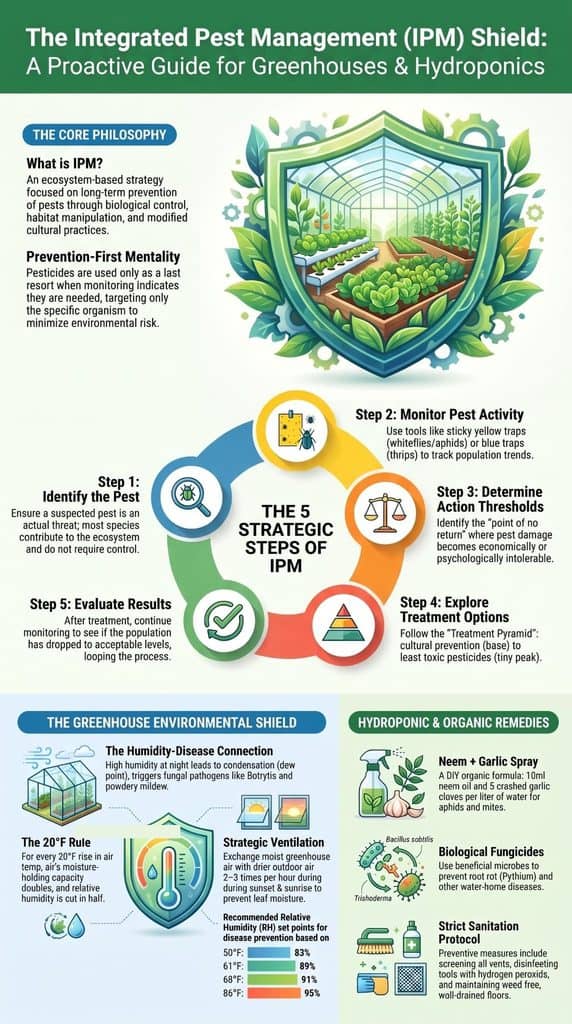
Soilless pest management works best with an Integrated Pest Management (IPM) approach, where growers identify pests early, prevent infestations, monitor crops, and use suitable controls as needed.
Hydroponic, aquaponic, and aeroponic systems can give pests different places to feed and reproduce, especially with media such as rockwool, coco coir, or clay pebbles. So the approach needs to fit the growing system. Keep reading for a practical pest management framework from Tophydroponicgarden.
Quick Reads: Hydroponic Pest Control Basics
- Prevent and monitor: Keep pests out with sanitation, screening, quarantine, and regular scouting.
- Use integrated controls: Combine physical methods and pest-specific biological controls instead of relying on one treatment.
- Manage the environment: Control humidity, airflow, irrigation, temperature, and growing-media conditions to reduce pest and disease pressure.
What Makes Pest Management Different Without Soil?
Soilless growing removes some soil-associated pest pathways, but pests can still enter through plants, air movement, tools, people, and moist growing media.
Hydroponic pest control is less about treating soil and more about controlling the growing environment. Rockwool, coco coir, hydroton, and bare-root systems each create different conditions for insects and their immature stages.
Inert media lack many natural soil-borne pathways, shifting attention toward environmental control, physical exclusion, and biological interactions. That distinction matters because a clean-looking system can still support an active pest population.
Which Pests Can Still Enter A Soilless Growing System?
Common problems include:
- Thrips
- Whiteflies
- Aphids
- Spider mites
- Fungus gnats
Aphids deserve your early attention because they reproduce incredibly fast, especially in warm, controlled environments like greenhouses. Aphids can reproduce rapidly under favorable conditions, allowing populations to increase quickly if they are not detected early.
That rapid growth is why a few unnoticed aphids can become a widespread infestation. Regular scouting helps catch them before populations build. Catching them early during routine scouting isn’t just a good habit, it’s also often the difference between a quick, easy fix and a much bigger pest management headache down the road.
Why Does Inert Media Change the Pest Life Cycle?
Inert media don’t eliminate moisture-dependent pest stages. Coco coir, rockwool, and other substrates can still provide humid spaces around roots and plant debris.
Bare-root systems remove some substrate habitat, while hydroton provides a different physical environment. From our experience with controlled growing systems, the practical question isn’t whether a medium is technically “soil-free.” It is whether that medium gives a pest somewhere favorable to survive.
Media management, your growing mix, its cleanliness, and how it drains, isn’t separate from pest control. Temperature, humidity, and airflow all shape whether pests want to move in, and your media is part of that picture. Treat it as core to your IPM plan, right alongside scouting and biological controls.
How Does Integrated Pest Management Prevent Infestations?

Integrated Pest Management prevents infestations by identifying pests early, monitoring population changes, reducing entry points, and applying targeted controls when needed.
Smith, H. A., Vallad, G. E., & Santos, B. M. (2013) found that
“The fundamentals of managing pests in protected structures are very similar in many respects to managing pests in field crops. The grower must still develop a management plan, assembling pertinent information for identifying, monitoring and controlling specific pests before planting. Integration of several pest management strategies into a comprehensive program is still critical.” Smith, H. A., Vallad, G. E., & Santos, B. M., 2013
IPM is useful because pest pressure rarely behaves the same way from one crop or growing room to another. A few fungus gnats call for a different response than widespread thrips.
Biological control is a system in which specialized biological control agents help keep pest populations below damaging levels. That approach fits soilless cultivation because growers can monitor a controlled environment closely.
What Are the Five Stages of A Soilless IPM Plan?
A repeatable plan can follow five stages:
- Prevent entry and favorable conditions.
- Identify and scout for pests.
- Monitor population thresholds.
- Apply non-chemical or biological controls.
- Evaluate population decline.
This order prevents treatment from being the first response.
Why Should Prevention Come Before Treatment?
Prevention goes a long way toward cutting down the number of problems you’ll have to deal with later. Simple steps like screening vents and doorways, keeping your growing area clean, quarantining new plants before they join the rest, and starting with healthy plant material all help close off the opportunities pests need to get established in the first place.
Handling these basics well means fewer pests ever make it to the point where you need to bring in beneficial insects or other biological controls. And when biological control does come into play, it works best as part of a thoughtful, ongoing strategy, released and managed with a plan in mind, rather than a single treatment you turn to once and forget about.
How Can You Keep Pests Out of a Soilless Grow Space?
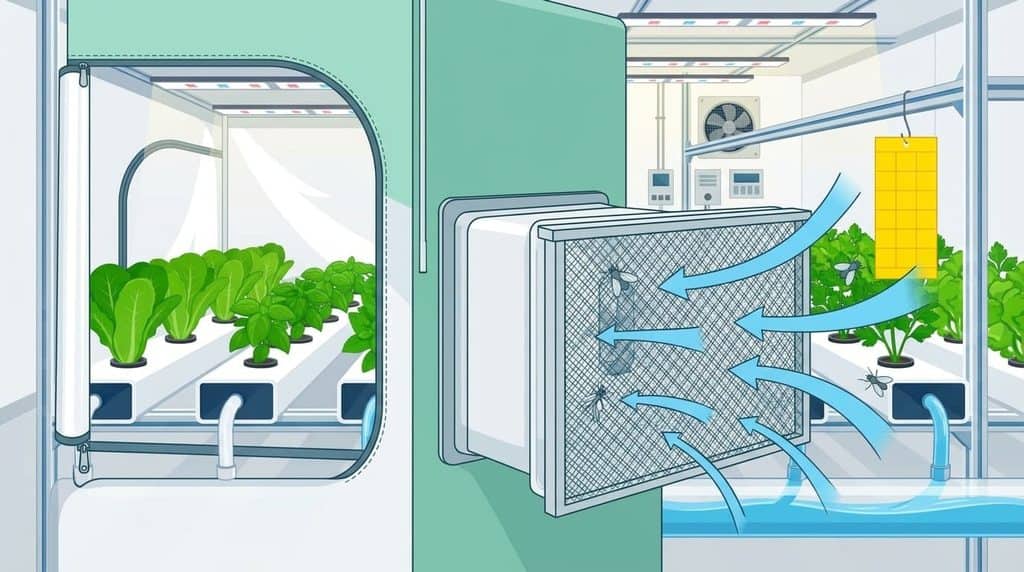
Screening, sanitation, clean incoming plants, and controlled movement can reduce the number of opportunities pests have to enter and spread.
Exclusion is particularly useful in indoor hydroponics because growers can control many access points. Intake vents, doors, tools, propagation areas, and new plants all deserve attention.
Fine insect netting and screened intake points serve as physical defenses against winged insects such as thrips, whiteflies, and fungus gnats. Physical separation also becomes useful once an infestation is detected.
Which Physical Barriers Work Best?
A prevention checklist includes:
- Screen vents and openings.
- Seal unnecessary gaps.
- Keep growing-room doors closed when practical.
- Separate clean and affected growing areas.
- Use suitable netting around vulnerable openings.
Physical ground covers are another handy tool for keeping your soilless root zones isolated from soil-borne pests and nematodes. By creating a barrier between your growing system and the ground below, you cut off an easy pathway pests could otherwise use to reach your plants’ roots.
How Should You Quarantine New Plants?
Inspect incoming plants prior to entry into an established production area. Look for signs of insects or eggs under leaves, at growing points and near the growing medium.
There is a separate observation area to help make it easier to monitor new plants without exposing the main crop. Quarantine new plants for an appropriate observation period before introducing them to the main growing area.
Keeping pests from getting in in the first place is one of the smartest moves you can make as part of a bigger prevention strategy. It’s a lot easier to block bugs at the door than to chase them down once they’ve already settled in.
How Do Sticky Traps Help You Catch Pest Problems Early?
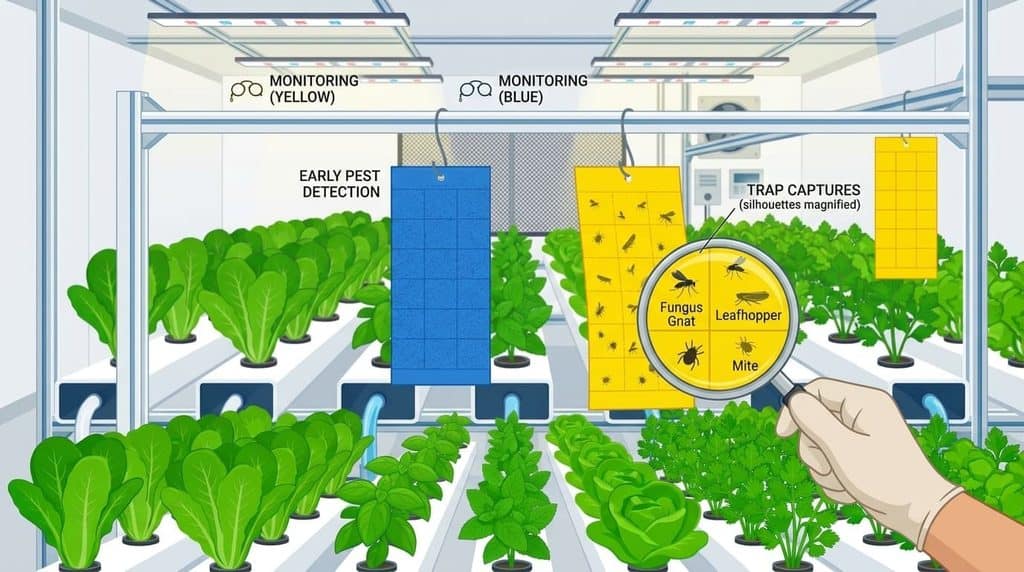
Sticky cards are mainly used as a monitoring tool to indicate the presence and population trends of pests before there is an actual infestation. Think of them as an early warning system. They don’t eliminate the problem, but they tell you something is there before it gets out of hand.
Every card is essentially a visible record of what’s flying around your growing space at any given time. Placement matters more than most people realize. Cards positioned near the canopy tend to catch activity that might otherwise go completely unnoticed until the damage is already done.
Checking them regularly and tracking what you find over time gives you a clearer picture of whether pest pressure is building, holding steady, or starting to drop, which makes it a lot easier to decide when and how to act.
Which Sticky Cards Target Common Flying Pests?
| Trap | Main monitoring targets |
| Yellow | Fungus gnats, whiteflies, aphids |
| Blue | Thrips |
Sticky cards are best thought of as an early-warning system rather than a way to wipe out a pest population on their own. They help you spot trouble while it’s still small, so you can act before it turns into a bigger infestation.
Data from Cloyd, R. A., & Sadof, C. S. (2003)
” … Our findings are the first to demonstrate, based on a case study over a 2-year period, that routinely scouting for thrips throughout the year can lead to fewer insecticide applications and thus possible cost savings in labor and insecticide purchases. This study suggests that sticky cards can be an effective tool for reducing insecticide applications in regions of the U.S. where there are seasonal fluctuations of thrips abundance.” (Cloyd, R. A., & Sadof, C. S., 2003)
What Should You Record During Scouting?
Record the following consistently:
- Pest type
- Trap location
- Approximate counts
- Plant symptoms
- Changes over time
A trap that’s catching more and more insects over time deserves a lot more of your attention than a single bug you spot once and never see again. That’s really the value of sticky cards. They’re a scouting tool that helps you track trends, so you can tell the difference between a random, one-time visitor and the start of a real problem.
Which Biological Controls Match Common Hydroponic Pests?
Biological control works best when the natural enemy matches the pest, crop environment, and conditions inside the growing space.
Beneficial organisms can occupy an important place in low-pesticide cultivation. The key is matching the biological control agent to the pest rather than releasing a random mixture of predators.
Which Beneficial Organisms Target Common Pests?
| Pest | Example biological control |
| Spider mites | Phytoseiulus persimilis |
| Thrips | Amblyseius swirskii / Neoseiulus cucumeris |
| Fungus gnat larvae | Stratiolaelaps scimitus / BTI |
| Aphids | Aphidius colemani / Chrysoperla carnea |
These organisms have different requirements. Predatory mites, parasitoid wasps, beneficial nematodes, and microbial controls shouldn’t be treated as interchangeable.
Why Can Beneficial Organisms Fail in Inert Media?
Some biological controls need suitable humidity, shelter, or carrier material. Fast-draining hydroton and bare-root NFT channels may offer fewer places for soil-associated predators to establish.
Biocontrol agents have species-specific requirements for humidity, temperature, food, and shelter, so environmental conditions should be matched to the organism being used.
How Can Sanitation Reduce Pest Pressure?

Credits: Kebun Firdaus
Sanitation removes plant debris and contaminated materials and surfaces that pests or pathogens can survive on, reducing pest pressure. Keeping growing areas clean will help prevent pests from hiding and reduce the chance of a problem spreading from plant to plant.
The attached research shows regular sanitation practices such as the removal of yellowing lower leaves and plant debris. Washdowns with water physically remove pests from foliage.
Which Sanitation Tasks Should Growers Prioritize?
A good sanitation program should include:
- Remove any damaged or infested plant material.
- Sterilize equipment and sanitize reusable growing media.
- Sterilize substrate trays.
- Keep area clean.
- Always check the equipment before moving it from one place to another.
Why Does Sanitation Matter After An Infestation?
Cleaning after an infestation matters because removing visible insects does not necessarily remove eggs, larvae, or contaminated material.
Sanitation also matters for disease management, although disease control is a separate topic from insect pest management.
How Should You Manage Fungus Gnats in Soilless Media?
Fungus gnat management requires monitoring adults while addressing larval habitat and moisture conditions around the growing media. Adult gnats are easy to spot on sticky cards, but that’s only part of the picture. The real damage happens underground, where larvae feed on roots and organic matter in moist media.
Catching adults on traps tells you they’re present, but it doesn’t solve the root cause. Managing moisture levels is just as important. Letting the growing media dry out slightly between waterings makes it far less hospitable for eggs and larvae to develop. A complete approach targets both stages at once rather than reacting to what’s visible on the surface.
Why Do Sticky Traps Alone Fail Against Fungus Gnats?
Sticky cards capture adults but don’t remove every immature stage in the growing medium. A decreasing trap count is good evidence, but doesn’t necessarily mean the lifecycle has been broken.
Fungus gnat suppression is a multi-stage process that includes monitoring, substrate management, physical barriers, and biological controls.
How Can Substrate Management Interrupt Their Lifecycle?
Consider the following measures:
- Reduce favorable habitat where appropriate.
- Cover exposed media where suitable for the growing system.
- Monitor adults and larval activity.
- Reduce algae around exposed wet surfaces.
- Use targeted biological controls when compatible with the system.
How Can You Build a Low-Pesticide Pest Management Routine?
A reliable soilless pest routine combines clean inputs, exclusion, scouting, environmental control, sanitation, and targeted biological measures to help growers maintain hydroponic plants while reducing pest pressure.
The strongest programs don’t wait for visible damage before monitoring. They establish a baseline, inspect regularly, and respond according to what the observations show.
What Should You Check Every Week?
Weekly Checklist:
- Inspect new and existing plants as part of regular hydroponic garden maintenance.
- Review sticky-card observations.
- Check leaves and growing media.
- Remove affected material promptly.
- Check the environmental conditions.
- Log reactions and changes.
Writing it down helps you tell the difference between an insect you saw once and an insect whose numbers are growing.
How Can Tophydroponicgarden Support A Cleaner Growing System?
Tophydroponicgarden can frame equipment around prevention rather than promising a single pest remedy.
That means seeking out equipment that offers controlled environments, easy sanitation, reliable monitoring and proper separation between growing areas.
A clean growing system isn’t pest-proof. It is a system where growers can identify problems early and respond without automatically reaching for synthetic pesticides.
What Is the Best Long-Term Strategy for Managing Pests Without Soil or Pesticides?
Effective pest management starts before an infestation takes hold. Prevention, consistent monitoring, and targeted controls work together to keep your soilless garden healthier and easier to manage.
By inspecting plants, tracking pest activity, maintaining clean conditions, and responding only when evidence calls for action, you can reduce recurring problems and create a more controlled growing environment with Tophydroponicgarden.
References
- https://www.semanticscholar.org/paper/Seasonal-Abundance-and-the-Use-of-an-Action-for-in-Cloyd-Sadof/03218ca0832316f0d6de912019a1506c27e602f7#1
- https://ask.ifas.ufl.edu/publication/IN994?downloadOpen=true#1
Related Articles
- https://tophydroponicgarden.com/hydroponic-garden-maintenance/
- https://tophydroponicgarden.com/how-to-sterilize-equipment-between-grows/
- https://tophydroponicgarden.com/how-to-maintain-hydroponic-plants/
Was this helpful?
I’m Barrie L., a passionate hydroponic gardening enthusiast dedicated to cultivating thriving, soil-less gardens. With a focus on all things hydroponic, I share my expertise on innovative growing techniques and sustainable practices through my blog, tophydroponicgarden.com. As a seasoned hydroponics specialist, my goal is to inspire and guide fellow gardeners in harnessing the power of water-based cultivation for bountiful and eco-friendly harvests. I’m also an author of the book “Hydroponics For Absolute Beginners: Your Step By Step Guide For How To Create An Hydroponics System At Home Without Soil, For Growing Vegetable, Fruit And Herbs.” which is sold on Amazon. Join me on a journey of redefining the way we cultivate plants, one nutrient-rich solution at a time. Happy growing!