
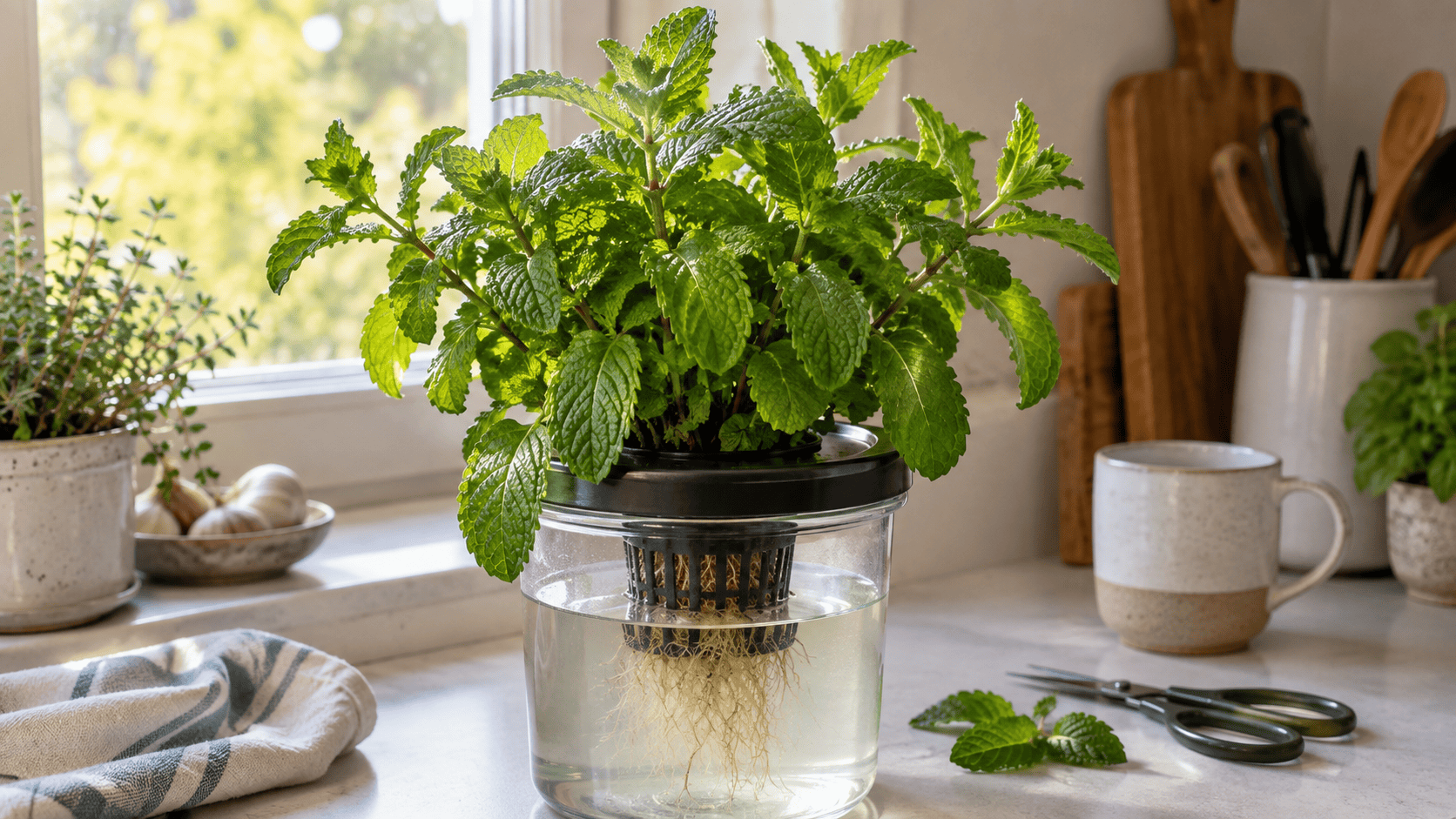
Growing mint using the Kratky method is easy to start, but keeping the same plant productive after several cuts takes more than topping up a jar whenever the water drops.
Mint grows fast, builds a dense root mass, and can use water much faster as it matures.
At Top Hydroponic Garden, the useful part is keeping that simple setup simple: protect the air gap, manage the reservoir carefully, and prune before the plant overwhelms its container.
Keep reading to see how to set up Kratky mint properly, maintain the air gap, and keep the plant productive for repeat harvests.
The Kratky Mint Basics in 30 Seconds
Kratky works by letting the nutrient level drop and creating an air gap around the upper roots.
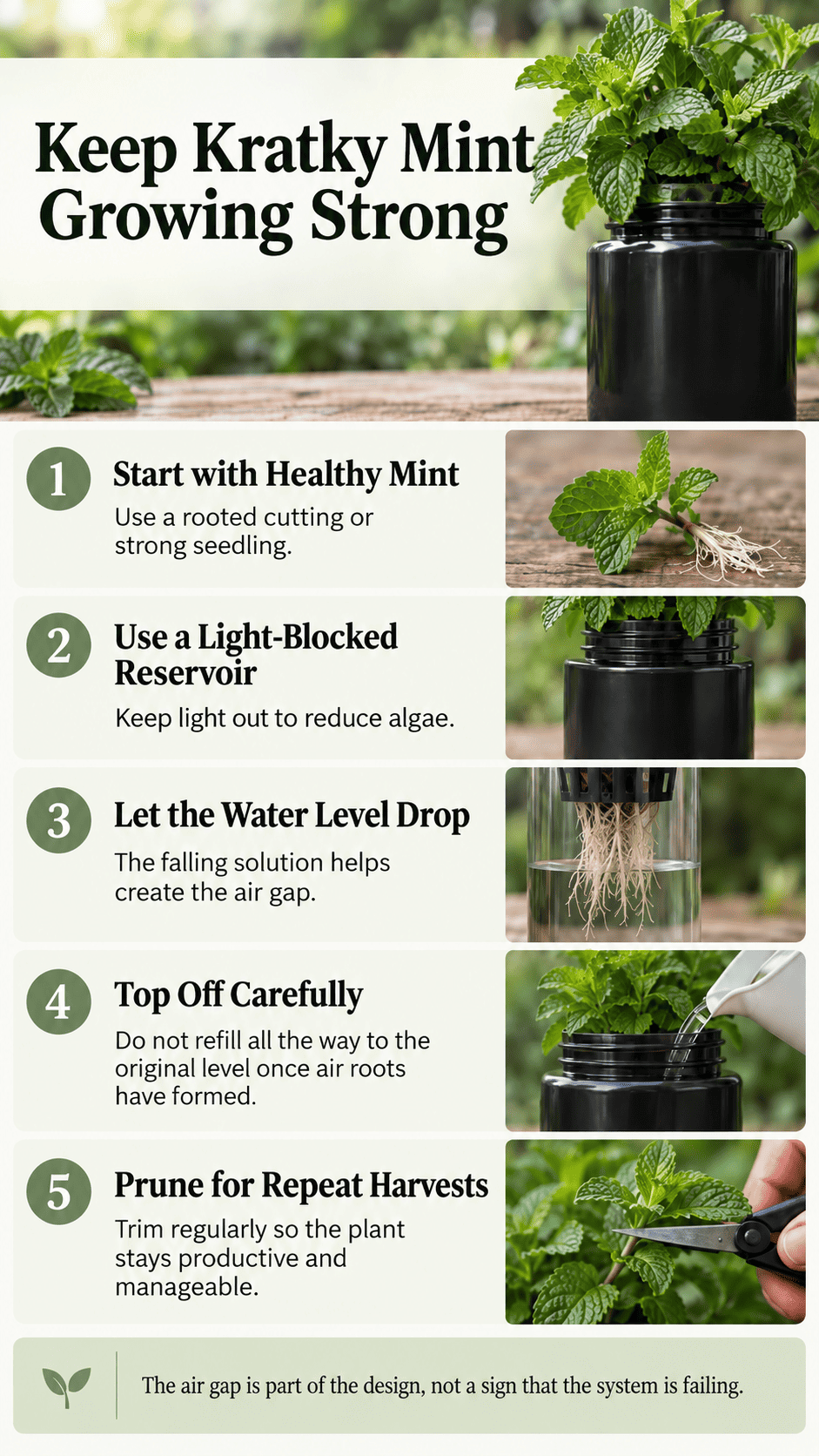
- Start with a healthy rooted cutting or seedling.
- Use a light-blocked reservoir and complete hydroponic nutrients.
- Let the nutrient level fall naturally.
- For repeat harvests, watch roots, water use, nutrients, and pruning.
The key is simple: don’t refill the reservoir to the top once the air gap has formed.
Is Mint a Good Plant for the Kratky Method?
Yes. Mint is a practical Kratky herb because it is grown mainly for leaves and stems, not for a heavy fruiting crop, and it can keep producing after trimming.
A passive reservoir also removes the need for an air pump or constant circulation, which suits a small countertop or shelf setup.
The tradeoff is vigor. Mint can grow faster than its container can comfortably support, especially after several harvests.
That means root density and water consumption matter more over time than they do with a short-cycle crop.
Plain water propagation is also not the same as long-term Kratky growing.
A cutting may root in water, but productive hydroponic mint still needs a complete nutrient solution and a root zone that can access both moisture and oxygen.
What Do You Need to Grow Mint With the Kratky Method?
You do not need much equipment, but container choice matters more than it first appears.
Use an opaque or fully light-blocked reservoir, a secure lid, a net cup, a small amount of suitable growing medium, and complete hydroponic nutrients.
A pH or EC meter is useful for longer grows, though it is not what makes the system work.
Give the reservoir enough volume that a mature plant does not empty it almost overnight. Light should also stay out of the nutrient solution because exposed water encourages algae.
If you are still comparing passive and powered setups, Top Hydroponic Garden’s DIY hydroponic system for herbs guide shows where Kratky, wick, DWC, and simple drip systems differ.
| Item | Purpose | Avoid |
| Opaque reservoir | Holds nutrients and blocks light | Clear container left uncovered |
| Lid and net cup | Supports the plant above the solution | Loose or unstable support |
| Growing medium | Holds the plant upright | Packing the stem too tightly |
| Hydroponic nutrients | Provides complete mineral nutrition | Using plain water long term |
| pH/EC meter | Helps track solution changes | Chasing numbers without checking the plant |
Should You Start Mint From a Cutting or Seedling?
A rooted cutting is usually the easiest choice because mint propagates readily and you can begin with a plant that already has several healthy roots.
An established seedling works too, especially if it has been started in a hydroponic-friendly plug or medium.
Whichever you use, keep the crown and stem above the nutrient solution.
The lower roots can reach moisture, but the whole plant base should not sit submerged. Remove damaged or rotting material before it goes into the container so you are not starting a passive system with a root-zone problem already developing.
How Large Should the Reservoir Be?
Choose a reservoir with enough volume for the plant you want to keep, not just the cutting you are planting today.
Mint can develop a thick root mass and increase its water use quickly after the canopy gets larger.
A tiny jar can work for a young plant, but it leaves very little buffer once summer heat, strong light, or vigorous growth speeds up water loss.
A larger opaque container usually means fewer emergency checks and more room for the air zone to develop without the roots immediately filling every available space.
How Do You Set Up Mint Using the Kratky Method?
The initial setup has one job: give young roots access to moisture while leaving room for the classic Kratky air zone to develop later.
That means the starting nutrient level can be relatively high, but it should not become a permanent fill line.
As mint drinks and grows, the solution level falls. Upper roots adapt to the humid space above the liquid while lower roots continue reaching the nutrient solution.
This gradual change supplies oxygen without a pump.
According to Bernard Kratky,
“Plant growth causes the nutrient solution level to decrease, and this creates an expanding moist air space.” ASHS, 2011.
That is why repeatedly filling an established container back to the top can create problems instead of fixing them.
Step 1: How Should You Prepare the Mint and Net Cup?
Start with healthy roots and a clean net cup.
Position the plant so its stem and crown stay above the reservoir while the lower root zone can reach moisture.
Use just enough clay pebbles, rockwool, or another suitable medium to keep the plant stable.
Do not compress the medium around the stem or force a large root bundle through a small opening. If you are transferring a rooted cutting, spread the roots gently rather than folding them into a tight ball.
The goal is support, not a packed root zone that stays excessively wet.
Step 2: How Should You Mix the Nutrient Solution?
Use a complete hydroponic nutrient rather than plain water with occasional household fertilizer.
Mix it according to the manufacturer’s hydroponic directions and start conservatively with young cuttings instead of assuming stronger nutrients will speed up establishment.
If you have meters, check pH and EC after mixing.
Treat those readings as monitoring tools, not numbers to chase blindly.
Mint nutrient response can vary with species, formulation, growth stage, and growing system, so one EC target should not be presented as universal.
A stable plant, healthy roots, and consistent new growth matter just as much as the meter reading.
Step 3: Where Should the Starting Water Level Sit?
At the beginning, let the nutrient solution reach the lower portion of the young root zone or starter plug so the plant does not dry out before roots extend downward.
It does not need to cover the entire root system.
Once the plant starts drinking, resist the urge to restore that original level every day.
The falling solution creates the moist air space that separates Kratky from a jar that is simply kept full of water.
Watch the roots as the level changes.
Healthy lower roots should continue reaching the solution while upper roots remain in the humid zone above it.
Step 4: How Much Light and Growing Space Does Mint Need?
Place the container where mint receives strong usable light without overheating the reservoir.
A bright window can work when it provides enough light, while a grow light is useful when indoor conditions produce pale, stretched growth.
Give the canopy room to spread and allow air to move around the leaves.
Dense mint can shade its own lower growth quickly.
Rotate a windowsill container if the plant keeps leaning strongly toward one side.
Light management should improve plant structure, not become an excuse to keep increasing nutrient strength when weak growth is really a lighting problem.
How Do You Maintain Kratky Mint for Repeat Harvests?
This is where mint gets more interesting than a typical one-harvest Kratky crop.
After you cut it, healthy mint can produce another flush of stems and leaves from the same root system.
As noted by Hazrati et al. (2024),
“The experiment consisted of harvesting mint plants three times when the plants reached a suitable maturity stage.” Hazrati et al. (2024).
A longer growing period means the reservoir also changes more:
- The plant usually drinks faster.
- Roots occupy more space.
- EC and pH may shift over time.
- The nutrient solution gets older.
- Pruning becomes part of reservoir management too.
You still want Kratky to remain low-maintenance. The difference is that you start responding to how an established plant behaves instead of treating every reservoir cycle exactly the same.
How Should You Top Off Without Flooding the Air Roots?
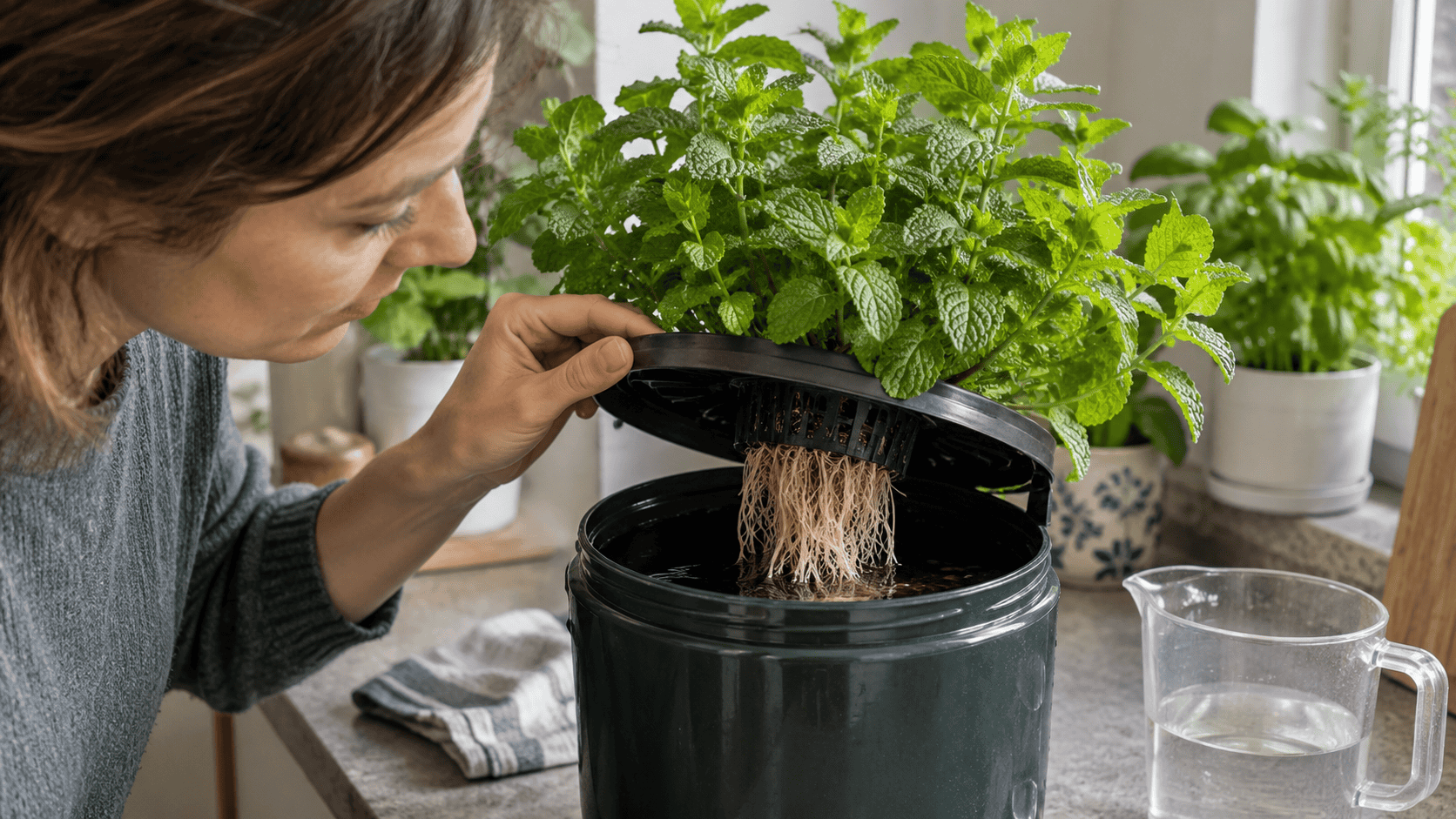
Check the actual water level before adding anything.
Once upper roots have adapted to the humid air zone, avoid refilling the reservoir to the original starting line and submerging them again.
For a longer-lived mint plant, a partial top-off may be needed when the solution gets too low, but the established air space should remain intact.
How much you add depends on the container and root position, not a universal schedule.
For a deeper look at this decision, Top Hydroponic Garden’s reservoir top-off guide explains why Kratky needs different treatment from actively aerated systems.
How Should You Manage Nutrients, pH, and EC Over Time?
A dropping water level does not mean the plant has consumed nutrients and water at exactly the same rate.
That is why pouring another full-strength nutrient mix into the reservoir every time it gets low can gradually create imbalance.
Before correcting the reservoir, check:
- Water level and recent consumption.
- pH and EC, if you use meters.
- New leaf color and growth.
- Root condition.
- How many times you have already topped it off.
After repeated top-offs, completely replacing an aging or difficult-to-manage solution can sometimes be cleaner than making another small correction.
What Should Healthy Kratky Mint Roots Look Like?
Healthy new roots are generally firm and light in color, though nutrient solution can cause some staining.
Do not diagnose root rot from color alone. Texture, smell, wilting, and new root condition give you a better picture.
Also watch how much physical space the roots occupy.
A dense root mass may still be healthy while making the system harder to manage.
If roots crowd most of the reservoir, hide the water level, or leave little usable solution volume, the problem may simply be that the mint has outgrown its current container rather than developed a nutrient deficiency.
How Do You Prune and Harvest Kratky Mint?
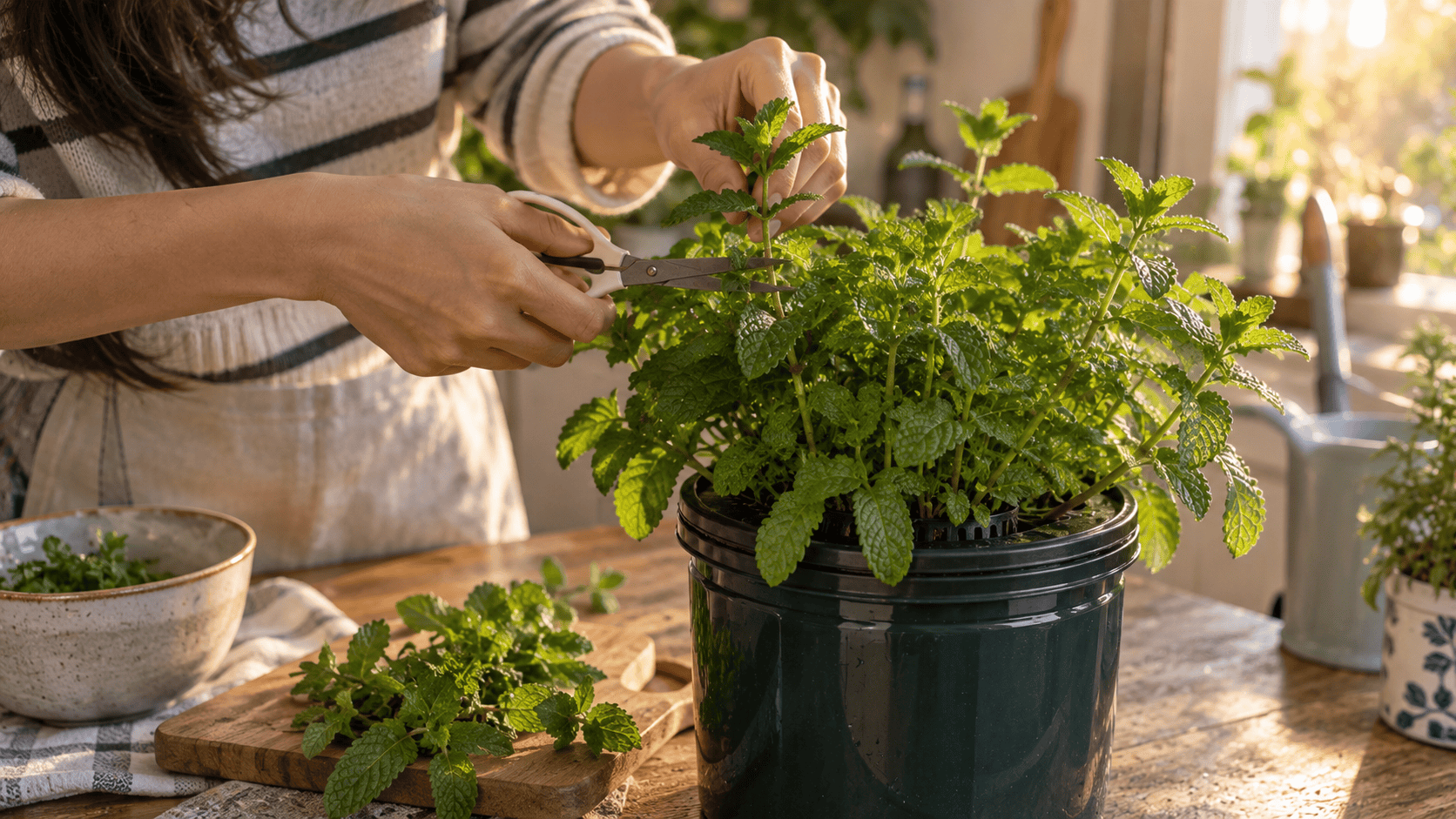
Regular pruning keeps mint productive above the lid while also making life easier below it.
A huge canopy needs more water, so controlling plant size can help a small passive reservoir remain manageable.
Rather than picking individual leaves every time, harvest usable stems. Make cuts above healthy nodes and leave enough foliage for the plant to recover.
A few habits help:
- Harvest the longest mature stems first.
- Leave smaller shoots to keep developing.
- Avoid removing nearly all foliage in one session.
- Trim regularly before the canopy becomes crowded.
You do not have to wait for the whole plant to reach the same height. Staggered harvesting gives you fresh mint more often and avoids repeatedly swinging between an oversized canopy and a heavily cut-back plant.
Where Should You Cut Mint for Better Regrowth?
Cut a stem just above a healthy node, leaving enough leaves below the cut for the plant to keep photosynthesizing.
New side shoots can then develop from the remaining growth points, which helps the mint become bushier instead of producing a few long stems.
Avoid removing nearly all foliage in one harvest, even if the plant looks vigorous.
Staggered cuts are easier on the plant and make the canopy simpler to manage.
If several stems are ready at once, take the longest first and leave smaller shoots to continue growing for the next harvest.
When Is It Better to Restart the Plant?
Keeping one mint plant alive forever is not the goal. At some point, starting a fresh cutting can be easier than continuously adapting a small reservoir to an oversized plant.
Consider restarting when:
- Roots occupy most of the reservoir.
- Maintaining the air gap becomes awkward.
- Water disappears unusually quickly.
- Older stems become woody.
- The canopy stays awkward after pruning.
- Root-zone problems keep returning.
Mint propagates readily from healthy stems, so restarting does not mean the previous crop failed.
What Problems Are Most Common With Kratky Mint?
Most Kratky mint problems are easier to diagnose when you check the system instead of reacting to one symptom.
Yellow leaves can have several causes, brown roots are not automatically rot, and fast water loss may simply mean the plant has outgrown its reservoir.
Start with water level, root texture and smell, light, pH or EC if available, and the amount of open reservoir space.
If algae or residue keeps returning, a proper reset may help.
Top Hydroponic Garden’s hydroponic herb system cleaning guide covers the process without turning routine cleaning into a complicated sterilization job.
| Symptom | Check First | Likely Issue | Practical Response |
| Pale leaves | pH, EC, leaf age | Nutrient availability issue | Check before fertilizing |
| Wilting with solution left | Roots and air gap | Root stress | Inspect root zone |
| Brown, slimy roots | Texture and smell | Root decline | Remove damaged roots and correct conditions |
| Green reservoir growth | Light leaks | Algae | Block light and clean |
| Water drops quickly | Plant and root size | Mature mint using more water | Check more often |
What Else Should You Know Before Keeping Kratky Mint Long Term?

Credits: WorldWellness Sustainable Farming
Long-term Kratky mint is less about following a rigid weekly schedule and more about noticing when the system changes.
A plant that needed little attention as a cutting may drink much faster after several harvests. Outdoor heat can speed water loss.
Source water can change how easily pH and EC stay stable.
Nutrient products also differ, so copying someone else’s exact mixing numbers is not always useful.
A few edge cases come up often but do not need their own full sections.
The short answers below cover those without repeating the setup, top-off, pruning, or root-management advice already explained above.
FAQ
Can You Grow Kratky Mint Outdoors?
Yes. Protect the reservoir from heat, heavy rain, and direct sunlight.
Can You Use Tap Water for Kratky Mint?
Usually, yes. Check the water first if it has very high mineral content or EC.
Can You Use Organic Fertilizer in a Kratky Mint Jar?
Yes, but complete hydroponic nutrients are usually easier to manage in a passive reservoir.
Can Mint Share a Kratky Reservoir With Another Herb?
Yes, but mint can outgrow slower herbs, so a separate reservoir is often easier.
How Do You Keep Kratky Mint Productive for Longer?
Good Kratky mint care is not about keeping the jar full.
Start with healthy roots, use complete nutrients, let the air gap develop, and adjust water, nutrients, and pruning as the plant gets larger.
For practical guidance on Kratky systems, reservoir care, and hydroponic herbs, Top Hydroponic Garden shares straightforward growing advice you can check as your setup develops.
Regular trimming helps keep repeat harvests manageable, while restarting from a fresh cutting can be the better choice once roots begin crowding a small reservoir.
References
- https://ashs.confex.com/ashs/2011/webprogram/Paper6326.html
- https://www.mdpi.com/2718260
Related Articles
- https://tophydroponicgarden.com/diy-hydroponic-system-for-herbs/
- https://tophydroponicgarden.com/how-to-top-off-your-hydroponic-reservoir/
- https://tophydroponicgarden.com/how-to-clean-a-hydroponic-herb-system/
Was this helpful?

I’m Barrie L., a passionate hydroponic gardening enthusiast dedicated to cultivating thriving, soil-less gardens. With a focus on all things hydroponic, I share my expertise on innovative growing techniques and sustainable practices through my blog, tophydroponicgarden.com. As a seasoned hydroponics specialist, my goal is to inspire and guide fellow gardeners in harnessing the power of water-based cultivation for bountiful and eco-friendly harvests. I’m also an author of the book “Hydroponics For Absolute Beginners: Your Step By Step Guide For How To Create An Hydroponics System At Home Without Soil, For Growing Vegetable, Fruit And Herbs.” which is sold on Amazon. Join me on a journey of redefining the way we cultivate plants, one nutrient-rich solution at a time. Happy growing!