

Many beginners find it challenging but kits and resources exist to help adoption. It still involves technical components that require learning and monitoring.
It’s a system where plant roots hang in the air and get misted with nutrient solution. That might sound like a science experiment, and honestly, it does require more attention than traditional gardening.
You’ll need to check timers and spray nozzles regularly. But plenty of people make it work in their own apartments. The key is to avoid overcomplicating things at the beginning.
It’s a bit like learning to drive a stick shift, awkward at first, then it becomes second nature. Let’s look at how to bypass the major headaches and get your plants growing.
Key Takeaways
- Start with a pre-built kit. Use hardy plants like lettuce.
- Your main job is preventing clogs and power failures, but monitoring nutrient balance, pH, and environmental conditions are also essential.
- Master checking pH and nutrients before you try to automate anything.
Where Beginners Usually Get Stuck
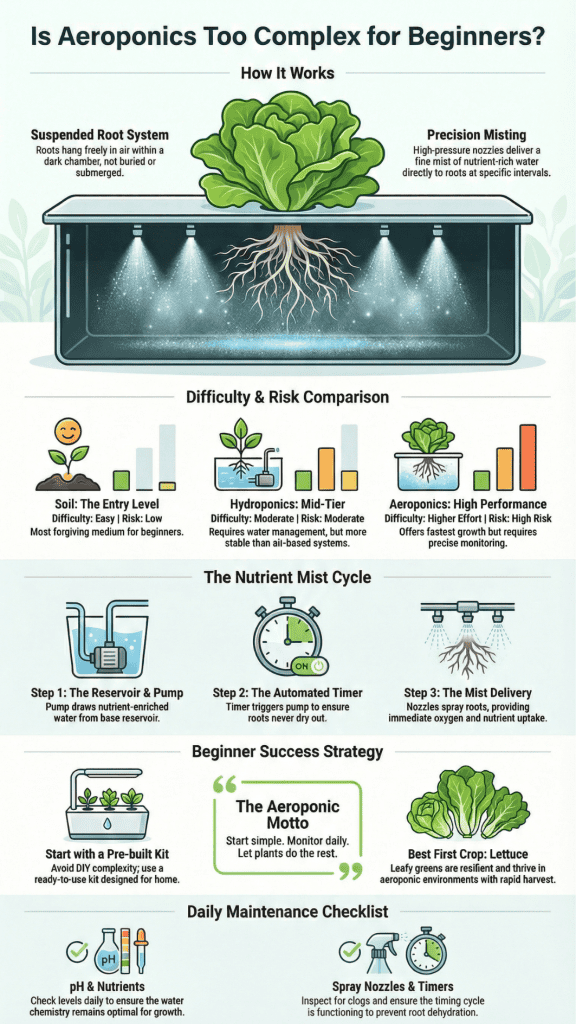
The system itself is straightforward and explains how aeroponics works in practice. A pump sends nutrient mix from a tank to spray nozzles in a dark root chamber. A timer cycles the pump on and off every few minutes.
That’s the whole cycle. You’ll need to check timers, spray nozzles, pH and nutrient levels regularly. Problems start at every connection. Minerals in the water can crust over the tiny nozzle holes.
A fragment of root or gunk can block a line. The pump might get airlocked. These are plumbing failures, not deep gardening secrets.
But equipment isn’t the only thing beginners struggle with. Unlike soil or even some hydroponic systems, aeroponics gives plants no cushion if conditions drift.
This sensitivity is a hallmark of the method, “Aeroponics rewards precision, while hydroponics rewards consistency. … It’s cleaner, highly efficient, and uses even less water than hydroponics. But it’s also more sensitive to errors.” -Hydroponics 360 [1]
Monitoring both equipment performance and plant health indicators (leaves, color, root vigor) is essential, because plants signal problems early.
Many think they need botany knowledge first. What you actually need is to know your pump’s flow rate and your nozzle’s spray size. You need to learn how to disassemble the spray manifold to clean it.
The Daily Checks You Can’t Skip

You can’t just set it up and walk away, not at the start. A five-minute daily routine stops most problems before they happen. Because there’s no soil or growing medium to stabilize conditions, nutrient levels can shift faster than beginners expect.
As another beginner guide explains, “Because there is no growing medium, the pH levels and EC readings of the nutrient reservoir are very unstable. You will spend a lot of time constantly monitoring pH and EC. This also makes the growing process more tricky to truly do well.” – Urban Vine Blog [2]
- Watch the mist. Is it a fine fog or heavy droplets? Big droplets mean a clog is forming.
- Feel the water tank. Is it cool? Warm water holds less oxygen and can cause root rot.
- Listen. Is the pump turning on and off with the timer? That steady click and hum is what you want to hear.
You do these checks like locking your front door. It becomes automatic. Even once experienced, missing checks regularly still poses risk; consistent habits are best. The plants will show you early warning signs, but routine monitoring matters.
A slight afternoon droop could mean the mist cycles are too far apart. Bright green leaf tips often mean the nutrient mix is correct. You begin to understand the system. It communicates.
Aeroponics Compared to Other Methods
Let’s be clear. For the easiest start, use a pot and some soil. Nothing is more forgiving. But you’re here because you want something else. Faster growth, less dirt, maybe to grow food in a small apartment. That’s where hydroponics and aeroponics come in.
| Growing Method | Difficulty for Beginners | Risk if System Fails | Growth Speed | Maintenance Level | Best For |
| Soil Gardening | Very easy | Low – plants can survive missed watering | Slow to moderate | Low | Traditional gardening and low effort growing |
| Hydroponics (DWC) | Moderate | Medium – plants have some buffer time | Fast | Moderate | Beginners wanting faster growth with less risk |
| Aeroponics | Higher but manageable | High – roots can dry quickly without mist | Very fast | Higher – requires regular checks | Growers wanting speed, efficiency, and compact systems |
Hydroponics, like a Deep Water Culture bucket, is the middle option. The roots sit in nutrient-rich water, with an air stone adding oxygen. It’s simpler than aeroponics. If the pump fails in a DWC system, you might have a day before plants struggle. In aeroponics, you have minutes.
That risk buys you something. Aeroponic roots get the most oxygen from the air and the most nutrients from the mist. The growth speed is surprising. A head of lettuce can finish weeks faster than in soil. Aeroponics is much more water-efficient than soil gardening, though precise savings depend on system design.
The trade-off is straightforward. Hydroponics is easier to run, generally more forgiving for beginners than aeroponics, with slower consequences for mistakes. Aeroponics is more efficient, but it needs a more watchful grower. For a beginner, the question isn’t which one is better. It’s which compromise you’re willing to handle right now.
Your First System: Buy, Don’t Build
The worst mistake a beginner can make is trying to build a high-pressure aeroponics setup from PVC pipes and random parts.
It usually leads to leaks, patchy mist, and a lot of aggravation. DIY can work if you have experience with plumbing and mist systems; beginners often benefit from kits.
DIY high-pressure builds can be complex for beginners; low-pressure kits or fogponics alternatives are easier starts.
Today, the practical choice is to buy a pre-made kit made for beginners. Having a rough idea of aeroponic system cost helps you choose the right size and features, and a beginner-friendly pre-built kit or low-pressure setup reduces complexity.
Think of a Tower Garden or a similar vertical aeroponic tower. Starter kits range from approx. $100 to $600+ depending on size and features. What you’re paying for is the engineering. The timer is pre-set. The pump is correctly matched to the spray nozzles.
The manual tells you exactly which nutrients to use and how much. It removes the guesswork from the “how.” You just follow the steps. You learn on a system that actually functions.
You see what “working correctly” looks like. Later, if you decide to build your own, you’ll have a real example in your mind. You’ll understand the needed pressure and the effective spray pattern.
Starting with a kit is like using training wheels. It lets you learn the feel without constantly crashing. And getting that first harvest of basil or lettuce from the tower will teach you more than any website.
Choose Your First Plants Carefully
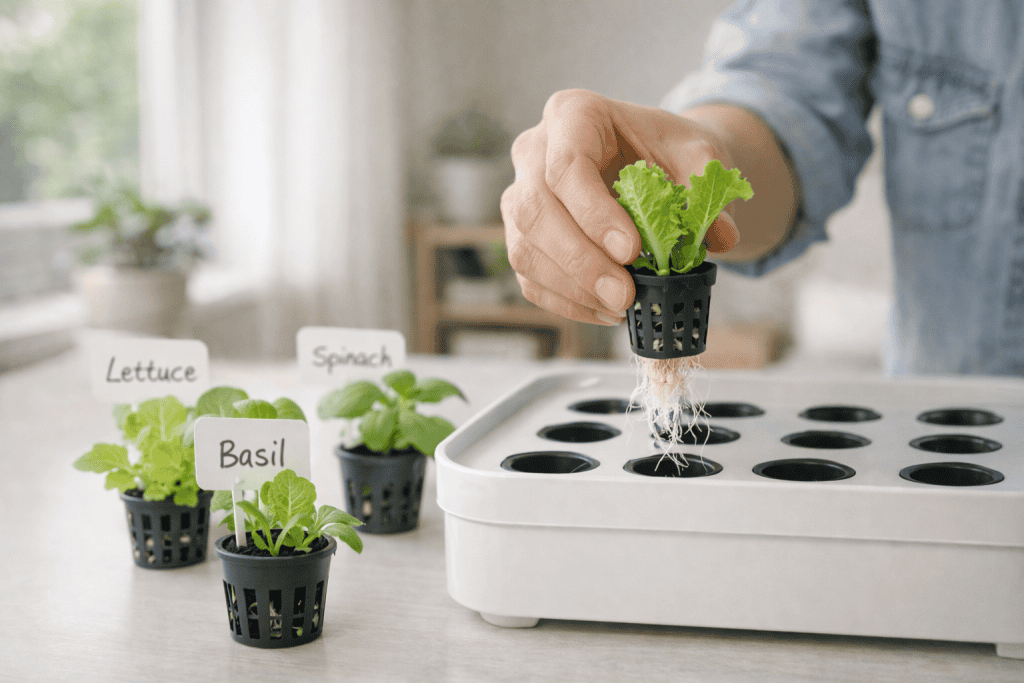
Don’t begin with strawberries or tomatoes. They’re sensitive. Start with plants that are almost like weeds. Leafy greens and herbs are ideal plants for aeroponics and make the best practice runs. Lettuce, kale, arugula, basil, mint.
These plants are resilient. They grow quickly, so you see results. They can tolerate small mistakes in nutrients or pH. If your timer is slightly off, they’ll likely be fine. They give you room to learn.
You see what a healthy, white, fuzzy root ball should look like. You learn how much water they use in a week. You watch how the leaves respond when you change the nutrient mix. It’s a feedback loop with guardrails.
After one or two rounds with lettuce, you gain confidence. You understand the routine. Then you can attempt something like a pepper or a cucumber.
You’ll have the fundamentals. You’ll know the warning signs. Starting with easy plants builds assurance, and in aeroponics, that assurance comes from keeping your first plants alive.
Keep It Simple and Let the Plants Work

Credits: 3D Print & Hydro Lifestyle
So, is aeroponics too complex for a beginner? It can be, if you start by building your own system and aiming for prize-winning tomatoes. But it doesn’t have to be.
The path for a new grower is clear and direct. Buy a kit. Plant lettuce. Do your quick daily checks. Learn the sounds and sights of a system that’s running well.
The perceived complexity fades when you break it into small, repeatable tasks. You aren’t operating a laboratory. It’s not advanced science, but it does require regular monitoring and eagerness to troubleshoot.
You’re running a pump on a timer and keeping things clean. The plants handle the growing. They want to grow. Your main job is to not interfere.
Try it with a small setup. You may find it’s less complicated than it seems.
FAQ
Is aeroponics hard for beginners starting their first home system?
Aeroponics for beginners often looks complicated because roots hang in air and rely on mist. The aeroponics learning curve becomes easier once you understand basic system parts, timer cycles, and nutrient mixing.
Starting aeroponics at home with a small, simple aeroponics setup lets you practice daily checks without feeling overwhelmed or pressured by large scale expectations during your first season.
Is aeroponics harder than hydroponics or soil for new growers?
Comparing aeroponics vs hydroponics difficulty helps beginners set realistic expectations. Aeroponics vs soil gardening requires more attention to equipment and timing, but offers faster growth and better root oxygenation.
Beginner hydroponic alternatives may feel simpler at first, yet indoor aeroponic gardening rewards careful learners who follow routines, track changes, and respond quickly to plant signals with consistent daily observation habits.
What equipment is required for a simple aeroponics setup at home?
A simple aeroponics setup needs a sealed grow chamber setup, a lightproof reservoir, and reliable sprayers and nozzles.
Your aeroponics equipment list should include a pump timer setup, aeroponic net pots, tubing, and a basic grow lights setup.
Strong aeroponics system components make aeroponic root misting consistent and reduce maintenance problems later during long term indoor growing conditions for beginners.
What common mistakes make aeroponics feel more difficult than it actually is?
Many beginner mistakes in aeroponics come from incorrect aeroponics timer cycles and poor aeroponic mist intervals. Skipping aeroponics pH management and ignoring aeroponics water quality can quickly cause nutrient deficiencies.
Common aeroponics mistakes also include preventing clogs in aeroponics too late and neglecting regular aeroponics reservoir cleaning, which leads to root stress and slow growth in small indoor systems especially.
Can beginners maintain aeroponic systems without advanced technical experience?
Maintaining aeroponic systems does not require engineering skills, but it does require consistency. Aeroponic system maintenance involves checking aeroponics nutrient schedule, aeroponics EC levels, and aeroponics temperature control regularly.
Beginners can handle aeroponics automation for beginners, basic aeroponics system monitoring, and simple cleaning routines if they follow a clear aeroponics maintenance checklist during normal indoor growing cycles at home environments.
References:
- https://hydroponics360.com/systems/aeroponics-vs-hydroponics/
- https://www.urbanvine.co/blog/aeroponics
Related Articles:
- https://tophydroponicgarden.com/how-much-does-an-aeroponic-system-cost/
- https://tophydroponicgarden.com/what-plants-can-be-grown-using-aeroponics/
- https://tophydroponicgarden.com/how-does-aeroponics-work/
Was this helpful?

I’m Barrie L., a passionate hydroponic gardening enthusiast dedicated to cultivating thriving, soil-less gardens. With a focus on all things hydroponic, I share my expertise on innovative growing techniques and sustainable practices through my blog, tophydroponicgarden.com. As a seasoned hydroponics specialist, my goal is to inspire and guide fellow gardeners in harnessing the power of water-based cultivation for bountiful and eco-friendly harvests. I’m also an author of the book “Hydroponics For Absolute Beginners: Your Step By Step Guide For How To Create An Hydroponics System At Home Without Soil, For Growing Vegetable, Fruit And Herbs.” which is sold on Amazon. Join me on a journey of redefining the way we cultivate plants, one nutrient-rich solution at a time. Happy growing!