

A good hydroponic strawberry feed needs the right mix of nitrogen, potassium, and calcium, plus micronutrients. Get the formula wrong, and your yield or fruit quality can suffer. The key is managing the nutrient ratios and electrical conductivity (EC) carefully. Let’s break down the exact recipe, how to mix it, and a solid feeding plan for better harvests.
What You’ll Learn: Strawberry Nutrient Essentials
This guide covers the key nutrient targets and feeding tips you need to grow healthier strawberry plants with better results.
- The best pH, EC, and PPM targets for strawberries.
- A practical DIY nutrient solution recipe.
- How to adjust feeding during each growth stage.
Why Hydroponic Strawberries Need a Special Nutrient Solution
Switching a greenhouse to strawberries can be deceptive. The plants are compact, but their nutritional demands are anything but simple. Their lifecycle is defined by sharp physiological shifts.
Early on, the plant prioritizes root growth. Then, it moves into a phase of intense leaf and canopy development. Finally, it switches entirely to fruit production.
Running a single, unchanging nutrient formula straight through these phases is a common mistake. The result is predictable: a greenhouse full of enormous, healthy-looking plants that produce disappointingly small and sour berries. The nutrient strategy must change as the plant changes.
Many beginner growers fall into the trap of using a single fertilizer recipe from clone to harvest. This often happens when they first grow hydroponic strawberries at home and assume one nutrient mix works for every stage.
While the plants might look visually stunning, you will often find that the resulting berries are small, hollow, or completely devoid of flavor.
The underlying issue is almost always an imbalance in your ratios, specifically, an excess of nitrogen.
While nitrogen is essential for building a robust vegetative canopy early on, keeping it high during the fruiting phase forces the plant to waste its energy pushing out new leaves rather than channeling sugars into the fruit.
It is incredibly frustrating to look at a massive, deep-green plant only to finish the season with a disappointing harvest.
Strawberries also respond quickly to nutrient changes. Salt buildup, unstable EC, or poor balance can affect growth faster than many people expect.
The goal is not to give the plant the most nutrients possible.
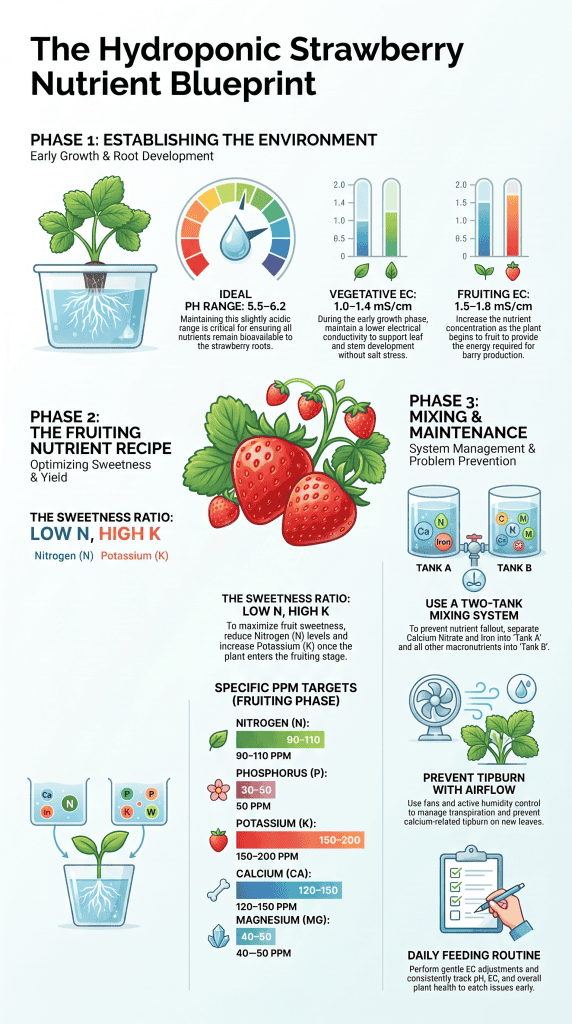
The goal is matching nutrient concentration with plant demand, such as reducing nitrogen during fruiting while increasing potassium to support sugar movement and berry development.
How Do Strawberry Nutrient Needs Change by Growth Stage?
Strawberries do not eat the same way all season.
A young plant needs support for roots and leaves. A fruiting plant needs more help with berry production.
| Growth Stage | Main Goal | Nutrient Priority |
| Vegetative | Root and leaf growth | Controlled nitrogen |
| Flowering | Support flowers | Calcium and balanced nutrients |
| Fruiting | Berry size and sweetness | Higher potassium |
While a baseline strategy of controlling nitrogen, increasing potassium post-bloom, and maintaining constant calcium availability sounds simple, execution is where most growers trip up. The golden rule in a strawberry greenhouse is to avoid sudden shocks to the root zone.
Instead of making drastic, panicked adjustments to your reservoir the moment a leaf tip changes color, you should gently step your EC up or down in increments of no more than $0.1mS/cm per day to allow the root tissue time to adapt to the shifting osmotic pressure.
Strawberries thrive in a tight, slightly acidic pH window; maintaining this stability ensures that critical micronutrients like iron remain fully bioavailable to the root tissue.
What pH and EC Levels Are Best for Hydroponic Strawberries?
Strawberries prefer a slightly acidic nutrient solution with a pH between 5.5 and 6.2. This range helps maintain nutrient availability, especially calcium and iron absorption.
The right pH helps roots absorb nutrients like iron and calcium. If the pH moves too far, some nutrients become harder for the plant to use.
| Parameter | Vegetative Stage | Flowering and Fruiting Stage |
| pH | 5.5 to 6.0 | 5.8 to 6.2 |
| EC | 1.0 to 1.4 mS/cm | 1.5 to 1.8 mS/cm |
| Water Temperature | 18 to 22°C | 18 to 22°C |
Keep checking:
pH after feeding.
EC levels.
Root color.
Leaf condition.
Strawberries are sensitive to strong nutrient solutions. If EC gets too high, roots can struggle.
How Do You Mix a Hydroponic Strawberry Nutrient Solution Recipe Per 100 Liters?

The mixing order affects nutrient availability because calcium nitrate can react with phosphate and sulfate compounds when concentrated together.
When concentrated Calcium Nitrate mixes directly with raw Phosphorus or Sulfates, an immediate chemical reaction occurs called precipitation, the minerals bind together and fall out of the solution as an unabsorbable, chalky white sludge at the bottom of your tank.
Once a mineral precipitates, it is locked out permanently, meaning your plants will starve for calcium no matter what your meters read.
A separate tank method helps avoid this.
The 100-Liter Direct Reservoir Recipe
This specific weight distribution is formulated as a direct-to-reservoir mix for a final 100-liter volume (not a concentrated stock solution).
Tank A (The Calcium/Iron Side): Dissolve 50g of Calcium Nitrate and 2.5g of Fe DTPA iron chelate into 5 liters of warm water. Tank B (The Macronutrient Side): In a separate clean bucket of warm water, completely dissolve 20g Potassium Nitrate, 20g Monopotassium Phosphate, 45g Magnesium Sulfate (Epsom salt), and 2g of your trace mineral mix.
The Routine: Fill your main 100L reservoir halfway with pure water. Pour in your diluted Tank B and stir vigorously. Only after Tank B is fully distributed should you slowly add your diluted Tank A. Let the reservoir aerate for 30 minutes to stabilize before you even touch your pH adjusters.
How Should Growers Mix Nutrients?
Taking an extra ten minutes during the mixing process saves you from having to flush a compromised system later.
By ensuring that your individual concentrated salts are entirely dissolved in water before they ever come into contact with one another, you guarantee that the final solution remains perfectly clear, fully bioavailable, and completely free of chemical fallout.
Why Should Calcium Be Mixed Separately From Other Nutrients?
Calcium helps strawberries build strong leaves, stems, and fruit. A common calcium target for fruiting strawberries is around 120 to 150 ppm in the nutrient solution.
But concentrated calcium can react with other nutrients before the plant gets a chance to use them.
Avoid mixing:
Calcium nitrate with potassium phosphate.
Calcium nitrate with magnesium sulfate.
Instead:
Mix each part separately.
Dilute first.
Combine after that.
This keeps the nutrients available in the solution.
What Nutrient Targets Support Strawberry Flowering and Fruiting?
During fruit production, strawberries usually need moderate nitrogen and more potassium.
A common target range:
| Nutrient | Target Range |
| Nitrogen | 90 to 110 ppm |
| Phosphorus | 30 to 50 ppm |
| Potassium | 150 to 200 ppm |
| Calcium | 120 to 150 ppm |
| Magnesium | 40 to 50 ppm |
Potassium supports:
Berry growth.
Sugar movement.
Fruit quality.
Research from Journal of the American Society for Horticultural Science shows
“Research published in the Journal of the American Society for Horticultural Science on potassium and nitrogen interactions in soilless strawberry production found that 11 mol per cubic meter of potassium in the nutrient solution produced the highest yield and fruit with the best nutraceutical quality, with the ionic concentration of the Universal Steiner’s Nutrient Solution proving the best nutritional option to maximize yield and nutraceutical quality of strawberry fruit.” –
Journal of the American Society for Horticultural Science
But adding extra potassium is not always better.
The growing system changes how plants respond.
A setup using NFT may handle nutrients differently from a DWC system.
Why Generic ‘Bloom’ Nutrients Fail Strawberries
Most off-the-shelf ‘Bloom’ or ‘Flower’ fertilizers are engineered for heavy-feeding, annual canopy plants (like tomatoes or peppers) that demand aggressive spikes in Phosphorus to drive massive flowering sites. Strawberries are entirely different beasts.
They require a highly restricted Phosphorus ceiling (ideally 30 to 50 ppm) paired with an aggressive escalator of Potassium to transport sugars straight into the ripening berries.
If you run a generic bloom mix, you will inadvertently spike your root-zone EC with excess, unabsorbed salts, stunting your berry size and causing severe salt-toxicity leaf burn.
These imbalances rapidly lead to localized calcium deficiencies and weak, aborted flowers. Remember: the root system cares entirely about the exact elemental ionic ratio in the water, not the marketing name printed on the front of the fertilizer jug.
How Can Growers Prevent Strawberry Tipburn?
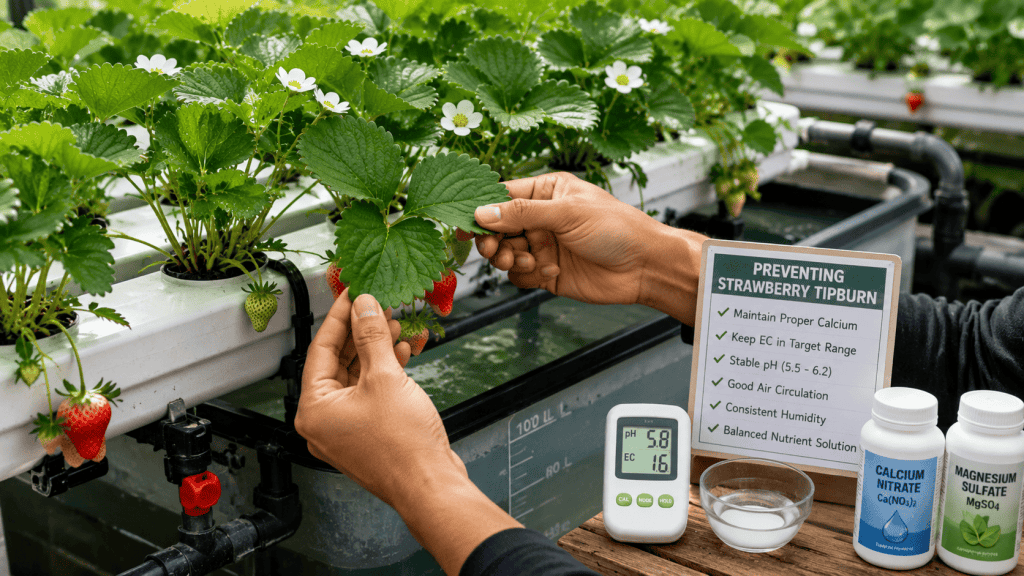
Tipburn usually appears on new growth. Symptom: brown leaf edges. Possible causes: poor airflow, high humidity, unstable EC, or calcium transport problems.
You might see:
Brown leaf edges.
Damaged young leaves.
Dry growing tips.
Seeing tipburn on new leaves often triggers a grower to add more calcium nitrate to the nutrient solution. This is usually a misstep. It can push the electrical conductivity too high and stress the plants further.
When you spot crisp, brown edges creeping onto your fresh, emerging leaves, your gut reaction is probably to dump more Calcium Nitrate into the reservoir. Don’t do it. Nine times out of ten, tipburn is a mechanical airflow problem, not a chemical shortage.
Calcium is a heavy, lazy mineral. It can only move through the plant via transpiration, which is essentially the plant ‘sweating’ water out of its leaves, drawing fresh water and calcium up from the roots like a straw.
At night, or in stagnant, humid air, that sweating stops completely. The calcium stalls in the plumbing and fails to reach the fast-growing leaf tips, causing them to die and turn brown.
By simply hanging a small, oscillating fan to keep a gentle, constant breeze across your canopy, you break up that stagnant air, get the plants breathing again, and naturally pull the calcium exactly where it needs to go.
Insights from e-GRO indicate
“Calcium uptake by plants is primarily driven by transpiration, but in strawberries, young tissues that haven’t emerged rely on a different mechanism for calcium supply, positive root/xylem pressure, which depends on high nighttime humidity rather than calcium concentration alone.” –
e-GRO
Humidity and airflow matter here because they directly affect plant health and many of the long-term benefits of growing strawberries, including healthier foliage and more reliable fruit production.
Try:
Improve airflow.
Keep humidity around 60 to 70%.
Keep roots healthy.
Avoid sudden EC changes.
Healthy roots make nutrient uptake easier.
Should Potassium Be Increased for Sweeter Hydroponic Strawberries?
During fruiting, potassium becomes more important because it supports sugar transport and berry development. Many hydroponic strawberry programs target around 150 to 200 ppm potassium.
It helps move sugars into berries and supports fruit development.
But more potassium does not automatically create sweeter strawberries because different strawberry varieties can respond differently to nutrient levels, fruit load, and growing conditions.
| System | Potassium & Operational Strategy |
| Substrate (Coir/Perlite) | Increase K aggressively up to 220 ppm; the media acts as a buffer against rapid EC spikes. |
| NFT Channels | Step up K by 15% weekly once buds emerge; high flow rates mean roots absorb ions rapidly. |
| DWC / Kratky | Maintain a strict ceiling of 180 ppm K. Because DWC roots sit directly in nutrient water without a buffering medium, sudden potassium increases can quickly change EC and stress roots, and because Deep Water Culture lacks media buffering, any unabsorbed potassium will rapidly alter your root-zone EC, risking chemical burn if water temperatures drift above 22°C. |
DWC growers must maintain strict oxygenation and water temp controls (18-22°C) since root zones lack media buffering.
Changes happen quickly.
Increase slowly.
Watch the plant.
How Should Beginners Adjust Strawberry Nutrients Through the Season?
New growers often make the same mistake.
They increase fertilizer too fast.
It feels logical. More nutrients should mean more growth.
Plants do not always work that way.
| Stage | Focus |
| Early Growth | Build roots |
| Vegetative | Grow leaves |
| Fruiting | Support berries |
Early Growth
Focus on the foundation.
Keep EC moderate.
Support root growth.
Vegetative Stage
Support healthy leaves.
Keep nitrogen controlled.
Too much nitrogen can reduce fruit production.
Fruiting Stage
Support berry growth.
Increase potassium carefully.
Check EC often.
What Water Quality Factors Affect Strawberry Nutrient Solutions?
Source water affects nutrient calculations because calcium, magnesium, and bicarbonates already contribute to the starting EC. Test water before adding fertilizer.
Before adding nutrients, check:
When you mix fertilizer into hard water, watch out. Hard water already has calcium and magnesium dissolved in it.
Adding your usual fertilizer dose on top of that can push the total mineral content, your EC, higher than you planned. The strength of the solution gets away from you.
That’s why you need to keep a log. Seriously, write it down. Note the exact amount of fertilizer you used, any pH shifts, your EC readings, and how the plants look afterward. Having those notes makes fixing things next time a whole lot simpler.
Hydroponic Strawberry Nutrient Recipe Comparison
| Formula Area | Target |
| Vegetative ratio | N P K Ca Mg S: 7.3 2.1 2.5 4.5 2.5 2.5 mEq/L |
| Fruiting ratio | N P K Ca Mg S: 7.0 2.1 4.0 3.0 1.5 1.5 mEq/L |
| pH target | 5.5 to 6.2 |
| Fruit quality target | Research shows a modified Steiner profile at 168 ppm N and 430 ppm K optimizes yield and Brix levels, though this requires a higher EC framework. |
These values are a starting point.
Every system is different.
Water, light, temperature, and growing methods all change the results.
How Can Tophydroponicgarden Growers Build a Reliable Feeding System?
A good nutrient routine comes from testing.
Not guessing.
Follow this process:
Test your water.
Mix nutrients correctly.
Set pH and EC.
Adjust by growth stage.
Track plant changes.
Avoid changing everything at once.
Make one change, then watch.
That way you know what helped.
Examples of Content They Can Create

Credits: Agriculture Academy
Hydroponic strawberry farming is a smart way to grow fruit without soil. In this method, plants get water and nutrients through a special system, which helps them grow in a clean and controlled environment.
Farmers use this approach because it can save space, reduce pests, and produce strawberries more consistently. It also makes it easier to manage plant health and harvest quality fruit. However, hydroponic farming needs the right setup, including good lighting, proper nutrient balance, and regular monitoring.
When done well, it can give strong results and high yields. This method is especially useful in places where land is limited or soil is poor.
For growers who want a modern and efficient farming style, hydroponic strawberries can be a practical choice. The key is to keep conditions stable so the plants can grow well and produce sweet, fresh berries.
FAQ
What nutrients do strawberries need in a hydroponic system?
Strawberries need a balanced combination of nitrogen, phosphorus, potassium, calcium, magnesium, and micronutrients to grow properly in a hydroponic system. The right hydroponic strawberry nutrients support root development, leaf growth, flowering, and fruit production. A strawberry nutrient solution formula should be adjusted based on the plant’s growth stage because each stage requires different nutrient levels. Fruiting strawberries commonly use nitrogen around 90 to 110 ppm, phosphorus 30 to 50 ppm, potassium 150 to 200 ppm, calcium 120 to 150 ppm.
How do I make a DIY hydroponic strawberry nutrient solution at home?
To mix your own solution at home, you need four core technical ingredients: technical-grade calcium nitrate, potassium nitrate, magnesium sulfate (Epsom salt), and a chelated trace element pack. By sourcing these individually, you can adjust individual macronutrients on the fly without triggering salt toxicity or forcing a premature flush. After mixing the nutrients, check the solution concentration, pH level, and EC level before feeding the plants.
What is the best NPK ratio for strawberries in hydroponics?
The NPK ratio for strawberries depends on the plant’s growth stage. Young plants usually need more nitrogen to support leaf and root growth, while flowering and fruiting plants require more potassium and phosphorus. A proper hydroponic strawberry fertilizer ratio helps improve flower development, fruit size, and overall plant health throughout the growing cycle.
How often should I change nutrients in a strawberry hydroponic system?
A strawberry hydroponic fertilizer schedule depends on the system, plant stage, and nutrient conditions. Regularly checking the reservoir helps maintain the right nutrient balance. Growers should monitor pH, EC level, and water quality before making adjustments. Proper hydroponic nutrient reservoir management prevents nutrient problems and supports healthy strawberry growth.
How can I fix nutrient problems in hydroponic strawberry plants?
Nutrient problems in hydroponic strawberries can appear as yellow leaves, slow growth, weak roots, or poor fruit production. Start by checking for strawberry nutrient deficiencies, incorrect pH, low EC levels, or poor water quality. Adjusting hydroponic strawberry nutrients, improving root zone conditions, and following a consistent feeding routine can help plants recover.
Improve Hydroponic Strawberry Harvests Over Time
Growing hydroponic strawberries can become frustrating when plants look healthy but harvest results stay inconsistent. A reliable feeding system tracks pH, EC, nutrient ppm, water temperature, and plant response over time. Small changes in feeding routines and pH checks can help you keep plants on track.
Mastering strawberries requires some experience, but a consistent feeding routine is far more effective than constantly reacting to nutrient problems.
In commercial hydroponics, the most valuable tool often isn’t a special supplement. It’s a detailed daily logbook.
TopHydroponicGarden focuses on data-based hydroponic feeding strategies by using crop cycle records, nutrient measurements, and EC tracking to help growers refine strawberry nutrient programs.
They recommend growers start by tracking daily runoff and electrical conductivity. This practice provides the insight needed to adjust formulas and ultimately improve fruit quality and brix levels.
References
- https://www.mdpi.com/2223-7747/9/4/441
- https://www.e-gro.org/pdf/E601.pdf
Related Articles
- https://tophydroponicgarden.com/benefits-of-growing-strawberries/
- https://tophydroponicgarden.com/best-strawberry-varieties-for-hydroponics/
- https://tophydroponicgarden.com/how-to-grow-hydroponic-strawberries-at-home/
Was this helpful?

I’m Barrie L., a passionate hydroponic gardening enthusiast dedicated to cultivating thriving, soil-less gardens. With a focus on all things hydroponic, I share my expertise on innovative growing techniques and sustainable practices through my blog, tophydroponicgarden.com. As a seasoned hydroponics specialist, my goal is to inspire and guide fellow gardeners in harnessing the power of water-based cultivation for bountiful and eco-friendly harvests. I’m also an author of the book “Hydroponics For Absolute Beginners: Your Step By Step Guide For How To Create An Hydroponics System At Home Without Soil, For Growing Vegetable, Fruit And Herbs.” which is sold on Amazon. Join me on a journey of redefining the way we cultivate plants, one nutrient-rich solution at a time. Happy growing!