

A useful hydroponic herb nutrient schedule chart should follow the plant, not just the calendar. Young seedlings need a lighter nutrient solution, while established herbs can handle stronger feeding as roots and leaves develop.
At Top Hydroponic Garden, we prefer looking at the growth stage together with EC, pH, and reservoir behavior instead of forcing every herb into the same Week 1, Week 2 routine.
This guide breaks down the schedule, herb-specific targets, and the signs that tell you when to adjust feeding.
Keep reading to see how to use the chart without overfeeding or chasing numbers that don’t match the plant.
The Feeding Pattern at a Glance
You don’t need a complicated weekly formula to keep hydroponic herbs fed properly.
- Start gently: Seeds and young seedlings need a weaker solution than established plants.
- Increase by growth stage: Move toward the herb’s normal EC range as roots and foliage develop.
- Measure before adding nutrients: A lower water level does not always mean the reservoir needs more fertilizer.
- Treat the chart as a starting point: pH, source water, plant condition, and EC trends still matter.
Once those four ideas make sense, the rest of the schedule becomes much easier to use.
What Is a Hydroponic Herb Nutrient Schedule?
A hydroponic herb nutrient schedule helps you decide when to begin feeding, when to raise nutrient strength, and when it makes more sense to leave the reservoir alone.
Three readings matter most:
- Nutrient strength: How concentrated the fertilizer solution is.
- EC: A reading that helps estimate the amount of dissolved salts in the water.
- pH: The acidity or alkalinity of the nutrient solution.
The nutrient label and the EC target do different jobs. The label tells you how that particular fertilizer should be mixed. EC helps you check the strength of the finished solution.
Plant age can still be useful for keeping records, but growth stage usually tells you more. Two herbs planted on the same day may not develop at the same pace or need identical feeding.
How Should Nutrient Strength Change by Growth Stage?
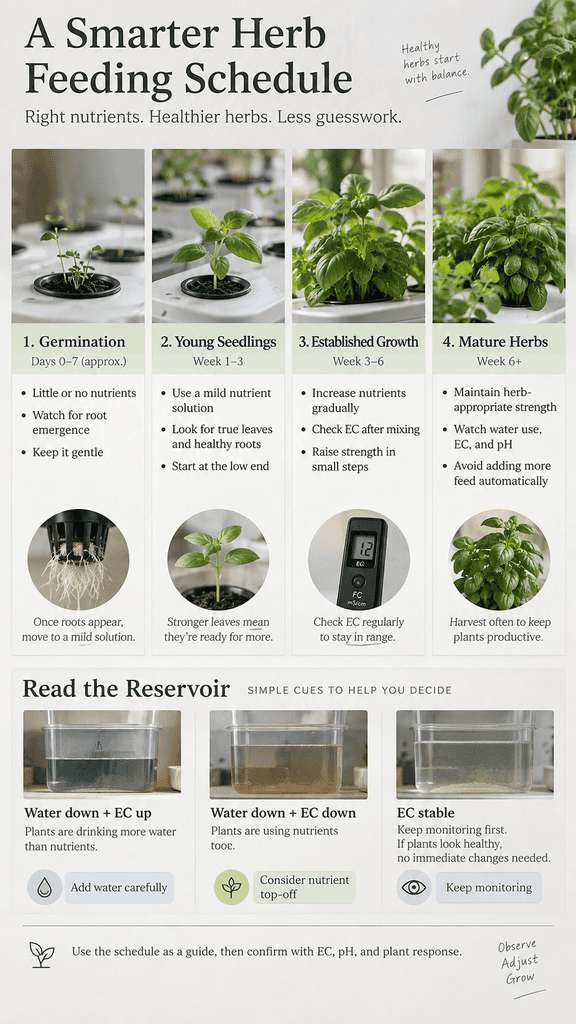
The simplest approach is to begin with very little fertilizer and increase the concentration as the plant establishes a larger root system and more active foliage.
The chart below works better as a progression than a strict calendar.
| Growth Stage | Nutrient Approach | EC Approach | What to Watch |
| Germination | Little or no fertilizer, depending on starter method | Very low | Root emergence and cotyledons |
| Young seedling | Mild nutrient solution | Lower than mature crop range | First true leaves and healthy roots |
| Established plant | Increase gradually | Move toward crop range | Faster leaf and root growth |
| Mature or harvest stage | Maintain crop-specific strength | Normal crop range | Water use and repeated regrowth |
| Stressed or newly transplanted | Avoid automatically increasing feed | Diagnose first | Roots, pH, temperature, and water quality |
The key is the transition between stages.
A young plant doesn’t suddenly need full-strength nutrients because it reached a certain number of days. Look for active roots, new leaves, and stronger water use before increasing concentration.
What EC and pH Should Different Hydroponic Herbs Use?
Hydroponic herbs don’t all prefer the same nutrient strength. Oklahoma State University Extension, for example, lists basil at 1.0 to 1.6 mS/cm, parsley at 1.8 to 2.2 mS/cm, and sage at 1.0 to 1.6 mS/cm. That difference alone is enough reason not to use one universal EC number for every herb.
For herbs without a single widely agreed crop-specific figure, the safest approach is to begin conservatively and adjust from plant response instead of treating an internet range as an exact recipe.
| Herb | Practical pH Range | Established Feeding Approach | Main Consideration |
| Basil | 5.5-6.0 | 1.0-1.6 mS/cm | Increase gradually from seedling strength |
| Mint | Around 5.5-6.5 | Low to moderate strength | Mature plants can use water quickly |
| Cilantro | Around 5.5-6.5 | Low to moderate strength | Avoid pushing stressed or heat-affected plants |
| Parsley | 6.0-6.5 | 1.8-2.2 mS/cm | Can run stronger than basil |
| Chives | Around 5.5-6.5 | Moderate strength | Watch response in shared reservoirs |
| Oregano | Around 5.5-6.5 | Conservative strength | Slow growth does not always mean underfeeding |
| Thyme | Around 5.5-6.5 | Conservative strength | Avoid unnecessarily strong solutions |
| Rosemary | Around 5.5-6.5 | Conservative strength | Root conditions matter as much as feeding |
| Sage | 5.5-6.5 | 1.0-1.6 mS/cm | Keep the solution fairly stable |
Published ranges can vary with cultivar, fertilizer formula, environment, and system design, so use them as working targets rather than perfect numbers.
Why Should You Start at the Lower End of the Range?
Young herbs have smaller roots and less foliage, so they usually need a milder nutrient solution than mature plants.
Increase nutrient strength gradually once you see:
- Several true leaves
- Healthy new roots
- Faster growth
- Higher water use
- No signs of salt stress
Avoid sudden jumps in concentration. Newly rooted cuttings and transplanted seedlings usually respond better to a mild solution that strengthens as they establish.
Use EC together with plant response instead of chasing a number alone. For a crop-specific example, see the hydroponic basil nutrient requirements guide.
Why Can Two Herbs Need Different Nutrient Strength?
Different herbs have different nutrient needs and salt tolerances, so one reservoir setting may not suit every crop equally.
This is especially common in:
- Countertop hydroponic gardens
- Shared DWC reservoirs
- Hydroponic towers
- Systems mixing seedlings with mature plants
When herbs share water, look for overlapping EC ranges rather than pushing every crop toward the same target.
If basil is thriving, that only tells you the conditions work for basil. Cilantro, parsley, or other herbs may still respond differently under the same nutrient strength.
How Do You Use the Nutrient Schedule Without Overfeeding?
Start with the water already going into the reservoir. Then add fertilizer according to the product instructions, mix it completely, measure EC, and make small corrections if needed.
A simple routine works well:
- Check your source-water EC.
- Add nutrients using the product’s correct dilution and mixing order.
- Mix thoroughly.
- Measure the finished EC.
- Adjust the concentration gradually.
- Check pH after the nutrient strength is set.
According to Oklahoma State University Extension,
“The pH of a nutrient solution influences the availability of nutrients, so it should be maintained in the optimum range.” – Oklahoma State University
That is why both readings matter. EC tells you about solution strength, while pH helps determine whether nutrients remain available to the roots.
Why Should You Check the Source Water First?
An EC meter doesn’t separate fertilizer from minerals that were already in your water.
Tap water may contain calcium, magnesium, bicarbonates, sodium, and other dissolved material. If your source water starts at 0.6 mS/cm, that’s very different from starting with water at 0.1 mS/cm.
Checking before mixing gives you a baseline.
Source-water alkalinity can also affect how stable pH remains. Water with higher alkalinity may keep pulling the pH upward after you adjust it.
So before blaming the fertilizer or adding another dose, know what your water contributes to the reservoir in the first place.
Should You Mix Nutrients Before Adjusting EC and pH?
Yes. Follow the fertilizer’s instructions first, then use your meter to see where the finished solution lands.
With multi-part nutrients:
- Dilute each component in the reservoir as directed.
- Mix before adding the next part.
- Don’t combine concentrated Part A and Part B directly.
- Let the solution mix before checking EC.
- Adjust pH after nutrient strength is set.
An EC target such as 1.4 mS/cm is not a universal recipe for a certain number of milliliters.
Different nutrient products can reach the same EC with different mixing rates and nutrient ratios. The chart tells you where you’re trying to land, not how every bottle should be dosed.
How Often Should You Add Nutrients to Hydroponic Herbs?
Don’t add nutrients just because several days have passed.
Hydroponic herbs remove water and dissolved nutrients at different rates. A large mint plant on a warm day may drink enough water to make the remaining solution more concentrated. Another actively growing crop may consume enough nutrients for EC to fall as the reservoir level drops.
That makes water level + EC trend much more useful than a weekly feeding rule.
Before topping off:
- Check the water level.
- Measure EC.
- Look at recent changes.
- Consider the plant’s growth stage.
- Then decide whether the reservoir needs water, nutrient solution, or no correction yet.
What If the Water Level Drops but EC Rises?
When water drops while EC rises, the remaining solution is becoming more concentrated.
The plant may be using proportionally more water than nutrients. Adding another strong nutrient dose at this point can push the concentration even higher.
A better response is to:
- Compare EC with the herb’s normal range.
- Add suitable water gradually if dilution is needed.
- Let the reservoir mix.
- Measure again.
- Adjust pH afterward if necessary.
The Top Hydroponic Garden reservoir top-off guide goes deeper into choosing between plain water and nutrient solution during a top-off.
A falling water line by itself isn’t enough information to make that decision.
What If Both the Water Level and EC Drop?
When water and EC fall together, the plants may be removing nutrients along with the water they use.
A properly mixed nutrient top-off may be useful, but don’t automatically repeat the original fertilizer dose.
Check:
- Current EC
- Crop target
- Remaining reservoir volume
- Recent top-offs
- Plant and root condition
Add the solution gradually and retest once everything is mixed.
If EC returns to a reasonable range, stop there. More nutrient isn’t automatically better just because the plant is growing quickly.
What If EC Barely Changes?
A fairly stable EC can mean water and nutrient use are staying reasonably balanced.
If the herbs look healthy, don’t make a correction just because another feeding day appears on your calendar.
Instead, keep an eye on:
- pH
- Root appearance
- Water temperature
- New growth
- Remaining reservoir volume
Trends are more useful than isolated readings.
Writing down a few readings over several days can tell you whether the reservoir is genuinely stable or simply changing too slowly to notice in one check. That saves you from correcting a nutrient solution that didn’t actually need fixing.
When Should You Replace the Nutrient Solution Instead of Topping It Off?

Top-offs help restore water or overall nutrient strength, but they can’t tell you exactly how much of each individual nutrient remains in the reservoir.
Plants don’t take up every element at the same rate. Source water may also keep introducing additional minerals each time you refill the system.
As noted by Meselmani,
“the composition of the solution must reflect the uptake ratio of individual elements by the crop.” – Meselmani, 2022
A full reset becomes worth considering when:
- EC or pH becomes unusually difficult to control.
- You’ve made many top-offs without changing the solution.
- Plant symptoms continue despite reasonable readings.
- Salt or residue has built up.
- You need a clean baseline for troubleshooting.
There’s no need to turn one replacement interval into a rule for every reservoir size and system.
How Should Feeding Change After Harvesting or Pruning Herbs?
Repeatedly harvested herbs don’t return to the seedling stage every time you cut them.
A mature basil or mint plant may lose plenty of foliage during harvest while still keeping a large, established root system. Dropping the nutrient solution back to seedling strength usually isn’t necessary.
After a heavier harvest:
- Keep nutrient strength reasonably steady.
- Avoid sudden increases or reductions.
- Watch the next flush of growth.
- Note how water use changes.
- Check whether older roots still look healthy.
If an aging herb has crowded roots, weak regrowth, or repeated problems, restarting with a younger plant may eventually make more sense.
The goal after pruning is stable recovery, not forcing faster regrowth with an aggressive fertilizer increase.
What If the EC Reading and the Plant Don’t Agree?
This is where a nutrient schedule stops being a recipe and becomes a troubleshooting tool.
A plant can look deficient while the reservoir already has a high EC. Another may look perfectly healthy while running slightly outside a published target.
Before changing fertilizer strength, look at the whole root environment:
- pH
- Root condition
- Water temperature
- Oxygen in water-based systems
- Starting-water EC
- Recent nutrient additions
A meter is useful, but it can’t tell you everything happening around the roots.
When the plant and the number seem to disagree, investigate first. Increasing fertilizer is only one possible response, and often not the first one worth trying.
Why Can EC Be High While the Plant Looks Deficient?
High EC means plenty of dissolved salts are present. It doesn’t prove every required nutrient is available in the right balance.
Before adding more fertilizer, check for:
- pH outside the useful range
- Damaged or unhealthy roots
- High reservoir temperature
- Poor oxygenation
- High source-water EC
- Recent overfeeding
This is one reason nutrient problems can feel confusing. A plant may show pale leaves or poor growth even when the reservoir already contains plenty of fertilizer.
If that pattern sounds familiar, the guide to fixing nutrient lockout in hydroponics covers the problem in more detail.
Adding another dose before checking these conditions can make an already concentrated reservoir harder to correct.
Why Might EC Keep Falling Quickly?
Fast EC decline can happen when large, actively growing plants are sharing a relatively small amount of nutrient solution.
Repeated harvesting can also trigger fresh growth, increasing demand again.
Instead of immediately doubling fertilizer strength, consider:
- Checking EC more often
- Increasing reservoir volume
- Making smaller nutrient corrections
- Watching water use
- Refreshing the solution when needed
A small reservoir changes faster because each day’s uptake represents a larger portion of the total solution.
The goal isn’t to make EC stop moving. It’s to keep the changes understandable and within a range the crop can handle.
Why Does pH Keep Rising After Adjustment?
Repeated pH rise isn’t always solved by adding more pH-down.
Source-water alkalinity can push the solution upward again. Nutrient uptake and other changes inside an older reservoir can also affect pH over time.
Check how quickly the rebound happens.
If the number climbs again shortly after every correction, look at:
- Source-water alkalinity
- Reservoir age
- Recent top-offs
- Nutrient concentration
- Root condition
A fresh nutrient solution can give you a cleaner baseline.
If the same pattern returns quickly, the starting water deserves more attention than another round of repeated pH adjustments.
Can Several Herbs Share One Nutrient Schedule?

They can, but the easiest combinations are herbs with reasonably similar nutrient and pH needs.
Problems become more likely when one reservoir contains plants with very different growth stages or feeding preferences. A small seedling and a large mature herb may technically be the same species, yet still place very different demands on the reservoir.
When sharing a system:
- Look for overlapping EC and pH ranges.
- Keep similar growth stages together when possible.
- Avoid pushing the whole reservoir toward the strongest feeder.
- Watch the more sensitive crop closely.
- Separate plants if the compromise stops working.
Basil growing well doesn’t automatically mean parsley, cilantro, rosemary, or another herb is equally comfortable.
Sometimes separate reservoirs are simpler than constantly trying to find one number that satisfies every plant.
What Nutrient Schedule Mistakes Should You Avoid?

Credits: New Agrarian
Most mistakes happen when the chart is treated as a rule instead of a guide.
Watch out for these habits:
- Feeding strictly by calendar without checking EC
- Giving seedlings mature-plant nutrient strength
- Ignoring source-water EC
- Adding fertilizer every time the water level falls
- Assuming good EC means every nutrient is perfectly balanced
- Mixing concentrated nutrient parts directly together
- Comparing PPM readings without knowing the conversion scale
- Increasing fertilizer whenever leaves look pale
- Forcing every herb in a mixed reservoir toward the same target
Constant correction can become a problem too.
If the plant looks healthy and readings are moving gradually, give the system time before changing something again. Stable growing conditions are usually more useful than chasing one perfect number all day.
FAQ
Can Basil, Mint, Cilantro, and Parsley Use the Same Nutrient Solution?
Sometimes. They can share a reservoir if their EC and pH ranges overlap, but parsley may prefer a stronger solution than basil. If one herb consistently struggles, separate reservoirs may be easier.
Should You Follow the Nutrient Bottle Schedule or the EC Chart?
Use both. Follow the product instructions for mixing, then use EC to check whether the finished solution suits the crop and growth stage.
Do You Add Nutrients Every Time You Top Off a Reservoir?
No. Check EC first. Rising EC may call for plain water, while falling EC can indicate that a nutrient top-off is more appropriate.
Is PPM the Same as EC in Hydroponics?
Not exactly. PPM is usually calculated from EC using a conversion factor, and different meters may use different scales. EC is generally easier for comparing nutrient guides.
Do Hydroponic Herbs Need Cal-Mag With Every Feeding?
No. A complete hydroponic fertilizer or source water may already provide enough calcium and magnesium. Add Cal-Mag only when the nutrient formula, water quality, and plant symptoms suggest it is needed.
What Should Guide Your Herb Feeding From Here?
A good hydroponic herb nutrient schedule chart gives you a starting point, not a dose you have to follow blindly. Match nutrient strength to the herb and growth stage, then use EC, pH, water use, and plant condition to decide what actually needs changing.
For more crop-specific nutrient and reservoir guides, you can check Top Hydroponic Garden as you fine-tune your own setup.
The simplest rule is still the most useful: feed gradually, measure before adjusting, and let healthy new growth show you whether the schedule is working.
References
- https://extension.okstate.edu/fact-sheets/electrical-conductivity-and-ph-guide-for-hydroponics
- https://www.intechopen.com/chapters/80089
Related Articles
- https://tophydroponicgarden.com/hydroponic-basil-nutrient-requirements/
- https://tophydroponicgarden.com/how-to-top-off-your-hydroponic-reservoir/
- https://tophydroponicgarden.com/how-to-fix-nutrient-lockout-in-hydroponics/
Was this helpful?

I’m Barrie L., a passionate hydroponic gardening enthusiast dedicated to cultivating thriving, soil-less gardens. With a focus on all things hydroponic, I share my expertise on innovative growing techniques and sustainable practices through my blog, tophydroponicgarden.com. As a seasoned hydroponics specialist, my goal is to inspire and guide fellow gardeners in harnessing the power of water-based cultivation for bountiful and eco-friendly harvests. I’m also an author of the book “Hydroponics For Absolute Beginners: Your Step By Step Guide For How To Create An Hydroponics System At Home Without Soil, For Growing Vegetable, Fruit And Herbs.” which is sold on Amazon. Join me on a journey of redefining the way we cultivate plants, one nutrient-rich solution at a time. Happy growing!