
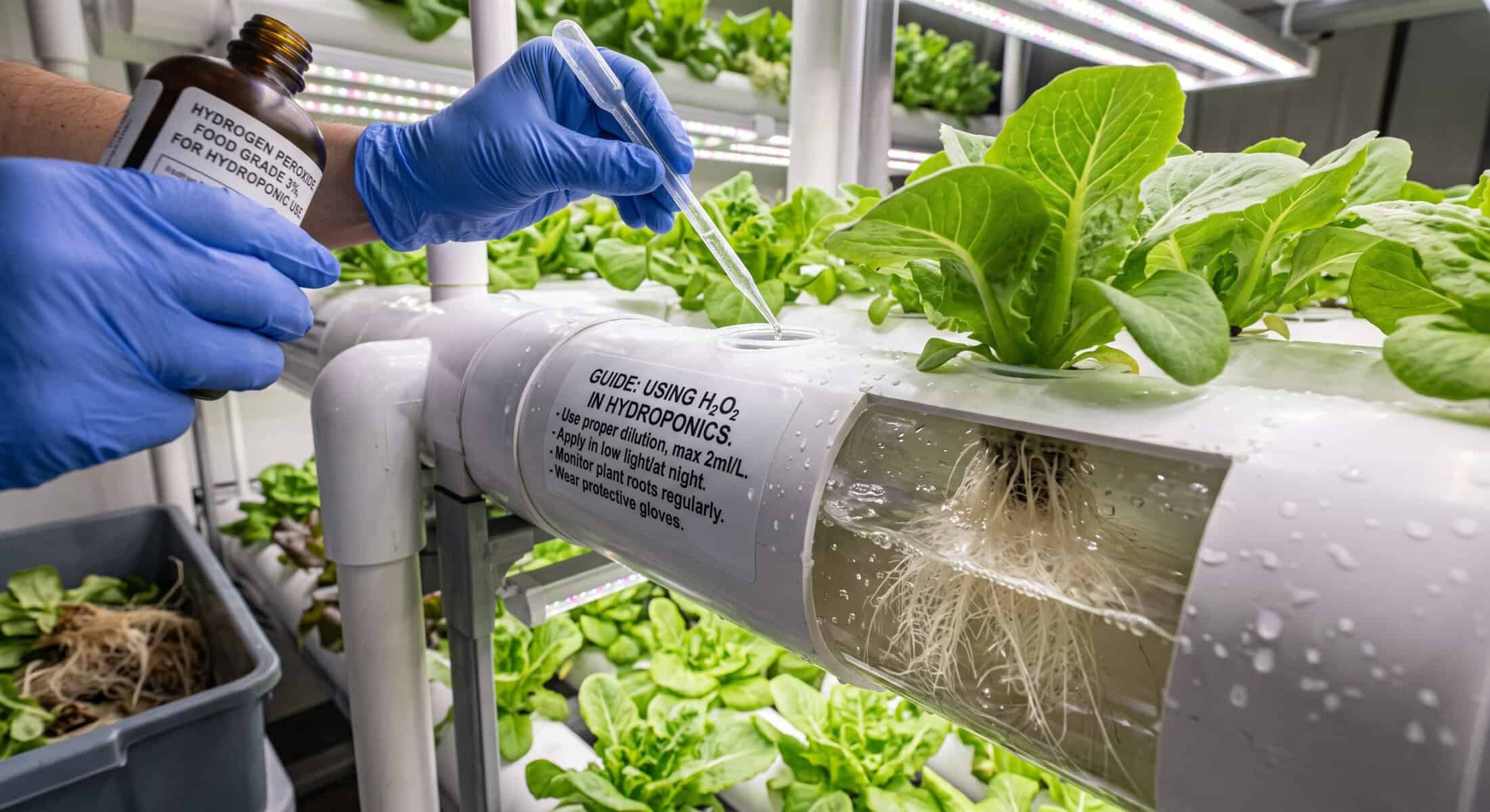
Hydrogen peroxide is sometimes used by hydroponic growers as a tool for managing oxygen, algae, microorganisms, and system cleanliness.
Because hydroponic plants depend directly on water and nutrient solution, maintaining a healthy root environment is essential. Issues such as poor oxygenation, algae buildup, and unhealthy roots can quickly affect plant growth.
Hydrogen peroxide can be useful in certain situations because it breaks down into water and oxygen and has oxidizing properties. However, the concentration and application method matter considerably.
Using too much hydrogen peroxide can damage plants, particularly sensitive crops and seedlings. Research has also shown that its effectiveness against algae is not universal.
Whether you are maintaining a small home system or a larger hydroponic setup, understanding how to use hydrogen peroxide in hydroponics can help you make more informed decisions about when it is appropriate and when other solutions are better.
UNDERSTANDING HYDROGEN PEROXIDE IN HYDROPONICS
Hydrogen peroxide can be used in several ways within hydroponic systems, but its purpose should be clearly understood before it is added to a nutrient reservoir.
- Understand How Hydrogen Peroxide Works. Learn how H₂O₂ breaks down into water and oxygen and why its oxidizing properties matter in hydroponics.
- Explore Different Applications. Discover how hydrogen peroxide may be used for oxygen support, algae management, and system sanitation.
- Protect Plant Roots. Learn why concentration, crop sensitivity, and application frequency are important when using hydrogen peroxide.
What Is Hydrogen Peroxide?
Hydrogen peroxide is a chemical compound with the formula H₂O₂.
It contains one more oxygen atom than ordinary water, H₂O. Because of this structure, hydrogen peroxide can break down into water and oxygen.
The reaction can be represented as:
2H₂O₂ → 2H₂O + O₂
This oxygen release is one reason hydrogen peroxide has attracted attention in hydroponics.
Hydrogen peroxide is also an oxidizing agent. It can react with organic materials and microorganisms in the growing environment.
This means that hydrogen peroxide may affect unwanted microorganisms, but it can also affect beneficial microorganisms that some hydroponic systems intentionally maintain.
The National Pesticide Information Center explains that hydrogen peroxide is a strong oxidizer and that its decomposition produces water and oxygen.
“Hydrogen peroxide is a strong oxidizer.” — National Pesticide Information Center
Why Use Hydrogen Peroxide in Hydroponics?
Hydroponic growers may consider hydrogen peroxide for several different reasons.
Some applications include:
- Supporting oxygen availability
- Managing algae
- Cleaning hydroponic equipment
- Reducing organic buildup
- Supporting root-zone management
However, hydrogen peroxide should not automatically be added whenever a plant looks unhealthy.
Problems such as yellow leaves, brown roots, or slow growth can have many causes, including nutrient imbalance, inappropriate pH, excessive temperature, poor aeration, or disease.
Before using hydrogen peroxide, identify the underlying problem.
For more information about maintaining the basic conditions of a hydroponic system, explore this guide on how hydroponics works to understand how water, nutrients, and oxygen work together.
How Does Hydrogen Peroxide Work in Hydroponics?
Hydrogen peroxide works through two primary properties.
First, it decomposes into water and oxygen.
Second, it acts as an oxidizing agent that can react with organic compounds and microorganisms.
The effect of hydrogen peroxide depends on several factors:
| Factor | Why It Matters |
| Concentration | Higher concentrations can increase the risk of plant damage |
| Plant species | Different crops have different tolerances |
| Plant age | Young plants and seedlings can be more sensitive |
| Water chemistry | pH and other water properties can influence decomposition |
| Organic matter | Organic material can consume hydrogen peroxide |
| Microorganisms | Beneficial and unwanted organisms may both be affected |
| Application frequency | Repeated exposure may increase plant stress |
Research published in Horticulturae found that hydrogen peroxide products could affect plant growth at higher treatment levels, while the effects on algae varied depending on the treatment and conditions.
Benefits of Using Hydrogen Peroxide in Hydroponics
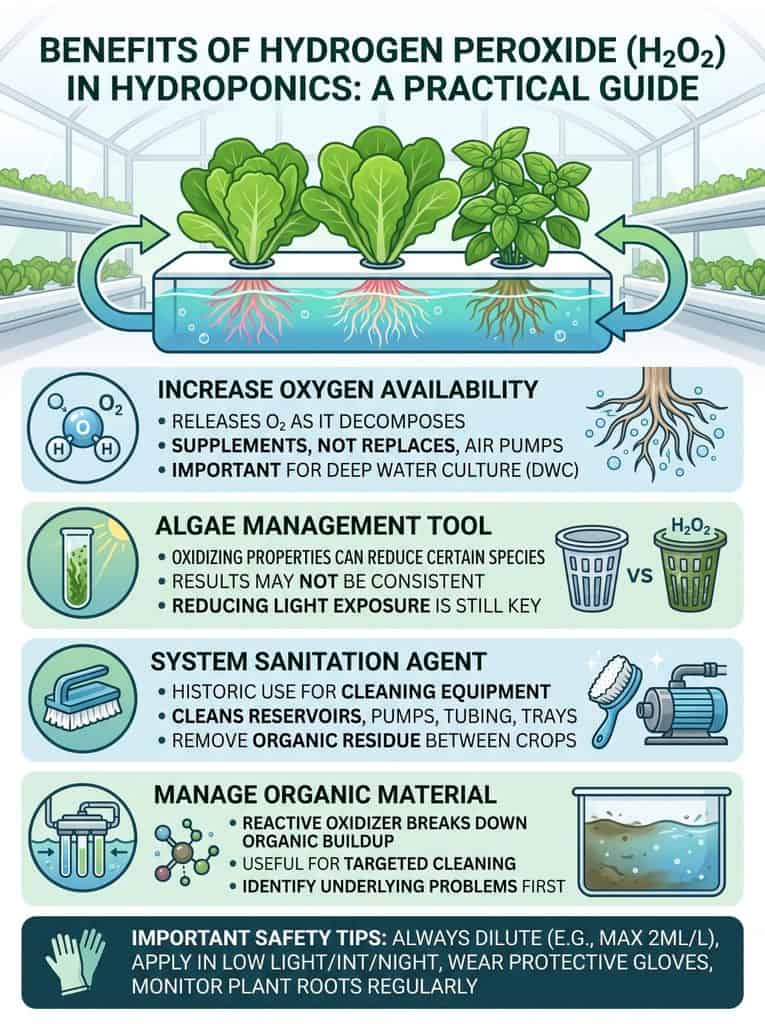
Hydrogen peroxide can have several potential uses in hydroponic systems.
However, these benefits should be considered alongside the potential risks.
1. May Increase Oxygen Availability
Plant roots require oxygen for respiration.
In systems such as deep water culture, roots can remain continuously exposed to nutrient solution, making oxygen management particularly important.
Hydrogen peroxide can release oxygen as it decomposes.
However, this does not mean it should replace an air pump or air stone.
Proper aeration provides a continuous method of supplying oxygen to the nutrient solution, while hydrogen peroxide decomposes over time.
If you are troubleshooting oxygen-related root problems, understanding the relationship between oxygen and root health is important. This guide on why hydroponic plants die also discusses root oxygen, water conditions, and other common causes of plant stress.
2. May Help With Algae Management
Algae can grow when light reaches nutrient-rich hydroponic water.
It can accumulate around:
- Reservoirs
- Net pots
- Growing channels
- Tubing
- Exposed root areas
Hydrogen peroxide has been investigated as an algae-management option because of its oxidizing properties.
However, research has shown that the results are not necessarily consistent.
A study of hydrogen peroxide products in an ebb-and-flow hydroponic system found that the treatments did not significantly affect overall algae growth based on algae dry weight, cell number, or chlorophyll-a measurements. Some individual algae species were reduced, however.
This means hydrogen peroxide should not be treated as a guaranteed algae solution.
Reducing light exposure to the nutrient solution remains an important part of algae prevention.
3. Can Be Used for System Sanitation
Hydrogen peroxide can also be used in some hydroponic sanitation applications. This is particularly relevant when cleaning equipment between growing cycles.
According to research published in Horticulturae, hydrogen peroxide has a long history of use as a sanitation agent:
“Hydrogen peroxide has been used as a sanitation agent for many years.” — Horticulturae, MDPI
The study also examined hydrogen peroxide products in an ebb-and-flow hydroponic system and evaluated their effects on basil, lettuce, and algae. This makes hydrogen peroxide relevant to hydroponic sanitation, although its concentration and application method need to be carefully controlled.
Equipment that may require cleaning includes:
- Reservoirs
- Pumps
- Tubing
- Growing trays
- Containers
- Irrigation components
The purpose of sanitation is to remove organic residue and reduce contamination before starting another crop. Always follow the product label and appropriate safety instructions when using hydrogen peroxide for sanitation.
4. May Help Manage Organic Material
Because hydrogen peroxide is an oxidizer, it can react with organic materials.
This property can make it useful for certain cleaning and sanitation applications.
However, cloudy water or organic buildup should first be investigated.
Adding hydrogen peroxide without identifying the cause may simply treat the symptom rather than correct the underlying problem.
Hydrogen Peroxide vs Aeration in Hydroponics
Hydrogen peroxide and aeration serve different purposes.
| Feature | Hydrogen Peroxide | Aeration |
| Oxygen source | Chemical decomposition | Air introduced into water |
| Oxygen supply | Temporary | Continuous while operating |
| Equipment | Not required | Air pump and diffuser |
| Effect on microorganisms | Can affect microorganisms | Primarily changes oxygen availability |
| Main purpose | Supplemental treatment | Oxygen management |
Neither approach should be confused with the other.
If a hydroponic system has insufficient oxygen, improving aeration, water movement, temperature control, and system design should generally be considered before relying on hydrogen peroxide.
How to Use Hydrogen Peroxide in Hydroponics
Using hydrogen peroxide requires more care than simply adding a fixed amount to a reservoir.
The appropriate application depends on:
- Hydrogen peroxide concentration
- Reservoir volume
- Plant species
- Plant age
- Hydroponic system
- Water chemistry
- Purpose of treatment
Research has used different hydrogen peroxide products and concentrations under controlled conditions, so experimental rates should not automatically be treated as a universal home-hydroponic recipe.
1. Identify the Problem
Start by determining why you are considering hydrogen peroxide.
For example:
Low oxygen: Check aeration, water temperature, circulation, and dissolved oxygen.
Algae: Look for light reaching the reservoir or exposed nutrient solution.
Brown roots: Check root texture, smell, oxygenation, and water conditions.
Poor growth: Check pH, EC, nutrients, temperature, lighting, and root health.
The cause should be addressed before adding a chemical treatment.
2. Check the Product Concentration
Hydrogen peroxide products can have different concentrations.
Household hydrogen peroxide is commonly sold at relatively low concentrations, while commercial agricultural products may be much stronger.
The concentration printed on the label is therefore important.
Do not copy the volume used by another grower unless the product concentration and application conditions are comparable.
3. Consider Your Growing System
Different hydroponic systems have different root environments.
For example:
- DWC keeps roots exposed to nutrient solution for long periods.
- NFT continuously moves a thin film of nutrient solution through channels.
- Ebb and flow periodically floods and drains the root zone.
- Kratky relies on a passive air gap as the water level decreases.
These differences influence oxygen availability and root exposure.
4. Follow the Product Label
If using a commercial hydrogen peroxide product, follow the manufacturer’s instructions.
Do not assume that all hydrogen peroxide products can be applied in the same way.
Some products may also contain other active ingredients.
5. Monitor the Plants
After application, observe the system rather than immediately repeating the treatment.
Check:
- Root appearance
- Root texture
- Leaf condition
- Plant growth
- Water clarity
- pH
- EC
- Dissolved oxygen when available
If the plants begin showing signs of stress, reassess the treatment.
How Much Hydrogen Peroxide Should You Use?
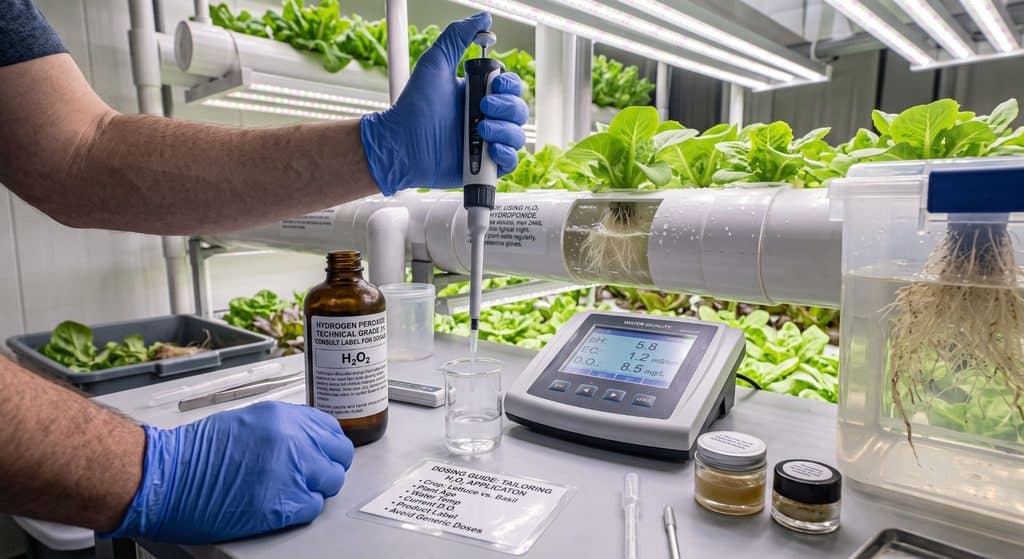
There is no single dosage that is appropriate for every hydroponic system.
This is because hydrogen peroxide concentration, crop type, plant age, water chemistry, and treatment purpose can all change the response.
A study involving lettuce and basil tested different hydrogen peroxide products and application rates in an ebb-and-flow system. Higher treatment levels of some products restricted lettuce growth, demonstrating why dosage cannot be separated from crop and product conditions.
For this reason, avoid treating a generic measurement such as “X mL per gallon” as universally safe.
Instead, use the specific product label and consider the crop and system conditions.
Can Hydrogen Peroxide Harm Hydroponic Plants?
Yes.
Hydrogen peroxide can have phytotoxic effects when used at excessive concentrations.
Research on lettuce and basil found that higher hydrogen peroxide treatments could restrict plant growth, with lettuce showing greater sensitivity than basil under the tested conditions.
Potential signs of plant stress include:
- Reduced growth
- Root damage
- Wilting
- Leaf discoloration
- Reduced biomass
Young seedlings may be particularly sensitive.
More hydrogen peroxide does not necessarily mean better results.
Hydrogen Peroxide and Hydroponic Roots
Healthy roots are one of the most important indicators of a functioning hydroponic system.
Before adding hydrogen peroxide, inspect the roots.
Healthy roots are generally:
- Firm
- Light-colored
- Free from excessive slime
- Free from foul odors
Brown roots do not automatically mean root rot.
Root color can be influenced by nutrients, organic compounds, or other factors.
Texture and smell are also important indicators.
If the roots are soft, slimy, or foul-smelling, investigate the root-zone environment before deciding on a treatment.
Does Hydrogen Peroxide Kill Beneficial Bacteria?
It can affect microorganisms.
Because hydrogen peroxide is an oxidizing agent, it does not necessarily distinguish between microorganisms that a grower considers beneficial and those considered unwanted.
This matters if you are using a hydroponic system that intentionally relies on beneficial microbial populations.
A sterile system and a biologically active system may therefore require different management strategies.
Understanding your system’s biological approach is important before using an oxidizing treatment.
Hydrogen Peroxide for Root Rot
Hydrogen peroxide is often discussed as a possible solution for root rot.
However, root rot is usually associated with broader root-zone conditions.
Potential contributing factors include:
- Low oxygen
- Excessive water exposure
- High water temperature
- Poor sanitation
- Root damage
- Pathogens
If roots are unhealthy, start by checking the environment.
Improving aeration and correcting water conditions may be more important than simply adding hydrogen peroxide.
For additional guidance, see this article about reviving a dying hydroponic plant, which covers water, roots, oxygen, and other common causes of hydroponic plant decline.
Hydrogen Peroxide for Algae
Hydrogen peroxide may affect algae, but prevention should remain the first step.
Start by limiting the conditions that allow algae to thrive.
These include:
- Light reaching the reservoir
- Exposed nutrient solution
- Organic buildup
- Poor system hygiene
Research found that hydrogen peroxide did not significantly reduce overall algae growth in the tested ebb-and-flow hydroponic system, although some individual algae species were reduced.
This suggests that growers should not rely on hydrogen peroxide alone.
Covering reservoirs and preventing light exposure can be a more fundamental part of algae management.
Using Hydrogen Peroxide in Different Hydroponic Systems
- Deep Water Culture
DWC systems keep plant roots in nutrient solution, so oxygen management is particularly important.
Air pumps and air stones are commonly used to maintain oxygen levels.
Hydrogen peroxide should not be considered a replacement for continuous aeration.
- Nutrient Film Technique
NFT systems move a thin film of nutrient solution through growing channels.
Water movement and root exposure influence oxygen availability.
A reliable pump and appropriate flow are important for maintaining the root environment.
- Ebb and Flow
Ebb-and-flow systems periodically flood the growing area before allowing the nutrient solution to drain.
Hydrogen peroxide has been specifically studied in this type of hydroponic system, including its effects on lettuce, basil, and algae.
- Kratky
The Kratky method relies on passive oxygen availability as the nutrient solution level falls.
Because it does not use continuous aeration, growers should understand the system’s oxygen dynamics before introducing additional chemicals.
Common Mistakes When Using Hydrogen Peroxide in Hydroponics
1. Using Too Much
A higher concentration does not automatically produce better results.
Excessive hydrogen peroxide can damage plants.
2. Copying Another Grower’s Dosage
Different products have different concentrations and formulations.
A rate used in one experiment may not be appropriate for another crop or system.
3. Replacing Aeration
Hydrogen peroxide should not be used as a shortcut for inadequate oxygenation.
Fix the underlying aeration problem first.
4. Treating Brown Roots Without Diagnosing Them
Brown roots are not always diseased.
Check texture, smell, water temperature, and oxygen conditions before deciding on treatment.
5. Using It in a Beneficial-Microbe System Without Considering the Effects
Hydrogen peroxide can affect microorganisms.
Know whether your system is designed around beneficial microbes or a more sterile approach.
Safety Tips When Handling Hydrogen Peroxide
Hydrogen peroxide should be handled carefully.
When using the product:
- Read the label carefully.
- Follow the manufacturer’s directions.
- Avoid contact with eyes and skin.
- Use appropriate protective equipment when required.
- Store the product correctly.
- Keep it away from children and pets.
- Do not mix it casually with other chemicals.
Higher-concentration hydrogen peroxide products require additional care.
Frequently Asked Questions About Hydrogen Peroxide in Hydroponics
1. Can you use hydrogen peroxide in hydroponics?
Yes. Hydrogen peroxide has been studied and used in hydroponic applications involving sanitation, oxygen support, and algae management. However, its safety and effectiveness depend on concentration, crop, and system conditions.
2. Does hydrogen peroxide replace an air pump?
No. Hydrogen peroxide can release oxygen as it decomposes, but it does not provide the same continuous oxygenation as an air pump and diffuser.
3. Can hydrogen peroxide damage hydroponic roots?
Yes. Excessive concentrations can cause plant stress and reduce growth. Research has shown that higher treatment levels affected lettuce growth under experimental conditions.
4. Does hydrogen peroxide kill algae in hydroponics?
It can affect some algae, but it is not guaranteed to eliminate algae from a hydroponic system. Research found no significant overall algae-growth effect from the tested treatments, although some individual algae species were reduced.
5. How much hydrogen peroxide should I add to hydroponics?
There is no universal dosage. The appropriate amount depends on the product concentration, crop, plant age, system, and purpose of treatment. Follow the specific product label rather than applying a generic dosage from another hydroponic system.
Why Hydrogen Peroxide Should Be Used Carefully in Hydroponics
Hydrogen peroxide can be a useful tool for certain hydroponic applications, particularly when growers understand its chemical properties and limitations.
It breaks down into water and oxygen and can interact with organic materials and microorganisms. These properties explain why it has been investigated for oxygen support, sanitation, and algae management.
However, the same oxidative properties can create problems when hydrogen peroxide is used excessively.
Research on lettuce and basil found that higher levels of some hydrogen peroxide products restricted plant growth, while the tested treatments did not significantly control overall algae growth.
The key is therefore to identify the problem before applying hydrogen peroxide.
If oxygen is low, improve aeration. If algae is present, reduce light exposure to the nutrient solution. If roots are unhealthy, investigate oxygen, temperature, water quality, and sanitation.
Hydrogen peroxide can be part of a hydroponic management strategy, but it should not replace the fundamentals of maintaining a healthy root environment.
Explore more hydroponic growing guides, nutrient management information, and practical plant care tips through TopHydroponic to build a healthier and more reliable hydroponic system.
REFERENCES
- https://www.mdpi.com/2311-7524/8/7/569
- https://npic.orst.edu/factsheets/hydrogen-peroxide.html
RELATED ARTICLES
- https://tophydroponicgarden.com/how-does-hydroponics-work-simply/
- https://tophydroponicgarden.com/how-to-revive-a-dying-hydroponic-plant/
- https://tophydroponicgarden.com/why-are-my-hydroponic-plants-dying/
Was this helpful?
