

A good reservoir top off starts with checking the water, EC, and pH before adding anything. Tophydroponicgarden can serve as a reference for keeping these checks part of a regular routine. Match the top-off water to the readings and crop needs, then monitor the reservoir again as the plants continue to grow.
Hydroponic Reservoir Top-Off: Quick Wins
A good reservoir top-off starts with accurate readings and the right correction, while knowing when repeated top-offs mean it is time for a full reservoir change.
- Measure first: Check reservoir volume, EC, pH, and source-water quality before adding anything.
- Match the correction to EC: High EC generally calls for dilution, while low EC can indicate that nutrients need to be restored.
- Know when to reset: Repeated top-offs can change nutrient ratios, so topping off cannot replace periodic reservoir changes.
What Should You Measure Before Topping Off?
Check the reservoir volume, EC, pH, and source-water characteristics before deciding what to add. This baseline prevents a routine hydroponic water top up from becoming an accidental nutrient adjustment.
Before adding top-off water to a hydroponic reservoir, a daily bench check helps confirm that key water and nutrient conditions remain within the appropriate range.
A calibrated probe meter positioned near the reservoir can be used to record six essential measurements consistently:
- Total fill depth
- EC
- pH
- Tap-water baseline EC
- Target crop thresholds
- Solution temperature
Taking these 30 seconds every morning prevents costly over-correction errors down the line.
Check EC and pH every day at the same time. This makes it easier to spot changes in the nutrient solution. But water quality matters too. Natural water can contain sodium, calcium, magnesium, bicarbonates, chlorides, and sulfates, which may affect the nutrient balance. Test your source water.
Why do EC and pH matter?
EC shows dissolved salts, while pH affects nutrient availability. So, water level alone doesn’t show whether the solution meets the crop’s target.
As highlighted by Oklahoma State University
“Oklahoma State University recommends checking EC and pH daily at the same time. Water quality can also affect nutrient solution chemistry.” – Oklahoma State University
EC targets vary by crop. Lettuce may need 1.2 to 1.8 mS/cm, basil 1.0 to 1.6 mS/cm, and tomatoes 2.0 to 4.0 mS/cm. Don’t use one target for every crop. Hydroponic solutions often use pH 5 to 6, but crop needs vary. Check the crop’s preferred range before adjusting.
How can you track water loss accurately?
Track the amount of water removed from the reservoir instead of guessing from the plant canopy or container height. Marking a hydroponic reservoir fill line or recording liters added each day makes water consumption easier to compare over time.
Daily EC and pH readings can then be paired with the water-loss record. If the reservoir water level drops while EC rises, the solution has become more concentrated. If both water level and EC fall, nutrient uptake may be contributing to the decline. That pattern matters because plant water uptake and nutrient uptake do not always occur at the same rate.
Should You Add Plain Water or Nutrient Solution?
High EC generally indicates that the reservoir needs dilution, while low EC can indicate that nutrients need to be restored. The exact correction depends on the crop target and the quality of the water being added.
| Reservoir condition | Preferred response |
| EC above target | Dilute with suitable water |
| EC below target | Add nutrients according to the crop program |
| EC near target | Replace consumed water while monitoring |
| EC trend unclear | Measure again before adjusting |
When should you use plain water?
Use suitable plain water when the reservoir has lost water but its nutrient concentration has become too high. Adding water lowers the concentration of dissolved salts and can bring EC closer to the crop target.
This is especially relevant when water evaporation or plant transpiration removes proportionally more water than nutrients. The result can be rising EC even though the reservoir volume is falling.
That said, plain water is not automatically the correct answer every time the water level drops. Source-water chemistry matters, and repeated additions of mineral-rich water can introduce unwanted ions.
When should you add nutrients?
Add nutrients when the reservoir EC is below the crop’s target and the nutrient program indicates that additional fertilizer is appropriate. Understanding how nutrient solutions interact with plant uptake can help explain why the correction should be measured rather than based only on how much water disappeared.
If the EC is too high, add water to dilute the nutrient solution. But if the EC is too low, add nutrient concentrate until it reaches the desired level. This helps keep the hydroponic solution within the target EC range. For a practical hydroponic reservoir refill, growers should prepare the nutrient solution separately, mix it thoroughly, and then add it gradually.
Why shouldn’t you use full-strength nutrients automatically?
Full-strength nutrient solution can push EC above the desired range when the reservoir already contains concentrated salts. It also assumes that plants remove every nutrient in exactly the same proportion as water, which is rarely a safe assumption.
In one experiment, because plants consume specific elements like potassium and nitrogen rapidly during growth, topping off exclusively with plain water dilutes the remaining elements, while topping off with full-strength solution can over-concentrate non-absorbed ions like sodium or sulfate.
EC can reveal that the overall salt concentration changed, but it cannot identify the concentration of each individual nutrient. That limitation makes repeated, automatic nutrient additions risky when the underlying nutrient ratios are unknown.
How Does Water Loss Affect Nutrient Concentrations?

Water loss changes reservoir chemistry because plants can absorb water and mineral nutrients at different rates. As a result, a hydroponic reservoir can become either more concentrated or more dilute even while its volume steadily falls.
When plants remove water faster than nutrients, dissolved salts remain behind and EC tends to rise. Adding appropriate water then dilutes the solution.
When nutrient uptake exceeds water uptake, EC can fall. In that case, simply replacing the lost water may leave the reservoir underfed.
Texas A&M’s replenishment experiment provides a concrete example. After 19 days, potassium reached zero in the RO-water and tap-water replenishment treatments, while nitrate and phosphorus also declined. Calcium changed little, whereas magnesium and sulfate showed different responses depending on the replenishment treatment.
The lesson is practical: water level alone cannot tell you whether a hydroponic nutrient solution needs water, nutrients, or a complete reset.
How Should You Prepare Top-Off Water?
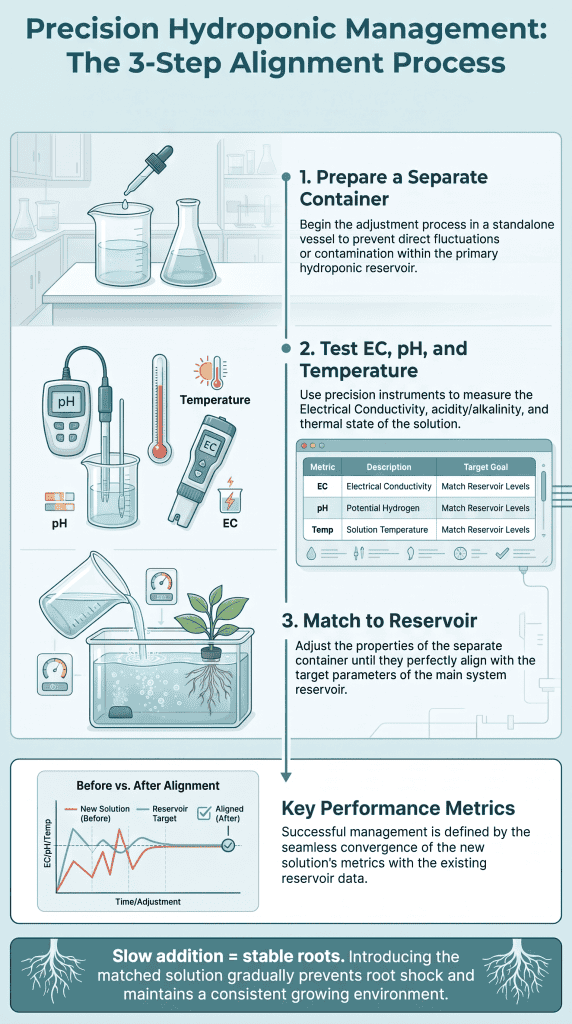
Prepare the addition separately, test its quality, and bring it reasonably close to the reservoir’s conditions before adding it. This reduces abrupt changes in EC, pH, and temperature.
How should you choose water for a hydroponic system?
The right water source depends on its chemistry and your nutrient program. RO water can help when source water has high mineral levels, while tap or filtered water may work if its EC and mineral profile suit the crop.
Test source water for pH, EC, and alkalinity before use. High-EC water adds to the food safe reservoir’s salt load, while repeated top-offs can gradually change the solution. Alkalinity, often linked to bicarbonates, can also raise pH and increase the need for adjustment.
Before adding water, check its pH, EC, alkalinity, and mineral content. Test first. It can help prevent nutrient and pH problems.
What Is the Correct Way to Add and Mix a Top-Off?
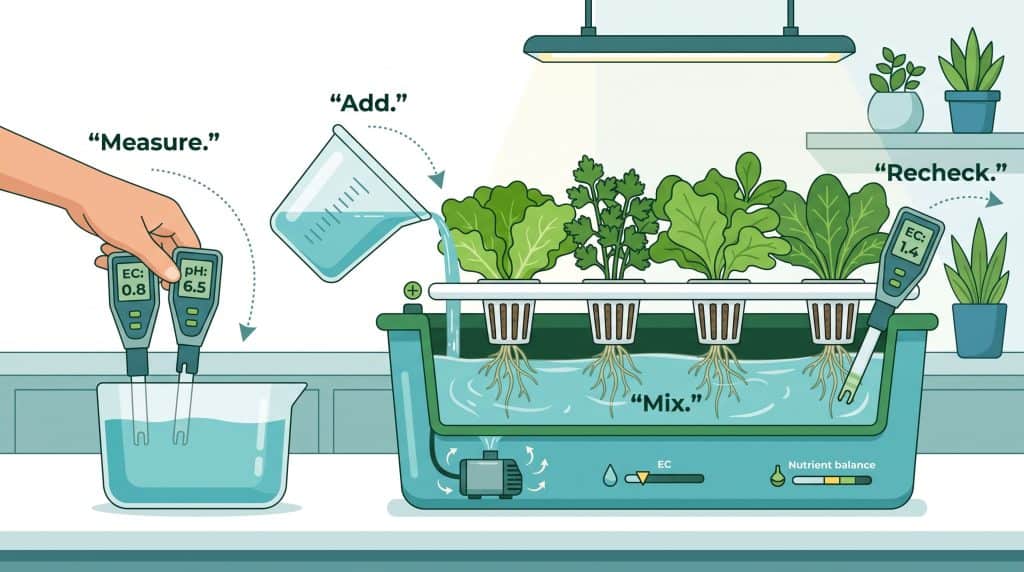
Add the prepared water or nutrient solution gradually, circulate it thoroughly, and retest the reservoir before making another adjustment.
A repeatable workflow looks like this:
- Measure the reservoir volume, EC, and pH.
- Compare EC with the crop’s target.
- Prepare plain water or a nutrient solution separately.
- Add the prepared solution gradually.
- Circulate until the reservoir is thoroughly mixed.
- Retest EC first, then adjust pH.
- Record the amount added and the final readings.
The order matters. Set the target EC first, then adjust the pH. Let the nutrient solution settle before checking the readings again.
In a small DWC or recirculating system, this process may take only a few minutes once the equipment is calibrated. But don’t rush it. Check the solution the same way each time. Consistent testing helps you track changes and avoid sudden adjustments.
How should you mix nutrient solution before adding it?
Dissolve and mix nutrients in a separate container according to the fertilizer manufacturer’s directions. Avoid dumping concentrated fertilizer directly onto roots or into a small, poorly mixed section of the reservoir.
Once the prepared solution is uniform, add it gradually while circulation is operating. This gives the reservoir a chance to distribute the new salts instead of creating a concentrated pocket.
How long should you wait before retesting?
Wait until the reservoir has circulated enough for the new water or nutrient solution to distribute evenly and the meter reading to stabilize. Oklahoma State University describes allowing the stirred solution to stabilize for a couple of minutes before using the reading for EC management.
Of course, exact mixing time depends on reservoir size, pump flow, and system design. The stable meter reading is more useful than a rigid timer.
Why Should You Adjust EC Before pH?
Adjusting EC before pH helps you set the nutrient strength of the hydroponic reservoir before fine-tuning its acidity. EC, or electrical conductivity, shows how strong the nutrient solution is. pH shows how acidic or alkaline the solution is. Both values affect nutrient availability and plant growth, but they should be adjusted in the right order.
Start by checking the reservoir’s EC and compare it with the target range for your plants. If the EC is too low, add nutrients as needed. If it is too high, dilute the solution with water. Mix the reservoir well and check the EC again before making further changes.
Once the EC is within the desired range, adjust the pH. Adding nutrients or water can change the pH, so adjusting pH first may mean you need to correct it again after changing the EC. Setting EC first makes the pH adjustment more accurate and reduces unnecessary corrections.
For a hydroponic reservoir top-off, this order keeps nutrient strength and pH easier to manage. Check EC, adjust it to the target range, mix thoroughly, and then adjust pH. This simple sequence helps maintain a more stable nutrient solution for healthy plant growth.
How should you adjust EC and pH?
If EC is too high, add suitable water gradually, circulate, and retest until EC approaches the crop-specific target. If EC is too low, add the appropriate nutrient solution or concentrate based on the crop program, then circulate and retest. Don’t treat a low EC reading as proof that one nutrient is deficient.
Adjust pH only after EC reaches the target. If you need to raise pH, adjust it gradually and recheck the solution. Record the starting EC, amount added, final EC, and final pH. Keep a clear record, so you won’t have to rely on memory.
How Does Source-Water Quality Change Your Top-Off Strategy?
The quality of your source water affects how you should top off a hydroponic reservoir. Adding water does more than restore the water level. It also adds minerals and salts that can change the nutrient balance, EC, and pH.
If your source water has low mineral content, such as reverse osmosis (RO) water, it adds little to the reservoir besides water. This gives you more control over nutrient strength. You may need to add nutrients after topping off if the EC drops below your target.
Tap water can be different. It may contain calcium, magnesium, bicarbonates, and other dissolved minerals. With repeated top-offs, these minerals can build up in the reservoir. This may raise EC or affect nutrient availability, even when you are not adding more fertilizer.
Before topping off, check the source water when possible. Knowing its EC and mineral content helps you decide whether plain water or treated water is the better choice. After adding water, circulate the reservoir and retest EC. Adjust the nutrient strength only after the water is fully mixed.
Consistent source water makes reservoir management easier. If your water quality changes between top-offs, monitor EC and pH more closely and make smaller adjustments.
How does water quality affect a hydroponic reservoir?
Hard water can add calcium, magnesium, bicarbonates, and other minerals, which may raise baseline EC and change the nutrient solution over time. RO water can make sense when source water has high mineral content or alkalinity that interferes with the nutrient program. But RO isn’t automatically better.
Tap water can work if its chemistry suits the crop and fertilizer program. Test tap water before using it. Its EC, alkalinity, sodium, and chloride levels can vary by location and season. Filtered water may reduce some contaminants, but filter performance varies. Test your source water regularly. Don’t assume clear water is suitable.
When Should You Stop Topping Off and Replace the Reservoir?
Repeated hydroponic reservoir top-offs cannot permanently preserve the original nutrient ratios, so a complete solution replacement remains part of reservoir management.
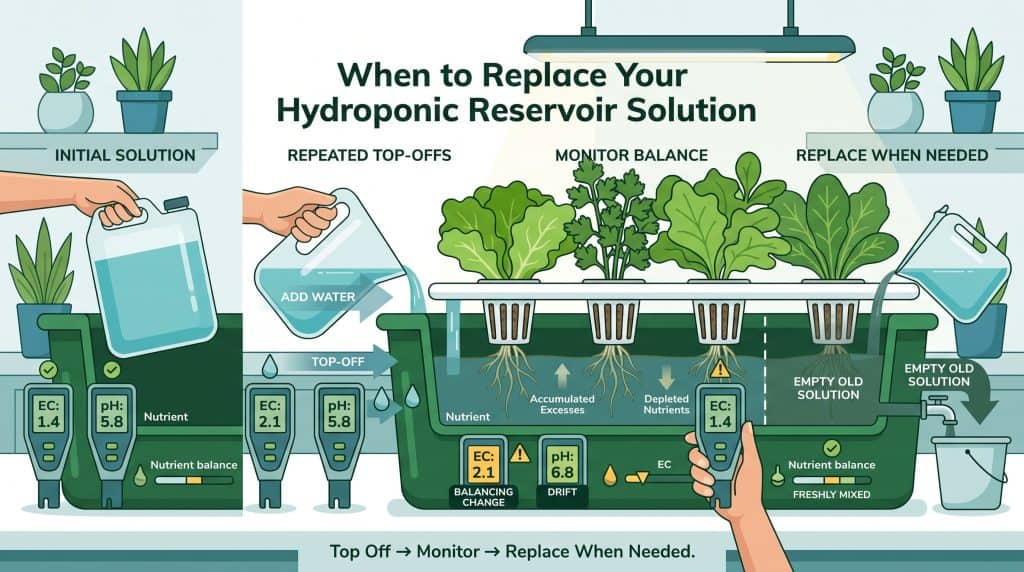
Every top-off changes the chemical history of the reservoir. Plants selectively absorb nutrients, while source water can introduce additional minerals. EC may remain within range even when individual nutrient concentrations have shifted.
This is why a full reservoir change is different from a hydroponic water replacement. A top-off restores volume. A complete reservoir reset replaces the entire nutrient solution and gives the crop a fresh starting composition.
Replace the hydroponic nutrient solution about every 2 weeks as a general guide. But the right schedule can vary with the crop and system. Water quality and daily management also affect how often the solution needs replacement.
Why can nutrient ratios drift even when EC looks acceptable?
EC measures the combined conductivity of dissolved ions. It cannot tell you whether nitrogen, potassium, calcium, magnesium, phosphorus, or micronutrients are each present at the intended concentration.
Potassium dropped to zero by day 19 in the water-replenishment treatments, while other nutrients changed at different rates. So, one EC reading can’t show the full nutrient balance in a hydroponic solution. Check individual nutrients when you need to find a specific deficiency.
What signs indicate a reservoir needs replacement?
A reservoir deserves closer attention when EC and pH repeatedly require correction, plant symptoms appear despite apparently acceptable readings, or the solution has accumulated substantial top-off volume.
Other warning signs include persistent nutrient imbalance, unexplained EC behavior, excessive salt accumulation, biological contamination, or a reservoir that has been maintained through repeated corrections for an extended period.
There isn’t one top-off schedule that fits every crop or hydroponic system. A 2-week guideline can serve as a useful starting point, but it shouldn’t replace crop-specific care. Check the plants and nutrient solution regularly, then adjust the schedule as needed.
Can You Automate Hydroponic Reservoir Top-Offs?

Credits: PA Hydroponics
Yes. Float valves and automated top-off systems can maintain reservoir volume, but automation does not replace EC, pH, source-water, or overflow management.
A float valve works by opening when the reservoir level falls and closing when the desired level returns. In a properly designed system, this can reduce the need for frequent manual hydroponic water top-ups.
Float-valve systems help maintain steady water levels in hydroponic systems. But replacing water automatically doesn’t restore nutrients that plants have already used. Nutrient levels still need to be checked and adjusted when needed.
How does a float valve work?
A float mechanism responds to water level. When the level falls, the valve opens and allows makeup water into the reservoir. When the level reaches its set point, the valve closes. This approach works well for maintaining volume, particularly in larger recirculating systems. The incoming water still needs to be appropriate for the nutrient program.
What can go wrong with automatic top-offs?
A stuck valve can continuously add water, causing dilution, overflow, or equipment damage. An automated system can also quietly alter reservoir chemistry if the source water contains substantial minerals.
The safest systems therefore include a secondary shutoff, overflow protection, appropriate tubing, and a reservoir volume limit.
How can you build in overflow protection?
Use a mechanical or electronic backup that can stop water flow if the primary valve fails. Secondary containment can also limit damage if a connection leaks.
| ATO approach | Main benefit | Main consideration |
| Manual top-off | Maximum control | Requires frequent checks |
| Float valve | Maintains water level | Does not automatically restore nutrients |
| Automated monitoring | Reduces manual adjustments | Requires calibration and maintenance |
Automation should reduce repetitive work, not eliminate reservoir monitoring.
Why Can “Chasing Deficiencies” Make Reservoir Problems Worse?
Repeatedly adding individual nutrients based only on EC or visible symptoms can worsen nutrient imbalance because EC cannot identify which individual elements are missing or accumulating.
A grower might see yellowing leaves, measure a low EC, and add more fertilizer. But the actual problem could involve pH, root health, source-water chemistry, or an imbalance between specific ions.
Different nutrients can change at different rates, even when the same water replacement method is used. So, a single EC reading may not show which nutrient is low. Check individual nutrient levels before treating a suspected deficiency.
Why isn’t EC enough to diagnose every deficiency?
EC measures the solution’s overall ionic conductivity. It does not identify the individual concentration of nitrogen, phosphorus, potassium, calcium, magnesium, or micronutrients.
In a recent analysis by Food & Energy Security says
“The 2026 study in Food & Energy Security demonstrated that EC was a “poor proxy for actual nutrient changes,” reinforcing that growers cannot rely on EC readings alone to understand the full nutrient picture.” – Food & Energy Security
A reservoir can therefore have an acceptable EC while still having an undesirable nutrient ratio. Conversely, a high EC does not automatically identify which salt is responsible.
When should you stop adding individual nutrients?
Stop repeatedly adding individual nutrients when corrections are producing unpredictable EC or pH changes, plant symptoms persist, or the reservoir has undergone extensive top-off cycles.
At that stage, continuing to add products can make the chemistry harder to interpret. A properly timed reservoir change can provide a cleaner baseline.
How can a full solution change reset nutrient ratios?
Drain the old solution, clean the reservoir and relevant equipment according to the system’s sanitation protocol, and prepare a fresh nutrient solution using tested source water.
The new solution provides a known starting point for EC and pH. That makes subsequent hydroponic reservoir monitoring much easier.
What Changes When You Use a Passive Kratky System?
Kratky systems need separate treatment because the changing solution level is part of their passive root-zone design. Unlike DWC or RDWC systems, passive Kratky setups rely on an air gap above the liquid for root aeration.
Topping off a Kratky container to its original fill line will submerge the air roots and drown the plant. If topping off is necessary during long crops, only add solution up to 30–50% of the container depth to preserve the root air zone.
Why does the air gap matter in Kratky?
In a passive Kratky system, roots develop in different zones as the nutrient solution level falls. The exposed portion provides access to oxygen while another portion remains in contact with nutrient solution.
Filling the container back to its original level can remove that intended air space. For that reason, a passive Kratky setup should be managed according to its specific design rather than treated like a conventional DWC reservoir.
Should you follow the same top-off routine as DWC or RDWC?
No. DWC and RDWC systems commonly depend on active aeration or circulation, while passive Kratky systems use a changing solution level and air gap. The uploaded research material specifically flags Kratky as an exception and warns against applying recirculating-system top-off rules universally.
What Is the Simplest Hydroponic Top-Off Routine to Follow?
The simplest reliable workflow is measure → decide → prepare → add → mix → retest → record → replace when necessary.
The sequence works because each step answers a different management question. First, the grower establishes what changed. Next, the grower decides whether the reservoir needs dilution or nutrient restoration.
Then the addition is prepared separately. After mixing, EC is checked before pH, and both readings are recorded.
For a hydroponic workflow, the routine can be kept simple:
- Check the water level and remaining volume.
- Measure EC and pH.
- Compare EC with the crop-specific target.
- Prepare suitable water or nutrient solution.
- Add gradually and circulate.
- Retest EC first, then pH.
- Record water volume, EC, pH, and date.
- Replace the reservoir when repeated top-offs no longer provide a reliable nutrient balance.
What should you check every time?
Check the water level, EC, pH, source-water quality, and reservoir temperature each day. Also inspect the roots, tubing, pump, air stones, and other equipment for clear signs of trouble.
Daily EC and pH checks help you spot changes early. Don’t rely on one reading alone. Track the readings over time so you can see trends and adjust the system before a small issue gets worse.
What should you record between top-offs?
Record the date, amount added, water source, EC before and after, pH before and after, and any nutrient additions.
A simple record can reveal whether hydroponic water consumption is increasing, whether EC consistently rises between checks, or whether the reservoir repeatedly requires the same correction.
When should you switch from topping off to changing the reservoir?
Switch when the reservoir has accumulated enough corrections that its original nutrient balance can no longer be confidently inferred from EC and pH.
The right replacement time depends on the crop and hydroponic system. A 2-week schedule can be a useful reference, but it won’t fit every setup. Some systems may need changes sooner, while others may go longer. Check the water level, EC, and pH before replacing the solution.
What Are the Most Common Hydroponic Top-Off Mistakes?
The biggest mistakes are guessing, ignoring source-water chemistry, adjusting pH before EC, automatically adding full-strength nutrients, and relying on EC alone.
| Common mistake | Better approach |
| Topping off without measuring EC | Measure before and after |
| Using one target for every crop | Follow crop-specific targets |
| Ignoring source-water quality | Test EC, pH, and alkalinity |
| Adjusting pH before EC | Set EC first |
| Continuously adding nutrients | Monitor nutrient drift and replace solution when needed |
| Overfilling the reservoir | Follow the system’s intended water level |
| Automating without backup protection | Add overflow and shutoff safeguards |
A common error is treating every falling water level as a signal to add fertilizer. That approach ignores whether the plants have already concentrated the remaining salts.
Another mistake is using a fixed top-off schedule without measuring actual water consumption. A mature crop under strong environmental demand might consume water very differently from a smaller crop.
The same issue applies to source water. Two reservoirs receiving identical fertilizer formulas can behave differently if one uses low-mineral RO water and the other uses mineral-rich municipal water.
The most useful correction is therefore not a more complicated formula. It is a better measurement.
FAQ
How do you know when to top off a hydroponic reservoir?
Check the reservoir water level before adding anything. A falling water level can result from plant water uptake or evaporation. Instead of following a fixed reservoir top off schedule, monitor the plants, water level, and solution readings. This approach helps you decide when to top off hydroponics without adding water unnecessarily.
Should you add water or nutrients during a hydroponic reservoir refill?
The right choice depends on the nutrient concentration in the reservoir. If EC rises because plants remove more water than nutrients, add plain water to dilute the solution. If nutrient levels have fallen because of plant uptake, add a diluted nutrient solution. Use the EC reading and your crop’s target EC to decide what the reservoir needs.
What should you check before adding water to a hydroponic reservoir?
Before you add water to a hydroponic reservoir, check the solution volume, EC, and pH. Check EC before topping off because EC can rise as the water level drops. Also, check pH before topping off because adding water can change the solution balance. These readings help you avoid unnecessary nutrient dilution and pH problems.
How is a top off different from a hydroponic reservoir water change?
A top off replaces water or nutrients lost through plant uptake and evaporation without removing the existing solution. A hydroponic reservoir water change removes the old solution and replaces it with fresh solution.
Regular top offs help maintain the water level, while a full water change can help address nutrient buildup, salt accumulation, or a persistent nutrient imbalance.
How can you avoid overfilling a hydroponic reservoir during a top off?
Use the hydroponic reservoir fill line or measure the reservoir volume before adding water. Stop when the solution reaches the recommended level for your system. In DWC and Kratky systems, avoid raising the water level too high because roots need access to oxygen. A Kratky system also needs an air gap as the plant develops.
Top Off Your Hydroponic Reservoir with a Clear Routine
Topping off a hydroponic reservoir isn’t just about adding water until the level looks right. Check EC and pH first, then decide whether the reservoir needs water or nutrients. Add the mixture gradually while the solution circulates, then retest before making another adjustment. That’s the part that prevents guesswork.
Tophydroponicgarden can help you keep this process more consistent by giving you a simple routine to follow. Record water use and test results each time, especially when the reservoir needs frequent top-offs. When the nutrient balance becomes unreliable, a full solution change is usually the better reset.
References
- https://extension.okstate.edu/fact-sheets/electrical-conductivity-and-ph-guide-for-hydroponics?Forwarded=pods.dasnr.okstate.edu/docushare/dsweb/Get/Document-10397/HLA-6722web.pdf#1
- https://openurl.ebsco.com/c/t4a2lo/EPDB%3Agcd%3A6%3A29925110/detailv2?sid=ebsco%3Aocu%3Arecord&id=ebsco%3Adoi%3A10.1002%2Ffes3.70220&bquery=AU%20Webster%2C%20Richard&page=1&link_origin=none&searchDescription=Webster%2C%20Richard&crl=f&x-cgp-token=t4a2lo
Related Articles
- https://tophydroponicgarden.com/choosing-a-food-safe-hydroponic-reservoir/
- https://tophydroponicgarden.com/how-to-raise-the-ph-in-your-reservoir/
- https://tophydroponicgarden.com/understanding-nutrient-solutions-for-plants/
Was this helpful?

I’m Barrie L., a passionate hydroponic gardening enthusiast dedicated to cultivating thriving, soil-less gardens. With a focus on all things hydroponic, I share my expertise on innovative growing techniques and sustainable practices through my blog, tophydroponicgarden.com. As a seasoned hydroponics specialist, my goal is to inspire and guide fellow gardeners in harnessing the power of water-based cultivation for bountiful and eco-friendly harvests. I’m also an author of the book “Hydroponics For Absolute Beginners: Your Step By Step Guide For How To Create An Hydroponics System At Home Without Soil, For Growing Vegetable, Fruit And Herbs.” which is sold on Amazon. Join me on a journey of redefining the way we cultivate plants, one nutrient-rich solution at a time. Happy growing!