

Testing your nutrient solution’s pH means checking how acidic it is on a scale from 0 to 14. Most plants take in nutrients best when the pH sits between 5.5 and 6.5. That’s a tight range, and it controls what your roots can actually grab from the water.
The University of Arizona’s Controlled Environment Agriculture Center points out a common problem. If the pH is wrong, your plants can’t use the nutrients in the solution, even if they’re there. So if your plants look sick but you’re still feeding them, pH is probably the reason.
Here’s how to test it, understand the numbers, and keep your solution stable the way growers who’ve been doing it for years actually do it.
Quick pH Testing Wins for Hydroponic Accuracy
- Accurate pH testing requires calibrated tools, proper sampling, and consistent timing
- Most hydroponic systems perform best at pH 5.5–6.5, not a fixed number
- Testing after mixing nutrients prevents major errors and wasted adjustments
pH: What It Is and Why It Counts
You’ve probably heard growers talk about pH all the time. But what is it, and why is it such a big deal for your plants? In simple terms, pH tells you how acidic or alkaline your nutrient solution is.
For plants grown in water, like in hydroponics, they can only grab the food they need if the pH is just right.
That sweet spot is usually between 5.5 and 6.5. The type and balance of nutrients in your solution also matter, so it’s helpful to understand hydroponic base nutrients and how they interact with pH.
Here’s the tricky part. The pH scale goes from 0 to 14, with 7 being neutral. A change of one full point isn’t a small adjustment, it’s a massive jump. Moving from a pH of 6.0 down to 5.0 makes your solution ten times more acidic.
Why does this matter so much? Research from places like Cornell University shows that when pH wanders outside that optimal zone, nutrients become harder for plants to absorb.
This is especially true for key micronutrients like iron and manganese. A shift of just half a point can noticeably slow down a plant’s ability to take in food.
Because of this, experienced growers don’t treat pH as a single perfect number to hit. They think of it as a window of availability.
Keeping your pH stable within that window is far more important than constantly adjusting to hit an exact figure.
If the pH isn’t right, a few things happen:
- Nutrient Lockout : The nutrients are in the water, but the plant can’t use them.
- Slow Growth: Roots become less efficient, stunting overall development.
- Hidden Deficiencies : Your plants might show signs of hunger even though you’re feeding them correctly.
Healthy growth isn’t just about how much food you give your plants. It’s about creating the right conditions so they can actually use it.
The Testing Routine

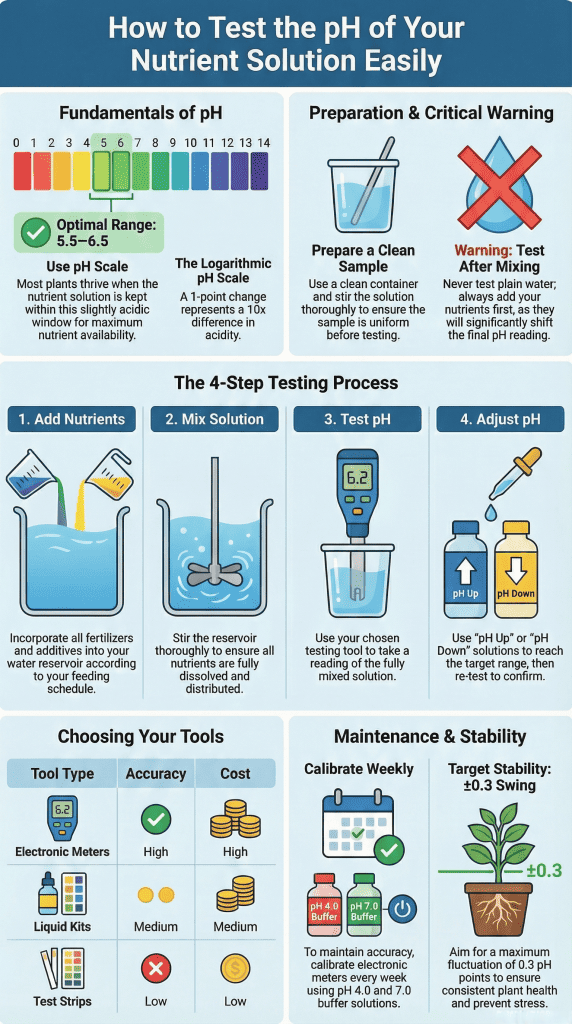
Always mix your nutrients into the water first, then test the pH and adjust it. The goal is to keep the reading steady within a narrow band.
A lot of growers test the plain water before adding anything. That’s a mistake. Adding nutrients can change the pH by over a full point, so a reading taken beforehand doesn’t mean much. Sticking to a consistent order mix, then test cuts down on errors.
Understanding when to add nutrients in hydroponics ensures your testing reflects what the plants actually receive.
Flairform Hydroponics notes that testing after you mix gives you a reading that actually matters, and it stops you from having to tweak the pH over and over.
Your meter’s reliability is key here. Even good tools, like the Bluelab pH Pen, need regular calibration. If you don’t calibrate, the readings can drift.
The basic rules are straightforward :
- Test after adding nutrients, never before.
- Aim to keep pH swings within half a point.
- Calibrate using pH 4.0 and pH 7.0 buffer solutions.
- Sometimes, cross-check your reading with another method.
In a system that’s running, small slips in pH add up quickly.
The Best Methods to Test Nutrient Solution pH
Electronic meters give the most reliable readings. Test strips and liquid kits cost less but sacrifice precision. Each method works, but the difference shows up when small pH shifts start affecting plant health.
| Method | Accuracy | Cost | Pros | Cons |
| Electronic meter | High (±0.01–0.1) | $40–$20 | Fast, precise | Needs calibration |
| Test strips | Low | $5–$15 | Cheap, simple | Subjective colors |
| Liquid kits | Medium | $10–$30 | Affordable | Human error |
Digital tools lead in serious setups. Brands like Hanna Instruments build meters that can detect even slight pH swings. That level of detail matters when plants depend on a narrow range.
Strips still have a place. They work well for quick checks. Liquid kits sit somewhere in between. They offer better consistency than strips but still depend on how well someone reads color.
Most growers don’t rely on just one tool. They mix methods to avoid blind spots.
- Use a meter for daily readings
- Use strips or liquid kits to double-check
- Watch for drift over time
This approach keeps readings honest.
Electronic pH Meters (Best for Precision)
A tool like the Hanna Instruments HI98107 pH ep Tester measures pH digitally and shows results within seconds. It removes guesswork and makes small changes visible.
It suits growers who need tight control. In hydroponics, a 0.3 shift can change how nutrients behave. A digital meter catches that early.
Pros
- High accuracy
- Fast readings
- Easy to track trends
Cons
- Needs regular calibration
- Probe wears out over time
Dealbreaker
If calibration feels like a chore, this tool becomes unreliable fast.
Best for
- Hydroponic systems
- Frequent monitoring
- Growers who want consistent data
pH Test Strips (Best for Quick Checks)
Products like Hydrion pH Test Paper use color changes to estimate pH. Dip, wait, compare. That’s it.
They work, but only to a point. Color matching depends on lighting and perception. Subtle differences can be hard to see.
Pros
- Low cost
- No setup required
- Easy to carry
Cons
- Low accuracy
- Hard to read in colored solutions
Dealbreaker
Not suitable when precise control matters.
Best for
- Quick checks
- Backup testing
- Beginners learning the basics
Liquid pH Test Kits (Best Balance Option)
A kit like the General Hydroponics pH Control Kit uses drops that react with the solution. The color result gives a more stable reading than strips.
It takes a bit more effort but reduces some guesswork. Still, it depends on visual comparison.
Pros
- More consistent than strips
- Affordable
- No calibration needed
Cons
- Slower process
- Still relies on color reading
Dealbreaker
Poor lighting or tinted solutions can skew results.
Best for
- Intermediate growers
- Cross-checking digital meters
- Situations without calibration tools
Each method solves a different problem. The real advantage comes from combining them. A meter handles precision. Strips or liquid kits confirm stability. That small layer of redundancy prevents costly mistakes.
Properly Preparing a Nutrient Solution Sample

Proper sample preparation ensures consistent pH readings by eliminating contamination and uneven mixing.
A nutrient reservoir often develops gradients. Without mixing, readings can vary by 0.2–0.4 pH units, according to hydroponic system studies.
Uniformity matters. Stirring or circulating the solution before testing eliminates false readings.
Preparation steps include :
- Mix the solution thoroughly after adding nutrients
- Use clean containers to avoid contamination
- Collect a representative sample
- Retest if results seem abnormal
Clean technique produces reliable data.
Calibrating Your pH Meter Correctly Every Time
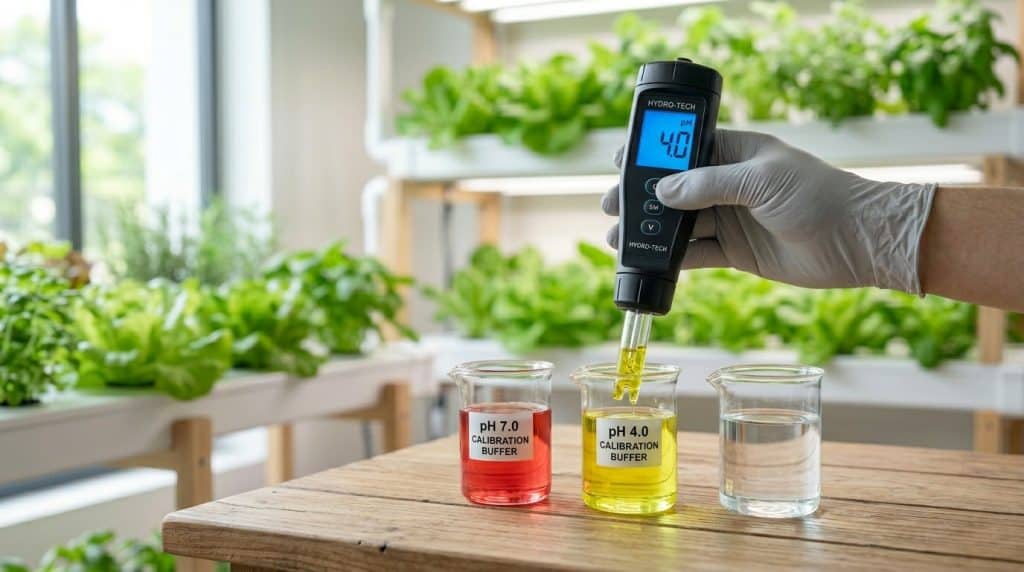
Calibration aligns your meter with known standards, preventing errors that can exceed 0.3 pH units.
Meters drift over time due to probe wear and contamination. Using NIST buffer standards helps maintain accuracy.
insights from University of Massachusetts Amherst indicate :
Calibrate the pen first according to the instructions, rinse off the buffer, and then place the pen directly into a sample large enough to completely immerse the sensor. Agitate the pen slightly in the sample to dislodge any air bubbles and then allow a stable reading to develop. University of Massachusetts Amherst
Calibration steps :
- Use fresh buffer solutions (pH 4.0 and 7.0)
- Rinse the probe between each step
- Blot gently instead of wiping
- Calibrate weekly or when readings drift
According to Hanna Instruments technical guides, multi-point calibration provides more accurate results across ranges than single-point calibration.
Consistent calibration separates reliable growers from frustrated ones.
Measuring pH: The Steps
Put your testing tool into the sample you’ve prepared. Wait for it to settle. Write down the number. Then see if it’s in the right zone.
The process boils down to two short steps. Do the test right. Then wait for a solid reading.
Research from Oklahoma State University Extension shows :
Calibrate the pH meter probe using the buffer solution. Make sure the nutrient solution is stirred up and allow the reading to stabilize, which may take a couple of minutes. If the pH reading is high, add phosphoric acid, citric acid, vinegar or pH down products slowly. Wait several minutes before adding more. Repeat until the pH reaches the optimum range. Oklahoma State University Extension
The workflow is a little different for each tool:
- Meter : Dip the probe, wait 5 to 30 seconds, note the value.
- Strip: Dip it, wait 15 to 30 seconds, match the color.
- Liquid Kit : Add the drops, swirl the vial, compare it to the chart.
If the number jumps around or looks strange, do the test again with a new sample.
Good readings come from being patient, not from rushing.
Test After, Not Before
You should test the pH after you add the nutrients, not before. The nutrient salts change the pH dramatically, so checking plain water gives you a number that’s wrong.
Hydroponic nutrients have things like nitrates and phosphates in them. These compounds change the acidity right away. Flairform Hydroponics says the shift can be more than one full pH point after you mix everything together.
Understanding how pH affects hydroponics helps you see why testing after adding nutrients is critical for healthy plant growth.
If you test the water first, you start a cycle of endless correction. A lot of growers call this pH chasing.
The practical order is strict:
- Add nutrients to the water.
- Mix it completely.
- Test the pH.
- Adjust it, then test again.
This method mirrors what your plants actually get from the solution. If you skip it, your system won’t stay stable.
The Problem with Cheap Meters
Budget pH meters drift. They react slowly. They can’t handle weakly buffered solutions well. All of this leads to readings that aren’t stable.
Sensor drift happens with all meters. Studies show the numbers can wander by 0.2 to 0.5 pH units if you don’t calibrate them right.
The environment messes with them too. Automatic Temperature Compensation (ATC) is a help, but only if the temperature when you calibrate matches the temperature when you measure.
You’ll usually see a few specific failures:
- The probe gets worse as it ages.
- The calibration routine is sloppy or infrequent.
- The meter is sensitive to CO₂ from an open reservoir.
- It takes a long time to settle on a number in a low buffer solution.
Growers who have been doing this for years tend to use one meter they know is good. They might check its result against another method now and then. They don’t swap tools often. Staying with one reliable tool works better than constantly changing.
Advanced Factors That Affect pH Accuracy in Nutrient Solutions

Credit : Growing with Glenna
Temperature, dilution, and buffer quality can distort readings even when using high-quality equipment.
Research published via National Institutes of Health (NIH) shows dilution based testing methods can raise measured pH by 0.38 ± 0.24 units, masking true root-zone conditions.
Temperature mismatch creates hidden errors. Calibrating at 25°C and measuring at 18°C introduces measurable deviation.
Buffer solutions also degrade. Exposure to air allows CO₂ absorption, shifting their pH over time.
Key advanced factors :
- Temperature mismatch during calibration
- Dilution errors in sample testing
- Old or contaminated buffer solutions
- Improved accuracy from in situ probes
These variables explain why readings sometimes don’t make sense.
Reading and Fixing pH
Look at your number and see where it sits compared to the target range of 5.5 to 6.5. Make changes slowly. Watch for trends over time instead of reacting to every little jump.
That 5.5–6.5 band is the goal, but a little movement is normal. A stable system might swing by about 0.3 points either way.
To get it steady, you need to do a few things:
- Use pH Up or Down, but add it bit by bit.
- Write down your readings every day.
- Keep an eye on how the numbers move over weeks, not hours.
- Don’t make tiny corrections all the time.
Sticking to this routine creates a predictable world for your roots.
FAQs
How do I test the pH of my nutrient solution at home?
Testing the pH of your nutrient solution is essential for healthy plant growth. You can use pH strips or a digital pH meter to measure accurately. Always mix the solution thoroughly before testing to get reliable results. Learning how to test the pH of your nutrient solution helps prevent nutrient deficiencies and ensures plants receive the proper nutrition.
Why is it important to know the pH of nutrient solutions?
Knowing the pH of your nutrient solution ensures that plants can absorb nutrients efficiently. If the pH is too high or too low, nutrients can become unavailable, causing poor growth. By understanding how to test the pH of your nutrient solution, you can maintain optimal conditions, support healthy plant development, and avoid nutrient-related problems.
How often should I check the pH of my nutrient solution?
You should check the pH of your nutrient solution regularly, ideally at least once a week or whenever you add fresh nutrients. Regular testing helps detect fluctuations early and prevents stress on your plants. Learning how to test the pH of your nutrient solution consistently allows you to maintain stable conditions and promote healthy growth.
What tools can I use to test the pH of nutrient solutions?
You can test the pH of your nutrient solution using pH test strips, liquid test kits, or a digital pH meter. Each method has benefits: strips are affordable, kits are easy to use, and digital meters provide precise readings. Knowing how to test the pH of your nutrient solution with the right tool ensures proper nutrient balance for your plants.
What signs indicate my nutrient solution pH is off?
Plants show signs of incorrect pH through yellowing leaves, stunted growth, or nutrient deficiencies. If these problems appear, it is essential to test and adjust the solution immediately. Understanding how to test the pH of your nutrient solution allows you to correct imbalances quickly and maintain healthy, thriving plants.
Take Control of Your Nutrient pH
If you’re tired of guessing and seeing uneven growth, focusing on consistent pH testing is the quickest fix. Small fluctuations may not seem like much, but they quietly stress your plants and slow results. Reality check: ignoring trends costs more than a minute of daily monitoring.
References :
1. http://www.hort.cornell.edu/greenhouse/crops/factsheets/hydroponic-recipes.pdf 2. 2.https://www.umass.edu/agriculture-food-environment/greenhouse-floriculture/fact-sheets/how-to-use-ph-ec-pens-to-monitor-greenhouse-crop-nutrition 3.https://extension.okstate.edu/fact-sheets/electrical-conductivity-and-ph-guide-for-hydroponics.html 4. https://pmc.ncbi.nlm.nih.gov/articles/PMC11004321/
Related Articles :
- https://tophydroponicgarden.com/what-are-hydroponic-base-nutrients/
- https://tophydroponicgarden.com/how-do-you-know-when-to-add-nutrients-to-hydroponics/
- https://tophydroponicgarden.com/how-is-ph-important-in-hydroponics/
Was this helpful?

I’m Barrie L., a passionate hydroponic gardening enthusiast dedicated to cultivating thriving, soil-less gardens. With a focus on all things hydroponic, I share my expertise on innovative growing techniques and sustainable practices through my blog, tophydroponicgarden.com. As a seasoned hydroponics specialist, my goal is to inspire and guide fellow gardeners in harnessing the power of water-based cultivation for bountiful and eco-friendly harvests. I’m also an author of the book “Hydroponics For Absolute Beginners: Your Step By Step Guide For How To Create An Hydroponics System At Home Without Soil, For Growing Vegetable, Fruit And Herbs.” which is sold on Amazon. Join me on a journey of redefining the way we cultivate plants, one nutrient-rich solution at a time. Happy growing!