
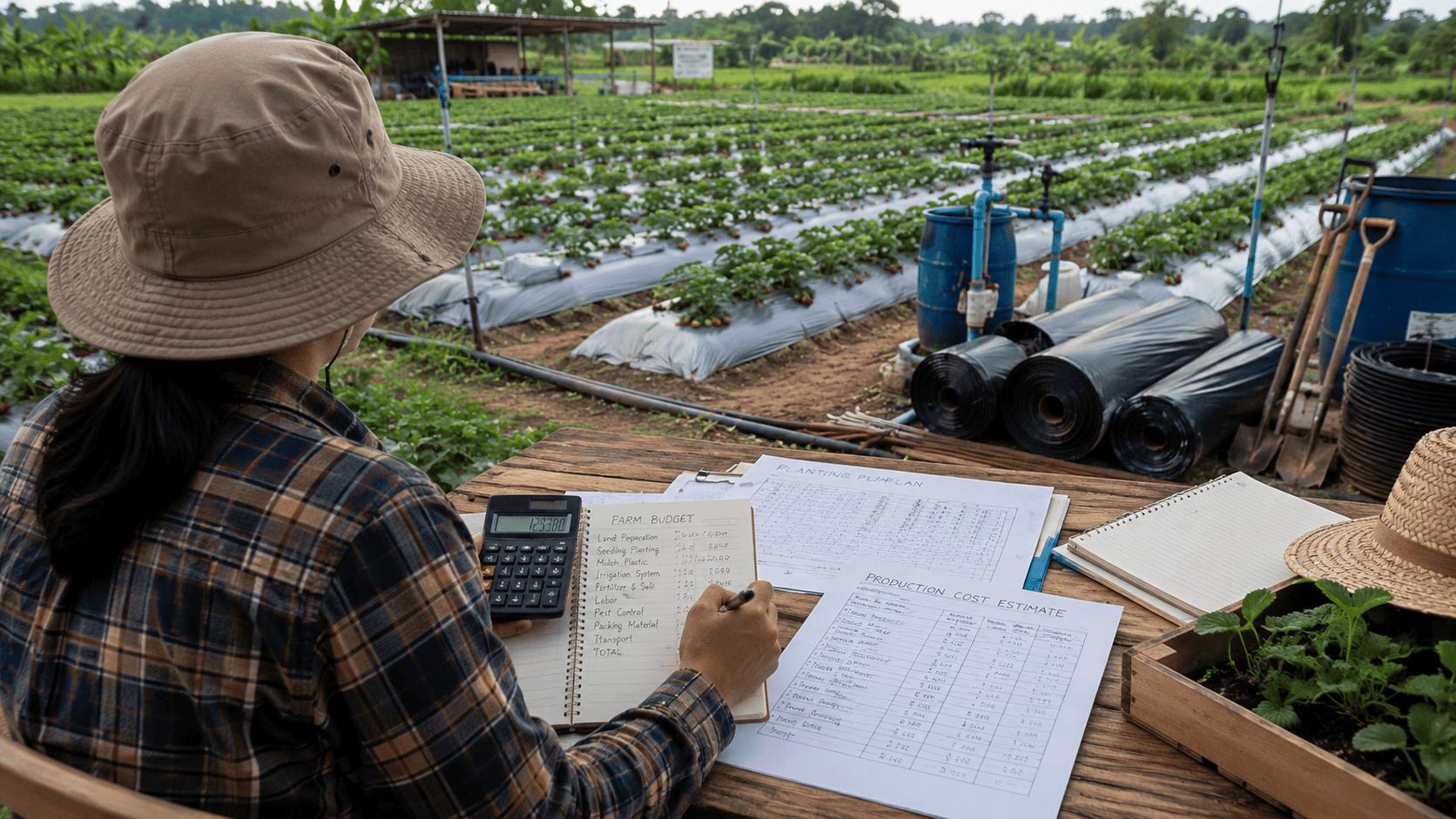
Understanding how to start a commercial strawberry farm requires selecting a production system aligned with verified market demand prior to planting. Good planning makes it easier to manage costs, protect fruit quality, and build a farm that can grow over time.
Strawberries can be profitable, but they also need careful handling because they don’t stay fresh for long. Keep reading to learn how to choose the right setup, avoid common mistakes, and build a successful commercial strawberry farm.
Commercial Strawberry Farming Key Takeaways
- Select the right sales model before investing in commercial strawberry production systems.
- Match growing methods with climate, resources, and local market conditions.
- Plan labor requirements and cooling systems early to protect profitability.
Choosing the Right Commercial Strawberry Farm Business Model
Your business model shapes everything from field size to customer relationships. A grower selling berries directly at the farm will need a different setup than someone supplying stores.
There are three common paths: pick-your-own (PYO), wholesale sales, and processing markets. Each one changes how the farm handles harvesting, packaging, and delivery.
Strawberries can bring strong returns compared with many field crops. But the fruit is delicate. Fresh berries lose quality fast, so growers need a clear plan before planting.
| Business Model | Target Market and Location | Primary Operational Requirement | Expected Gross Margin Range |
| Pick-Your-Own (PYO) | Peri-urban locations within 30 miles of population centers | Parking infrastructure, agritourism liability coverage, customer facilities, and field signage | 60% – 75% due to reduced harvesting labor costs |
| Commercial Wholesale | Regional grocery distributors and food terminal networks | Daily cold-chain management, GAP certification, and strict fruit grading standards | 25% – 40% through high-volume production |
| Industrial Processing | Bakeries, jam manufacturers, frozen fruit processors, and beverage companies | Secondary sorting systems and bulk freezing capacity | 10% – 20% by utilizing lower-grade or excess fruit |
PYO farms can reduce some harvest labor because customers collect the fruit. Still, they need parking, clean facilities, and a good visitor experience. Most people forget that part.
Wholesale farms usually spend more on packing areas, cold storage, and transportation. Buyers expect consistent fruit size, quality, and delivery schedules.
So, research the market before buying plants. Find out who will buy the berries, what prices customers accept, and how far the farm is from buyers.
As noted by University of Delaware Cooperative Extension:
“It is imperative to have a marketing plan before raising strawberries” – University of Delaware Cooperative Extension
Feasibility assessments must analyze four core logistics parameters: local buyer density within a 50-mile radius, transit time to distribution hubs, seasonal labor availability, and minimum break-even price thresholds per pound. It’s much cheaper to change a business plan than rebuild a farm.
Estimating Startup Costs for a Commercial Strawberry Farm
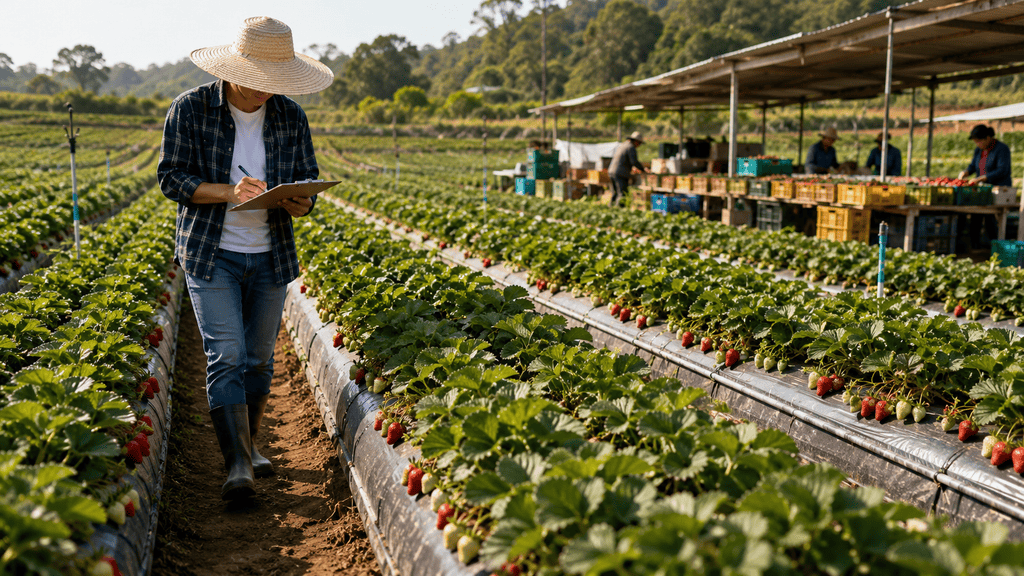
Startup costs depend on the growing method, farm size, equipment, and labor needs. A small field operation and a high-tech indoor system require very different budgets.
Open-field plasticulture requires an estimated initial capital investment of $3,500 to $5,000 per acre for bed shaping, dual-drip irrigation installation, and 1.2-mil black polyethylene mulch. In comparison, substrate tabletop hydroponic setups demand upward of $45,000 to $60,000 per acre due to structural framing, drip emitters, and automated dosing manifolds.
Indoor strawberry farming can work in areas where land is limited or premium prices are possible. But it also adds costs for electricity, climate control, and repairs. Get the numbers before spending money. A spreadsheet showing expected yield, costs, and selling price can reveal problems early.
A first-year commercial plot helps growers measure:
- Yield per acre
- Labor needs
- Crop losses
- Customer demand
That information matters. Every farm has different conditions, and guessing can get expensive.
Comparing Commercial Strawberry Growing Systems and Production Methods
The right production system depends on climate, available money, labor access, and the target market. There isn’t one method that fits every farm.
Commercial growers often choose between annual plasticulture, matted row systems, and protected growing methods.
Annual plasticulture is widely used because it allows growers to plant fresh certified plants each season. Raised beds improve drainage, while mulch helps control weeds and keeps fruit cleaner.
A typical setup includes:
- Raised strawberry beds
- Drip irrigation
- Plastic mulch
- Certified plants
Matted row systems are more common in cooler regions. Plants remain in the field for several years and produce runners that create new plants. This approach can reduce yearly planting costs, but it needs careful management.
Hydroponic and vertical systems have gained attention because they allow farming in controlled spaces. Yet these systems can cost much more than field production. The numbers have to make sense before investing.
Most beginners are better off proving demand first. Build a reliable customer base, learn the crop, then consider bigger changes.
Really, good plants and reliable buyers still matter more than expensive equipment.
Selecting the Best Strawberry Varieties for Commercial Production
Choosing strawberry varieties affects fruit size, harvest timing, shipping ability, and customer satisfaction. The right choice depends on local weather and how berries will be sold.
The main categories are June-bearing, day-neutral, and everbearing strawberries.
| Strawberry Photoperiod Category | Flowering Trigger and Fruiting Window | Commercial Yield Potential | Primary Variety Examples |
| June-Bearing (Short-Day) | Produces flower buds under day lengths below 12 hours with one concentrated 3 – 4 week harvest period in spring | 1.0 – 1.5 lbs per plant | Chandler, Camarosa, Sweet Charlie |
| Day-Neutral | Produces flowers continuously between 35°F and 85°F (2°C – 29°C) regardless of day length | 1.5 – 2.2 lbs per plant over 6 – 8 months | Albion, San Andreas, Seascape |
| Everbearing | Produces two to three harvest cycles during spring, summer, and autumn | 0.8 – 1.2 lbs per plant | Fort Laramie, Quinault |
Popular commercial varieties include Chandler, Camarosa, and Albion. Each has different traits, so growers should compare them with local growing conditions.
Certified plants are worth the investment because unhealthy planting material can create problems before harvest begins.
Before ordering plants, check:
- Growing season length
- Local temperatures
- Buyer preferences
- Disease risks
Good variety choices give growers a stronger start. It’s one decision that affects the entire season.
Land Preparation Essentials Before Planting Commercial Strawberries
Healthy strawberry plants begin with healthy soil. Before planting, growers need to check drainage, nutrients, and soil structure.
Strawberry root systems require a well-drained sandy loam with organic matter above 3% and an optimal pH range of 5.8 to 6.2. Soil testing helps farmers understand what the field needs before adding fertilizer or other amendments.
Poor drainage can create serious problems. Water sitting around strawberry roots can increase the risk of diseases that damage plants and reduce harvests.
Field preparation usually includes:
- Soil testing
- pH correction
- Deep tillage
- Drainage improvements
- Crop rotation
A good preparation timeline may look like this:
| Timing | Main task | Purpose |
| 6 – 12 months before planting | Soil testing | Fix nutrient issues |
| 3 – 6 months before planting | Field preparation | Improve root growth |
| Weeks before planting | Install irrigation | Ready the field |
Some growers also use cover crops or other soil management practices to improve field conditions. The best approach depends on local climate and previous crops.
Warm, rainy regions often need extra drainage planning because excess moisture can quickly damage strawberry roots.
So, don’t rush this stage. A strong field gives plants a better chance from the first season.
Building Raised Beds and Efficient Strawberry Irrigation Systems
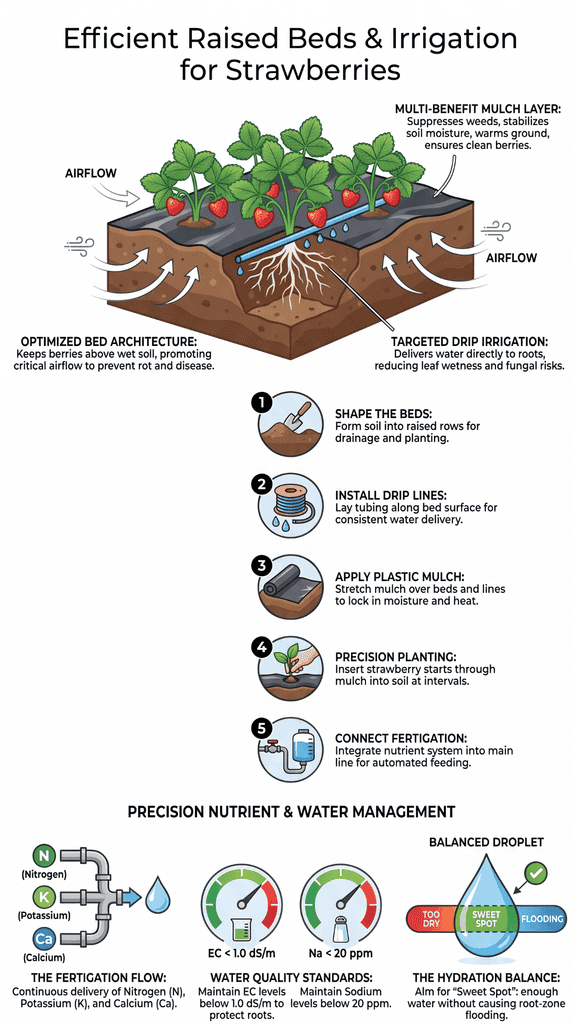
Commercial strawberry farms usually rely on raised beds, drip irrigation, and plastic mulch. These systems help manage water, weeds, and fruit quality.
Raised beds keep berries away from wet soil and improve airflow around the plants. Drip irrigation delivers water close to the roots while reducing leaf moisture that can encourage disease.
The basic installation process includes:
- Shape raised beds.
- Install drip lines.
- Apply plastic mulch.
- Plant certified strawberries.
- Connect fertigation systems.
Plastic mulch helps by:
- Reducing weeds
- Keeping soil moisture stable
- Warming soil early
- Keeping berries cleaner
A strawberry irrigation system must provide enough water without flooding the root zone. Too little water affects fruit size. Too much water creates disease problems.
Fertigation allows growers to send nutrients through irrigation lines. Nitrogen, potassium, calcium, and other nutrients can be adjusted as plants grow.
Irrigation water must be tested prior to planting to ensure an Electrical Conductivity (EC) below 1.0 dS/m and sodium levels under 20 ppm, as elevated salinity directly inhibits root elongation and reduces overall yield.
So testing the water source before installing a system is a smart move. Small details add up. A good irrigation setup can save time and reduce crop problems later.
Managing Strawberry Fertilizer, Pests, and Diseases for Healthy Crops
Strawberry production requires regular monitoring. Plants change throughout the season, and nutrient needs change with them.
Fertigation regimes shift throughout the crop cycle: vegetative growth requires a balanced N-P-K ratio such as 15-5-15, whereas bloom and fruit development demand elevated potassium (e.g., 10-5-25) alongside supplemental calcium nitrate to maintain fruit wall firmness and prevent tip burn.
| Area | Common issue | Management method |
| Nutrition | Poor nutrient balance | Soil and tissue testing |
| Disease | Mold and root problems | Prevention and monitoring |
| Pests | Mites and insects | Integrated pest management |
Common strawberry diseases include:
- Botrytis fruit rot
- Powdery mildew
- Anthracnose
- Root diseases
Integrated Pest Management requires weekly monitoring of canopy undersides. Two-spotted spider mites (Tetranychus urticae) are managed biological-first by releasing predatory mites (Phytoseiulus persimilis) at a density of 1 to 2 mites per plant upon initial detection, minimizing reliance on chemical miticides during peak harvest.
Walking the fields often helps growers catch problems early. A small pest issue can become a major loss during a short harvest period.
Most people underestimate observation. Good records and frequent checks can save a lot of money.
Labor Planning for Efficient Strawberry Farm Operations
Strawberries are one of the most labor-demanding fruit crops because harvesting represents 50% to 60% of total seasonal operating expenses.
Workers must handle berries gently because damaged fruit loses value quickly. Harvest schedules also matter because ripe strawberries need frequent picking.
| Labor area | Main concern |
| Harvesting | Frequent picking |
| Weed control | Manual work |
| Plant care | Regular maintenance |
| PYO farms | Customer management |
Large farms may use seasonal agricultural workers, while smaller farms may use pick-your-own models to reduce some harvest costs.
But PYO farms still need management. Customers need safe paths, clean areas, payment options, and clear instructions.
Labor planning should cover:
- Harvest dates
- Worker training
- Transportation
- Peak demand periods
Get the schedule ready before berries ripen. Peak harvesting requires 5 to 7 experienced field workers per acre, capable of picking an average of 20 to 30 pounds per hour directly into retail clamshell containers to prevent secondary handling damage.
Protecting Strawberry Quality During Harvest and Storage
Fresh strawberries are highly perishable. Once picked, they need quick handling to protect quality.
Research from AGRIS shows:
“Highly perishable fruits, susceptible to mechanical injury, decay and physiological disorders during storage,” – AGRIS
Good post-harvest handling includes:
- Pick ripe fruit
- Handle gently
- Remove field heat
- Use protective packaging
- Keep berries cold
Commercial farms often use:
- Cooling systems
- Refrigerated storage
- Clamshell packaging
- Temperature-controlled transport
| Post-Harvest Stage | Operational Parameter | Agronomic & Commercial Benefit |
| Harvesting | Early morning harvesting completed before pulp temperature exceeds 65°F (18°C) | Minimizes field heat accumulation and reduces respiration rate prior to pre-cooling |
| Forced-Air Cooling | Core pulp temperature reduction to 32°F – 34°F (0°C – 1°C) within 60 minutes of picking | Delays fruit softening, inhibits Botrytis cinerea growth, and extends wholesale shelf life |
| Refrigerated Storage | Controlled relative humidity maintained strictly between 90% and 95% | Prevents moisture transpiration, avoids berry weight loss, and preserves green calyx freshness |
| Cold Chain Transport | Continuous temperature monitoring at 34°F (1°C) with sealed pallet wrapping | Eliminates condensation cycles during transit that trigger rapid fungal rot |
Cold storage is not an optional extra for many commercial farms. A strong harvest can lose value if berries sit too long in warm conditions. Quality after harvest affects customer reviews, repeat sales, and wholesale relationships.
Building a More Profitable Strawberry Farming Business
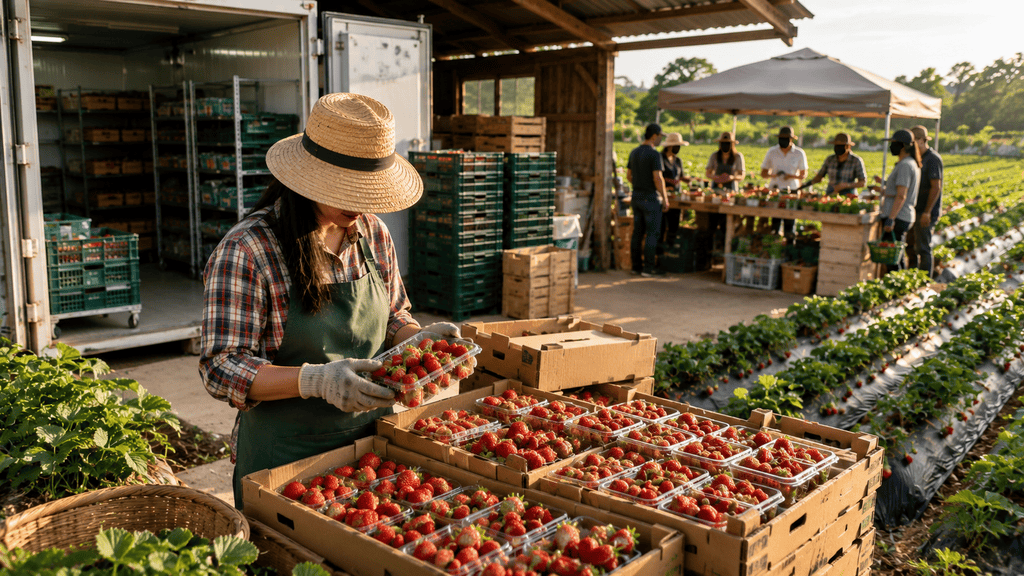
Growing more strawberries does not always mean making more money. A profitable farm depends on keeping costs under control, reducing losses, and finding the right buyers.
Successful growers pay attention to:
- Production costs
- Yield per acre
- Labor expenses
- Selling prices
- Fruit losses
Before expanding, create a simple plan. Ask:
- Who will buy the strawberries?
- How much does each pound cost to produce?
- Can labor costs stay manageable?
- Is the farm reaching its expected yield?
Many new growers run into problems by:
- Choosing the wrong plants
- Expanding too soon
- Forgetting cooling needs
- Spending heavily before testing demand
So, build the foundation first. A farm with good planning, reliable customers, and careful cost control has a stronger chance of staying profitable.
Smart Farming Technology for Commercial Strawberry Growers
My HYDROPONIC Strawberry Tunnel is Almost 100 Percent Automated!
Credit: HomeGrown Passion
Technology can help growers save time and collect better information. But tools only help when they solve a real problem.
Common technologies include:
- Automated irrigation
- Climate sensors
- Nutrient monitoring
- Greenhouses
- Hydroponic systems
High tunnels can extend growing seasons and protect plants from harsh weather. Hydroponic systems can increase production in limited spaces. Still, technology has costs. Electricity, repairs, and training all affect profitability.
A sensor can show soil moisture, but it cannot replace good farming decisions. The grower still needs to choose the right variety, market, and production method.
First-Year Roadmap for Commercial Strawberry Farming
New growers should test their idea before making a large investment. The first year should focus on learning what works.
A basic timeline:
| Period | Main action |
| Months 1 – 3 | Research markets and test soil |
| Months 4 – 6 | Prepare fields and install systems |
| Months 7 – 12 | Grow, harvest, and review results |
Track important information:
- Yield per acre
- Production costs
- Customer feedback
- Labor needs
- Fruit quality
Small-scale production can teach valuable lessons before moving into larger operations. Every location has different conditions. Weather, nearby competition, and customer habits all affect results.
FAQ
What factors affect commercial strawberry farm startup costs?
The cost of a strawberry farm startup depends on land size, growing methods, equipment, labor, and production goals. A detailed strawberry farming budget should include expenses for plants, field preparation, irrigation, fertilizers, pest management, harvesting, and packaging. Planning these costs early helps growers avoid financial problems and create a more realistic path toward profitable production.
Which strawberry varieties are suitable for commercial production?
Choosing the right varieties affects fruit quality, harvest periods, and market demand. Many growers compare best commercial strawberry varieties based on climate, flavor, shelf life, and customer preferences. Day-neutral strawberries, June-bearing strawberries, and everbearing types each have different growth patterns, so selecting varieties that match local conditions can improve strawberry production results.
What irrigation system works best for strawberry farming?
A reliable strawberry irrigation system helps maintain healthy plants and consistent fruit development. Many commercial growers use drip irrigation for strawberries because it delivers water directly to the root zone while reducing excess moisture on leaves. Proper strawberry irrigation scheduling also prevents water stress and supports better yields throughout the growing season.
How can new growers manage strawberry farm operations?
Good strawberry farm management involves planning daily tasks, monitoring plant health, controlling costs, and maintaining fruit quality. New growers should understand strawberry cultivation practices, labor needs, and seasonal activities before expanding. A clear strawberry farming business plan can help organize production goals, marketing steps, and long-term decisions for a successful farm.
Build a Strawberry Farm That Keeps Growing
Running a strawberry farm takes steady work, and small mistakes can cost you time and money. You need a clear plan, healthy plants, and a system that helps you grow with confidence. That’s what matters.
Commercial viability depends on maintaining fruit firmness above 3.5 lb/cm² and sugar content at a minimum of 8.5° Brix. Reaching these physical metrics ensures shipping durability while satisfying retail market specifications.
If you’re looking for practical support, tophydroponicgarden can help you build a stronger strawberry farming business with simple guidance that fits your goals.
References
- https://www.udel.edu/academics/colleges/canr/cooperative-extension/fact-sheets/plasticulture-strawberries/
- https://agris.fao.org/search/zh/records/64747150425ec3c088f21a66
Related Articles
- https://tophydroponicgarden.com/strawberries/
- https://tophydroponicgarden.com/best-strawberry-varieties-for-hydroponics/
- https://tophydroponicgarden.com/what-are-the-benefits-of-hydroponic-strawberries/
Was this helpful?
