

Proper spacing in hydroponics prevents root crowding, ensures optimal airflow, and guarantees adequate light exposure for healthy growth. For best results, space leafy greens at 15–20 cm and herbs at 20–25 cm, while larger fruiting crops like tomatoes require 45–60 cm for easy management.
Since plants grow rapidly in NFT, DWC, and Dutch Bucket systems, they fill gaps faster than expected. To maximize your harvest, it is essential to follow specific spacing charts and layout tips while avoiding common mistakes that can restrict airflow and hinder development.
Hydroponic Spacing Essentials for Healthier Growth
Proper hydroponic spacing supports healthier roots, better airflow, stronger light exposure, and more consistent plant growth throughout the system.
- Plant spacing should match mature plant size, root expansion, reservoir capacity, airflow needs, and light penetration instead of seedling size.
- Different crops and hydroponic systems require different spacing. Lettuce and basil need less room, while tomatoes and DWC systems require wider root-zone clearance.
- Overcrowded hydroponic systems reduce airflow, trap humidity, and increase the risk of fungal diseases such as powdery mildew, especially in indoor growing environments.
Why Plant Spacing Matters in Hydroponics
Plant spacing affects much more than how many net pots fit inside a system. It changes airflow, humidity, root health, nutrient stability, and even harvest quality.
In my three years of running NFT systems, I’ve seen ‘hydro-growth’ catch beginners off guard. I once crowded my Bok Choy too closely, and within 20 days, the root mats were so thick they literally acted like a dam, causing the nutrient solution to overflow out of the channels.
You can’t just plan for the seedling; you have to respect the ‘biomass explosion’ that happens in week three. That fast growth becomes a problem when plants are packed too closely together. Leaves start touching earlier than expected, especially under LED grow lights or inside enclosed grow tents.
When plants become overcrowded, airflow slows down between leaves. Growers often call these areas “airflow dead zones.” “I’ve seen entire harvests wiped out by Powdery Mildew in less than 48 hours because of a ‘humidity pocket.’
My rule of thumb: if you can’t feel a light breeze hitting the stem of the plant in the center of your system, your spacing is a health hazard. It’s better to harvest 10 premium, disease-free heads than 20 moldy ones that you can’t safely consume.
Another common problem is uneven light exposure. Large plants block light from reaching lower leaves. Smaller plants stretch upward searching for light, causing weak stems and thin growth. This is often called leggy growth.
Crowded hydroponic systems can also create nutrient imbalance inside shared reservoirs. Larger plants absorb nutrients faster than smaller neighboring crops. Over time, pH and EC levels become less stable.
Heat buildup becomes another issue under strong LEDs. Dense foliage traps warm air near leaf surfaces, which can stress cool-weather crops like lettuce and spinach. Some growers notice earlier bolting in systems with poor spacing and weak airflow.
Common spacing problems include:
- Root rot from trapped moisture
- Humidity buildup between leaves
- Weak lower-canopy growth
- Faster disease spread
- Tangled roots inside reservoirs
- Uneven nutrient uptake
Good spacing helps plants dry faster after watering or misting cycles. It also makes the entire system easier to manage during pruning and harvesting.
Pro-tip: If space is limited, vertical training and strategic pruning (like removing lower leaves) can help maintain airflow in systems with fixed pod spacing.
Canopy Space vs. Root Space
Hydroponic spacing happens both above and below the system.
Most beginners only think about leaf spacing. Experienced growers pay just as much attention to the roots underneath the reservoir. In systems like Deep Water Culture (DWC), roots can become massive within a few weeks.
When too many plants share the same reservoir, roots often tangle together into thick mats. Some growers call this “root lock” because removing one net pot can damage nearby plants.
Crowded roots reduce oxygen movement in the water. Nutrient uptake becomes uneven, and water temperatures can rise faster. This can stress plants even if the leaves still look healthy at first.
Root spacing matters most in:
- Deep Water Culture systems
- Shared raft systems
- NFT channels
- Vertical hydroponic towers
Many growers use larger reservoirs than beginners expect because extra water volume helps stabilize pH, EC, and oxygen levels.
How to Calculate Proper Hydroponic Plant Spacing

Beginners often measure from the net pot, not the harvest. This is a rookie mistake. A Butterhead lettuce can easily expand to the size of a dinner plate. If you drill your holes only 10cm apart, those plants will be ‘wrestling’ for light long before they’re ready for the salad bowl.
A small seedling may only need a few centimeters early on, but mature plants can spread much wider by harvest time, which surprises many growers during their first hydroponic plant setup.
1. Measure Mature Plant Width
Always base spacing on the final canopy size.
For example:
- Butterhead lettuce can spread over 20 cm
- Basil often reaches 25 cm or more
- Tomato plants may spread beyond 60 cm
Spacing based on mature width helps prevent overcrowding later in the grow cycle.
2. Match Spacing to Light Coverage
LED lights do not spread evenly across every leaf surface. Plants packed too closely together create shaded zones beneath the canopy.
Research from the International Journal of Agricultural Technology shows
“this competition is not just about nutrients. The study notes that wide plant spacing ‘contributed to having more number of leaves per plant resulting in a wider leaf area to intercept the sunlight for photosynthesis and consequently more assimilates produced and accumulated into the plant'” – International Journal of Agricultural Technology
When lower leaves lose light, they weaken and eventually die off. This reduces overall yield and airflow.
3. Think About Reservoir Stability
Large fruiting plants consume much more water and nutrients than leafy greens. If too many heavy feeders share one reservoir, nutrient levels can swing quickly.
Stable reservoirs usually produce healthier plants and fewer deficiency problems.
4. Leave Room for Maintenance
Many hydroponic systems look organized at the beginning but become difficult to manage once plants mature.
Leave enough room for:
- Pruning
- Reservoir cleaning
- Root inspection
- Trellis adjustments
- Pump maintenance
Ignoring maintenance space often leads to skipped cleaning and algae buildup.
5. Consider Airflow Direction
Fans and intake vents affect humidity patterns across the canopy.
Plants near walls and corners usually receive weaker airflow than plants in the center of the system. Those crowded areas often become fungal hotspots first.
The Service Gap Most Beginners Ignore
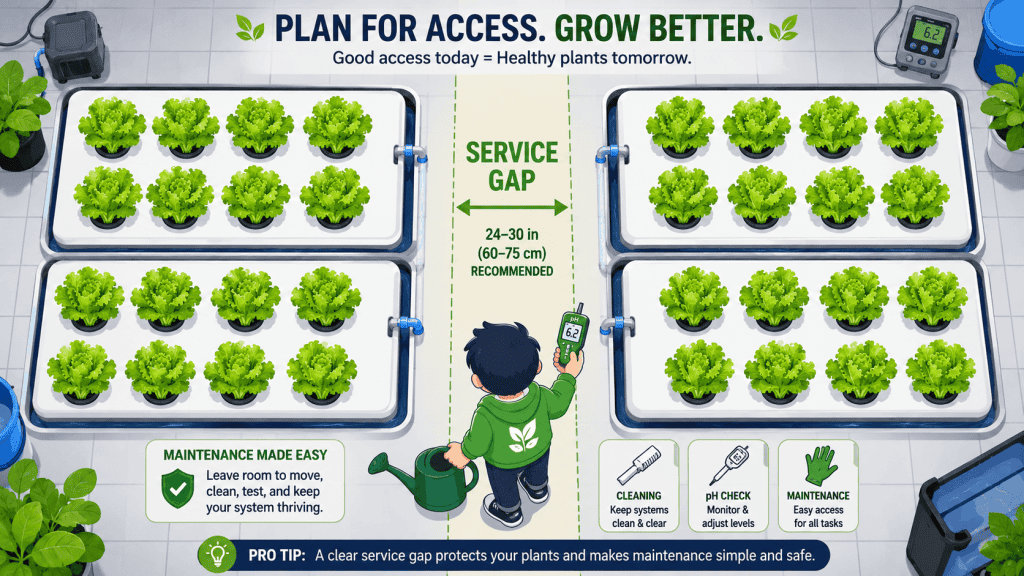
One of the biggest hydroponic mistakes is building systems that become impossible to access later.
Plants may fit perfectly during week one, but mature foliage can completely block reservoirs, pumps, tubing, and air stones.
Don’t build yourself into a corner. I once designed a vertical tower system so tight against the wall that I had to dismantle the entire frame just to reach a clogged air stone. Now, I always leave a 50cm ‘service lane.’ If you can’t comfortably reach your reservoir to scrub it or check your pump without snapping a branch, your layout has failed the maintenance test.
Useful service gaps include:
- Reservoir access space
- Air hose clearance
- Pump inspection room
- Trellis adjustment space
- Walkways around larger systems
Without these gaps, simple maintenance turns into a full system teardown.
Best Hydroponic Spacing by Plant Type
Different crops need different spacing because root growth and canopy size vary heavily between species.
Leafy greens can grow relatively close together. Fruiting plants require much more room for airflow and nutrient stability. Fruiting plants require much more room for airflow and nutrient stability, which is why many good plants for hydroponics beginners choose lettuce, spinach, and basil before moving into larger fruiting crops.
Insights from RWTH Aachen University indicate
“‘yield may be increased for any crop by up to 25% using optimal spacing in leafy vegetables like lettuce,’ noting that optimal spacing ‘promotes the abundance of leaves, branches, and healthy foliage’ while densely planted crops inhibit proper growth and development.” – RWTH Aachen University
| Plant Type | Recommended Spacing | Best System | Main Overcrowding Risk |
| Lettuce | 15–20 cm | NFT / Raft | Leaf rot |
| Basil | 20–25 cm | NFT / DWC | Bush overcrowding |
| Mint | 25+ cm | DWC | Aggressive root spread |
| Tomatoes | 50–60 cm | Dutch Bucket | Heavy shading |
| Cucumbers | 45–60 cm | Dutch Bucket | Trellis congestion |
| Peppers | 30–45 cm | Drip Systems | Nutrient instability |
| Spinach | 15–20 cm | NFT | Early bolting |
| Kale | 25–35 cm | DWC / Raft | Lower leaf shading |
| Strawberries | 20–30 cm | Towers / NFT | Crown rot |
Commercial hydroponic farms often use wider spacing than hobby systems because stable airflow becomes more important at larger scale.
Square Grid vs. Staggered Layouts

(Credits: UrbanAgMike)
Most hydroponic systems use either square layouts or staggered layouts. Square grids are easier to build and measure. Many beginners prefer them because drilling channels and aligning net pots is simpler.
If you’re tight on space, stop using square grids. I switched to a staggered ‘zigzag’ formation and it was a game-changer. By offsetting the rows, each plant’s canopy fits into the ‘gap’ of the next row, like a Tetris piece. This naturally creates diagonal ‘air highways’ that allow your oscillating fans to actually reach the inner foliage where mold usually starts.
The benefits of staggered spacing include:
- Better airflow between leaves
- Improved light penetration
- Reduced shading
- More efficient canopy spread
The downside is extra planning. Irrigation lines, support rails, and trellis systems become more complicated to arrange.
Still, many growers prefer staggered layouts for dense indoor systems because airflow problems appear much later during growth.
Why Pod Count Can Be Misleading
Many hydroponic systems advertise high pod counts, but those numbers often reflect seedling spacing rather than mature plant spacing, which can confuse hydroponics beginners trying to maximize every open pod too early in the growth cycle.
A system may advertise space for 24 plants, but fully grown lettuce or basil can quickly overcrowd the setup. Leaves begin touching, airflow drops, and maintenance becomes difficult.
This problem is common in compact countertop systems and vertical towers. Growers often leave some pods empty on purpose to improve airflow and light penetration.
Common overcrowding signs include:
- Lettuce heads touching before harvest
- Tangled roots beneath the reservoir
- Lower leaves turning yellow
- Slow drying foliage
- Reduced airflow near the center
In many cases, fewer healthy plants produce better harvests than crowded systems struggling with humidity and nutrient stress.
How Airflow and Humidity Affect Spacing
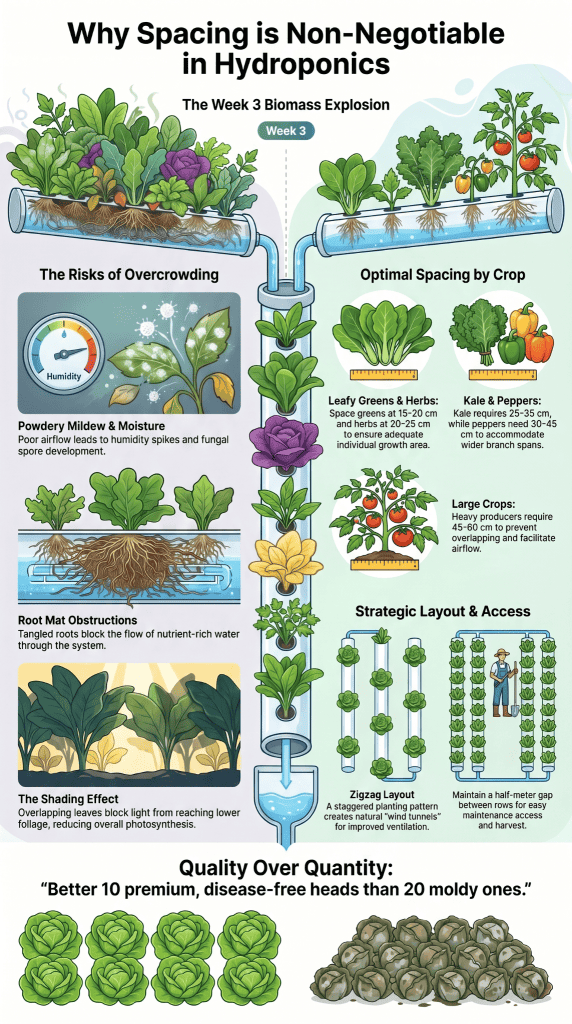
Airflow is one of the most overlooked parts of hydroponic spacing.
Plants release moisture through transpiration. In crowded systems, that moisture becomes trapped between leaves and raises humidity around the canopy.
High humidity slows evaporation from leaf surfaces. Wet foliage stays damp longer, increasing the risk of fungal problems like powdery mildew and botrytis.
This problem gets worse under strong LED lights, as heat builds up near the tops of the plants while airflow underneath becomes too weak.
Indoor growers often notice:
- Condensation on leaves
- Damp canopy centers
- Weak airflow beneath foliage
- Increased mildew outbreaks
- Heat pockets under LEDs
Good spacing helps air move freely across the canopy. Oscillating fans also help prevent stagnant air zones.
When planning hydroponic spacing, growers should think about:
- Fan placement
- Tent size
- Seasonal temperatures
- Humidity levels
- LED heat output
Even strong nutrients cannot compensate for poor airflow conditions.
Signs Your Hydroponic Plants Are Too Close Together
Spacing problems usually appear slowly over time.
Lower leaves often show the first warning signs because they receive the least airflow and light.
Common signs include:
- Leggy stems
- Yellow lower leaves
- Tangled roots
- Wet foliage that dries slowly
- Heat trapped beneath LEDs
- Powdery mildew spots
- Weak airflow between plants
Root-bound hydroponic plants may also develop sudden nutrient problems because overcrowded reservoirs become unstable faster.
Catching these signs early helps prevent larger disease outbreaks later in the grow cycle.
Common Hydroponic Spacing Mistakes
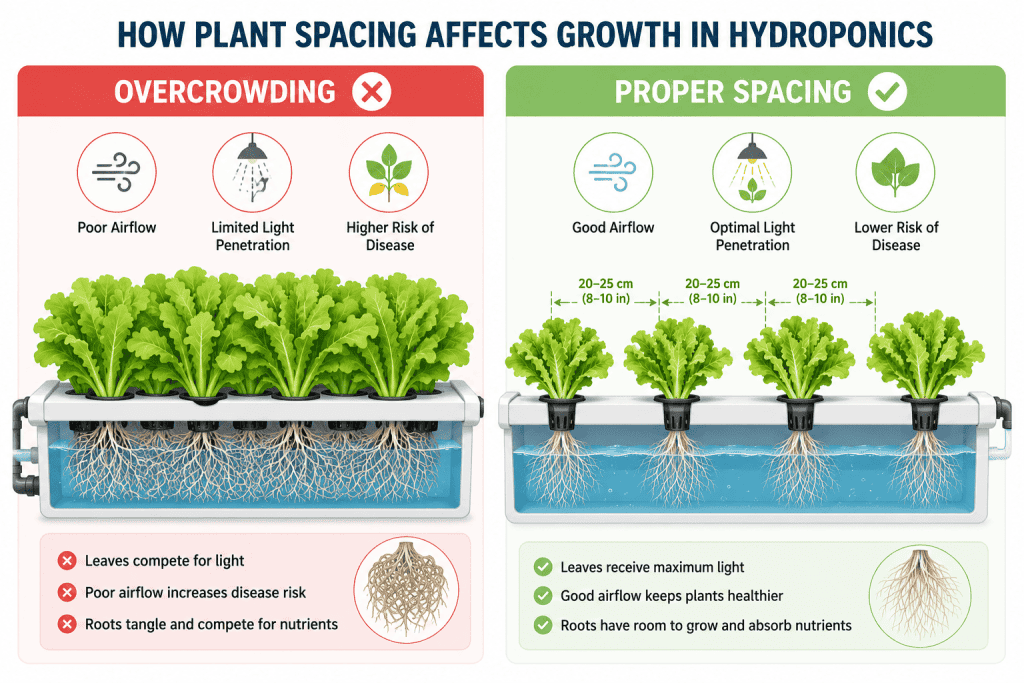
Most spacing mistakes happen because growers try to fit in too many plants instead of focusing on keeping them healthy.
One of the biggest mistakes is spacing plants based on seedling size. Young plants may appear tiny at first, but mature canopies expand quickly under hydroponic conditions.
Other common mistakes include:
- Ignoring trellis width for tomatoes and cucumbers
- Using small reservoirs for heavy feeders
- Blocking access to pumps and tubing
- Packing vertical towers too tightly
- Forgetting root expansion below net pots
- Increasing LED intensity instead of improving spacing
Many beginners try solving poor growth by adding more light. In reality, overcrowding and weak airflow are often the bigger issue.
Overcrowded systems also require more maintenance because roots trap debris and reduce water circulation.
Building a High-Yield Hydroponic Layout
High-yield systems focus on balance rather than maximum plant count.
Healthy airflow, stable nutrients, and easy maintenance usually outperform overcrowded layouts with unstable conditions.
Experienced growers often care more about usable harvest weight than total plant numbers.
Well-designed hydroponic layouts usually include:
- Staggered plant spacing
- Open airflow lanes
- Separate reservoirs for heavy feeders
- Trellis access space
- Easy cleaning access
A system may look empty during early growth, but that extra space becomes valuable later once plants mature.
Giving plants enough room early often leads to healthier roots, stronger stems, and cleaner harvests.
FAQ
How do you space plants in a hydroponic system correctly?
Proper spacing in a hydroponic system allows every plant to receive enough light, airflow, water, and nutrients. When plants grow too close together, leaves overlap and roots compete for oxygen inside the reservoir. Small leafy greens usually need less space than large fruiting crops. You should always plan spacing based on the plant’s mature size instead of the seedling size to prevent overcrowding later.
Can poor hydroponic plant spacing affect plant health?
Yes, poor hydroponic plant spacing can weaken plant growth and increase disease problems. Crowded plants block airflow between leaves, which raises humidity levels around the canopy. Excess moisture often leads to mold, mildew, and root stress in enclosed growing systems. Tight spacing also reduces light exposure for lower leaves, causing uneven growth and smaller harvests compared to properly spaced hydroponic crops.
Does crop type change hydroponic garden spacing requirements?
Different crops require different hydroponic garden spacing because plant size, root systems, and leaf spread vary significantly. Lettuce, spinach, and herbs can grow closer together because they stay compact during maturity. Tomatoes, cucumbers, and peppers require much wider spacing to support larger roots and heavier foliage. Checking the expected mature plant width helps prevent crowding and improves airflow throughout the growing area.
How often should you adjust spacing plants in hydroponics indoors?
You should check spacing plants in hydroponics at least once every week during active growth. Hydroponic plants often grow faster than soil-grown crops because nutrients remain constantly available. As leaves expand, plants may begin blocking airflow and light from nearby crops. Moving containers farther apart when plants become crowded helps maintain healthy airflow, stable humidity, and consistent plant development inside indoor growing systems.
What problems happen when hydroponic crop spacing is too tight?
Hydroponic crop spacing that is too tight can reduce airflow, increase humidity, and limit healthy root development. Plants growing too closely together compete for light, nutrients, and oxygen inside the system. Crowded leaves also stay wet longer after watering or misting, which encourages fungal problems. Proper spacing improves light distribution, supports stronger plant growth, and helps maintain healthier growing conditions throughout the entire system.
Give Your Hydroponic Plants Room to Grow
Crowded hydroponic plants often lead to weak airflow, tangled roots, and more time spent fixing preventable problems. You might save space at first, but tight layouts can quickly make pruning, cleaning, and plant care harder. That catches up fast.
Good spacing makes growing easier over time. When you plan around mature plant size instead of squeezing in extra pods, plants stay healthier and harvests become more reliable.
A simple spacing adjustment can improve root health, reduce disease pressure, and help your whole system run smoother from start to finish.
References
- https://www.thaiscience.info/journals/article/ijat/10992913.pdf#3#3
- https://publications.rwth-aachen.de/record/1012272/files/1012272.pdf?version=1#4#2
Related Articles
- https://tophydroponicgarden.com/hydroponics-for-beginners/
- https://tophydroponicgarden.com/hydroponic-first-plant/
- https://tophydroponicgarden.com/good-plants-for-hydroponics-beginners/
Was this helpful?
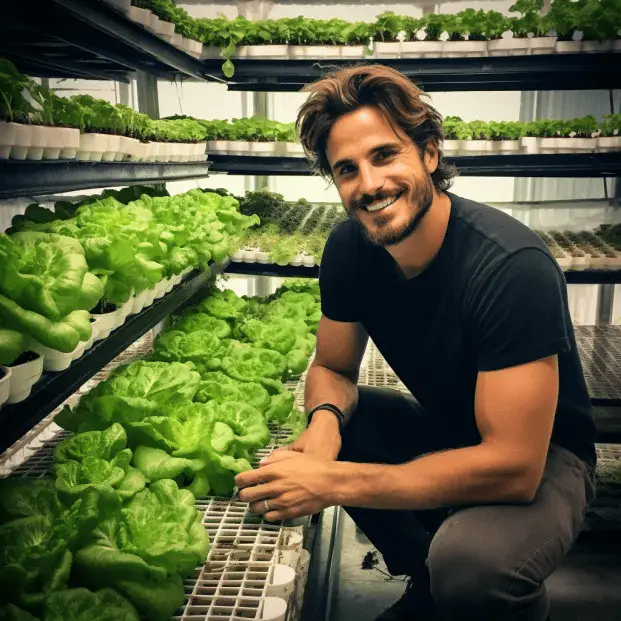
I’m Barrie L., a passionate hydroponic gardening enthusiast dedicated to cultivating thriving, soil-less gardens. With a focus on all things hydroponic, I share my expertise on innovative growing techniques and sustainable practices through my blog, tophydroponicgarden.com. As a seasoned hydroponics specialist, my goal is to inspire and guide fellow gardeners in harnessing the power of water-based cultivation for bountiful and eco-friendly harvests. I’m also an author of the book “Hydroponics For Absolute Beginners: Your Step By Step Guide For How To Create An Hydroponics System At Home Without Soil, For Growing Vegetable, Fruit And Herbs.” which is sold on Amazon. Join me on a journey of redefining the way we cultivate plants, one nutrient-rich solution at a time. Happy growing!