

Over a decade of managing commercial deep water culture systems has shown that maintaining a hydroponic nutrient solution pH strictly between 5.5 and 6.5 is non-negotiable for maximizing crop yields. This precise range ensures roots absorb essential minerals effectively.
When plant leaves turn yellow despite a perfectly balanced nutrient mix, an unstable reservoir pH is likely locking out essential food. Raising these levels requires precision, as sudden chemical shifts often induce severe root shock and halt growth completely.
Reservoir pH Essentials You Should Know
- Maintain your crop’s recommended pH range instead of chasing one exact number. Always mix nutrients before adjusting pH.
- Use a hydroponic pH up solution in small doses. Allow the reservoir to circulate before retesting. Monitor both pH and EC because they influence each other.
- Investigate repeated pH drops instead of constantly adding more pH increaser for hydroponics.
The Importance of Reservoir pH for Healthy Plants
The pH of your nutrient tank controls whether your plants can actually use the food you give them. You can have a perfectly mixed fertilizer, but if the pH is wrong, your plants can’t absorb it. It’s not about having more nutrients in the water; it’s about whether the chemistry lets the roots take them in.
Research from places like the University of Georgia shows that nutrient availability swings wildly with pH changes.
As noted by Springer Nature:
“Root zone pH is a key factor governing micronutrient solubility in soilless plant culture, directly influencing nutrient uptake and crop health.” – Springer Nature
This means checking your pH isn’t optional, it’s a core task for anyone growing plants in water, whether you have a small setup at home or a large commercial operation.
When your nutrient solution gets too acidic, key elements get locked up. Calcium, magnesium, and phosphorus become much harder for plants to absorb, even though your water test might show they’re technically still there.
This leads to a common mistake. Growers see signs of deficiency and add more fertilizer, but the problem doesn’t go away. That’s because the issue isn’t a lack of nutrients, it’s that the pH is preventing access to them. You’re dealing with nutrient lockout, not a deficiency.
If your reservoir pH stays too low for too long, you’ll likely see:
- Stunted root growth.
- Signs of calcium and magnesium deficiency in the leaves.
- Generally weak, unhappy plants.
- A higher chance of complete nutrient lockout.
- Slower growth and smaller harvests.
Field logs from cultivating heirloom tomatoes in recirculating systems reveal a critical pattern. Maintaining a strict 6.0 to 6.2 reading during the heavy fruiting stage prevents the sudden calcium lockouts that typically cause blossom end rot.
While standard charts suggest a broad 5.8 to 6.5 range, pinpointing the optimal sub-range for specific growth phases consistently yields superior harvests.”
It’s also important to remember that not all hydroponic systems are the same. A deep water culture (DWC) tank might see pH drift differently than a nutrient film technique (NFT) channel or an ebb and flow system. That’s why regular testing with a meter or drops is always better than guessing.
Signs Your Reservoir pH Is Too Low

The best tool for catching a pH problem is a calibrated digital pH meter. It gives you a real number before your plants even start to look sick. By the time you see yellow or discolored leaves, the pH has likely been off for days, and nutrient uptake has already slowed down.
When pH is unstable, plants often grow slowly, have weak stems, and their leaves turn pale. The tricky part is these symptoms look just like a nutrient deficiency. That’s why testing is so much better than just looking at the plants.
A good digital meter is more precise than most of the liquid test kits that change color. To keep it accurate, you need to calibrate it regularly with pH 4.0 and pH 7.0 buffer solutions. A bad reading can make you adjust the pH when you don’t need to.
Before you reach for any pH Up product, run through this simple list:
- Measure the current pH of your nutrient solution.
- Double-check that your pH meter is calibrated.
- Take an EC or PPM reading.
- Look at the roots. Are they brown or do they smell bad?
- Check the temperature of the water in your reservoir.
- Make sure your air pump is working and the water is well-aerated.
How often you test makes a difference. A brand new nutrient solution can be unstable, so it’s smart to check the pH daily for the first few days until it settles.
You should also test your water:
- Before you mix in new nutrients.
- After you top off the reservoir with fresh water.
- Right after a complete reservoir change.
- Any time your plants suddenly look stressed.
Keeping a simple grow log where you write down the pH, EC, water temperature, and what you see can show you patterns. You might spot a slow drift in pH long before it causes a major issue.
Safe Steps How to Raise the pH in Your Reservoir
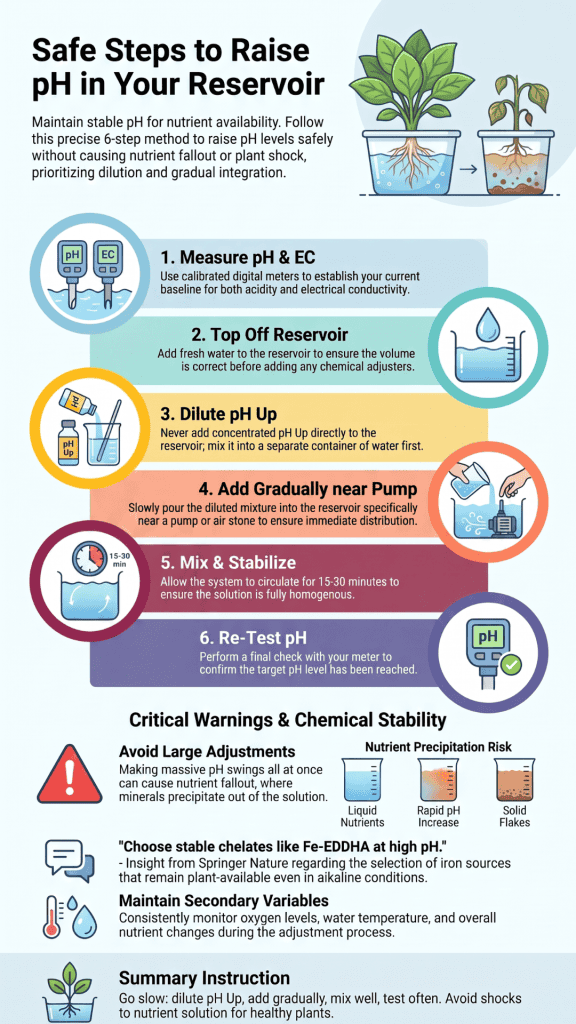
The key is to go slow. Add a little pH Up, mix the water well, then test again. Don’t just dump a bunch in all at once.
The pH Up products made for hydroponics usually contain potassium hydroxide or potassium carbonate. These ingredients are effective at raising the pH and are compatible with your nutrient solution, as long as you use them properly.
Making a huge pH correction all at once is a bad idea. It shocks the water chemistry and you’ll probably overshoot your target. Small, gradual adjustments keep the nutrients dissolved in the water. If you raise the pH too fast, the minerals can fall out of the solution, a problem called nutrient fallout or precipitation.
Here’s a step-by-step process to follow:
- Measure your current pH and EC.
- If your EC reading is very high, try topping off the reservoir with fresh water first. This can sometimes help.
- Take the recommended amount of pH Up and dilute it in a separate container of fresh water. Never add it straight from the bottle.
- Slowly pour this diluted mixture into your reservoir near a pump, return line, or air stone where the water is moving fast.
- Let the system run and mix for at least 15 to 30 minutes.
- Test the pH again.
- Only repeat these steps if you still need to raise the pH a little more.
Pouring concentrated pH adjuster into still water creates dangerous pockets of very high pH. This is what causes nutrients to crash out of the solution. Once that happens, those nutrients are gone and your plants can’t use them.
Insights from Springer Nature indicate:
“Managing root zone pH precisely is essential for keeping nutrients soluble, and that growers must be especially careful when pH rises, as it can make certain nutrients unavailable. Their work highlights the need to “carefully select appropriate micronutrient fertilizers (especially stable chelates such as Fe-EDDHA at higher pH)” to avoid precipitation.” – Springer Nature
Patience is better than force. A lot of growers get stuck “chasing pH,” making tiny corrections all day long. It’s normal for pH to drift a little as plants eat and drink, especially in active systems like Deep Water Culture (DWC).
Good maintenance is about more than just pH. It also means keeping an eye on oxygen levels, maintaining a steady water temperature, and changing your nutrient solution on a regular schedule instead of constantly fixing it with chemicals.
Choosing the Right Reservoir pH Up Product
For hydroponics, it’s best to use a pH Up product made specifically for it. They’re designed to work with your nutrients and give you consistent results.
Not all alkaline products are the same. Which one you should use depends on your water, your nutrient mix, and how you run your system. Picking the right one helps you avoid throwing your nutrient balance out of whack.
| Product | Best For | Important Note |
| Hydroponic pH Up (Potassium Hydroxide) | Everyday pH adjustments | Works fast and is the most common type. |
| Potassium Carbonate pH Up | Creating a more stable pH | Acts slower but helps buffer the pH, making it less likely to swing. |
| Potassium Silicate | Raising pH and adding silica | Must be added carefully to avoid clouding or nutrient fallout. |
| Fresh Water Dilution | When your EC is too high | Lowers nutrient strength while also helping to adjust pH. |
| Baking Soda | Emergency use only | Adds sodium, which builds up in your system and can harm roots over time. |
A lot of new growers ask about using baking soda. Yes, it will raise the pH in a pinch, but it’s a bad habit. Every time you use it, you’re adding sodium to the water. Sodium isn’t a plant nutrient, and in a recirculating system, it doesn’t get used up, it just accumulates. Over weeks or months, that built-up sodium can start to damage your roots.
Potassium-based products are the standard choice because plants actually need potassium. It’s part of their food. Still, if you’re constantly dumping in pH Up, you’re adding a lot of extra potassium, which can mess up the balance of other nutrients. That’s why regularly dumping and refilling your reservoir is a necessary part of maintenance, not an optional chore.
Often, if you find yourself constantly correcting pH, the real problem isn’t which product you’re using. The issue is usually something else in your setup.
Reasons Reservoir pH Becomes Too Low
If your pH is constantly falling, it’s usually a sign of something else going on in your tank. It’s not that you need more pH Up.
All reservoirs change as plants use the water and food. A little drift is normal. But if you’re adjusting the pH every single day, something else is probably wrong.
A very common reason is your nutrients getting too strong. When water evaporates, or plants drink water faster than they eat nutrients, everything in the solution gets more concentrated. This can drive the pH down. Often, just topping off the tank with fresh water will fix both the high EC and the low pH, no chemicals needed.
The plants themselves change the water’s chemistry. During a growth spurt, roots take up certain nutrients faster than others, which naturally shifts the pH. A healthy, active reservoir won’t hold one perfect pH number all day, it will gently swing.
Here are some other things that can cause your pH to keep dropping:
- Inadequate reservoir volume, specifically anything under 5 gallons per mature plant, severely limits buffering capacity against rapid chemical changes.
- Furthermore, nutrient solution temperatures exceeding 72°F (22°C) rapidly accelerate microbial activity, directly driving down pH levels.
- Algae growth: Light leaking into the tank lets algae grow, which affects pH.
- Not enough oxygen: Poor aeration from a weak air pump can change water chemistry.
- Water is too warm: Higher temperatures speed up all the biological activity in the water.
- A bad meter: An uncalibrated pH meter is giving you the wrong number.
Many growers watch both their EC and pH meters together. The pattern tells a story. If both numbers are moving in a predictable way over a week or two, it might just mean your nutrient solution is old and needs to be changed.
The goal isn’t to stop all pH movement with chemicals. You get a stable system from mixing your nutrients right, keeping the reservoir clean and dark, checking your numbers consistently, and changing the solution on a regular schedule. Constant correction is a symptom, not a solution.
Maintaining Stable Reservoir pH
How Often Should I Change Out My Nutrient Reservoir—Really?
YouTube: Everest Fernandez
Stable reservoir conditions reduce the need for constant pH adjustment and help plants absorb nutrients more efficiently.
Many growers focus on correcting pH after it changes instead of preventing fluctuations in the first place. Building a consistent maintenance routine keeps your hydroponic reservoir pH within the correct range while minimizing stress on plants.
Water quality is one of the biggest factors affecting pH management. Source water with high alkalinity naturally resists pH changes, while reverse osmosis (RO) water contains very little buffering capacity and may experience faster pH fluctuations after nutrients are added.
Keeping the nutrient reservoir clean also improves stability. Organic debris, algae, and unhealthy roots can alter hydroponic water chemistry and contribute to repeated pH drift over time.
Environmental conditions matter just as much. Warm nutrient solutions hold less dissolved oxygen, encouraging microbial activity that may influence reservoir water quality and root health. Most hydroponic systems perform best when water temperatures remain between 65°F and 70°F (18–21°C).
A simple maintenance routine goes a long way toward preventing unnecessary corrections:
- Test pH and EC at the same time each day.
- Use consistent source water for every reservoir refill.
- Keep the nutrient tank completely lightproof.
- Maintain proper reservoir aeration with air stones or circulation pumps.
- Replace nutrient solution on a regular schedule.
- Avoid making multiple pH adjustments within a short period.
That said, stability should always be the goal instead of achieving one exact decimal reading. A reservoir that naturally fluctuates slightly within the recommended range is generally healthier than one experiencing frequent chemical corrections.
Adjusting pH After Adding Nutrients
A stable system means you don’t have to constantly adjust the pH, and your plants can take up nutrients without stress. Most people react to pH changes instead of preventing them. A good routine keeps your pH in the right zone and your plants happier.
Your water source makes a huge difference. Water with high alkalinity (like some tap water) fights pH swings. On the other hand, pure Reverse Osmosis (RO) water has almost no buffering power, so its pH can jump around more after you add nutrients.
Don’t forget the environment. Warm water holds less oxygen, which can lead to more bacteria and root problems. For most systems, you want your nutrient solution to stay cool, between 65°F and 70°F (18–21°C).
A simple daily routine prevents most issues:
- Check pH and EC at the same time every day.
- Always use the same type of water to top off or mix new solution.
- Make sure no light gets into your nutrient tank.
- Keep the water moving with air stones or a circulation pump.
- Change out the entire nutrient solution on a regular schedule.
- Don’t make a second pH adjustment right after the first. Let it settle.
Remember, the goal is stability, not a perfect number. A reservoir that drifts gently between 5.8 and 6.2 is usually healthier than one you’re constantly dosing with chemicals to keep it pinned at 6.0.
Common Mistakes That Cause Reservoir pH Problems
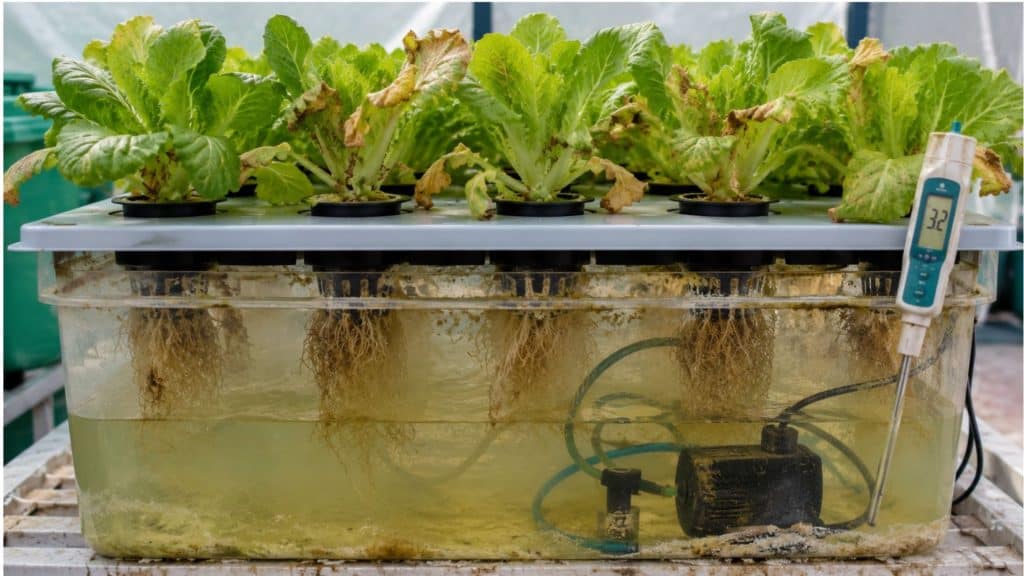
Most pH problems come from how we test and adjust, not from bad nutrients. The biggest mistake is adding too much pH Up at once. These products are strong. A big correction will often shoot the pH right past your target, forcing you to use pH Down right after. It’s a frustrating cycle.
Another common error is not mixing the water. If you test the pH right after adding an adjuster, you’re not getting a true reading. The chemical hasn’t spread evenly through the whole tank yet.
Here are the usual pitfalls to avoid:
- Pouring pure pH Up directly into calm water.
- Using a pH meter you haven’t calibrated in weeks.
- Trying to fix every tiny, hourly change in the reading.
- Not paying attention to your EC or PPM meter.
- Mixing supplements that don’t play well together.
- Waiting until your plants look sick to check the pH.
- Letting the same nutrient solution get too old.
It’s easy to think every pH drop needs a chemical fix, but that’s not always true. Sometimes a high EC reading is the real clue, topping off with fresh water is the answer. Other times, the whole batch of nutrients is just exhausted, and a complete change is the fastest way to reset everything.
No reservoir stays perfectly still. As plants eat, they change the water. That’s normal. The point of checking regularly is to see the natural drift and understand it, so you can act before it turns into a real problem.
FAQ
Does Water Temperature Affect Reservoir pH Stability?
Yes. Water temperature affects dissolved oxygen levels and overall hydroponic water chemistry. Warm water holds less oxygen, which can increase microbial activity and lead to more pH fluctuations. Keeping the nutrient solution within the recommended temperature range supports root zone health, improves nutrient uptake, and helps maintain a more stable hydroponic reservoir pH.
Can Low Dissolved Oxygen Affect Nutrient Uptake?
Yes. Low dissolved oxygen reduces root activity and limits plant nutrient availability, even when the nutrient solution contains enough nutrients. Good reservoir aeration helps roots absorb nutrients more efficiently while supporting healthy growth. Proper oxygen levels also improve the overall performance of your hydroponic growing system and reduce plant stress.
Can Baking Soda Raise Reservoir pH Safely?
Baking soda for pH can temporarily raise reservoir pH, but it is not recommended for regular use. It adds sodium to the nutrient solution, and sodium can build up over time in recirculating systems. For a safe pH adjustment, use products specifically made for hydroponics instead of household ingredients.
How Often Should You Calibrate a Digital pH Meter?
A digital pH meter should be calibrated regularly to provide accurate readings. Most growers calibrate the pH meter every one to two weeks or before making important reservoir adjustments. Using fresh calibration solutions and checking the meter before reservoir water testing helps you make accurate pH corrections and avoid unnecessary adjustments.
Raise the pH in Your Reservoir with Confidence
When your reservoir pH keeps drifting, your plants can struggle to take up the nutrients they need. Small changes made over time work better than quick fixes. Keep testing your water, mix nutrients in the right order, check EC with pH, and keep your reservoir clean. That’s what helps plants stay healthy from start to finish.
If you want more practical tips, tophydroponicgarden is a good place to keep learning. Their guides can help you handle common hydroponic problems with more confidence, so you can spend less time fixing issues and more time growing healthy plants.
References
- https://rd.springer.com/article/10.1007/s42729-025-02839-5
- https://rd.springer.com/article/10.1007/s42729-025-02839-5
Related Articles
- https://tophydroponicgarden.com/how-to-grow-from-cuttings-in-hydroponics/
- https://tophydroponicgarden.com/can-you-grow-celery-hydroponically/
- https://tophydroponicgarden.com/what-are-the-easiest-hydroponic-herbs/
Was this helpful?
