

Lower tomato leaves on mature hydroponic plants often remain shaded, retain moisture longer, and create ideal conditions for fungal diseases, especially in hydroponics where they’re near water and media. That makes them a target for problems.
In my greenhouse, I routinely strip away the bottom 6 to 12 inches of foliage on mature plants. Clearing out these old, yellowed leaves eliminates microclimates where stagnant, humid air sits, allowing the healthy upper canopy to do its job without fighting off disease.
Want to know exactly which leaves to cut and which to keep? Keep reading.
Quick Read: Prune Smart for Airflow and Steady Growth
Good hydroponic tomato pruning is less about removing a lot and more about removing the right parts at the right time, mainly lower, damaged, or unproductive growth, to keep airflow strong and plants healthy throughout the system.
This approach helps prevent disease, supports better light penetration, and keeps the plant focused on producing quality fruit instead of excess foliage.
- Remove lower, damaged, and yellow leaves first
- Focus on improving canopy airflow, leaf drying speed, and light penetration to lower fruit clusters.
- Keep healthy upper leaves to support fruit growth
Don’t Turn Pruning Into a Haircut
This happens all the time.
A grower sees a tomato plant getting crowded and decides it’s time to prune. Five minutes later, half the leaves are gone.
That’s usually not the answer.
Tomatoes need a healthy canopy to produce energy. While pruning helps control growth, removing too much foliage can slow development and stress the plant.
Think of pruning as guiding the plant, not fighting it.
The goal is to maintain an open tomato canopy that improves airflow, increases light exposure, and reduces humidity around leaves, while keeping enough healthy leaves to support fruit production.
Many growers follow a simple rule:
Never remove more than one-third of the plant during a single pruning session.
It’s a good guideline because it prevents overreacting.
Heavy pruning can lead to:
- Slower growth
- Smaller fruit
- Delayed ripening
- Extra plant stress
From what I’ve seen, small weekly adjustments almost always beat a major cleanup once a month.
Less dramatic.
Much better results.
A Simple Pruning Schedule

People often ask how often they should prune.
The answer is easier than most expect.
Check your plants once a week.
That’s it.
Walk down the row or around your system and look for new suckers, yellow leaves, damaged growth, or stems that need support. Most maintenance can be done in a few minutes.
Weekly tasks:
- Remove new suckers
- Inspect leaf axils where new tomato suckers commonly emerge
- Remove yellow foliage
- Inspect support clips
- Remove foliage blocking airflow between stems and fruit clusters
As noted by Oklahoma State University Extension
“This weekly habit lines up with what Oklahoma State University Extension recommends specifically for hydroponic tomato production. Their fact sheet on pruning hydroponic crops points out that suckers are easiest to remove by hand once a week, while they’re still only 2 to 2.5 millimeters long, since at that size they snap off cleanly without injuring the main stem. Wait too long between checks and those same suckers turn into thick side branches that need cutting tools and leave bigger wounds behind.” –
Oklahoma State University Extension
Then once a month, step back and look at the bigger picture.
Monthly tasks:
- Check canopy density
- Inspect root growth
- Review support systems
- Lower vines if needed
- Look for overcrowding
Simple routines work because they’re easy to follow.
And that’s what matters.
Root Pruning: The Part Most Growers Forget
When people talk about pruning tomatoes, they’re usually thinking about leaves and stems.
Fair enough.
But roots need attention too.
In hydroponic systems like DWC, RDWC, NFT, and vertical towers, tomato roots can become surprisingly large. A healthy root system is great, but eventually it can create problems.
Overgrown tomato roots may block drains, restrict nutrient circulation, and reduce dissolved oxygen availability.
They can slow water movement.
Sometimes they grow into neighboring sites and compete for space.
These issues can reduce root-zone oxygen levels and increase the risk of root disease.
If root growth starts causing issues, a light trim may help restore water flow and improve oxygen circulation.
Signs root pruning may be needed include:
- Slow drainage from root mass accumulation
- Water flow problems
- Crowded root masses
- Reduced oxygen movement through the root zone
- Roots spreading into other sites
Research from Frontiers in Plant Science shows
“This isn’t just a hydroponic folk rule, either. A review published in Frontiers in Plant Science examined exactly this problem in recirculating systems and found that as root mats build up over a growing cycle, they progressively block the thin film of moving nutrient solution from reaching air, creating low-oxygen conditions that weaken root membranes and leave roots more vulnerable to pathogens like Pythium. Crowded, unmanaged roots aren’t just a plumbing nuisance, they change the chemistry and biology happening at the root surface.” –
Frontiers in Plant Science
The key word here is “light.”
Most experienced growers remove only a small portion of the root mass. Around 10% to 15% is a common range.
More isn’t better.
After root pruning, keep an eye on the plant for a few days. Watch water uptake, nutrient levels, and overall growth.
Most healthy plants recover without much trouble. It’s also a good time to evaluate the condition of your hydroponic solution, since root maintenance and reservoir performance often affect each other.
What Happens When Tomatoes Get Too Tall?
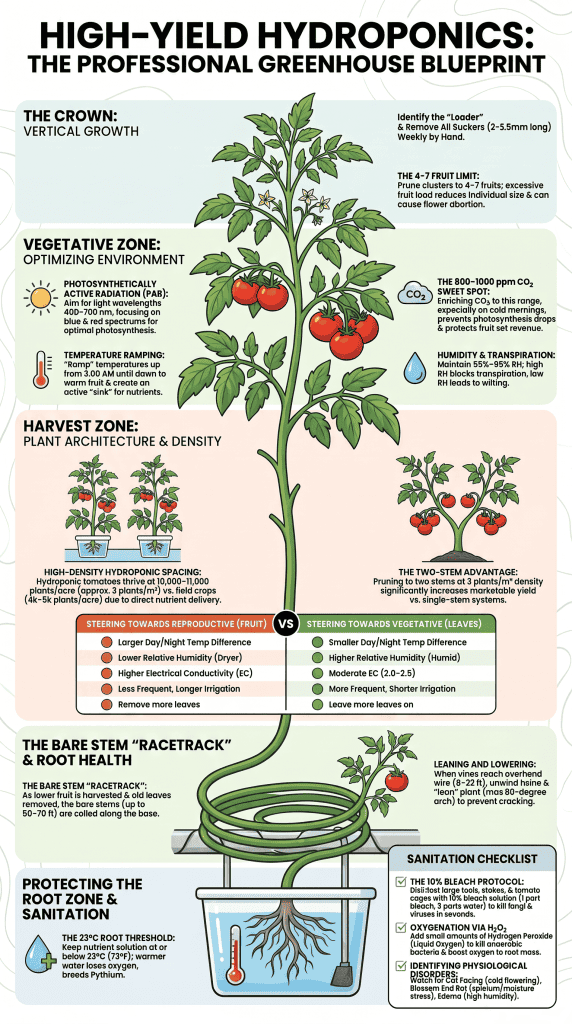
If you’re growing indeterminate tomatoes, this question eventually comes up.
They just keep growing.
In a greenhouse or grow tent, it’s not unusual for a healthy tomato vine to reach the roof. At that point, something has to give.
One option is topping.
Topping the Plant
Topping means removing the growing tip at the top of the main stem.
Removing the apical growing tip redirects plant energy from vertical growth toward fruit ripening and cluster development and puts more energy into ripening existing fruit.
Growers often use topping when:
- Plants reach maximum height
- The season is ending
- Space becomes limited
It’s a straightforward solution.
Cut the tip and control the height.
Problem solved.
The Lower-and-Lean Method
Commercial growers often use a different approach.
Instead of cutting productive vines, they slowly lower them.
The process is simple:
- Lower the stem a little.
- Move support clips.
- Lean the vine sideways.
- Let new growth continue upward.
This technique allows growers to keep harvesting from the same plant for a much longer time.
Pretty clever.
And surprisingly effective.
The lower-and-lean method allows indeterminate tomato vines to maintain continuous fruit production without exceeding greenhouse height limits.
How Pruning Affects Water and Nutrient Use
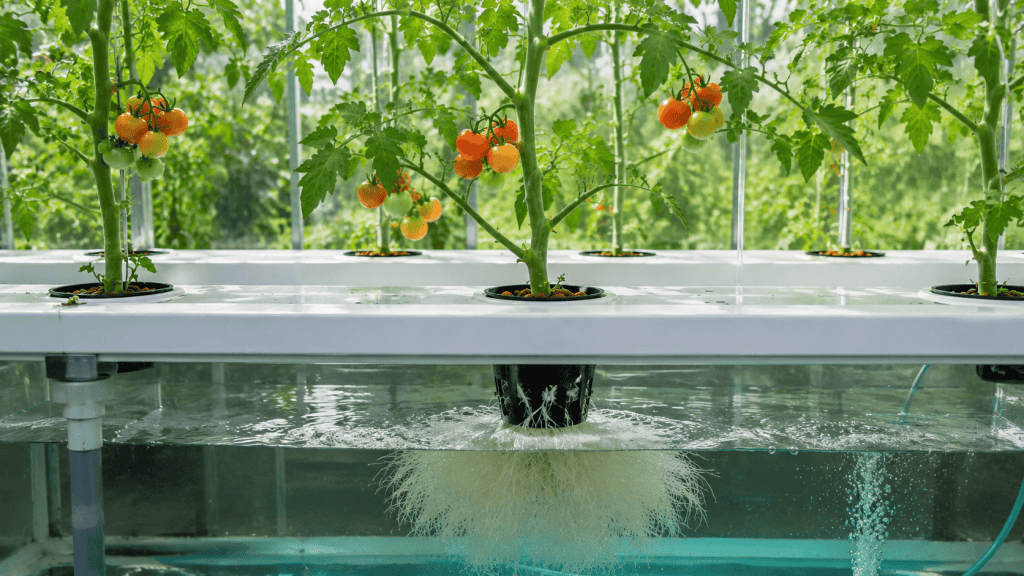
Pruning influences plant transpiration, nutrient uptake, and reservoir water consumption.
It also changes how the plant uses water.
When a large amount of foliage is removed, the plant loses part of its transpiration system. With fewer leaves, less water escapes into the air.
As a result, water uptake may slow for a short time.
Nitrogen, potassium, and calcium demand may temporarily decrease after heavy foliage removal.
After heavy pruning, you will likely see lower water use and slightly higher EC readings because the plant is transpiring less.
Don’t panic, but don’t ignore it either. Because a ruined crop is an expensive mistake, always use a recently calibrated EC meter to test your reservoir post-pruning.
An EC increase greater than 0.2 mS/cm often indicates reduced water uptake following heavy pruning.
Still, it’s worth checking your reservoir after major pruning work. Changes in plant demand can influence how efficiently hydroponic nutrients are being used throughout the system.
A quick look can save headaches later.
Common Tomato Pruning Mistakes
Most pruning mistakes aren’t complicated.
They’re usually small decisions that add up over time.
Treating Every Tomato the Same
Indeterminate and determinate tomatoes don’t grow the same way.
Prune them the same way, and one of them may suffer for it.
Know what variety you’re growing before making major cuts.
Forgetting to Clean Tools
Hydroponic systems make it easy for diseases to spread.
One dirty pair of snips can move problems from plant to plant faster than many growers realize.
Disinfect pruning shears between plants to prevent transmission of bacterial, fungal, and viral pathogens.
It’s worth the extra minute. Small maintenance habits like tool sanitation often have a bigger impact on plant health than growers expect.
Pruning Wet Plants
Wet leaves are more vulnerable to disease problems.
Whenever possible, wait until the foliage is dry before pruning.
Removing Too Many Leaves
This one catches beginners all the time.
The plant looks crowded, so more leaves come off.
Then more.
Then even more.
Before long, the plant has lost a large part of the canopy it needs to produce energy.
Don’t chase perfection.
Healthy plants don’t need to look bare.
Ignoring Airflow
A dense tomato canopy traps humidity around leaves and slows surface drying.
And trapped moisture creates ideal conditions for disease.
Failure to prune often leads to excessive canopy density, poor airflow, and increased disease pressure.
Quick Reference: What to Cut and What to Keep
| Cut | Keep |
| Suckers | Main leader |
| Diseased leaves | Flower clusters |
| Yellow foliage | Healthy upper canopy |
| Damaged branches | Fruiting stems |
| Reservoir-touching leaves | Productive foliage |
Keep this table handy.
It’s easier to make good pruning decisions when you’re not trying to remember everything at once.
Examples of Content They Can Create

Credits: Alice’s Garden To Plate
Pruning tomato plants in hydroponic systems is essential for getting the best fruit production. When you prune, you redirect the plant’s energy to its most productive parts, like developing buds and flowers.
The first step is removing the bottom seedling leaves. These original leaves from when the plant started growing are no longer needed and steal energy from the top of the plant where fruit forms. Cutting them off also prevents disease. Soil-borne diseases can splash up onto lower leaves in outdoor growing, but removing them eliminates this risk entirely.
Another critical pruning task is removing “suckers.” Suckers are small shoots that grow between the main stem and branches. They strip nutrients away from your main fruit-bearing branches. When you cut suckers out, the plant channels that energy into producing more buds and fruit instead.
Finally, pruning bottom leaves improves airflow around the plant. Good airflow prevents fungus, disease, and moisture problems that can damage your tomatoes.
FAQ
When should I start pruning my hydroponic tomatoes?
Start pruning the moment your young plants begin pushing out their first aggressive side shoots, typically 3 to 4 weeks after transplanting. I make it a habit to check them every single week; if you let it go longer, a manageable canopy quickly turns into an overgrown jungle that suffocates airflow.
How does removing suckers actually improve my final yield?
Pinching off suckers stops the plant from wasting energy on growing useless vegetative stems. I’ve found that strictly maintaining a single main vine keeps the plant focused entirely on swelling those fruit clusters, which makes trellising much easier and keeps your yield highly predictable.
Removing suckers directs carbohydrates and nutrients toward fruit trusses rather than additional side shoots. Proper removal also improves tomato plant structure training and supports stable hydroponic tomato plant health.
Why is hydroponic tomato canopy management important for airflow and light?
Managing your hydroponic tomato canopy is key for airflow. Good circulation drops humidity around the plants, helping leaves dry faster and cutting the risk of diseases like botrytis or powdery mildew.
Removing the lower, shaded leaves is a direct move. It gets rid of growth that traps moisture, slashing humidity at the plant base. This action also lets more light reach the lower fruit clusters, strengthening the whole plant against disease in a crowded grow space.
What mistakes should I avoid when pruning determinate varieties?
Pruning determines tomato hydroponics must be done carefully because these plants have a fixed growth cycle. Over-pruning tomato flowers reduces fruit production and weakens tomato fruit load management.
Cutting too many leaves early reduces pruning for bigger fruit and limits energy production. If you make a careless cut on the main stem, you risk stunting its growth for weeks.
Because determinate varieties naturally stop growing and set all their fruit at once, over-pruning them simply deletes your future harvest. Keep your snips away from their main branches.
How do trellising and pruning work together to keep my system clean?
I use heavy-duty roller hooks and twine to support my main stems. By keeping the vines perfectly upright and well-trained, I can pack more plants into my square footage while ensuring the stems don’t buckle under the weight of a heavy cluster of fruit.
Vertical trellising keeps fruit clusters off the ground, improves canopy organization, and allows more uniform light distribution. This vertical layout ensures every leaf gets equal access to your grow lights, meaning the plant wastes zero energy struggling for position. It keeps the workspace clean and makes harvesting painless.
Final Thoughts on Pruning Hydroponic Tomato Plants
The best hydroponic tomato growers treat pruning as a routine, not a one-off task. A few minutes each week can prevent crowded vines and keep growth under control. Remove suckers while they are still small, trim leaves that block light or show issues, and keep the plant supported as it develops.
Good pruning improves airflow and lets more light reach the canopy, helping fruit develop more evenly. Proper pruning helps maintain tomato canopy structure, improves airflow, and reduces the risk of fungal infections throughout the growing season, when growth is guided early. Try applying these pruning habits this week and watch how quickly your system responds at harvest.
References
- https://www.frontiersin.org/journals/plant-science/articles/10.3389/fpls.2026.1829367/full
- https://extension.okstate.edu/fact-sheets/pruning-hydroponic-crops
Related Articles
- https://tophydroponicgarden.com/how-often-to-change-hydroponic-solution/
- https://tophydroponicgarden.com/how-long-do-hydroponic-nutrients-last/
- https://tophydroponicgarden.com/how-to-maintain-hydroponic-plants/
Was this helpful?

I’m Barrie L., a passionate hydroponic gardening enthusiast dedicated to cultivating thriving, soil-less gardens. With a focus on all things hydroponic, I share my expertise on innovative growing techniques and sustainable practices through my blog, tophydroponicgarden.com. As a seasoned hydroponics specialist, my goal is to inspire and guide fellow gardeners in harnessing the power of water-based cultivation for bountiful and eco-friendly harvests. I’m also an author of the book “Hydroponics For Absolute Beginners: Your Step By Step Guide For How To Create An Hydroponics System At Home Without Soil, For Growing Vegetable, Fruit And Herbs.” which is sold on Amazon. Join me on a journey of redefining the way we cultivate plants, one nutrient-rich solution at a time. Happy growing!