

Good support can make vining crops easier to manage through the season. Check ties and frames as plants gain weight, since stems and fruit can shift the load quickly. Vertical hydroponic towers and indoor growing setups require frames suited to the system and expected plant load.
Specialized resources such as TopHydroponicGarden can offer information on reservoir-compatible frames, while the basic principle remains the same: support structures should be built to handle the plant’s full mature weight.
Vining Support Quick Wins
- Match the trellis structure to the crop’s mature size, attachment method, and fruit weight.
- Use soft ties, clips, or suitable twine to train young vines without cutting into expanding stems.
- Prioritize anchoring and load capacity when supporting indeterminate tomatoes, melons, squash, and other heavy vines.
Why Do Vining Crops Need Structural Support?
Structural support keeps many vining crops upright, keeps leaves off the soil, and makes plants easier to check and harvest.
Trellises can help lower disease risk by keeping plants raised off the ground. Supported fruit has less contact with slugs and rot, while training long vines upward can help them grow in smaller garden spaces.
Growing plants vertically can help keep the area around them better ventilated, make it easier for treatments such as fungicides to reach the plant, and keep the foliage from coming into close contact with the soil.
Vertical support also makes better use of limited garden space. Rather than allowing stems to spread across the bed, you can guide them upward. This opens up more room at ground level for pathways, companion plants, or other vegetables.
The setup can also make plants easier to reach. Leaves, flowers, and young fruit are easier to check. Irrigation and weed control are also easier without stepping over vines.
- Space: Vertical growth uses less ground space.
- Airflow: Raised foliage can dry faster with good spacing.
- Fruit quality: Supported fruit has less soil contact.
- Maintenance: Training makes plants easier to inspect and harvest.
Trellising can help with disease control, but it does not prevent disease on its own. Heavy pruning can also expose fruit to too much heat and sun. Good airflow, dry foliage, and proper support for vining plants such as cucumbers, beans, and tomatoes can help reduce these problems.
What Type of Support Does Each Vining Crop Need?
The best support depends on whether a crop climbs with tendrils, twining stems, or a naturally sprawling growth habit.
As noted by Journal of Experimental Botany
“associated with longitudinal, not skewed, microtubule patterning” – UFRGS Climb de Voo Group
A cucumber trellis, pea trellis, or bean trellis can be relatively light because many of these vining plants can attach themselves to the structure. Tomatoes need a different crop support system because indeterminate stems keep extending throughout the season.
Vining tomatoes can grow 3 to 5 feet long or more, so a small cage may not provide enough support for many indeterminate varieties.
| Crop | Growth habit | Suitable support | Key consideration |
| Cucumbers | Tendrils | Mesh, netting, A-frame | Support developing fruit and vines |
| Peas | Tendrils | Netting, string, wire | Fine climbing surface works well |
| Pole beans | Twining stems | Poles, strings, teepee | Provide vertical surfaces |
| Indeterminate tomatoes | Long, branching stems | Stakes, cages, panels, strings | Structure must handle extended growth |
| Small squash | Trailing/climbing | A-frame or strong mesh | Support depends on fruit size |
| Melons | Trailing vines | Strong trellis plus slings | Fruit weight can exceed vine capacity |
| Large pumpkins | Heavy trailing vines | Usually ground-grown | Weight can make vertical growing impractical |
The distinction between crops matters because support for vining plants is not one-size-fits-all. A fine mesh can work beautifully for peas but may be awkward for a vigorous tomato plant. A rigid panel can handle a large canopy but may create more cleanup work at the end of the season.
How Do Tendrils and Twining Stems Differ?
Tendrils grab nearby supports and curl around them. Twining stems wrap themselves around poles, strings, or other supports as they grow.
As highlighted by Biblioteca Virtual da FAPESP
“perform exaggerated circumnutation” to find a support, and “in response to mechanical stimulus, they grow towards the support (thigmotropism), tailoring their development to firmly attach to it (thigmomorphogenesis)” – FAPESP
The difference comes from thigmotropism, which is how plants respond to physical contact. Cucumbers and peas usually climb with tendrils, while pole beans climb by winding their stems around a support.
For tendril crops, use mesh, trellis netting, or closely spaced wire. These give the tendrils something to catch. Twining crops need poles, bamboo stakes, trellis string, or thicker supports that their stems can wrap around.
The basic rule is simple: give the plant something it can grip. A smooth frame with wide gaps may be strong, but it won’t give the plant much to hold onto.
Which Trellis Systems Work Best for Different Crops?
The strongest trellis isn’t always the best choice. It needs to match the crop, the space you have, the local wind, and how much work you’re willing to put into setup and cleanup.

Common options include A-frame trellises, T-post and cattle-panel structures, vertical strings, individual stakes, heavy-duty cages, and arbors. Reinforcing mesh is also a good material for homemade tomato cages. With proper care, these cages can last for years.
For a small vegetable garden, an A-frame gives plants two sides to climb without taking up much ground space. Heavier crops need stronger support. Rigid panels fixed to solid, well-anchored posts can handle more weight.
String trellises work a bit differently. An overhead frame carries much of the load, which makes this setup useful for greenhouse cucumbers and indeterminate tomatoes. Hold stems with plant clips, or guide them around the string as they grow.
When Should You Choose an A-Frame Trellis?
An A-frame trellis is a good choice when you want plants to grow upward without putting up a tall, permanent wall.
Its two sides give cucumbers and smaller squash plenty of room to climb while keeping the base fairly narrow. It can also shade the soil underneath, but that depends on which way the frame faces and how thick the vines become.
Wind can be a problem. A light A-frame covered with mature vines can catch strong gusts like a sail. In an exposed garden, use stakes, cross-bracing, or deeper anchors to keep the frame steady.
Why Do Cattle Panels and T-Posts Suit Heavy Vines?
T-posts and rigid galvanized panels give heavy vines the support they need when lightweight cages aren’t strong enough.
Four-foot concrete reinforcing mesh can provide a stronger alternative to store-bought wire cages. Its 4-inch grid is rigid enough to support heavy mid-season canopies while leaving enough room to reach ripe fruit without damaging the branches.
But reinforcing mesh can be stiff and hard to handle. Wear gloves, long sleeves, long pants, and eye protection when cutting or shaping it.
There’s one more thing to think about. Keep a good pair of bypass pruners handy for end-of-season cleanup, dead tomato vines grip onto heavy mesh like iron. Cutting the main stem at the base and letting the foliage dry out for a week makes stripping the cage much faster.
When Does a String or Twine System Make More Sense?
A string system works well when you have a strong overhead frame and want support that can come down at the end of the season.
This setup is common in greenhouses and high tunnels. Hanging trellis twine can support indeterminate tomatoes and cucumbers. As the plants grow, you can train, clip, twist, or lower the stems along the twine.
Natural-fiber options such as untreated sisal, cotton, and hemp can also make cleanup easier. These materials can be composted with spent vines after harvest.
But the frame still carries the load. String can’t fix weak posts, poor anchors, or an overhead bar that isn’t strong enough for the crop.
How Can You Secure Vines Without Damaging Stems?
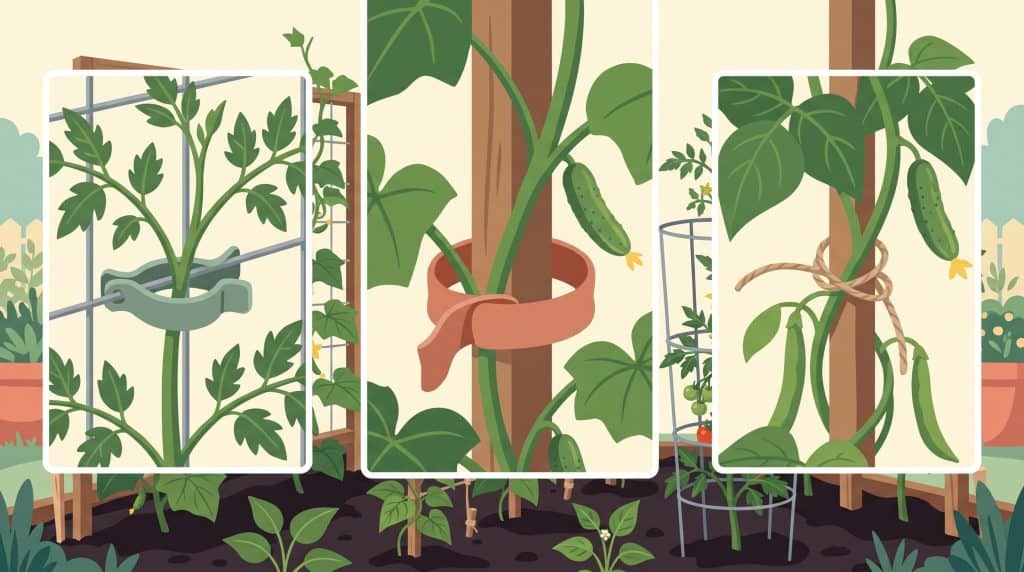
Secure vines loosely enough to allow continued stem expansion, using flexible ties, clips, or suitable twine rather than rigid wire.
Young growth is easier to train than mature stems. Check plants frequently and redirect shoots before they become tangled or too woody to move safely.
For tomato plant support, soft plant ties can hold the main stem against a stake or cage. Plastic plant clips can attach tomatoes to vertical strings without requiring tight knots.
A practical attachment system should:
- Allow the stem to expand.
- Avoid cutting into tender tissue.
- Hold the plant close enough to the support.
- Remain easy to adjust during rapid growth.
Check supported plants often and guide new growth so the vines stay secure as they grow.
Do not treat pruning as a substitute for structural support. Pruning can reduce excessive foliage and weight in some systems, but the plant still needs a support system suited to its growth habit.
How Should You Support Heavy Fruits on a Trellis?
Heavy fruit may need extra support when the vine or trellis can’t safely handle its growing weight.
When cantaloupes reach about baseball size, each fruit can be placed in a sling tied to the main frame. T-shirt material or scrap mesh can spread the weight evenly, helping reduce strain on the vine as the fruit approaches a 3-pound load before it naturally slips.
This works best for smaller melons and other fruit that the trellis can safely hold. Long-vined crops with fruit up to about 3 pounds can be grown on a trellis, while larger squash and pumpkins are usually better left on the ground.
Put the sling in place while the fruit is still small. Check it as the fruit grows so the material doesn’t press too tightly around it.
Which Fruits Benefit Most From Slings?
Melons and smaller winter squash are good choices for slings when the trellis can handle both the vine and the fruit.
Large squash and pumpkins are different. Their weight can put too much strain on a garden trellis, even when the vine looks strong.
So, look at the total weight the frame will carry, not only the number of vines. One plant with several heavy fruits can put more stress on a trellis than many bean vines with much lighter fruit.
How Can Trellising Improve Airflow and Disease Management?
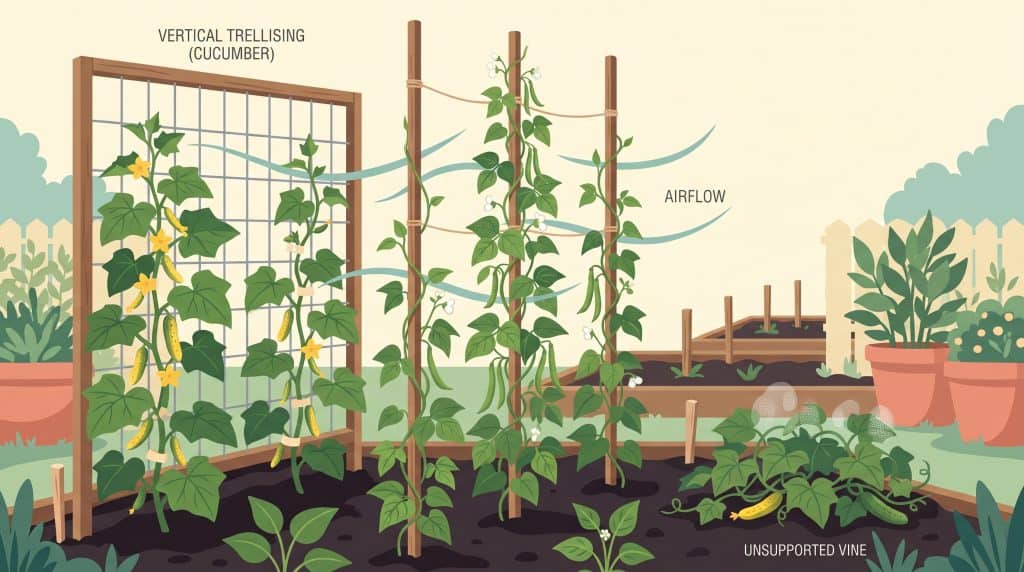
Trellising can give plants more space around their leaves and improve airflow. But it’s only one part of good disease control.
Give plants enough room for air to move, keep the leaves dry, and support vining crops such as cucumbers, beans, and tomatoes. For crops such as leafy greens grown in dense spaces, good airflow also helps keep foliage from staying wet for too long. Remove diseased leaves with care and avoid taking off more than one-third of the plant’s leaves.
Growing plants vertically can also make disease checks easier. With less foliage piled against the soil, you can check leaves, stems, and fruit more easily and catch problems sooner.
Still, don’t overdo the pruning. Plants need their leaves to make energy, and those leaves can also protect developing fruit from strong sunlight.
How Much Foliage Should You Remove When Managing Disease?
Remove leaves only when there’s a clear reason to do so. Don’t strip the plant just to make the trellis look more open.
A thick canopy can slow drying, but removing too many leaves can cause other problems. As a general limit, remove no more than one-third of a plant’s leaves when dealing with diseased foliage.
For home gardens, careful training, enough space between plants, and proper watering are usually a better place to begin than heavy pruning.
Why Can Lightweight Trellises Collapse in Wind?
Lightweight trellises can fail when wind pushes against a full canopy, adding force to the weight of the vines and fruit.
The risk grows as plants get taller and thicker. A cucumber plant may be easy to support as a seedling, but once its leaves cover a large part of the netting, the wind has much more leverage.
Tall supports also put more force on their anchors. If posts are set too shallow or the soil is loose, the frame may lean before the trellis material breaks.
Wind can be a common weak point for light A-frames and vertical netting, especially during strong summer storms. Use deeper anchors, wider bases, cross-bracing, and stronger posts when needed.
- Anchor vertical supports deep in the soil.
- Add diagonal braces to tall frames.
- Keep unsupported trellis height reasonable.
- Check the usual wind direction first.
Research on trellis-wire tension also shows how crop weight can change as plants grow. That research focuses on grape systems, though, so it doesn’t give a safe load limit for home vegetable trellises.
There isn’t one wind rating for every homemade vine support. Soil, frame shape, crop density, material strength, and wind exposure all affect how well a structure holds up.
Why Can Living Trellises Fail Under Heavy Vines?

Credits: MIgardener
Living supports such as corn and sunflowers can hold climbing beans, but they aren’t as predictable as a built trellis.
The Three Sisters method grows corn, climbing beans, and squash together, with corn acting as the support for the beans. It can work when the corn is well established before the beans start growing quickly.
But heavy vines can pull corn or sunflower stems over, especially when the roots aren’t well anchored or the soil is loose. Wind can make this worse. Once a bean vine climbs the plant, it creates more surface area for wind to push against. That can put extra force on the stem and roots.
A built bean trellis is a safer choice in windy areas or when the support plant is still small. It also gives growers more control over plant spacing, height, and cleanup. Living supports still have a place in the garden. They work best when the support crop is established early and the climbing vines don’t overwhelm it.
How Should You Compare Biodegradable Twine With Plastic Netting?
Biodegradable twine is easier to clean up after the growing season. Cut it away, remove it with the old vines, and you’re done. Plastic netting lasts longer, but dead vines can get tangled in it.
Natural-fiber twine can be cut away with the plants at the end of the season. Jute and hemp are common choices because you can compost the old vines and natural twine together.
Plastic netting can be useful if you plan to reuse it. It can last across seasons when protected from strong sunlight and damage. The grid also gives tendrils plenty of spots to grab.
But cleanup can take longer. Dead vines can wind through the openings, and pulling them out by hand takes time.
| Support material | Main advantage | Main drawback | Best use |
| Jute or hemp twine | Easy to clean up | Doesn’t last as long | Beans and cucumbers |
| Synthetic trellis string | Strong and reusable | Needs disposal | Greenhouses and repeat crops |
| Plastic netting | Plenty of room to climb | Dead vines can get tangled | Peas and cucumbers |
| Wire mesh | Strong and sturdy | Vines can be hard to remove | Heavy crops |
| Bamboo | Light and renewable | Can break down over time | Stakes and small supports |
There isn’t enough tested data for exact compostability, lifespan, or material breakdown. More testing is needed before giving specific numbers.
How Can You Make Rigid Wire Supports Safer to Build?
Anchor rigid wire supports before cutting or unrolling them. Remove or cover sharp ends before plants or people get near them. Concrete reinforcing mesh can work for a vegetable trellis, but large rolls can spring back with a lot of force. The main hazards are sudden movement and sharp cut edges.
A safer approach is to control the wire before cutting it. Secure the section you’re working on, use the right cutting tool, and keep your hands and body away from spots where the wire could move.
Wear safety gear that fits the job. Gloves, eye protection, long sleeves, and sturdy shoes are good choices when cutting or shaping heavy wire.
Once you’ve made the cuts, check every exposed end. File down sharp tabs or cover them with a suitable material so they don’t catch on clothing, skin, or plant foliage. There isn’t a verified injury-rate figure or formal safety standard for this specific task. Avoid adding a safety statistic unless it comes from a reliable construction or workplace safety source.
What Advanced Canopy Systems Can Improve Productivity?
Divided canopy systems can help spread light and improve fruit production in grape growing. But those results don’t automatically apply to backyard vegetables.
The Geneva Double Curtain (GDC) splits grapevine growth into two sides. This changes where the shoots and leaves grow on the trellis. Research in the provided material reports yield increases of 44% to 90% in some divided-canopy comparisons.
The research focuses on grapes, not cucumbers, beans, tomatoes, or squash.
That matters because grapes and garden vegetables grow very differently. Grapes are woody vines that live for years and use a specific fruiting system. Cucumbers, on the other hand, are seasonal vines that need a different type of support.
There is still a useful idea here. How leaves, shoots, fruit, and sunlight are spread across a trellis can affect the crop.
For home gardens, advanced canopy systems are better treated as specialized methods, not as a standard trellis for every crop.
How Can Growers Monitor Trellis Loads More Precisely?
Digital sensors aren’t needed to check frame strain. Gardeners can inspect vertical support posts every few weeks and give them a firm shake. Any movement under the weight of wet leaves and heavy fruit signals a need for added support, such as a stake driven into the soil at a 45-degree angle.
Research from the USDA Agricultural Research Service describes an automated system that records changes in trellis tension every 10 seconds.
This method makes more sense for commercial vineyards and research work. A home gardener doesn’t need electronic sensors to know if a cucumber trellis is strong enough.
Still, the idea is useful. Trellis loads change as plants grow. A frame that holds leaves early in the season may carry a lot more weight once fruit develops.
For home gardens, a quick visual check is usually enough. Look for leaning posts, stretched netting, sagging strings, bent wire, loose anchors, or stems pulling away from their supports. The research supports the idea of tracking changing loads, but it doesn’t mean a home trellis needs constant digital monitoring.
What Should You Check Before Choosing a Vining-Crop Support?
Choose a support system based on the mature crop rather than the size of the young plant. Start with the plant’s climbing method. Tendril crops need surfaces they can wrap around, while twining crops need poles, strings, or other vertical structures.
Then estimate the mature canopy and fruit load. Tomatoes in Hydroponic can require substantial support as indeterminate varieties continue growing, while a heavy melon may require a sling even when the vine itself climbs easily. For hydroponic setups, the growing conditions also matter when choosing support and maintaining the crop.
Check these factors before installing a crop support system:
- Crop growth habit and attachment method.
- Mature plant height and canopy size.
- Mature fruit weight.
- Expected number of fruits.
- Wind exposure.
- Soil and anchor conditions.
- Trellis height and support spacing.
- Required clips, ties, or netting.
- Installation effort.
- Harvest access.
- End-of-season cleanup.
- Material durability and reuse.
A support that looks oversized at planting time can become appropriately sized once the canopy reaches full growth. Planning for the mature plant reduces mid-season repairs.
Which Support System Is the Best Overall Choice?
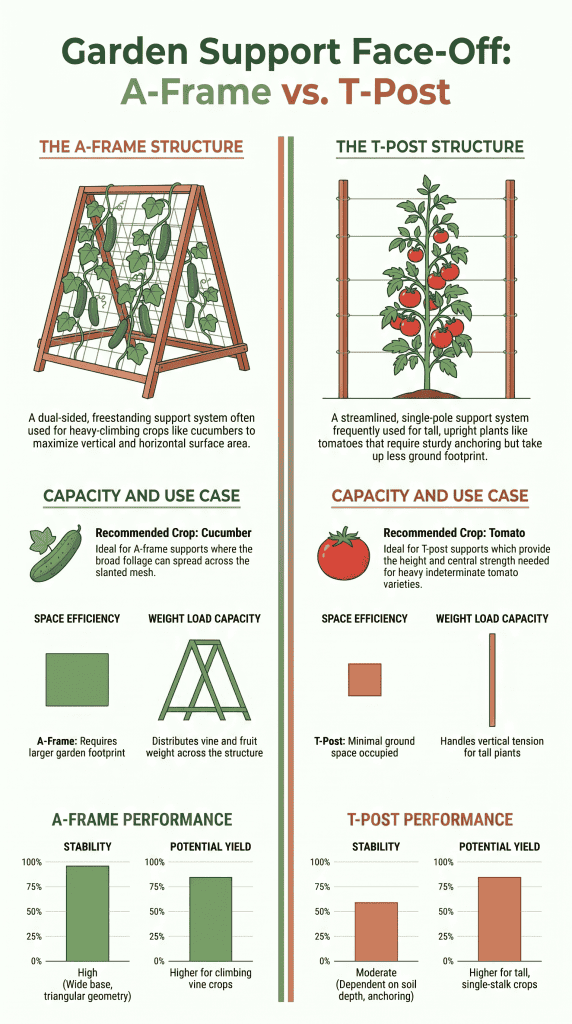
The best support depends on the crop and where it’s growing. Different setups fit different garden needs.
For small spaces, an A-frame gives plants two sides to climb without using much ground space. It’s a good fit for cucumbers and smaller squash.
For heavy crops, T-posts and rigid panels give indeterminate tomatoes and large vines much more support. Cattle panels and concrete reinforcing mesh are also stronger options than flimsy store-bought cages.
In greenhouses, overhead strings make it easier to train indeterminate tomatoes and cucumbers. Natural-fiber twine can also make seasonal cleanup easier.
For individual plants, stakes give direct support to lighter crops or single-stem tomatoes.
Perennial vines need something more permanent. Arbors and pergolas can support long-term growth overhead.
If easy cleanup matters, hanging natural-fiber twine can be a better choice. Cut it away at the end of the season instead of pulling dead vines out of rigid mesh.
In the end, match the support to the plant and the growing space. The strongest or most expensive option isn’t always the right one.
How Can You Build a Support System That Lasts?
A support system that lasts starts with the mature plant in mind. Think about its size, how much fruit it may carry, how you’ll anchor the frame, and how you’ll take it down later.
First, check the crop’s expected size before planting. A small seedling won’t show you how much support a full-grown plant will need.
Then pick a climbing surface that fits the plant. Tendrils need fine grids, twining stems need poles, and heavy crops need rigid supports.
Don’t overlook the anchors. A strong panel can still fall if it’s fixed to weak stakes. Even a basic trellis can hold up when its anchors are placed well.
Train plants early. Guide young vines toward the support before they spread into nearby plants.
Leave enough space to reach the plants. You’ll need room for harvesting, checking leaves, and other routine work.
Think about cleanup, too. Rigid mesh can take a long time to clear when vines die back. Natural-fiber lines can be cut away with the old plants.
A good support needs to hold the crop, give vines room to climb, and stay practical from planting through cleanup.
FAQ
How high should a trellis be for different vining vegetables?
The right trellis height for vegetables depends on the mature size and growth habit of each crop. Cucumbers and peas usually need moderate support, while pole beans and indeterminate tomatoes often need taller structures. A vertical trellis also helps with keeping vines off the ground, which makes better use of limited garden space.
What is the best way to train vines without damaging the stems?
Gentle vine training techniques work best when stems are young and flexible. To train vines, guide the growing stems along the support and secure them loosely. Soft plant ties and plant support clips can hold stems without restricting growth. Regular adjustments keep developing vines attached to the structure without causing unnecessary stem damage.
How can a trellis support heavy fruit without bending or breaking?
A sturdy vining crop support should handle the mature weight of both vines and fruit. Melons often benefit from a fruit sling for melons or melon support sling beneath developing fruit. Heavy crops also require heavy-duty plant support, secure anchors, and strong connections to prevent excessive strain on the structure.
How can vining crops be supported in a small garden?
A vertical plant support directs vine growth upward instead of allowing it to spread across the ground. A string trellis system, mesh trellis, or A-frame trellis can provide effective support in limited spaces. These structures can also help with preventing vines from sprawling, while making harvesting and routine plant care easier.
What support works best for vining crops grown in containers or greenhouses?
Container and greenhouse crops need a garden plant support that fits the growing space and provides adequate stability. A homemade vine trellis, bamboo trellis, or greenhouse vine support can guide vines upward. For hydroponic systems, hydroponic vining plant support should be securely anchored and strong enough to hold mature vines and developing fruit.
How to Provide Support for Vining Crops Without Overbuilding
When vines start growing fast, a weak or oversized support can quickly become a problem. You need a setup that can handle the mature plant without making your garden harder to manage. Keep it practical. Choose support based on crop weight and how the plant climbs.
A simple structure is often enough when it’s matched to the crop and local conditions. Tophydroponicgarden can be a helpful shortcut if you want support options without overcomplicating the setup. The right choice should make training easier while keeping plants supported and fruit accessible.
References
- https://bv.fapesp.br/pt/publicacao/258127//#1
- https://www.ufrgs.br/climbdevogroup/pt/publications/#main#1
Related Articles
- https://tophydroponicgarden.com/what-vining-plants-work-well-in-hydroponics/
- https://tophydroponicgarden.com/best-leafy-greens-for-hydroponic-growth/
- https://tophydroponicgarden.com/ideal-ph-for-tomatoes-in-hydroponics/
Was this helpful?

I’m Barrie L., a passionate hydroponic gardening enthusiast dedicated to cultivating thriving, soil-less gardens. With a focus on all things hydroponic, I share my expertise on innovative growing techniques and sustainable practices through my blog, tophydroponicgarden.com. As a seasoned hydroponics specialist, my goal is to inspire and guide fellow gardeners in harnessing the power of water-based cultivation for bountiful and eco-friendly harvests. I’m also an author of the book “Hydroponics For Absolute Beginners: Your Step By Step Guide For How To Create An Hydroponics System At Home Without Soil, For Growing Vegetable, Fruit And Herbs.” which is sold on Amazon. Join me on a journey of redefining the way we cultivate plants, one nutrient-rich solution at a time. Happy growing!