

You should test your source water before adding nutrients to the reservoir. Checking EC/TDS, pH, and alkalinity reveals the levels of dissolved minerals and other characteristics that influence nutrient uptake, pH stability, and overall plant health.
Because municipal and well water quality can change over time, establishing a baseline helps identify potential problems before they affect your crop. Many hydroponic issues originate from the water itself rather than nutrient formulas or plant genetics.
Understanding how to properly test your source water gives you the information needed to make informed adjustments and maintain more consistent growing conditions. Read on to learn how professional growers evaluate water quality before every planting cycle.
Quick Read: The Foundation of Hydroponic Water Quality
Accurate source water testing provides the baseline information needed for effective nutrient management and healthy plant growth.
- Test EC/TDS, pH, and alkalinity before adding nutrients, as these are the most important water quality parameters for hydroponics.
- Ideal source water typically measures 0.0–0.4 mS/cm EC or 0–200 ppm TDS, and calibrated digital meters provide the most reliable readings.
- Testing baseline water chemistry helps prevent nutrient lockout, root stress, and unstable reservoir conditions before they affect plant growth.
What Parameters Should You Test in Source Water?
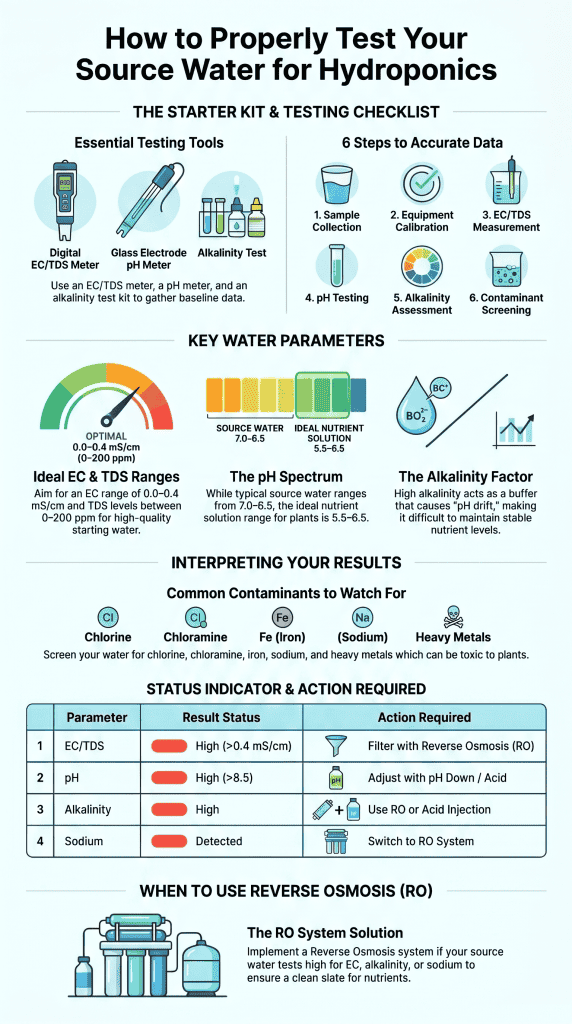
Every hydroponic grower should test EC/TDS, pH, and alkalinity before adding nutrients. These measurements show what is already in your water. This helps you decide if you need to treat it before use.
Clear water does not inherently guarantee quality or suitability for hydroponic systems. Even water that appears visually pristine may contain dissolved minerals, excessive sodium, or high levels of bicarbonates that can negatively interact with nutrient solutions.
Many professional growers conduct routine testing on every batch of source water before introducing it to their systems. This preventative measure ensures the reservoir environment supports plant development rather than creating chemical conflicts that impede growth.
EC/TDS Testing
Electrical conductivity (EC) measures how well water conducts electricity. Higher readings indicate greater concentrations of dissolved minerals and salts.
TDS, or total dissolved solids, is often displayed as parts per million (ppm). Many meters convert EC readings into TDS automatically.
Source water with a low EC gives growers more control over nutrient formulas. This is because there are fewer unknown minerals competing with the nutrients you add.
Typical goals include:
- EC: 0.0–0.4 mS/cm
- TDS: 0–200 ppm
- Stable readings between testing periods
High EC does not always mean the water is unusable. This simply means you may need more testing to see which specific minerals are causing that reading.
Research from Nature Scientific Reports shows
“EC2 significantly reduced the uptake of essential macronutrients… calcium, magnesium… and micronutrients… iron,” demonstrating that high baseline salinity physically blocks nutrient absorption. – Nature Scientific Reports
When evaluating Total Dissolved Solids (TDS), growers must consider the meter’s specific conversion factor rather than relying solely on the displayed numerical value.
Most handheld devices utilize either a 500 or 700 scale to convert Electrical Conductivity (EC) into parts per million (ppm). Understanding this conversion is critical, as failing to account for the device’s inherent scale can lead to significant errors in nutrient concentration.
When utilizing online cultivation guides, it is essential to confirm that the meter is calibrated to the same measurement scale used by the guide’s author.
Many experienced growers prefer relying on Electrical Conductivity (EC) readings, typically measured in mS/cm, because this serves as a universal standard.
Adopting this metric eliminates the ambiguity and potential for error introduced by inconsistent conversion settings across different monitoring devices, ensuring that nutrient applications remain both precise and reproducible.
pH Testing
pH measures how acidic or alkaline water is.
Most hydroponic crops absorb nutrients efficiently when the nutrient solution remains between pH 5.5 and 6.5. Source water, however, commonly measures between pH 7.0 and 8.5.
A high starting pH is not necessarily a problem. What matters more is understanding how the water behaves after nutrients are mixed.
Testing pH before you add nutrients helps you set a baseline. This makes it easier to troubleshoot problems later on.
Alkalinity Testing
Alkalinity is often overlooked, yet it can have a greater impact on reservoir stability than pH itself.
This measurement reflects the concentration of bicarbonates and carbonates in the water. These compounds act as buffers that resist pH change.
Water with high alkalinity may repeatedly push pH upward, even after acid has been added.
Growers who struggle with recurring pH drift frequently discover that alkalinity, not pH, is the underlying issue.
Other Useful Measurements
For growers utilizing well water, basic Electrical Conductivity (EC) and pH testing often prove insufficient. A comprehensive laboratory mineral panel is highly recommended to identify potential issues that standard handheld meters cannot detect.
Well water composition can fluctuate significantly; beyond standard mineral or salt content, it may contain hidden levels of iron or sulfur. These elements can chemically interact with and “lock out” essential micro-nutrients, preventing plants from absorbing necessary minerals regardless of how well the nutrient solution is formulated.
Professional water analysis provides the precision needed to preempt these imbalances and maintain a stable growing environment.
These measurements become increasingly valuable for larger systems, commercial operations, and growers using well water.
Build Your Hydroponic Test Kit
Reliable testing does not require expensive laboratory equipment. Most growers can build a dependable testing kit with a few essential tools.
The key is accuracy and consistency rather than cost, especially for growers learning the fundamentals of hydroponics for beginners and establishing good testing habits early.
Essential Equipment
| Tool | Purpose |
| Digital EC/TDS meter | Measures dissolved minerals and salts |
| Digital pH meter | Measures acidity and alkalinity |
| pH calibration solutions | Verifies meter accuracy |
| EC calibration solution | Confirms conductivity readings |
| Alkalinity test kit | Measures bicarbonates and carbonates |
| Clean sample container | Prevents contamination |
| Chlorine/chloramine test kit | Detects municipal water disinfectants |
Many growers spend heavily on nutrients while using neglected testing equipment. In practice, a properly maintained meter often provides more value than another bottle of additives.
Why Digital Meters Matter
Paper strips offer rough estimates, but they often lack the precision needed for hydroponic management.
A digital pH meter can detect small changes that influence nutrient availability. Likewise, a quality EC meter helps growers track mineral levels with greater confidence.
Regular calibration matters more than purchasing the most expensive model available. Consistent meter care should be considered part of routine hydroponic garden maintenance, helping growers make decisions based on reliable data instead of guesswork.
How Do You Properly Test Your Source Water?

Testing follows a straightforward process. Consistency matters more than speed.
Step 1: Collect a Clean Sample
Use a clean container and collect water directly from the source that will be used for growing.
If using tap water, allow the water to run briefly before filling the sample container. This helps remove stagnant water from the plumbing.
Allow the sample to reach room temperature before testing.
Step 2: Calibrate Your Meters
Before taking measurements, verify that all meters are calibrated according to the manufacturer’s recommendations.
Skipping calibration introduces uncertainty into every reading that follows.
Step 3: Measure EC/TDS
Insert the EC probe into the sample and wait until the reading stabilizes.
Record the result in a notebook, spreadsheet, or digital log.
Monitoring trends over time often reveals seasonal changes that would otherwise go unnoticed.
Step 4: Measure pH
Rinse the probe with distilled water before testing.
Place the probe in the sample and wait for the reading to stabilize.
Record the result alongside the EC measurement.
Step 5: Measure Alkalinity
Follow the instructions provided with the alkalinity test kit.
This step helps explain why some water sources remain stable while others constantly drift upward in pH.
Step 6: Check for Contaminants
If using municipal or well water, test for common contaminants such as chlorine, chloramine, iron, or excessive sodium.
These substances can influence root health and nutrient availability even when EC and pH appear acceptable.
Beyond pH: Why Alkalinity Causes Unstable Reservoirs
Many growers focus on pH because it is easy to measure and easy to adjust. However, successful balancing pH requires understanding the water’s buffering capacity, not simply reacting to the number shown on a meter.
Alkalinity tells a different story. It explains how strongly the water resists those adjustments.
Imagine pushing a ball uphill. If the hill is steep, the ball naturally rolls back down. High-alkalinity water behaves in a similar way. Even after pH has been lowered, the buffering compounds continue pushing the water toward its original level.
As noted by University of Florida Research
“in the absence of [buffers], pH was very unstable… Higher alkalinity sources showed greater increase in pH,” and that in some cases, “No… concentration tested was able to buffer the high alkalinity water source” – University of Florida Research
Common signs of excessive alkalinity include:
- pH rises repeatedly after adjustment
- Increased use of pH Down products
- Yellowing leaves despite proper feeding
- Nutrient lockout symptoms
- Inconsistent reservoir readings
In many hydroponic systems, managing alkalinity solves problems that constant pH adjustments cannot fix. Understanding this relationship helps you spend less time treating symptoms and more time fixing the root cause.
How Should You Interpret Your Water Test Results?
Collecting data is only useful if you know what the numbers mean. The goal is not to chase perfect readings. The goal is to identify conditions that may affect plant growth and make corrections when necessary.
| Test Result | What It May Indicate | Recommended Action |
| EC above 0.5 mS/cm | Excess dissolved minerals | Consider filtration, dilution, or further analysis |
| EC below 0.1 mS/cm | Very low mineral content | Monitor calcium and magnesium levels after mixing nutrients |
| pH above 8.0 | Reduced nutrient availability | Adjust after nutrient mixing if needed |
| Chlorine present | Potential root stress | Remove with carbon filtration or dechlorination |
| Chloramine present | Can affect beneficial microbes | Use activated carbon filtration |
| High alkalinity | pH drift and buffering issues | Reduce alkalinity before routine pH adjustments |
| High sodium | Nutrient competition | Consider reverse osmosis treatment |
| Heavy metals detected | Plant toxicity risk | Confirm through laboratory testing |
Rather than adding supplements immediately, identify the source of the problem first. Water chemistry often explains issues that appear to be nutrient deficiencies.
Why do pH and EC Meters Become Inaccurate?
Even quality meters lose accuracy over time.
The probes used in digital meters gradually wear down, and calibration settings drift. A meter that was accurate a month ago may provide misleading readings today if it has not been checked.
Common warning signs include:
- Sudden nutrient deficiencies
- Readings that seem unusually high or low
- Large pH swings without an obvious cause
- Conflicting results between different meters
- Persistent plant problems despite following the same routine
Meter Maintenance Tips
To improve accuracy:
- Calibrate pH meters using pH 4.0 and pH 7.0 buffer solutions.
- Check calibration weekly during active growing cycles.
- Rinse probes after every use.
- Store pH probes in proper storage solutions.
- Replace aging probes when readings become unreliable.
When plants show signs of struggle, many growers reflexively attribute the issue to nutrient imbalances. However, data indicates that approximately 90% of these “mystery” deficiencies stem from inaccurate readings caused by uncalibrated monitoring equipment.
To ensure consistent crop health, indoor gardeners must prioritize the maintenance of their measurement tools with the same level of diligence applied to the plants themselves. Regularly calibrating meters remains an essential step in maintaining optimal growing conditions and preventing avoidable nutrient errors.
What Water Contaminants Should Hydroponic Growers Watch For?
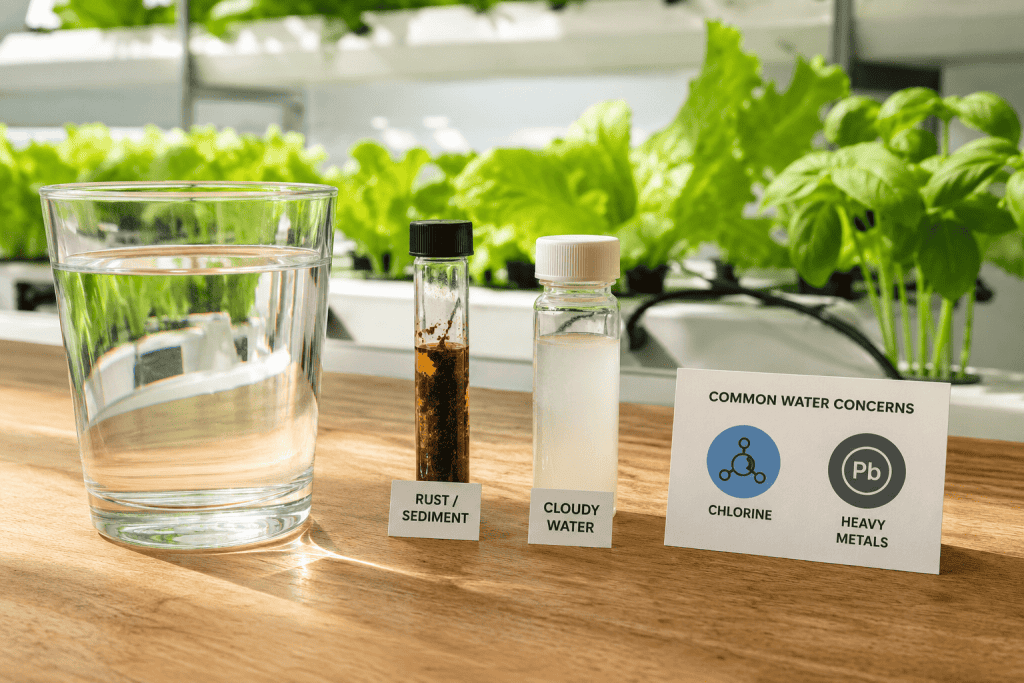
EC, pH, and alkalinity are great places to start, but they do not identify every substance in your water.
Some contaminants can affect plant growth even when basic measurements appear normal.
Chlorine
Municipal water systems commonly use chlorine for disinfection.
While safe for human consumption at regulated levels, chlorine may stress roots and reduce populations of beneficial microorganisms in hydroponic systems.
In some cases, simply allowing water to sit exposed to air can reduce chlorine levels.
Chloramine
Many cities now use chloramine instead of chlorine because it stays stable for longer in water pipes.
Unlike chlorine, chloramine does not dissipate quickly through simple aeration.
Activated carbon filtration is often necessary for removal.
Iron
Well water frequently contains dissolved iron.
Small amounts may not cause problems, but elevated levels can stain equipment, interfere with nutrient balance, and contribute to unwanted buildup inside irrigation lines.
Sulfur Compounds
Sulfur-containing compounds can produce a noticeable odor and affect overall water quality.
They are more common in some groundwater sources than in municipal systems.
Sodium
High sodium levels are problematic because sodium competes with beneficial nutrients during uptake.
Plants do not need much sodium, so high levels are bad for hydroponic systems.
Heavy Metals
Lead, arsenic, cadmium, and other heavy metals are uncommon in many water supplies but should never be ignored.
If contamination is suspected, professional laboratory testing provides the most reliable answers.
When Should You Consider Reverse Osmosis (RO) Water?
Reverse osmosis systems remove most dissolved minerals and contaminants from your water.
Many experienced growers use RO water because it provides a predictable starting point.
Instead of working around unknown mineral levels, they begin with water that contains very few dissolved solids and then build a nutrient solution from scratch.
Comparing Tap Water and RO Water
| Tap Water | RO Water |
| Mineral content varies | Very low mineral content |
| May contain chlorine or chloramine | Most contaminants removed |
| Seasonal changes possible | More consistent quality |
| Less control over nutrient profile | Greater control over nutrient profile |
| Alkalinity can be high | Lower buffering capacity |
RO systems are particularly useful when:
- Source water has high EC
- Alkalinity remains difficult to manage
- Sodium levels are elevated
- Water quality changes frequently
- Consistent nutrient control is a priority
RO water is not required for every hydroponic system, but it can simplify nutrient management when source water creates ongoing challenges.
Pro-tip: If you decide to go the RO route, remember that you are starting from zero. Because RO water is essentially a blank slate, you must add a Cal-Mag supplement to your mix. I’ve seen many beginners run into stunted growth because they forgot that plants need those base minerals to build cell walls; RO water alone simply cannot sustain them.
When Is Professional Water Testing Worth the Cost?

Credits: The Leca Queen
Home testing equipment covers the basics well. However, it cannot identify every dissolved element in the water.
Laboratory analysis becomes valuable when recurring problems remain unexplained.
Situations where professional testing may help include:
- Persistent crop performance issues
- Well-water systems
- Suspected heavy metal contamination
- Commercial greenhouse operations
- Unexplained nutrient lockout
- Unusual plant symptoms despite proper feeding
Professional laboratories often use advanced techniques such as ICP-OES analysis. These tests measure individual elements like calcium, magnesium, sodium, iron, zinc, and many others.
The resulting report gives a detailed look at water chemistry that handheld meters cannot provide.
For commercial growers, the cost of testing is often small compared with the potential cost of reduced yields or crop losses.
Testing Your Source Water: a Practical Action Plan

Strong hydroponic systems begin with reliable information. Testing source water before every planting cycle creates consistency and reduces surprises later.
A simple workflow looks like this:
- Measure EC/TDS.
- Measure pH.
- Test alkalinity.
- Record all results.
- Check for contaminants when necessary.
- Calibrate meters regularly.
- Correct water quality issues before mixing nutrients.
- Retest periodically throughout the year.
Focus on the three measurements that matter most:
- EC/TDS
- pH
- Alkalinity
Together, they provide a clear picture of how the water is likely to behave once nutrients are introduced.
FAQ
Can seasonal changes affect hydroponic water quality?
Yes. Seasonal changes can affect hydroponic water quality, especially when using municipal or well water. Rainfall, drought, groundwater fluctuations, and maintenance work can change dissolved mineral levels, water alkalinity, and sodium concentrations. Regular water quality monitoring helps identify these changes early and allows growers to make adjustments before water conditions affect nutrient availability or plant growth.
How often do I need to re-test my water?
You should review and update your water quality checklist at least every few months or whenever your water source changes. Regular source water testing helps establish a reliable baseline water quality profile and makes it easier to detect new contaminants or mineral imbalances. Consistent water quality management supports stable growing conditions, improves nutrient solution stability, and reduces unexpected hydroponic problems.
Can hard water reduce nutrient solution efficiency?
Yes. Hard water contains elevated calcium and magnesium concentrations, which can affect nutrient solution efficiency. Water hardness testing helps determine whether these dissolved minerals are already present in significant amounts before nutrients are added. Understanding water hardness, carbonate hardness, and bicarbonate levels allows growers to adjust nutrient formulations more accurately and maintain better nutrient balance within the system.
What additional tests can improve hydroponic troubleshooting?
Additional tests can provide valuable information when common measurements do not explain plant health issues. Water contamination detection, water chemistry analysis, heavy metal testing, and testing for iron, nitrate, phosphate, and sulfate levels can reveal hidden water quality problems. These tests help identify factors that may affect nutrient uptake, root development, and overall hydroponic system performance.
Why are proper water sampling procedures important?
Proper water sampling procedures help ensure that test results accurately reflect the actual condition of the water source. Poor sampling methods can produce misleading readings for electrical conductivity, total dissolved solids, and other water quality parameters. Accurate sampling improves hydroponic water analysis, supports more reliable water quality reports, and helps growers make better decisions about water treatment and nutrient management.
Keep Your Hydroponic System on Track
When water quality isn’t consistent, you can end up dealing with nutrient issues, unstable pH levels, and slower plant growth even when everything else seems right. It happens more often than many growers realize.
The good news is that regular testing makes it easier to stay ahead of problems before they affect your crops. If you’re looking to improve your water management routine, Tophydroponicgarden offers practical guides that can help you make better decisions and maintain more reliable growing conditions over time.
References
- https://www.nature.com/articles/s41598-026-44508-2?draft=journal
- https://ufdcimages.uflib.ufl.edu/UF/E0/05/80/12/00001/do_Amaral_Trientini_M.pdf#10#7
Related Articles
- https://tophydroponicgarden.com/hydroponics-for-beginners/
- https://tophydroponicgarden.com/hydroponic-garden-maintenance/
- https://tophydroponicgarden.com/balancing-ph-in-your-hydroponic-garden/
Was this helpful?

I’m Barrie L., a passionate hydroponic gardening enthusiast dedicated to cultivating thriving, soil-less gardens. With a focus on all things hydroponic, I share my expertise on innovative growing techniques and sustainable practices through my blog, tophydroponicgarden.com. As a seasoned hydroponics specialist, my goal is to inspire and guide fellow gardeners in harnessing the power of water-based cultivation for bountiful and eco-friendly harvests. I’m also an author of the book “Hydroponics For Absolute Beginners: Your Step By Step Guide For How To Create An Hydroponics System At Home Without Soil, For Growing Vegetable, Fruit And Herbs.” which is sold on Amazon. Join me on a journey of redefining the way we cultivate plants, one nutrient-rich solution at a time. Happy growing!