

Good algae control starts with the basics. Tophydroponicgarden can be a useful reference when checking light leaks, nutrient strength, and cleaning routines. If algae return, look for the cause before treating the growth itself. Early checks can help keep the reservoir, roots, and equipment cleaner through the next growing cycle.
Keep Algae Out of Your Hydroponic System
- Block light first: Use an opaque reservoir, covered openings, and shaded growing media to keep light away from nutrient-rich water and roots.
- Keep water conditions in check: Maintain suitable nutrient levels, pH, EC, and temperature for your crop, and avoid unnecessary fertilizer buildup.
- Clean the system regularly: Remove algae and plant debris, clean equipment between growing cycles, and fix recurring light leaks instead of relying on chemical treatments alone.
What Causes Algae Growth in Hydroponic Systems?
Algae usually starts when a hydroponic system has the right mix of light, nutrients, water, and warmth. Light is the biggest factor. If sunlight or grow light reaches the nutrient solution, algae can grow quickly. Clear reservoirs and tubes, exposed rockwool, and uncovered net pots can give it an easy place to start.
Nutrient-rich water can make the problem worse. The University of Minnesota Extension notes that too much fertilizer may encourage algae on hydroponic roots. Warm water can also support algae and bacteria.
Algae growth in a hydroponic system often starts with a few common problems:
- light bleeding through unmasked net pots
- Nutrient solution staying above 68°F (20°C) in setup
- Stagnant dead spots in the reservoir
- EC rising above the range recommended for the crop can leave more dissolved nutrients available in the solution.
A small patch on exposed rockwool may stay localized, but spreading algae can reach roots, tubing, and other wet surfaces.
How Does Light Trigger Algae Growth?
One of the best ways to stop algae is to keep light away from the water. Algae use light for photosynthesis, so light reaching nutrient-rich water can support continued growth.
The University of Minnesota Extension recommends using opaque materials and covering the reservoir. An opaque container helps block light from getting into the water and reaching the roots.

A 2025 South Dakota State University Extension guide also recommends opaque, non-porous containers around the root zone. Keep the nutrient solution and wet growing media covered, even when grow lights are running.
Research from NASA ADS shows
“Scientific literature on industrial microalgae production has investigated using a “light–dark-cycle with induced anaerobic conditions” as a method to inhibit the growth of contaminants. This shows that managing light and oxygen conditions is a recognized, scientific strategy for influencing microbial growth.” – NASA ADS
Check more than just the reservoir. Look at the tubing, net pots, rockwool, and other wet areas. If light can reach them, algae may grow there.
Where Do Common Light Leaks Occur?
Most recurring algae problems come from small openings that are easy to overlook during setup. Reservoir walls and lids are obvious targets. Clear or translucent tubing is less obvious, while gaps around net pots can expose nutrient solution directly beneath the plant canopy.
Rockwool, LECA, clay pebbles, and shallow NFT channels can also develop localized algae because their wet surfaces receive light.
Check these areas first:
- Reservoir walls and lid seams
- Net-pot ridges
- Unused hydroponic holes
- Clear airline and nutrient tubing
- Rockwool surfaces
- LECA and other growing media
- Ebb-and-flow trays and exposed channels
Run the grow lights at their normal intensity and inspect the reservoir, tubing, net pots, and media for any visible glow or light reaching wet surfaces.
How Can You Make a Hydroponic Reservoir Light-Proof?
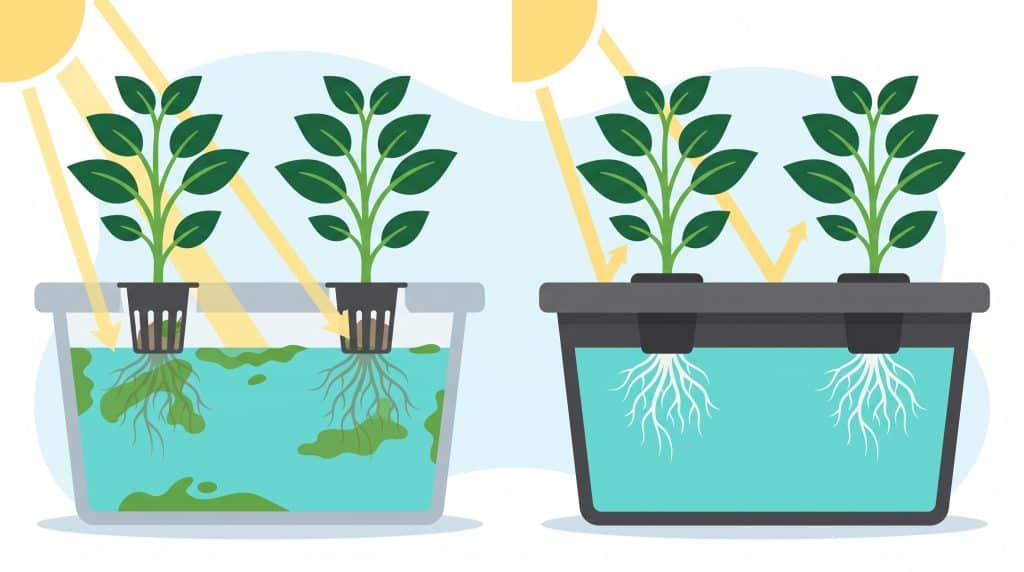
A hydroponic reservoir is less likely to grow algae when the walls, lid, openings, and connected tubing keep light away from the nutrient solution.
The easiest option is an opaque reservoir that does not let visible light reach the nutrient solution. Black plastic can work well, but the finished container should be checked for light leaks.
The University of Minnesota Extension recommends opaque materials and reservoir lids to limit light and reduce algae growth. This works for deep water culture, Kratky, NFT, ebb-and-flow, and many DIY systems.
If the container is translucent, adding a light barrier is a practical fix. You do not have to replace the container right away.
Which DIY Materials Can Block Light?
Several cheap materials can help make a poorly covered reservoir dark. Reflective insulation, opaque plastic, dark covers, HVAC foil tape, and neoprene collars can keep light out when there aren’t gaps. What matters most is whether the finished cover blocks visible light from reaching the nutrient solution, including around seams and openings.
A black inner layer can block light, while a white or reflective outer layer can help reduce heat. Still, check the finished container. Don’t assume a certain color means it’s opaque.
Tests of different storage totes found that translucent blue and white bins developed visible surface film after 6 days under standard PAR lights. Wrapping the same bins in black HVAC foil tape stopped algae growth during a 30-day trial without using hydrogen peroxide.
This physical approach can cut down on repeated chemical treatments. It’s a practical option for growers who want less algae without disturbing beneficial biology.
How Should You Manage Nutrients to Limit Algae?
Nutrients should match the crop’s needs. Too much fertilizer can give algae more nutrients to grow.
The University of Minnesota Extension lists overfertilization as one cause of excess algae in NFT systems. So don’t add fertilizer just because plants look hungry. Mix nutrients based on the crop, water source, fertilizer directions, and test results.
Research from Hainan University also found that
“Nutrient levels can affect algae growth. The study on Isochrysis algae found that nutrients such as NaNO₃ nitrogen can support growth under the right conditions.” – Hainan University
Electrical conductivity, or EC, shows how strong the nutrient solution is. Checking pH also helps plants take in nutrients properly.
Check the solution after adding water or when plant growth changes. Evaporation can raise nutrient strength, while plants use water and nutrients at different rates. An NFT lettuce grower might check EC and pH regularly and consider changing hydroponic water when the nutrient solution no longer matches the crop’s needs.
Useful nutrient practices include:
- Follow crop-specific fertilizer directions.
- Check EC instead of guessing.
- Check pH regularly.
- Don’t add fertilizer without testing.
- Remove plant debris from the reservoir.
- Change the nutrient solution as needed.
Some hydroponic studies, including Rutgers research on basil, use a pH near 5.8 to support nutrient uptake. But changing pH alone won’t control algae. Keep nutrients balanced, limit light, and clean the system before algae spreads.
Does Water Temperature Affect Algae Growth?
Warm nutrient solution can help algae and bacteria grow faster. Evaporation can also leave the remaining water with a higher nutrient concentration.
The University of Minnesota Extension notes that warmer temperatures can encourage algae and bacterial growth in NFT systems, which may mean changing the nutrient solution more often. The right temperature depends on the crop and system, so there is no single target that works for every setup.
Temperature also affects dissolved oxygen. Warm water holds less dissolved oxygen, which can put more stress on plant roots when aeration is poor.
A stable hydroponic system can benefit from maintaining hydroponic plants under suitable growing conditions:
- Checking reservoir temperature
- Keeping reservoirs away from unnecessary heat
- Using reflective outer coverings when needed
- Providing enough aeration in DWC systems
- Keeping water moving when circulation is needed
With passive systems such as Kratky, there is less control over circulation and aeration. Because of this, blocking light and keeping the water at a suitable temperature become even more important.
How Should You Clean an Algae-Affected Hydroponic System?
An algae-affected hydroponic system should be drained, cleaned thoroughly, rinsed, and sanitized before fresh nutrient solution is added.
The University of Minnesota Extension recommends cleaning with warm, soapy water, followed by an approved food-grade sanitizer between growing cycles. Algae can remain on reservoirs, pumps, channels, tubing, and other surfaces even after the green water is gone.
Start by removing plant debris and draining the old solution. Scrub surfaces instead of relying on sanitizer alone, since organic residue can reduce sanitation effectiveness.
A basic reservoir cleaning sequence is:
- Drain the old nutrient solution.
- Remove algae, roots, and plant debris.
- Scrub the reservoir and equipment.
- Rinse away loose residue.
- Apply sanitizer according to its label.
- Rinse if the label requires it.
- Reassemble the system.
- Refill with fresh nutrient solution.
- Check for light leaks.
Not all disinfectants work the same way, so using the wrong product or concentration can make cleaning less effective or cause other problems. Regular cleaning helps keep algae from coming back. Hydrogen peroxide can be useful for cleaning equipment, but using it around live roots requires extra care.
Should You Use Hydrogen Peroxide to Control Hydroponic Algae?
Hydrogen peroxide can disinfect equipment, but one peroxide dose should not be treated as a universal fix for algae in a living hydroponic root zone.
3% hydrogen peroxide (H2O2) can be used to disinfect inanimate surfaces or equipment between cycles. However, adding it directly to a system with active roots requires precise, low dosing to avoid burning delicate root hairs
That difference matters in hydroponics. Cleaning a reservoir is not the same as adding peroxide to nutrient water around living roots.
Hydrogen peroxide breaks down into water and oxygen, but strong or poorly measured peroxide can damage plant tissue and affect microbes. The risk is higher when doses are calculated incorrectly or peroxide is mixed with biological products.
A safer approach is:
- Follow the product label.
- Separate equipment cleaning from live-root treatment.
- Check the concentration before measuring.
- Follow the required contact time.
- Follow PPE and rinsing instructions.
- Do not assume a higher dose works better.
Peroxide also will not fix the cause if light still reaches the reservoir. Algae can return after cleaning if the same light leak is still there.
What Are the Risks of Improper Chemical Dosing?
Using the wrong amount of a chemical can stress plants, hurt roots, upset microbes, and make cleaning less effective.
Too much hydrogen peroxide can damage roots and harm helpful organisms that support root health. This can be a problem in living hydroponic systems. Growers using beneficial bacteria should avoid combining them with oxidizing treatments.
The main risks include:
- Root or plant damage
- Loss of helpful microbes
- Poor sanitation from too little product
- Equipment compatibility issues
- Unneeded chemical exposure
- Algae returning through light leaks
Peroxide can still be useful for cleaning reservoirs between growing cycles when used correctly. The treatment should fit the job rather than using the same chemical on every green surface.
Should You Choose a Sterile or Living Hydroponic System?
A sterile hydroponic system tries to keep microbes to a minimum. A living system, on the other hand, keeps certain helpful microbes in the root zone.
Neither method will stop algae by itself. You still need to block light, keep water conditions in check, and stay on top of regular cleaning and maintenance.
| Strategy | Main approach | Key consideration |
| Sterile | Sanitation and microbial reduction | Requires consistent hygiene |
| Living | Beneficial microbial management | Avoid incompatible sanitizers |
| Hybrid | System-specific combination | Verify product compatibility |
A sterile reservoir may use regular cleaning and selected oxidizers. A living reservoir may use helpful microbes, such as Bacillus, while avoiding treatments that kill them.
Research from Bowling Green State University found that plant nutrient uptake can affect nutrients available to other organisms. This suggests competition may affect algae growth, but does not prevent it.
Growers should choose one approach and stick with it. Systems using beneficial microbes should not use peroxide without checking compatibility. Sterile systems need careful cleaning because they do not rely on beneficial microbes.
Some growers combine approaches between crops, but treatments should be checked for compatibility before use.
Can UV Treatment Prevent Algae in Hydroponics?
UV treatment can reduce free-floating microorganisms in circulating water. However, growers should check whether the UV system is compatible with their nutrient formula before using it for regular algae control.
UV systems work by exposing microorganisms to ultraviolet light. This is different from blocking light from the reservoir. A UV clarifier treats water as it passes through the unit, while an opaque reservoir stops light from reaching the nutrient solution and helps prevent algae growth.
This distinction is important for nutrient chemistry. High-intensity UV radiation can degrade certain synthetic chelated iron compounds (like Fe-EDTA or Fe-DTPA), converting iron into forms less accessible to plants.
The effect depends on factors such as UV wavelength, strength, exposure time, nutrient chemistry, and the type of chelate used. So, it is too broad to say that every UV system will cause iron to precipitate.
If you use UV, keep an eye on:
- Nutrient formulation
- Iron availability
- Plant symptoms
- UV intensity and exposure time
- Water flow through the unit
- Water clarity and algae levels
UV can be a useful extra control method in a well-designed hydroponic system. It should not replace an opaque reservoir, though. Blocking light tackles algae at the source by stopping it from growing in the first place.
Are Advanced Treatments Worth Considering?
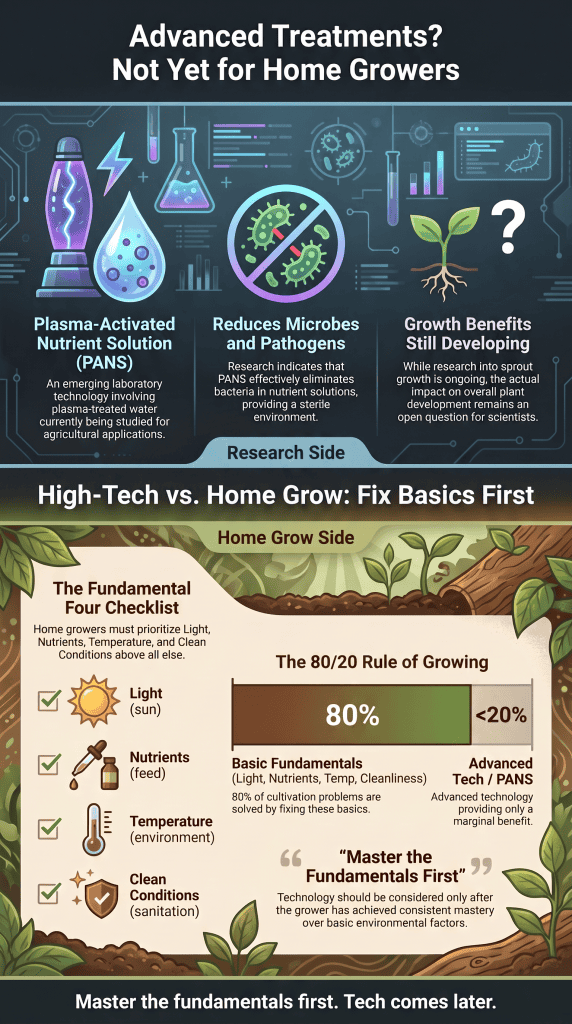
Advanced treatments can help in large farms and research labs. But for most home growers, there’s no need to reach for special technology yet. Fix the basics first: light, nutrients, temperature, and clean growing conditions. That’s usually where the real problems are.
One option researchers are testing is plasma-activated nutrient solution, or PANS. Plasma treatment may change the nutrient solution and reduce some microbes. Researchers are also checking whether it can help plants grow. The research is still developing, though, so most home growers don’t need PANS right now.
Can Plasma-Activated Nutrient Solution Reduce Algae?
Research from Rutgers University found that one plasma-activated nutrient solution treatment for hydroponic sweet basil lowered algae levels by up to 24% compared with the control.
The 2023 study, Growth of Hydroponic Sweet Basil (O. basilicum L.) Using Plasma-Activated Nutrient Solution, tested basil under specific conditions. The result is research finding, not a home hydroponic recipe. The study also used a pH setpoint of 5.8. That doesn’t mean every crop needs a pH of exactly 5.8 to prevent algae.
PANS is still more useful for research and advanced production than a small Kratky bucket. UV treatment and biological inoculation also need system-specific testing. Fix basic physical controls first.
What Is the Best Algae-Prevention Routine for Beginners?
If you’re new to hydroponics, you can prevent most algae problems with a few basic habits. Keep light out of the nutrient solution, check your nutrients, watch the growing conditions, and clean the system often. It doesn’t have to be complicated.

Credits: Soothing Leaf
Daily Checks
Daily inspections catch small algae problems before they spread through the system.
- Inspect the reservoir for green water or surface film.
- Check exposed media for green patches.
- Look for light entering through lids or gaps.
- Observe water movement and aeration.
- Remove plant debris when visible.
A quick visual check can take less than a minute. It is especially useful after changing the reservoir, moving the system, or installing new grow lights.
Weekly Checks
Weekly maintenance should focus on areas that are easy to overlook during daily observation.
- Inspect tubing and pump areas.
- Check EC and pH according to the crop’s requirements.
- Examine reservoir covers and seals.
- Inspect net-pot openings.
- Check growing media for exposed wet surfaces.
- Look for recurring algae hotspots.
A recurring green patch is useful diagnostic information. If algae repeatedly appears beside one net pot, channel opening, or tube connection, that location probably has a light leak or trapped organic material.
Between Growing Cycles
Between crops, give the system a full cleaning instead of a quick wipe.
Drain the system and remove plant scraps, roots, sediment, and algae. Scrub the reservoir, channels, pump, and reachable tubing. Use a suitable sanitizer as directed, rinse as instructed, and let the parts dry when needed.
Then put the system back together and test it under the grow lights before adding the next crop.
What Should You Do If Algae Keeps Coming Back?
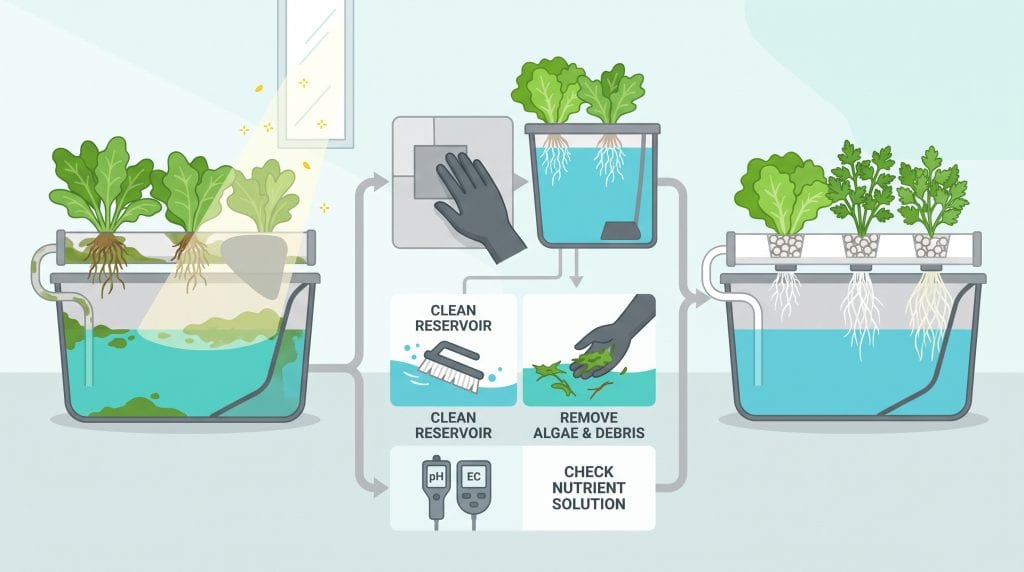
If algae keeps coming back, the main problem probably hasn’t been fixed.
Check light exposure first. Then look at nutrient levels, temperature, water movement, and system cleanliness. Repeated chemical treatments can add extra work without fixing the real cause.
Use this troubleshooting sequence:
- Check all reservoir surfaces for light leaks.
- Check clear or translucent tubing.
- Cover unused net-pot and channel openings.
- Check exposed rockwool, LECA, and other media.
- Check nutrient concentration and pH.
- Check reservoir temperature.
- Inspect pumps, air stones, and tubing.
- Drain the system and clean buildup.
- Reassemble it with better light blocking.
- Check the same algae spot after restarting.
This helps narrow down the cause.
For example, green algae around a net pot with a dark reservoir points to a local light leak. Green water throughout a translucent bucket points to light reaching the reservoir.
A system that stays clean after light-proofing provides stronger evidence that the original problem was optical rather than nutritional.
Which Algae-Control Methods Should You Prioritize?
The best way to control algae is to block it from the start. Use physical controls first, then move to more advanced treatments if needed.
| Priority | Action | Purpose |
| 1 | Block light | Remove the main energy source for photosynthesis |
| 2 | Control nutrients | Avoid unnecessary nutrient availability |
| 3 | Manage temperature | Reduce conditions that support rapid growth |
| 4 | Clean regularly | Remove established algae and organic buildup |
| 5 | Consider treatments | Add advanced controls when justified |
This can also cut down on chemical use. A black reservoir with a tight lid doesn’t need chemicals to block light.
Pay attention to the growing media, too. Keep wet LECA, rockwool, and exposed trays shaded. Cover unused openings with opaque plugs or covers. The same idea applies to DWC, Kratky, NFT, and other hydroponic systems. The hardware
How Can Hydroponic Help Growers Prevent Algae?
Hydroponic can focus on system design, regular cleaning, and keeping light out of the nutrient solution instead of relying on chemical treatments.
A good setup should keep light out from day one. Use an opaque reservoir, a snug lid, covered openings, and tubing that blocks light. Keep exposed growing media shaded, too. This gives growers fewer algae problems to deal with later.
For home growers, useful design features include:
- Opaque reservoir walls
- A secure reservoir lid
- Light-blocking tubing
- Covers for unused openings
- Shaded net pots and media
- Easy access for cleaning
- Simple spots for routine checks
This also makes problems easier to find. If light is blocked and the system is easy to clean, algae spots are easier to spot and fix. Hydrophonic can present algae prevention as part of normal care, not as a chemical fix.
FAQ
Why does algae keep growing in my hydroponic water?
Algae growth in hydroponics usually occurs when light reaches nutrient-rich water. Sunlight and algae growth are closely connected because algae need both light and nutrients to reproduce.
Warm water, excess nutrients, and poor water circulation can speed up growth. To control algae in hydroponics, inspect the system for light leaks, keep the reservoir covered, and maintain clean equipment.
How can I stop algae from growing around my plant roots?
Algae on hydroponic roots develops when light reaches the root zone through exposed net pots, growing media, or reservoir openings. To stop algae in hydroponic systems, block light from net pots, cover unused hydroponic holes, and keep roots inside a dark reservoir. If algae is present, remove it during a water change and clean affected surfaces thoroughly.
What should I do if I find algae on my growing media?
Algae on growing media often appears on LECA, rockwool, or other moist surfaces exposed to light. Remove the visible algae, rinse or replace the affected media when necessary, and clean nearby equipment. Then reduce light exposure by covering exposed media and net pots. These steps help prevent algae buildup and reduce the chances of future growth.
Can I prevent algae in hydroponics without using chemicals?
Yes, you can prevent algae without chemicals by focusing on hydroponic algae prevention practices. Use an opaque hydroponic reservoir, block light from the reservoir, maintain proper hydroponic nutrient balance, and keep water temperatures within the recommended range for your crops.
Consistent cleaning and nutrient solution maintenance can create algae-free hydroponics without relying on chemical treatments.
How often should I clean a hydroponic reservoir to prevent algae?
Most hydroponic growers should clean the reservoir and inspect the system whenever they replace or refresh the nutrient solution. During cleaning, remove any algae buildup, sanitize hydroponic equipment, and check for light leaks.
Regular hydroponic reservoir maintenance helps prevent hydroponic reservoir algae, improves hydroponic water cleanliness, and reduces the risk of future algae blooms.
Keep Your Hydroponic System Dark and Clean
Algae can become a headache when light reaches your nutrient solution, especially near the reservoir or net-pot gaps. You may see green growth in the water, tubing, or growing media. The fix is pretty simple. Block the light and keep the system clean.
For an easier routine, Tophydroponicgarden can be a useful resource for algae prevention and basic system care. Stick with the basics before trying advanced treatments. Check your water often, clean problem spots early, and look for gaps where light can reach the roots. Keep up with these checks, and algae is easier to control.
References
- https://nshu.hainanu.edu.cn/en/article/doi/10.15886/j.cnki.hdxbzkb.2008.01.016?viewType=citedby-info#1
- https://ui.adsabs.harvard.edu/abs/2025JAPco..37….1L/abstract#1
Related Articles
- https://tophydroponicgarden.com/how-to-properly-clean-a-hydroponic-system/
- https://tophydroponicgarden.com/how-to-maintain-hydroponic-plants-2/
- https://tophydroponicgarden.com/how-often-to-change-hydroponic-water/
Was this helpful?

I’m Barrie L., a passionate hydroponic gardening enthusiast dedicated to cultivating thriving, soil-less gardens. With a focus on all things hydroponic, I share my expertise on innovative growing techniques and sustainable practices through my blog, tophydroponicgarden.com. As a seasoned hydroponics specialist, my goal is to inspire and guide fellow gardeners in harnessing the power of water-based cultivation for bountiful and eco-friendly harvests. I’m also an author of the book “Hydroponics For Absolute Beginners: Your Step By Step Guide For How To Create An Hydroponics System At Home Without Soil, For Growing Vegetable, Fruit And Herbs.” which is sold on Amazon. Join me on a journey of redefining the way we cultivate plants, one nutrient-rich solution at a time. Happy growing!