

A TDS meter estimates nutrient strength by measuring electrical conductivity (EC) and converting it to a PPM reading. But PPM scales vary between meters, so EC gives you a more consistent way to compare nutrient solutions
Before you test, prepare the solution, check your source-water baseline, and make sure the meter is clean and calibrated.That makes your readings easier to trust and repeat. Keep reading to learn how to use a TDS meter properly, with more practical hydroponic tips from Tophydroponicgarden.
Quick Reads: TDS Meter Essentials
- Measure EC first, using a consistent PPM scale and testing temperature.
- Mix nutrients fully before testing, and check pH alongside EC/TDS.
- Treat readings as an indicator of overall nutrient strength, not individual nutrient levels.
What Does a TDS Meter Actually Measure?
A TDS meter does not measure the weight of dissolved solids. It measures the electrical conductivity (EC), which is a measure of the amount of charged ions in the water. From that, the meter estimates Total Dissolved Solids (TDS) or parts per million (PPM) by applying a conversion factor.
However, this factor isn’t the same everywhere. It varies depending on the solution. TDS-to-EC ratios anywhere from 0.50 to 0.75, and sometimes even as high as 0.96. So those numbers on that screen are estimates, not real weights.”
Here is how these terms break down in practice:
- EC: An unprocessed conductivity reading.
- TDS: An estimate of dissolved solids, based on EC.
- PPM: The meter’s reading after converting the EC reading.
- Limitation: EC gives you overall ionic strength but can’t tell you amounts of specific nutrients.
If you want better accuracy, recording EC values whenever you can is a good move, especially if you’re comparing readings from different TDS meters. It’s easier to rely on the raw conductivity numbers than on varying TDS or PPM estimates.
Why Can Two TDS Meters Show Different PPM Readings?
Sometimes two TDS meters will give you different PPM numbers for the exact same nutrient solution. That’s because they don’t always use the same conversion scale. The most common ones are 500 and 700. So, you can’t just compare PPM values without first seeing what scale each meter is on.
Here’s how it breaks down:
| Scale | Conversion | Example at 1.5 EC |
|---|---|---|
| 500 | EC × 500 | 750 PPM |
| 700 | EC × 700 | 1,050 PPM |
This means a few hundred PPM difference doesn’t automatically mean the solution changed. The meters might just be converting the same electrical conductivity in different ways. It’s a reminder to check your meter’s scale before jumping to conclusions about water quality.
Should You Use EC Instead of PPM?
Electrical conductivity (EC) often works better as a common reference because it avoids much of the confusion that comes with different PPM conversion factors. That doesn’t mean PPM is useless. If a fertilizer guide gives you targets in PPM, just make sure you know what scale the meter uses.
A few tips to keep in mind:
- Record EC in millisiemens per centimeter (mS/cm) whenever possible.
- Double-check your meter’s PPM scale before relying on a PPM chart.
- Never compare readings from 500-scale meters directly with those using 700-scale.
- Follow crop-specific guidelines instead of using a fixed universal PPM target.
The research provided here points clearly to focusing on the raw EC values rather than trusting PPM numbers without question. It’s a clearer, less misleading way to track nutrient strength in your solution.
What Equipment Do You Need Before Measuring?

Getting accurate TDS or EC readings means starting with clean gear. Any leftover residue on the probe or container can throw off your measurements. Along with that, temperature and calibration errors often sneak in as culprits, too.
Here’s what you’ll need for a solid setup:
- TDS/EC meter
- Clean glass or plastic container
- Distilled or reverse osmosis (RO) water for rinsing
- Calibration solution recommended by the manufacturer
- Sample of the nutrient solution you want to test
- Thermometer, unless your meter already adjusts for temperature
It might seem like a lot, but keeping things clean and calibrated makes a real difference. Probe buildup, unaccounted-for temperature changes, and loose calibration are common reasons for bad readings. You don’t have to guess. Just clean, rinse, and calibrate right.
How Should You Calibrate a TDS or EC Meter?
Getting your meter to give reliable readings starts with following the calibration steps from the manufacturer. Don’t assume one size fits all, each meter has its own quirks.
Here’s a general approach, but always check your meter’s manual:
- Consult your meter’s manual for model-specific calibration protocols.
- Always rinse the probe with distilled water before submerging it into a standard reference calibration solution (such as 1.41 mS/cm EC).
Calibration solutions often fall between 0.5 and 5.0 mS/cm, usually based on sodium chloride (NaCl). Some meters come factory calibrated, so don’t assume you always need to tweak settings manually. It pays to know your specific model.
How Do You Prepare a Nutrient Sample for Testing?
Mixing the nutrient solution well matters because an uneven reservoir gives readings that don’t tell the full story. Having the right items needed for a hydroponic system also makes it easier to prepare and test the sample consistently.
Follow this order:
- Test source water first.
- Record starting EC/TDS.
- Add nutrients as instructed.
- Stir the solution thoroughly using a clean mixing wand to ensure all mineral salts are fully dissolved.
- Let the solution sit.
- Take a sample.
- Measure and note EC/TDS.
Source-water EC counts because it already holds dissolved ions before you add nutrients. The research stresses setting a baseline for source water before adjusting your nutrient levels. Without that, you’re flying blind.
What Is the Correct Way to Take a TDS Reading?
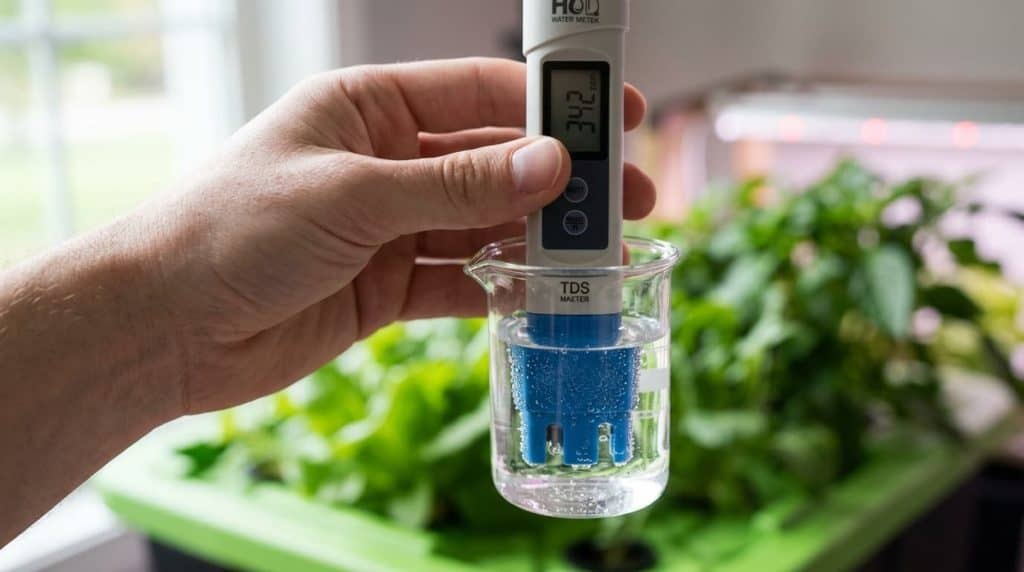
Getting a good reading takes patience and care. Rinse first, then steady the probe to avoid bubbles that can mess with the numbers. Give it time, usually 10 to 30 seconds, until the reading stops jumping. Then write down everything: EC, PPM, temperature, and what scale your meter uses.
Do the following:
- Rinse probe with distilled or RO water .
- Turn the meter on.
- Place the probe into the nutrient sample.
- Move the probe slowly allowing any trapped bubbles to escape.
- Do not move the probe.
- Allow the reading to stabilize.
- Record EC, PPM, temp, and scale on meter.
- Rinse and store the probe according to the manufacturer’s instructions.
Skipping these steps leads to shaky data, which no one wants.
How Does Temperature Affect Nutrient-Strength Readings?
Temperature is important for EC readings, because the ions move faster or slower as the water heats or cools. Some meters have automatic temperature compensation (ATC) that can help but it is easier to compare results if the test conditions are kept constant.
Just a couple of things to remember:
- Many meters feature Automatic Temperature Compensation (ATC).
- It is convenient to test in the range of 18–22 °C.
- Standard electrical conductivity measurements are normalized to a universal reference temperature of 25°C (77°F), as outlined in agricultural testing guidelines.
If you take multiple measurements, trying to test at similar temperatures cuts down on needless variation. Otherwise, you’re chasing numbers that wiggle just because the water’s warmer or colder.
What PPM or EC Level Should You Aim For?
There is no one PPM number that fits all crops, fertilizers, water types or growth stages. It’s best to follow advice for the particular crop vs. generic charts that can lead you astray.
Data from Singh & Dunn (2017)
“Thus, the conductivity of the solution increases with added ions. So EC is a good measure of the amount of salts in the solution. A higher EC means higher salt concentration, while a lower EC means a lower salt concentration. Excessively high levels of nutrients induce osmotic stress, ion toxicity and nutrient imbalance, while excessively low values are mostly accompanied by nutrient deficiencies and decreasing plant growth. In soilless culture, total salt concentration of a nutrient solution is the most important characteristic.” (Singh & Dunn, 2017)
Here’s a quick look at some references:
| Crop context | Source-supported reference |
| Hydroponic lettuce | ~1,250 µS/cm or ~800 PPM TDS |
| Leafy vegetables | 800–1,400 PPM |
| General hydroponic pH reference | 5.5–6.5 |
The research shows leafy veggies thrive between 800 and 1,400 PPM, or about 1.1 to 2.0 mS/cm EC, and highlights how TDS and pH are linked. Take this as a reminder: don’t treat one PPM number like a universal feeding plan.
Why Should You Measure pH Alongside TDS?
TDS or EC tells you how strong the ionic content is, but it doesn’t guarantee the plant can access all those nutrients. pH matters because it controls how well plants can take them up.
The research points to a general pH range of 5.5 to 6.5 for many hydroponic crops, though each plant might have its own preference. Knowing how to test pH alongside TDS gives you a clearer picture of the nutrient solution.
It’s easier to think of it as a three-part test:
- EC/TDS: measures total ionic strength.
- pH: Opens up the way for nutrients to be available.
- Plant condition: Demonstrates the true effect through growth and health.
No matter what the meters say, the plant’s response remains the ultimate test.
What Does a Rising or Falling TDS Reading Tell You?
Sometimes, just looking at a spot reading of TDS doesn’t tell the whole story. It’s like catching a single frame from a movie. It can tell you what’s going on, but not the whole picture. The real insight is when you line it up with the water level of the reservoir and observing overall plant appearance. Here’s a simple table to show what can be happening:
| Observation | Possible interpretation |
| PPM rises while water level falls | Water may be leaving faster than nutrients |
| PPM falls while water level falls | Nutrients may be removed faster than water |
| PPM and water level fall proportionally | Nutrient concentration may be relatively stable |
Bannon, S. P. et al. (2026) found that
“Over both treatments, EC was found to be a poor proxy for actual nutrient changes. These findings highlight a trade-off between yield maximisation and nutrient-use efficiency, emphasising the need for more strategic nutrient management.” Bannon, S. P. et al. (2026)
Take these patterns as clues, not hard facts. They’re more like signs that something’s up rather than a final answer. Watching EC or TDS over days or weeks usually gives something far more useful than freaking out over one odd number.
How Can You Troubleshoot an Unstable TDS Reading?
Before jumping to adjust nutrient levels, it pays to double-check your hydroponic supplies and probe. Small issues, easy to miss, can throw off your readings and send you chasing ghosts. Here’s what to look at first:
- Clean any salt buildup from the probe.
- Shake off or push out air bubbles near the electrodes.
- Check the battery life.
- Make sure you’re reading the right EC or PPM scale.
- Calibrate the instrument using an appropriate calibration solution.
- Keep samples at constant temperature.
- Stir the nutrient solution well before sampling.
- Take the measurement again to confirm.
The SERP research keeps pointing to the same culprits: residue stuck on the probe, drained batteries, temperature shifts, and confusion between scales. These tend to mess with reliability more than you might think.
What Are the Biggest TDS-Meter Mistakes to Avoid?
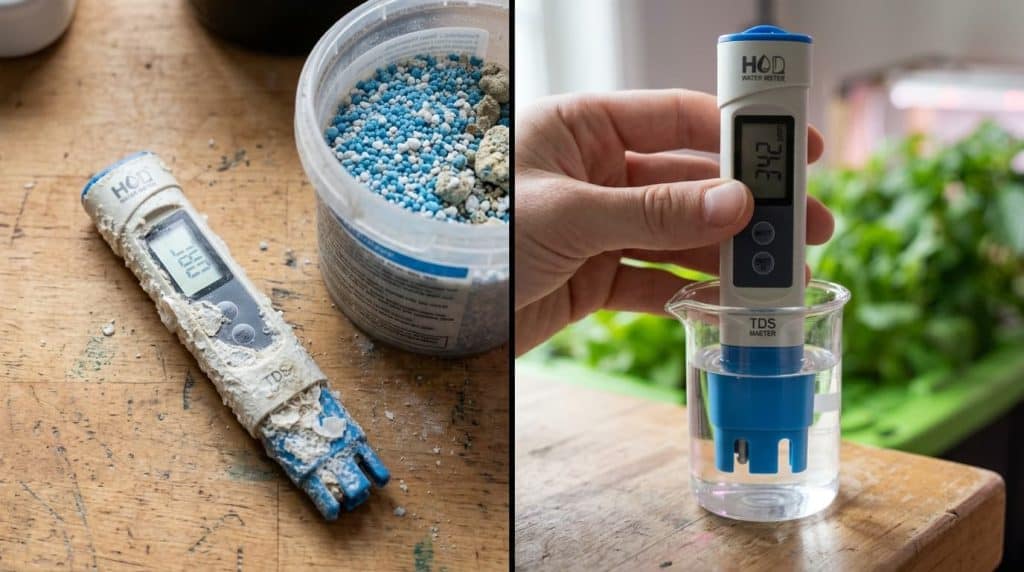
It’s easy to slip up by thinking PPM means the same everywhere, or that a quick EC reading tells you everything about nutrients. These mistakes happen more than you’d expect. Here are some common ones to watch out for:
- Comparing PPM readings from different scales like they’re equal.
- To focus on a PPM number, without thinking about what the crop really needs.
- Forgetting to check the EC or TDS of the source water.
- Taking readings from a nutrient mix that hasn’t been stirred well.
- Overlooking pH altogether.
- Assuming EC measurements show details about single nutrients.
TDS and PPM numbers can lead you astray, especially when meters use different conversion factors or when the type of solution isn’t accounted for. So it’s better to be cautious with these values.
How Can You Build a Reliable Nutrient-Strength Routine?
Sticking to the same test method each time helps make sense of changes in EC and TDS. Record those along with temperature, then check your numbers against what your crop needs. A simple routine goes like this:
- Check source-water EC or TDS.
- Prepare nutrients the same way every time.
- Mix the solution thoroughly.
- Measure EC first, don’t just trust PPM conversions.
- Record pH and temperature too.
- Watch the trends over time.
- Adjust to crop and fertilizer needs.
- Always clean your meter after use.
Consistency turns scattered numbers into useful info.
How Can You Make Measurements Easier with Tophydroponicgarden?
Tracking just one number, like PPM, only shows part of the story. When you keep EC, TDS, temperature, pH, and the crop’s growth stage all recorded together, you start seeing how they move and link with each other. That fuller picture helps make better sense of nutrient strength and what the plants actually need at any given moment.
How Often Should You Measure Nutrient Strength?
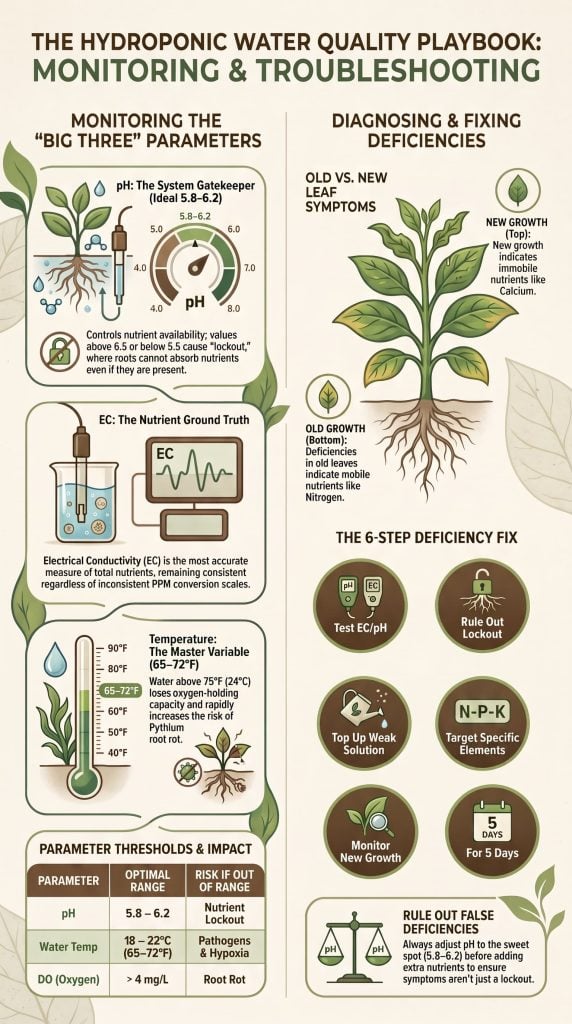
By testing TDS or EC on a regular basis you can see any changes in nutrient concentration before they become major problems. The exact schedule will depend on the system and the crop but making measurements under consistent conditions will make your readings easier to compare.
Should You Check TDS Before and After Feeding?
Yep. After you mix, and before you make any further adjustments, check the nutrient solution. This provides a baseline of the current nutrient strength and helps avoid unnecessary nutrient dosing.
Record EC or TDS reading, temperature and pH together. Add nutrients and remeasure after thorough mixing of the solution. Do not adjust the solution based on a reading taken before the nutrients are fully distributed.
How Can You Track TDS Changes Over Time?
Write down your readings easily instead of trying to remember them all. Record the date, EC or TDS, pH, water level, temperature and any nutrient adjustments you make.
By keeping an eye on these numbers you can see TDS swings and changes in nutrient uptake. A slow change may be easier to understand if you can compare it to previous measurements and the growth stage of the plant.
How Do You Adjust Nutrient Strength After Testing?

Credits: Indoor Farm
Adjust the strength of nutrients according to reading, crop requirement, source water quality and stage of plant growth. Always check the meter and solution before making any large changes from one unusual measurement.
When Should You Add Nutrients to the Reservoir?
If your crop and growth stage target concentration is higher than what is measured, add nutrients. Before adding more, check that the meter is clean, the solution is mixed and the reading is stable.
Add nutrients slowly (don’t change too much at once). Once more, stir the solution and test it again for the new nutrient levels.
When Should You Dilute a Nutrient Solution?
When the measured nutrient level is higher than the desired range for the crop, dilute the solution. Adding clean water will dilute the concentration, but will not remove nutrients that are already there.
Add clean, pH-balanced water to the reservoir and stir thoroughly. Shaking a large reservoir is impractical and creates air bubbles that distort your next reading. Take another reading of TDS or EC. Remember that the overall mineral concentration when you add water will depend on the source-water TDS.
FAQ
Can TDS readings tell you if plants are underfed?
A low TDS reading can suggest that nutrient strength is lower than expected, but it does not confirm a nutrient deficiency by itself. Check the crop stage, source-water TDS, plant growth, and pH before changing the nutrient solution.
EC/TDS measures overall ionic strength rather than individual nutrients, so plant symptoms and crop-specific feeding recommendations still matter.
Should you measure TDS before or after adding nutrients?
Measure the source water first to establish a baseline TDS. Then add your hydroponic nutrients, mix the solution thoroughly, and take another reading. Comparing the two measurements shows how much the nutrient solution changed from the starting water.
Recording both values can also make reservoir management easier because source-water differences may affect the final nutrient strength.
Can a TDS meter measure individual nutrients?
No. A TDS meter estimates total dissolved solids through electrical conductivity rather than identifying individual nutrients. A reading can show that the solution has more or fewer dissolved ions, but it cannot tell you how much nitrogen, potassium, calcium, or another specific nutrient is present.
Individual nutrient concentrations require more specialized testing than routine TDS measurement.
Why does my TDS reading change after topping off the reservoir?
Adding water changes the concentration of dissolved nutrients, so the TDS reading can move after topping off. The direction and size of the change depend on the starting nutrient concentration, water volume, and TDS of the added water. Measure the reservoir after mixing thoroughly rather than making an adjustment immediately based on the first reading.
How often should you check nutrient strength?
The right frequency depends on the crop, growing system, and how quickly the nutrient solution changes. Regular monitoring helps you spot TDS fluctuations before they become large. Record EC or TDS, pH, temperature, and water level together. Looking at the trend over several measurements is more useful than reacting to one unusually high or low reading.
Measure with Confidence
When measuring nutrient strength, consistency matters more than chasing a single PPM number. Use EC as one of your references, keep sampling methods consistent, maintain your meter, and account for temperature. However, even though EC is a useful indicator of overall ionic strength, it does not identify individual nutrient concentrations.
Most importantly, follow crop-specific recommendations and watch trends over time. Accurate measurements help you make smarter adjustments, maintain balanced nutrient solutions, and support healthier, more predictable hydroponic growth.
References
- https://onlinelibrary.wiley.com/doi/10.1002/fes3.70220
- https://extension.okstate.edu/fact-sheets/electrical-conductivity-and-ph-guide-for-hydroponics?Forwarded=pods.dasnr.okstate.edu/docushare/dsweb/Get/Document-10397/HLA-6722web.pdf#1
Related Articles
- https://tophydroponicgarden.com/hydroponic-supplies-basics/
- https://tophydroponicgarden.com/how-to-test-the-ph-of-your-nutrient-solution-easily/
- https://tophydroponicgarden.com/items-needed-for-hydroponic-system
Was this helpful?

I’m Barrie L., a passionate hydroponic gardening enthusiast dedicated to cultivating thriving, soil-less gardens. With a focus on all things hydroponic, I share my expertise on innovative growing techniques and sustainable practices through my blog, tophydroponicgarden.com. As a seasoned hydroponics specialist, my goal is to inspire and guide fellow gardeners in harnessing the power of water-based cultivation for bountiful and eco-friendly harvests. I’m also an author of the book “Hydroponics For Absolute Beginners: Your Step By Step Guide For How To Create An Hydroponics System At Home Without Soil, For Growing Vegetable, Fruit And Herbs.” which is sold on Amazon. Join me on a journey of redefining the way we cultivate plants, one nutrient-rich solution at a time. Happy growing!